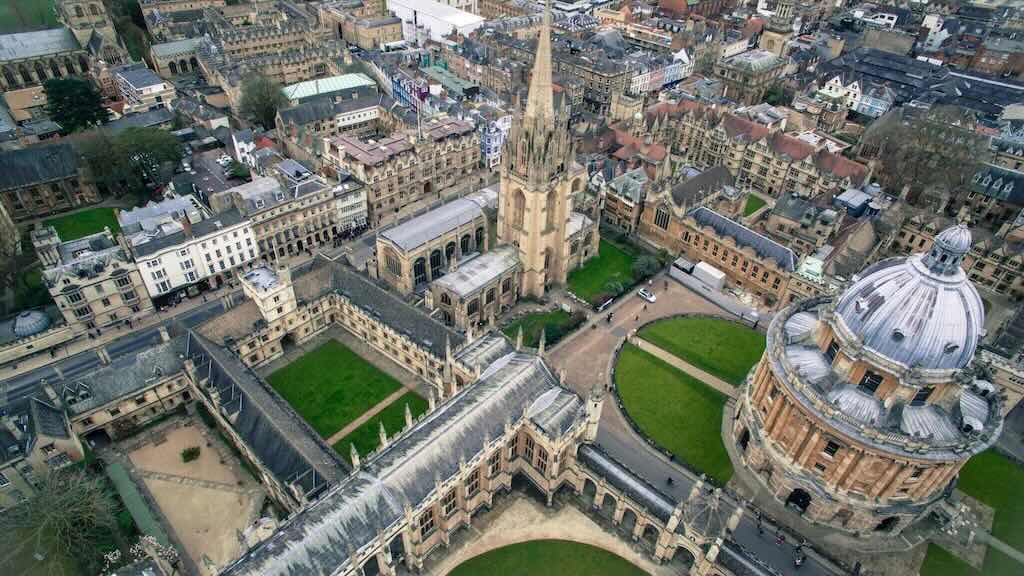
I decided to attend a series of four adult courses in Oxford, during one month in the summer of 2026. A pre-course and in-course assignment was required for each.
The subjects were:-
“130 Years of Discovery: Nuclear and Particle Physics from Becquerel to Gianotti“
“Smaller Than the Atom: A Primer on All Things Quantum“
“The Architectural Secrets of Oxford’s Classical Buildings“.
“Understanding Space and Time“.
For more information on this particular series of courses, check out Oxford University Summer School for Adults – 2026.
I’ve added also a few details and comments on the course itself.
The coursework had to follow these requirements:-
- Submit to oussa@conted.ox.ac.uk
- Should include the assignment cover sheet(s)
- Use .pdf
- Use double-spaced 12 pt Times New Roman font
- File name SURNAME, FORENAME – COURSETITLE
- Include footnotes
- Leave wide margins for comments
- Number and name on each page
- Use A4 and print only on one side.
130 Years of Discovery: Nuclear and Particle Physics from Becquerel to Gianotti
Pre-Course Assignment – Babylonian Omen Classification as an Early System of Knowledge
The task was to describe a classification model/system to organise information, not related to nuclear and particle physics. Explain its development, use and limitations (possible examples include the periodic table in chemistry, taxonomy in biology and several rock classification systems in geology).
The tutor did make one very pertinent comment. I added some additional highlights of the Babylonian civilisation at the end, and I should have instead used the opportunity to explain more fully the limitations of the approach to understanding omens, and how following civilisations addressed those weaknesses, e.g. lack of cause-effect.
In-Course Assignment – The Tau Neutrino
The task was to write about one of the elementary particles in the Standard Model, but excluding the electron, photon and neutrino. I looked at a few options, but decided to focus on the Tau Neutrino (for no particular reason). I think the tutor would have also accepted-liked that I twist my in-course assignment around, starting from the “kink” in the track photo, and explaining what that meant.
General Comments – The group consisted of six students, four Americans, a young Brazilian, and myself. The tutor was Susan Bigge, a US physics teacher and K-12 STEM coordinator. She had a preset plan, which she customised day-by-day, but generally she followed a relativity coherent approach, including a reasonable dose of basic mathematics. Overall, the group was in a learning mode.
Recommended Reading
Gino Segrè & Bettina – The Pope of Physics – Enrico Fermi and the Birth of the Atomic Age (my book review)
Henry Holt – Richard Feynman – Six Easy Pieces: Essentials of Physics Explained by Its Most Brilliant Teacher (my book review)
Daniel Whiteson and Jorge Cham – We Have No Idea – A Guide to the Unknown Universe John Murray (my book review)
Understanding the Nature of Small - A Primer On All things Quantum
Pre-Course Assignment – GPS as an example of the Power of Ten
The task was to take inspiration from the book powers of 10 where each picture zooms in 10X, and choose a length scale (example the size of an ant or a spec of dust) describe the world from this point of view then zoom in 10X. How would your observations of the world change?
In-Course Assignment – The Einstein Telelscope
The task was to choose a quantum oddity and describe how classical ideas fail to explain it. Being sure to highlight where normal intuition fails and contrast it with the quantum description of the oddity.
Frankly, I was not happy with my in-course assignment. Looking at the complete Einstein Telescope made my text too long, too complicated, and not well focussed. My impression was that the tutor had the same opinion. Had I been on a points-based course program, I would have had to completely redraft my assignment. I should have just focussed on the squeezed-vacuum injection.
General Comments – The group consisted of 9 people, including myself. The tutor was Timothy Charlton, a neutron scattering scientist at Oak Ridge. The overall approach was more “workshop” than “class room”. A lot of mathematics, a lot different examples where quantum physics takes front seat, and a lot of Q&A.
I think most people were wanting more or less the same thing from the previous week’s particle physics course. But this week it’s possible that everyone will have a different view as to how successful it was. Personally I had no explicit expectation, so I learned a lot, but I’m not sure how much I will retain in the years to come.
My only real comment would be that as the week progressed it began to feel like being hit by a “fire hose” of information, much of which I could not digest. However, many of the other students appeared to appreciate this approach.
Recommended Reading
Henry Holt – Richard Feynman – Six Easy Pieces: Essentials of Physics Explained by Its Most Brilliant Teacher (my book review)
The Architectural Secrets of Oxford’s Classical Buildings
Pre-Course Assignment – Two Examples of Classical Architecture
The pre-course assignment was to “Write about one or two classical buildings that you have visited or that greatly interest you. Discuss their location and history, provide some illustrations and explain what it is about the architecture and features of the buildings that interests you”. Despite the fact that it did not follow a classical interpretation of architecture, and was not a classical presentation, the tutor, I think, was appreciative, and enjoyed the read.
In-Course Assignment – Fit for Purpose
The in-course assignment was to “Write a narrative and suggest symbolic themes for one or more of sites in the city. Must be accompanied by photographs…”.
My assignment was appreciated, the feedback was useful, and I did make a few corrections. From the first two weeks I had learned to look at the background, draft that as an (optional) annex, and then draft the assignment. It helped that the two buildings I took to task, were easier to research, digest, and analyse.
General Comments – It’s interesting that in my first week its was a “classroom” model, the second week a “workshop” model, and this week was different again.
The group consisted of 8 people, two Americans, a woman from Singapore, and five Europeans, including myself. The group was generally younger, and at least four were professionals (studying architecture or working in interior design). The others were on long-term adult education courses, where attendance and course assignments were assessed.
The approach of the tutor, Robert Adam, was in one way more focussed with his session presentations (not surprisingly on classical architecture), yet more free-wheeling in style, and more open in the questions and discussions. I enjoyed the format. Also he introduced some key changes to the usual format. Firstly, we had three invited talks by professionals who took the time and trouble to come and see us. It was an excellent initiative. Also we had a walk round Oxford to identify a series of building, some quite unknown to the visiting tourist, and full of often “hidden” references to classical architectural rules. Finally, there was the option, taken up by the three training/trained architects, to design classical façades for a new school of architecture (fictive), on a nearby building site.
If anything, I enjoyed this week the most, in part because it was nice to have a break from physics. It also re-ignited my interest in architecture in general.
Recommended Reading
Robert Adam – Classical Architecture (my book review)
John Summerson – The Classical Language of Architecture (my book review)
J.J. Coulton – Ancient Greek Architects at Work (my book review)
James Curl – Classical Architecture (my book review)
Understanding Space and Time
Pre-Course Assignment – My Space – My Time
The pre-course assignment was to “describe your earliest ideas about time and space. For example, did you have any sense about an absolute condition of rest; or about time flowing uniformly, at the same rate for all clocks?”. Frankly, I didn’t understand the question, nor what was expected. So I cobbled together a potted history of the way is see space, and way I, and my wife, saw time, during the 49 years were were together. I would have been happy not to have be “caned”, but we did have a interesting discussion.
In-Course Assignment – The Eddington Experiment
I was also at a loss to decided what to do for my in-course assignment. Finally in discussing with the tutor, we decided on the Eddington Experiment of 1919, and I agreed to make it a presentation (only the second I had seen during my 4 weeks, not counting the architectural designs).
I started with making a kind of background document based around the original 1919 publication of the results, which due to download limits on WordPress is divided into four parts.
Eddington’s Experiment (part 1)
Eddington’s Experiment (part 2)
Eddington’s Experiment (part 3)
Eddington’s Experiment (part 4)
The above document includes a series of overheads, which I have separately listed below:-
Why 29 May 1919 – and Why Two Expeditions
Calculations of Light Deflection by the Sun
Sobral – The 4-inch Telescope with 8.inch Coelostat
The Carte du Ciel Astrograph Objective used in the 1919 Eclipse Experditions
1919 Eddington Expedition Equipment – Sobral, Brazil
- What they Actually Recorded – 29 May 1919 at Sobral
- How the Plates were Measured – From Glass Plate to X-Y Coordinates
- From Measured Coordinates to Einstein’s Deflection – The Analysis
A word of warning. The overheads were generated by ChatGPT, after numerous iterations and corrections. They are very compressed, in order to stay within the time available. This is not always a judicious decision, because the overheads become very crowded, and the important messages are lost. In addition they include mistakes that I was not able to correct. Take them for what they are.
I’m not sure what my fellow travellers thought, they were too kind to say “rubbish” to my face. The tutor was kind in her comments.
General Comments – Again the format for this week was slightly different from the past three weeks. The tutor, Marina Debattista, a Departmental Lecturer in Lifelong Learning (Physical Sciences) at the University, took a more lecture approach. This often involved quite dense text overheads, that did not present well, but were very useful as course documents.
My personal highpoint was preparing and making the presentation. Firstly, re-learning how I built a presentation, assembled the overheads, and trained my speaking skills. During my career, which closed in 2007, I made many presentations, to audiences ranging from 7 to 700. I was an early adopter of powerpoint type presentations, introduced video early on, and generally took seriously the need to present, e.g. inform and in some way entertain. As usual, my overheads were too crowded with information, and I talked too much. But overall it was an enjoyable moment, and it nicely closed the entire 1-month long experience.
Recommended Reading
Kaku, Michio – Einstein’s Cosmos – How Albert Einstein’s vision transformed our understanding of space and time (my book review)
W.W. Norton Krauss, Lawrence – A Universe from Nothing (my book review)
Carlo Rovelli – The Order of Time (my book review)
Would I do it again?
Things that surprised me. Firstly, given what looked like a natural alignment of topics, week by week, I though the 4-week cycle might be followed by many people. But it turned out I was probably the only person there for four continuous weeks. I did meet people who followed two weeks, who integrated a week in Oxford with weeks elsewhere (e.g. Cambridge), and who integrated the week with holidays in the UK (one person for a 2-month trip).
I was also very surprised to see so many different nationalities, with quite a few Americans, but also people from New Zealand, Australia, Singapore, Chile, Brazil, Germany, Belgium, etc.
The four different courses were all run quite differently, and all the participants were active, although I suppose this was to be expected for a system of voluntary inscription. The range of backgrounds, experiences and interests, was impressive.
I was not participating as part of an adult education course or certification, but just as a way to keep my mind active. In many ways I learned more from the recommended books, than from the courses themselves. But the course provided a context that the books didn’t. It’s true I would not have read intensely those books if I had not been preparing for the course.
Writing now (Sept. 2026) I would certainly like to do similar courses again. Perhaps in different places (e.g. Cambridge, or even Paris, or China, why not, most are in English). I might avoid “generic” physics, although I can imagine changing my mind on that one. Topics that would attract me were on AI, media manipulation (propaganda and fake news), non-proliferation, etc. Funnily, after a chat with someone during the last week, creative writing, might be an interesting challenge.