I had decided to follow an Oxford University Summer School (2026) on the subject “The Architectural Secrets of Oxford’s Classical Buildings”.
One of the recommended reading was “Classical Architecture” by Robert Adam. As far as I know this book is out of print, but copies can still be found.
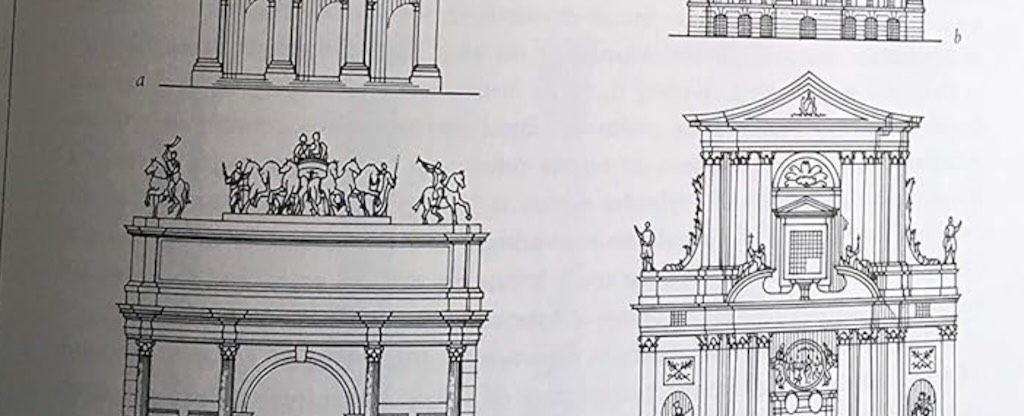
This is more a reference book, rather than a book designed to describe, argue, postulate, etc. As the author states “each page of text is a self-contained essay, with a drawing”, ranging over nearly 300 pages, from Origins and Egypt, though to a series on Classical Designs. Some of the pages and drawings describe different uses of pediments or different types of arches and vaults, and other pages and drawings are about complex mouldings or scrolled brackets.
What the reviewers wrote?
It is my understanding that the author was not aiming at a scholarly work, but more as a reference book useful to practising architects, architectural students, and traditional designers. Reviewers gave the author credit for this, and praised the hundreds of carefully prepared line drawings, diagrams, reconstructions and analytical sketches.
The illustrations were widely regarded as one of the book’s greatest strengths, and I found them fascinating.
Also reviewers appreciated that the author started with Greek and Roman architecture, and continued through to 20th-century traditional architecture. All presented as a succession of evolutions within one continuous tradition.
Reviewers did note that 20th-century Modernism appeared as something against which classical architecture was contrasted. Another criticism was that the author did not look at economics, patronage, or labour practices, for example. Consequently some academic reviewers felt the cultural context was thinner than a formal analysis.
My review
I did not read every page. I sampled the ones that attracted me, probably as the author intended.
I find it harsh that the book was complimented for its completeness, and then criticised for what was left out. The reality is that you only need to open to one page, and you know exactly what type of book it is.
The book is closer to an encyclopaedia, and I didn’t expect it to be a conventional history. It’s not a book you start at page one, and read to the end. If anything I would have liked even more detail in the drawings.
My guess is that it was, in its day, a popular book found on the shelves of many practicing architects. It sits on my shelf next to my copy of “The Architecture of England” by Doreen Yarwood, a book I bought in 1967 for £3:75.