I had decided to follow an Oxford University Summer School (2026) on the subject “130 Years of Discovery: Nuclear and Particle Physics from Becquerel to Gianotti”.
One of the recommended reading was “The Pope of Physics” – Enrico Fermi and the Birth of the Atomic Age, by Gino Segrè and Bettina Hoerlin (2016).
After completing my very short review, I decided to exploit the opportunity and try to recall the little I knew about Fermi’s work and impact. I’ve added these…
Annex – Fermi’s Theory of β-Decay
Annex – The first controlled nuclear chain reaction (1942) – with a link to The Manhattan Project, and the World’s First Self-Sustaining Chain Reaction
What the critics thought?
This is not a physics book, and most reviewers consider it a well written, highly readable and informative biography of one of the most important physicists of the 20th century. Many complimented Segre and Hoerlin for bringing Fermi to life in an easily readable fashion. The book reinforced Fermi position as one of the world’s great physicists, alongside Lawrence, Oppenheimer and Einstein.
For some reviewers it opened up a new perspective on Fermi’s role in the development of atomic weapons, whilst others focussed more on his almost unique ability to jump back and forth between theory and experimentation.
Some reviewers complained that they learnt little more than what they already knew, and called the book “a serviceable but unremarkable biography”. A few highlighted the fact that Fermi appeared “to treat the bomb blast as just another physics experiment”.
My opinion
Firstly, I found this book a very easy-to-read biography of one of the most important physicists of the 20th century. I have always admired those who could casually jump back and forth between theory and experiment, and for me Fermi sits on the top of that tree. In this sense I expected much from this book.
Despite dating from 2016, it must now be out-of-print, because I had to buy a second-hand copy through Amazon. I don’t know why, the book itself was in excellent condition, but it felt older. It had that boring grey binding and slightly off-white pages, characteristic of older books.
The book is divided into five broad parts, starting with his life in Italy, then his work in the US leading to the world’s first atomic “pile”, and concluding with his period in Los Alamos, and his untimely death at the age of only 53.
The first two parts covers Fermi’s life in Italy, and I felt it tried to portray fairly well the life of an Italian researcher at that time. However, I would have like more facts about how research funding was organised, and, for example, how salaries compared with those scientists and engineers working in Italian industry. Also how did the life of an Italian researcher compare to that in France, Germany or Denmark.
I lived and worked in Italy in the 1970s, and I missed those little remarks that touched on the everyday life of a group of aspiring scientists. There was a lot of “went there, went here”, but little on the details that would have made the character of Fermi, and the others, more alive.
The next part concerned Fermi’s move to the US and the building of the world’s first “pile”. I felt that the text became tighter, almost aligned with the increasing importance of the research in the war effort. I didn’t learn anything new, but I liked better the overall rhythm.
Part four, the Atomic City, was about Fermi’s stay in Los Alamos. I liked the interplay with what was happening in Italy at the time. Despite living in Italy for about 10 years, the war period was not one I had read-up on, so it was quite illuminating. It highlighted Fermi’s apolitical stance on war, and even on the moral questions about detonating atomic bombs on civilians.
The last part followed Fermi back to Chicago, and his death at the age of 53.
Conclusion
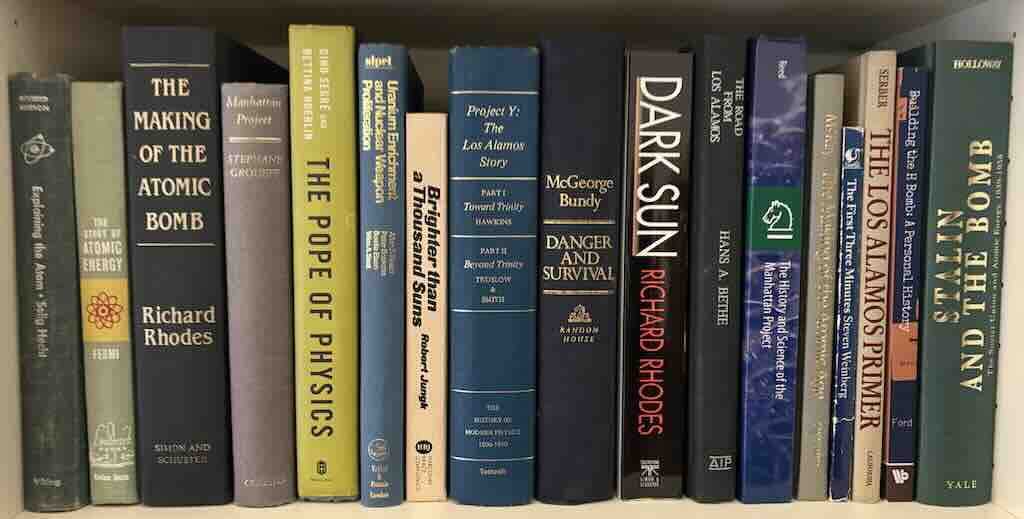
I had to read this book for my Summer School, and I did learn a little more about the life and personality of Fermi. For that I am grateful. I don’t think I learned anything new about his work, or the Manhattan Project, but I already had a decent library on the topic.
However, check out these videos:-
post script
Scribbled in the inside cover were some words, more or less clear
Dallas Metrocare (presumed officially “Dallas County Mental Health and Mental Retardation Center (Metrocare Services)”
-Skillman
-Samuel
These were, and still are, two of the major adult outpatient clinic sites.
Then followed Dr. Fenton and a Dr. Ma??toony (or similar).
It would appear that a Dr. Barry Fenton was a psychiatrist at the clinic, but is not currently listed. The second name could refer to Dr. Art Mirzatuny, also once list with the clinic, but is also no longer list.
To whomever might recognise this, rest assured, your book has found a new home and sits comfortably with new friends.
Annex - Fermi's Theory of β-Decay
The discovery of radioactivity
When Henri Becquerel (1852-1908) discovered radioactivity in 1896, nobody knew what was happening inside atoms. He wrote “uranium émettaient des radiations dont l’existence n’avait pas encore été reconnue, et que ces radiations jouissaient de propriétés remarquables, dont quelques-unes sont comparables aux propriétés du rayonnement étudié par M. Rontgen“.
By 1899–1900, Ernest Rutherford (1871-1937) and Paul Villard (1860-1934) had established the alpha–beta–gamma classification. Although at the time anything emitted from a radioactive substance and travelling outward would be called a radiation or a ray, and the physical nature of alpha (α), beta (β) and gamma (γ) radiation, was as yet unknown.
The three types of observed emissions, α, β and γ, would be found to be respectively, helium nuclei, J.J. Thomson’s electrons, and high energy electromagnetic radiation. This annex will try to explain how β-decay was found to be a manifestation of a weak interaction, whose understanding required several unexpected, and quite radical changes in our assumptions about the basic laws of nature.
You can read Rutherford’s original 54 page article “Uranium Radiation and the Electrical Conduction produced by it“. It’s a good read because you can see the difference between the reality of 1899, and how modern science now describes the same experiment.
The nature of α-, β- and γ-radiation
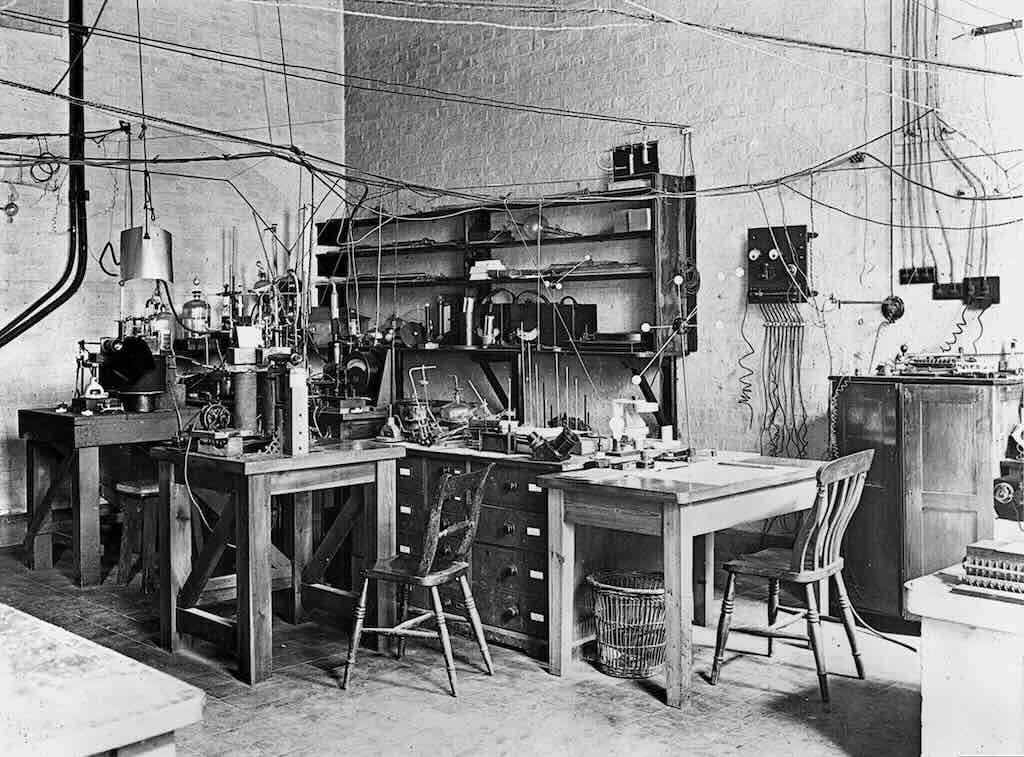
It’s true that Rutherford observed that the emissions from uranium were not all equally penetrating. But he was not trying to discover rays. He was investigating how strongly uranium radiation caused gases to conduct electricity. This meant he looked at refraction and polarisation of radiation from uranium metal and its compounds, and also for thorium radiation. He studied the opacity of substances for the radiation, the absorption of the radiation by gases, the conductivity produced in gases by complete absorption of the radiation, and the variation of the rate of discharge with distance between the plates.
Rutherford’s looked at the electrical discharge caused by the radiation, which was much more rapid than the photographic method, and also admitted of “fairly accurate quantitative determinations”. At the time it was postulated that “the rays in passing through the gas produce positively and negatively charged particles in the gas, and that the number produced per second depends on the intensity of the radiation and the pressure”. The term ion was given to them from analogy with electrolytic conduction, but at the time it was not assumed that the ion was necessarily of atomic dimensions, and it could have been “a multiple or submultiple of the atom”.
What Rutherford expected was ionisation proportional to the intensity of the radiation and the pressure, absorption of radiation proportional to pressure, the existence of saturation current, a rate of recombination of the ions proportional to the square of the number present, and the disturbance of the potential gradient between two plates when exposed to the radiation.
He actually started with experiments to decide whether the same radiation was emitted by uranium and its compounds and whether the radiation was homogeneous. In fact Wilhelm Röntgen (1845-1923) had observed that the X-rays varied widely in their power of penetration of solid bodies.
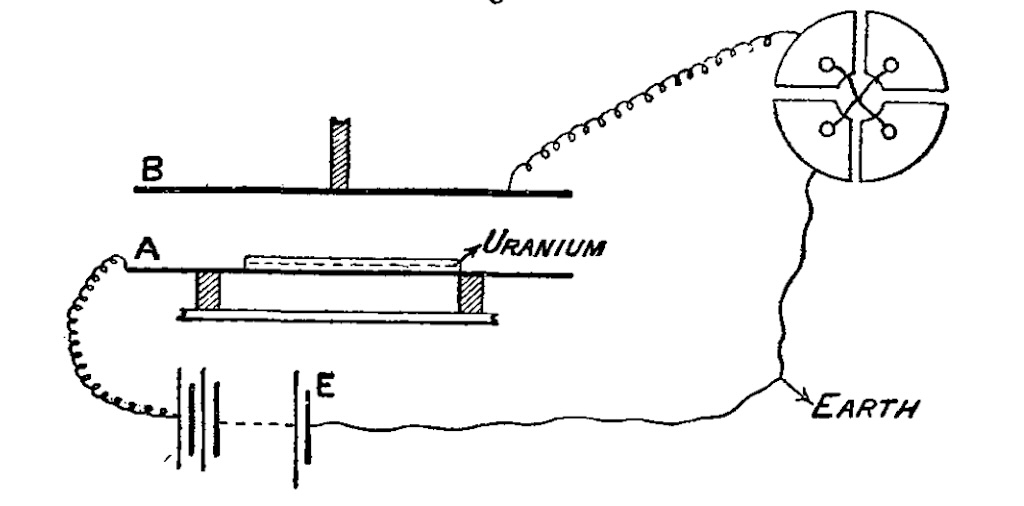
In order to test the complexity of the radiation, an electrical method was employed. Rutherford spread the sample of uranium (metal or compound) uniformly over the centre of a horizontal zinc plate, fixed parallel to another zinc plate (4 cm separation). Both plates were insulated, and the first was connected to one pole of a 50 volt battery, the other pole was to earth. The second zinc plate was connected to one pair of quadrants of an electrometer, the other pair also connected to earth. This is a description of what was often called a “plate capacitor“.
Under the influence of the uranium radiation there was a rate of leak between the two plates, as measured by the movement of the electrometer-needle. When the motion was steady, this was taken as a measure of the current through the gas.
Successive layers of thin metal foil were then placed over the uranium compound and the rate of leak determined for each additional sheet. The foil was so-called Dutch metal, an extremely thin beaten metal foil made primarily from a brass alloy (80-90% copper + 10-20% zinc), manufactured as a cheap imitation of gold leaf.
When two thicknesses were added at once, the square root of the observed ratio was taken, for three thicknesses the cube root. For the first ten thicknesses of metal the rate of leakage diminished approximately in a geometrical progression as the thickness of the metal increased in arithmetical progression. Being in accordance with an ordinary absorption law, showed that this part of the radiation was approximately homogeneous.
But with uranium oxide and layers of thin aluminium leaf, what was observed was different. For the first three layers of aluminium foil, the intensity of the radiation fell off according to the ordinary absorption law. But after the fourth thickness, the intensity of the radiation was only slightly diminished by adding another eight layers.
The initial passage of the radiation through 0.002 cm of aluminium reduced the radiation intensity to about 1/20th of its value. The intensity was again reduced to about half of that value after passing through an additional thickness of 0.05 cm, corresponding to 100 sheets of aluminium foil.
Experimental practice in the late 19th century was often exploratory rather than hypothesis-driven. Radioactivity had only been discovered three years earlier by Becquerel, and almost nothing was known about the nature of the emitted radiation. In such circumstances it was normal to vary as many experimental parameters as possible, including the uranium compound under study, the thickness of the radioactive layer, the absorber material, and the absorber thickness. Rutherford’s use of different uranium preparations together with Dutch metal, aluminium leaf and other absorbers appears consistent with a systematic attempt to map the absorption behaviour of uranium radiation rather than a specific search for multiple radiations. It was during this broader programme of measurements that the evidence for two distinct components, later named alpha and beta radiation, emerged.
It’s also worth mentioning that Rutherford also reported the observation of an activity from radon later identified as 220Rn in the 1900 article “A radio-active substance emitted from thorium compounds”. 220Rn occurs in the decay chain of 232Th. Rutherford wrote that he had found that thorium compounds continuously emitted “radioactive particles of some kind”, which retained their radioactive powers for several minutes. This ‘emanation’ had the power to ionise gas and passing through thin layers of metals, and, with great ease, through considerable thicknesses of paper… and passed through a plug of cotton-wool without any loss of its radio-active powers. It was also unaffected by bubbling through hot or cold water, and weak or strong sulphuric acid. In this respect it acted like an ordinary gas… The result shows that the intensity of the radiation had fallen to one-half its value after an interval of about one minute. Historically this was called Thoron, a naturally occurring radioactive gas, that comes from thorium found in rocks and building materials like concrete, brick, and granite.
Rutherford drew the conclusion that uranium radiation “is complex, and that there are present at least two distinct types of radiation, one that is very readily absorbed, which will be termed for convenience the α radiation, and the other of a more penetrative character, which will be termed β-radiation”.
Rutherford concluded “The character of β-radiation seems to be independent of the nature of the filter through which it has passed. It was found that radiation of the same intensity and of the same penetrative power was obtained by cutting off the α-radiation by thin sheets of aluminium, tinfoil, or paper. The β-radiation passes through all the substances tried with far greater facility than the α radiation”.
The most extensive description I’ve found is the 1904 Untersuchungen über die radioaktiven substanzen by Marie Curie (1867-1934), with the translation and additions by Walter Kaufmann (1871-1947).
In 1894 G. Johnstone Stoney (1826-1911) in The London, Edinburgh and Dublin Philosophical Magazine and Journal of Science, wrote a letter to the editor entitled “Of the “Electron”, or Atom of Electricity” (July-Dec. page 418). In it he claimed to have used the term “electron” to describe “valency-charge” in electrolysis as a minimum quantity of electricity, “which like an electrical atom is no longer divisible”. I guess this comes closest to the idea of a charge carrier, where electrons, ions and holes are examples.
More importantly in 1897 J. J. Thomson (1856-1940) published “Cathode Rays“, where he concluded that cathode rays consisted of negatively charged corpuscles (not called electrons) much smaller than atoms, and with a very large charge-to-mass ratio. The scientific community later attached Stoney’s name “electron” to Thomson’s corpuscle.
I would like here to note that Thomson was an influential teacher, and seven of his students went on to win Nobel Prizes, namely Rutherford, Bragg, Barkla, Aston, C. T. R. Wilson, Richardson and Appleton. Also his experiments to determine the nature of positively charged particles, with Francis William Aston, was the first use of mass spectrometry.
The idea of a very small negatively charge particle (corpuscle) was revolutionary for the time. For most of the 19th century atoms had been regarded as the fundamental building blocks of matter. Thomson’s experiments suggested that atoms themselves contained smaller constituents. But there was no connection between Thomson’s corpuscles and radioactivity, which itself had only been discovered one year earlier (in 1896).
The next advance came from studies of the behaviour of β-rays in electric and magnetic fields. Researchers including Henri Becquerel and Walter Kaufmann found that β-rays were strongly deflected in a manner similar to Thomson’s corpuscles. It’s worth mentioning that Kaufmann’s early work (1901–1903) confirmed for the first time the velocity dependence of the electromagnetic mass (later called relativistic mass) of the electron. He was also the first to discuss Albert Einstein‘s theory of special relativity, and argued that, although Einstein’s theory was based on quite different conditions and was logically more satisfying, it was observationally equivalent to Lorentz’s theory. I think he was the first to speak of the “Lorentz–Einstein” theory, although he refuted principle of relativity.
Measurements of the charge-to-mass ratio of β-rays yielded values close to those obtained by J.J. Thomson for cathode-ray particles. The conclusion gradually emerged that β-rays were not a new form of radiation but streams of very fast electrons emitted by radioactive substances.
This was a major conceptual step. Radioactivity was no longer simply the emission of mysterious rays. At least one component of radioactive emission could now be identified with a known particle.
The atom and the nuclear model
During the first decade of the 20th century, radioactivity became increasingly linked with the internal structure of atoms. Work by Frederick Soddy (1877-1956) and others showed that radioactive substances changed into different elements through a sequence of spontaneous transformations, i.e. that radioactivity is due to the transmutation of elements.
These discoveries challenged the long-standing belief that chemical elements were immutable. Radioactive decay demonstrated that one element could naturally transform into another, implying that atoms possessed an internal structure capable of change.
The picture became clearer after Rutherford’s nuclear model of the atom in 1911. From scattering experiments involving α particles and thin metal foils, Rutherford concluded that most of an atom’s mass was concentrated in a tiny central nucleus. Radioactive processes increasingly came to be viewed as nuclear phenomena rather than ordinary chemical changes. Rutherford’s The Scattering of α and β Particles by Matter and the Structure of the Atom, is also well worth a read. In it he concludes that “the atom consists of a central charge supposed concentrated at a point, and that the large single deflexions of the α- and β-particles are mainly due to their passage through the strong central field”. He also suggested that “the value of this central charge for different atoms is approximately proportional to their atomic weights”, but it was not possible to say if the charge was positive or negative.
It’s true that by 1911 Rutherford already had the experimental results from Hans Geiger (1882-1945) and Ernest Marsden (1889-1970) showing that about 1 in 20,000 α particles could be scattered through angles of roughly 90° in gold foil only about 0.00004 cm thick. Rutherford rightly regarded this as incompatible with J.J. Thomson’s “plum pudding” model and used it to propose a concentrated central charge.
A further advance came through the work of Frederick Soddy (1877-1956) and Kazimierz Fajans (1887-1975). They independently arrived at the law of radioactive displacements governing the transmutation of elements during radioactive decay.
They showed that radioactive emissions systematically altered the position of an element within the periodic table (see Soddy’s The Radio-Elements and the Periodic Table). Alpha emission caused an element to move two places lower in atomic number, while β-emission caused it to move one place higher. These relationships revealed that β-decay was not merely the emission of an electron. It was a process that transformed one atomic nucleus into another.
Although the mechanism remained unknown, physicists now understood that β-emission was directly connected with changes occurring inside the nucleus itself.
It’s worth mentioning that Soddy also developed a perspective on economics rooted the laws of thermodynamics, but he was “roundly dismissed as a crank”. Yet today most of his proposals are now conventional practice, e.g. to abandon the gold standard, let international exchange rates float, use federal surpluses and deficits as macroeconomic policy tools that could counter cyclical trends, and establish bureaus of economic statistics (including a consumer price index).
Before moving on it’s also worth noting that Soddy wrote in 1904 that “The man who put his hand on the lever by which a parsimonious nature regulates so jealously the output of this store of energy would possess a weapon by which he could destroy the earth if he chose”. In fact Soddy’s predictive imagination inspired H.G. Wells to write The World Set Free, a fiction novel published in 1914, suggesting how weapons could be made from atomic discoveries.
The puzzle of β-decay
By 1914 physicists believed they understood the basic nature of beta rays. They were electrons emitted during radioactive transformations occurring within atomic nuclei.
The β-decay was identified as the reaction AZX→ AZ+1Y + e-, where a nucleus AZX decays to a nucleus AZ+1Y, with the emission of an electron.
If β-decay were a two-body nuclear process then conservation of energy and momentum would require the decay energy to be divided in a fixed way between the emitted electron and the recoiling daughter nucleus. The β-electrons should therefore have a sharply defined energy, not a continuous range.
The remaining question concerned the energies of those electrons.
Working with β-radiation from Radium B and Radium C, James Chadwick (1891-1974) measured the distribution of electron energies using magnetic analysis. If β-decay consisted simply of a nucleus emitting an electron, then conservation of energy suggested that every emitted electron should possess the same energy.
The original paper was “Intensitätsverteilung im magnetischen Spektrum von β-Strahlen von Radium B+C”, in the Verhandlungen der Deutschen Physikalischen Gesellschaft. Not only is it impossible (for me) to find a publicly available copy of this paper, but we are also faced with the question, what is Radium B and C?
A later historical summary of Rutherford’s work notes that he found radioactivity deposited on electrodes, dissolved it from them, interpreted the decay curve, and “identified three radioactive substances which he named Radium A, Radium B and Radium C. The letters marked a position in the observed decay sequence, not chemical identity. In fact Rutherford wrote that an “analysis of the decay curves of excited activity, produced for different intervals of exposure in the presence of the emanation, shows that there are three well-marked changes occurring in emanation X of radium. In the first change, half the matter is transformed in 3 minutes; in the second, half in 34 minutes; and in the third, half in 28 minutes. The first change is accompanied only by α rays, the second change is not accompanied by α rays at all, and the third change by α, β, and γ rays. The 28 min half-life of the third decay was later named radium C (214Bi)”.
So Radium B and Radium C were the names given to successive radioactive products in the radium decay series. They were identified experimentally by their distinct half-lives, radiation, and chemical behaviour. Only later were they recognised as Lead-214 and Bismuth-214 respectively.
What Rutherford and others were actually detecting were successive radioactive products in the Radium decay series. Radium A was what is now known as Polonium-218, formed by the α-decay of Radon-222. Radium B was Lead-214, produced by the α-decay of Radium A. Radium C was Bismuth-214, produced by the β-decay of Radium B and notable for its intense β- and γ-radiation. Radium C′ was Polonium-214, formed from Radium C and characterised by a very short half-life and α emission. Radium D was Lead-210, the much longer-lived product that followed Radium C′.
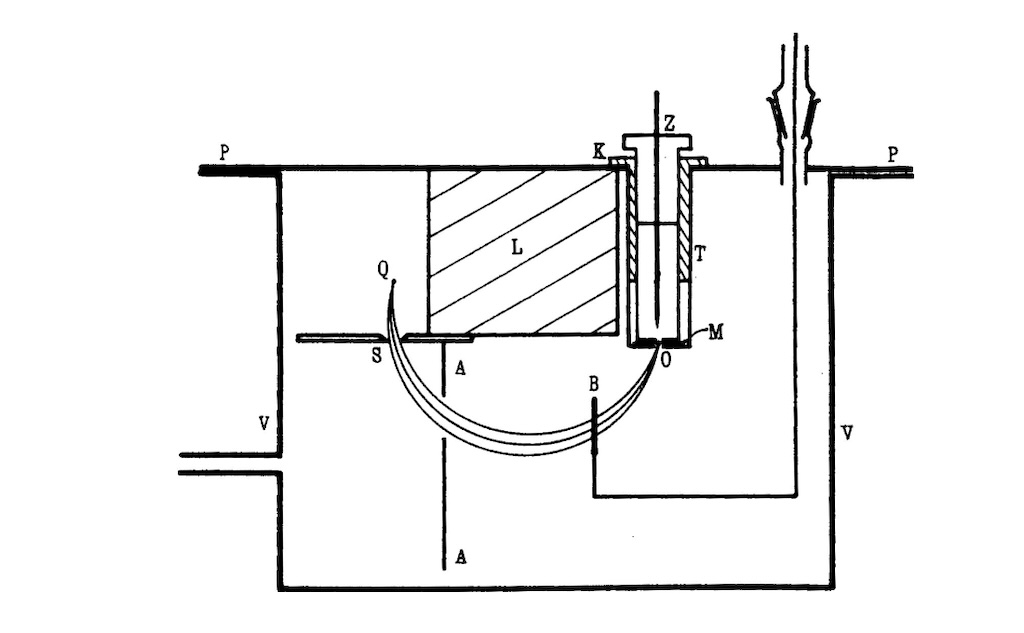
Not finding a copy of Chadwick’s original paper I was able to turn to the unusually titled paper by Allan Franklin entitled The Machine Speaks Falsely. Chadwick’s instrument had at Q a radioactive source in the form of a brass plate exposure to radium emanation (radon). A Geiger counter (or ionisation chamber) was placed at O (rather than a photographic plate). Both the ionisation chamber and the Geiger counter showed that electrons emerged with a continuous range of energies extending from low values up to a characteristic maximum. This observation created one of the most important unsolved problems in early nuclear physics and opened the path that would eventually lead to Pauli’s neutrino hypothesis and Fermi’s theory of β-decay.
Chadwick’s results were published in 1914, but we can zoom forward to the result of Charles Ellis (1895-1980) and WA Wooster in 1927. The paper of Franklin is well worth a visit to know what happened between 1914 and 1927.
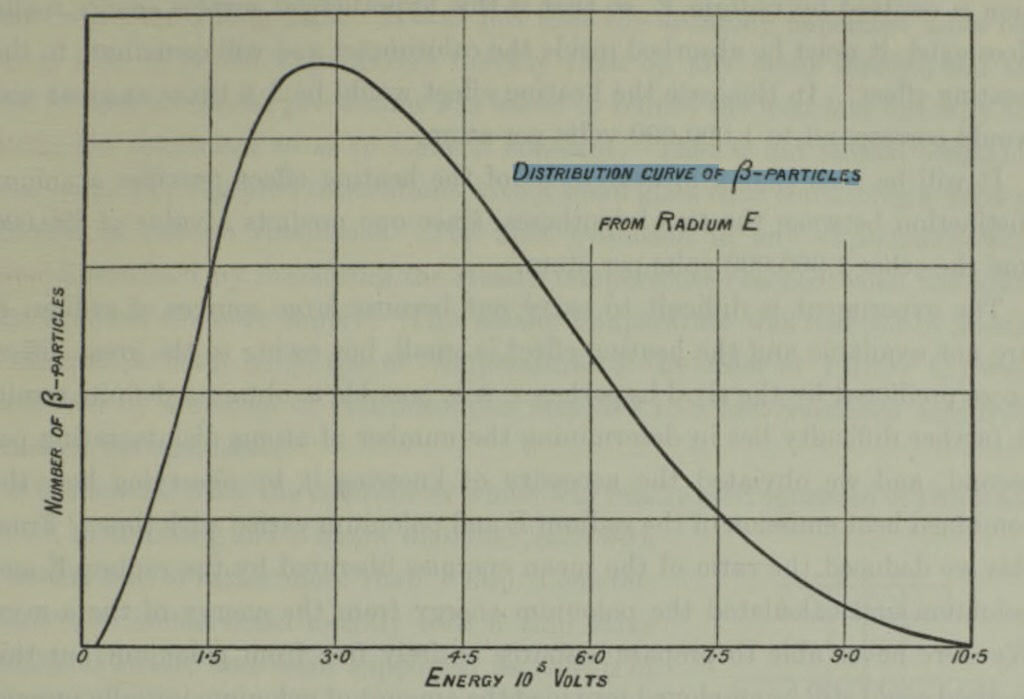
So in 1927 Ellis and Wooster provided strong independent evidence that the energy spectrum of electrons emitted in β-decay was continuous. The above curve is taken from Ellis and Wooster The Average Energy of Disintegration of Radium E. They did this by measuring the average energy of disintegration of electrons in the β-decay of Radium E, using the heating effect produced by those electrons. If the energy spectrum really was continuous then the average energy obtained from the heating effect measurement would equal the average energy obtained by other methods, including ionisation. If the energy spectrum was mono-energetic and the observed spectrum due to unknown energy losses, then the average heating energy measured should be at least as large as the maximum energy measured in the continuous spectrum. For Radium E the average and maximum energies were 390 keV and 1.05 MeV, respectively.
Radium E was chosen as the source of β-decay electrons because it was a radioactive source that produced no significant number of γ-rays. Thus, the energy emitted was carried solely by the electrons. Again the paper of Franklin described very well the heating effect of the β-rays and the use of a calorimeter.
Ellis and Wooster measured the total heat produced by the β-decay of Radium E and found an average electron energy of about 390 keV, in agreement with the average energy inferred from the observed continuous spectrum. This was far below the approximately 1.05 MeV expected if all electrons were emitted with a single energy and merely appeared continuous because of experimental energy losses. Their result therefore demonstrated that the continuous β-spectrum was a genuine physical phenomenon and not an experimental artefact.
This created a serious problem, because the conservation of energy appeared to fail in β-decay. The reality was that the continuous spectrum had been known for years, but Ellis and Wooster made it much harder to dismiss.
The problem was that the first law of thermodynamics states that energy cannot be created or destroyed, only transformed from one form to another. At the time physicists believed that beta decay involved only two objects after the decay, namely the daughter nucleus and the electron. And given that the masses of each are fixed, the total energy released in the decay must also be fixed. Which means that the electron must always leave with the same kinetic energy (as already was well known from α-decay). So the conclusion was that for β-decay the electron must also be seen as a sharp spectral line or peak, and not as a continuous spectrum.
The implication was that it might be necessary to not only renounce the conservation of energy, but to also renounce to the invariance of physical laws by translation of time. This idea was considered but it would have had profound implications for physics.
Why did it appear to affect conservation of energy? A continuous spectrum would imply that an electron could be emitted with a variety of energies, and if less than the maximum, the remaining (or missing) energy must go somewhere else. The daughter nucleus recoils slightly, but calculations showed that its recoil energy was far too small to account for the missing energy. So that energy would genuinely have disappeared, or been destroyed (thus contradicting the first law of thermodynamics).
Why would it have affected time-translation invariance? In physics, a translation in time means performing the same experiment at different times, and getting the same result. If the laws of physics are unchanged, then the outcome should be governed by the same rules. This connection with energy conservation was established mathematically by Emmy Noether (1882-1935) in 1918. Albert Einstein and Norbert Wiener said that she was the most important woman in the history of mathematics. Suppose the laws of nature are identical today and tomorrow, her theorem proved that physics possesses time-translation symmetry, and this means that energy must be conserved. Conversely, if energy is not conserved, then somewhere the laws must depend explicitly on time, and nature would behave differently at different moments.
Wolfgang Pauli and the neutrino hypothesis
I think it’s useful to not forget that in 1925, the Dutch physicists Samuel Abraham Goudsmit (1902–1978) and George Eugene Uhlenbeck (1900–1988), working in Leiden under Paul Ehrenfest, proposed that the electron possesses an intrinsic angular momentum independent of its orbital motion. This new property, later called spin, provided a natural explanation for previously puzzling features of atomic spectra, including the anomalous Zeeman effect and the observed doubling of many spectral lines. The proposal introduced a new quantum degree of freedom with two possible orientations, now designated spin-up and spin-down. Electron spin rapidly became a central element of quantum theory and was incorporated into Wolfgang Pauli’s exclusion principle and later into relativistic quantum mechanics through Paul Dirac’s theory of the electron. The concept of spin would ultimately prove essential not only in atomic physics but also in nuclear and particle physics, where intrinsic angular momentum is a fundamental property of all elementary particles.
The original publication was “Ersetzung der Hypothese vom unmechanischen Zwang durch eine Forderung bezüglich des inneren Verhaltens jedes einzelnen Elektrons“. However, in 1971, Goudsmit gave and excellent lecture to the Dutch Physical Society. Before moving on, have a look at Sebens’s How Electrons Spin from 2024.
On the 4 December 1930, while at ETH Zürich, Wolfgang Pauli (1900-1958) addressed a short letter to Lise Meitner et al. (being the participants at a Tübingen conference). Starting, “Dear radioactive ladies and gentlemen“, he proposed the existence of a hitherto unobserved neutral particle with a small mass, no greater than 1% the mass of a proton, to explain the continuous spectrum of beta decay.
Pauli called this new particle a “neutron”, later Fermi would name it the neutrino.
In fact Pauli was sufficiently uncertain of his idea that he circulated it privately among trusted experimental colleagues. So the neutrino entered physics first as a conference letter rather than as a scientific presentation.
Chadwick discovers the neutron
In 1930, at the Physikalisch-Technische Reichsanstalt in Berlin-Charlottenburg, Walther Bothe (1891-1957) and Herbert Becker showed that beryllium, boron, fluorine, and lithium atoms, when bombarded by α-particles emitted by polonium, produce highly penetrating radiation. They believed these were very energetic γ-rays (“Höhenstrahlung”), the most penetrating known at the time. They hypothesised that these light nuclei capture the α-particles, and that the γ-rays carried the excess energy released.
49Be + 24He → *13C→ 612C + γ
where *13C is a excited carbon-13 nucleus with an extremely short half-life.
Many historical publications such as W. Bothe, H. Becker, Künstliche Erregung von Kern–γ–Strahlen, Z. Phys. 66 (1930) 289, are unfortunately still hidden, often indirectly, behind paywalls.
This was the first in a series of experiments that led James Chadwick to conclude, in February 1932, that not γ-rays, that the penetrating radiation consisted not of γ-rays but of neutral particles, later called neutrons, produced in the reaction…
49Be+ 24He→ 612C+ n
A year later, Irène Curie (1897-1956), when studying the absorption of this secondary radiation from Be and Li, found that it penetrated through materials even more easily than initially predicted by Bothe. It passed through several centimetres of lead, and appeared to be the most penetrating γ-rays emitted by radioactive elements. Frédéric Joliot (1900-1958) studied radiation emitted by boron, bombarded by α-particles from polonium, and reached a similar conclusion. To explain this effect, they both assumed that the emitted γ–rays possessed very high energy.
Two years later, Irène and Frédéric Joliot-Curie observed, by measuring the ionisation produced by the secondary radiation from boron and beryllium in a chamber with a thin aluminium (Al) window, that the ionisation increased when they placed a hydrogen-containing material in front of the window. The effect appeared to be due to the ejection of protons (or “H-rays” as they were sometimes called then) whose speed could reach nearly 10% of the speed of light. The authors accepted without question Bothe’s hypothesis that secondary radiation consisted of γ-rays. A more detailed study of their interaction with matter revealed internal contradictions in the γ-ray hypothesis, and prompted the authors to even suppose “a new mode of interaction of radiation with matter”.
I. Curie, Sur le rayonnement γ nucléaire excité dans le glucinium et dans le lithium par les rayons α du polonium, C. r. hebd. séances Acad. sci. Paris 193 (1930) 1412 (glucinium is an old synonym of beryllium).
F. Joliot, Sur l’excitation des rayons γ nucléaires du bore par les particules α. Énergie quantique du rayonnement γ du polonium, C. r. hebd. séances Acad. sci. Paris 193 (1931) 1415.
I. Curie, F. Joliot, Émission de protons à grande vitesse par les substances hydrogénées sous l’influence des rayons γ très pénétrants, C. r. hebd. séances Acad. sci. Paris 194 (1932) 273.
I. Curie, F. Joliot, Effet d’absorption de rayons γ de très haute fréquence par projection de noyaux légers, C. r. hebd. séances Acad. sci. Paris 194 (1932) 708.
I. Curie, F. Joliot, Errata to “Effet d’absorption de rayons γ de très haute fréquence par projection de noyaux légers”, C. r. hebd. séances Acad. sci. Paris 194 (1932) 1032.
It is often very difficult to isolate a link to these exact papers, but it’s possible to browse older collections of the Comptes rendus de l’Académie des sciences, and hunt out exact references.
On the other side of the Channel, at the Cavendish Laboratory in Cambridge, James Chadwick, who had been searching for the neutron (whose existence Rutherford suspected), had a different idea.
Already in 1920 Rutherford had been troubled by the possible structure of the atom and by the concept that the atomic nucleus should also reveal the presence of neutral, massive particles. In his 1920 “Bakerian Lecture” Rutherford hypothesised that, within a nucleus, there could be one or more “very strong electron-proton combinations”, while at the same time persisting with the possibility that in the nucleus there could coexist a number of protons exactly equivalent to the number of atomic, peripheral electrons, which orbited at enormous distances from the nucleus.
At that time, the presence of electrons inside the nucleus was not an abstruse concept. Rutherford referred to the experiments of Becquerel, who as early as 1896 had demonstrated, unequivocally, that some atomic nuclei (Uranium salts) emitted electrons of high energy, called β-rays. So from that time, scientists were thinking about nuclei containing both protons and electrons i.e. nuclear electrons.
Rutherford added that, since the atom was hydrogen neutral, and considered as a nucleus of single unit charge, having an electron attached at a certain distance, that “under some conditions it may be possible for an electron to combine much more closely with the hydrogen nucleus, forming a kind of neutral doublet. Such an atom would have very novel properties. Its external field would be practically zero, except very close to the nucleus, and in consequence it should be able to move freely through matter”. In this context, under conditions of very high density (as the nuclear matter), it may turn out that the electron is subjected, in addition, to intense forces, so as to remain trapped in the nucleus.
In the following month, at the British Association Meeting of 25 August 1920, Rutherford named this neutral doublet with the term “neutron”. Rutherford’s presentation was entitled “The Building up of Atoms”, but I have not yet found a copy. There is mention that the same text was published in Engineering (Vol. 110, 1920, p. 382), but I haven’t yet found a copy of that article either.
Around the same time, two other authors proposed the existence of nuclear “neutral systems”. Van den Broek (1870-1926) had hypothesised that the atomic number (Z) was equal to half the atomic mass (A) and that it was equal to the number of electrons orbiting around the nucleus. He proposed that there might be electrons inside the nucleus (positively charged). Later he suggested that there was a group of neutral particles consisting in the combination of a α-particle with 2 electrons, giving rise to radioactivity. Van den Broek wrote that the atomic nucleus could be made of an even number of α-particles and of H nuclei, which, together with the electrons (or β-rays), made “compound systems”.
Also in 1920, William Draper Harkins (1873-1951) hypothesised that the combination of 2 helium nuclei with 2 electrons represented an important constituent of atomic nuclei, especially of the heavier ones. Basically when describing the structure of the nuclei, he considers the nucleus was formed by helium nuclei electrically neutralised by “cementing electrons“. At this time the idea was that the atomic nucleus was constituted of only protons and electrons. Scientists believed that emitted electrons (β-rays) had to pre-exist somewhere in the atom, or in the nucleus.
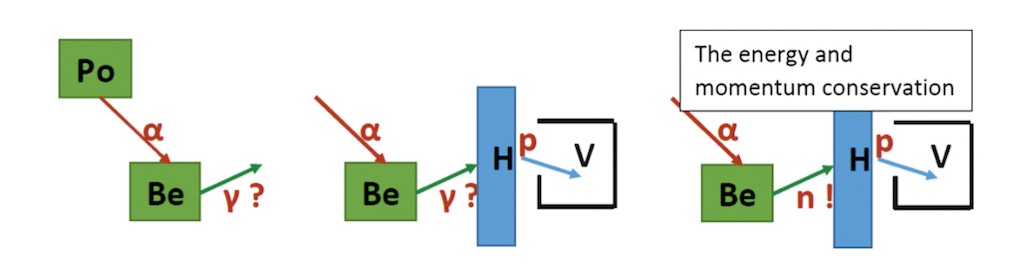
On the left we have Bothe’s experiment with Be bombarded by α-particles (in red) of Po emits a-radiation (in green) of great penetrating power, which Bothe assumed to be γ-rays.
In the middle we have Joliot-Curie’s experiment, where H, when hit by the radiation marked in green, emits protons of high energy.
On the right we have Chadwick’s experiment, where he analysed the conservation of energy and momentum in these nuclear reactions.
Chadwick, after repeating and improving his experiments, published in late February 1932, a very short but particularly clear article, in which he demonstrated that the γ-ray interpretation was incompatible with the observed recoil particles if the known laws of conservation of energy and momentum and known γ-ray interactions were assumed. For example, if beryllium emitted γ-rays, then the observed reaction would be
49Be + α → 613C + γ
Chadwick observed that the mass defect of 613C was known with sufficient precision that it could be shown that the energy of the photon emitted in this process cannot be greater than about 14 MeV. It was difficult to attribute such a “quantum” to the observed effects. In fact he showed that the recoil protons, the recoil nitrogen nuclei, and the recoil helium nuclei, could not simultaneously be explained by a 14 MeV gamma ray using the known interaction of γ-rays with matter, principally Compton scattering. In addition, he also measured recoil nuclei from hydrogen, helium and nitrogen, and using conservation of momentum and energy, he showed that one single neutral particle could explain all three sets of measurements.
Chadwick noted that the difficulties disappeared if one assumed that the radiation consists of “particles of mass 1 and charge 0”, or “neutrons”. If the reaction is
49Be + α → 613C + n
there remains a substantial amount of kinetic energy available for the neutron (n).
The letter to the editor of Nature announced the discovery (27 February 1932). The definitive evidence appears in the longer Royal Society paper published 1 June 1932.
The Joliot-Curies were not immediately convinced (I. Curie, F. Joliot, Projections d’atomes par les rayons trés pénétrants excités dans les noyaux légers, C. r. hebd. séances Acad. sci. Paris 194 (1932) 876). They conducted further experiments, but quickly concluded that they “provided new support for the neutron hypothesis” (I. Curie, F. Joliot, Sur la nature du rayonnement pénétrant excité dans les noyaux légers par les particules α, C. r. hebd. séances Acad. sci. Paris 194 (1932) 1229). In particular, they considered another nuclear reaction, producing nitrogen from boron
115B + α → 147N + n
and found that, under this hypothesis, the maximum energy of the neutrons corresponded to the experimentally measured energy of the ejected protons. Moreover, the emission of high-energy secondary electrons observed previously was also consistent with the neutron hypothesis.
In their 1933 paper Preuves expérimentales de l’existence du neutron, they rightly added that the radiation was complex and that γ-rays were present, as well as neutrons. The same observation had been made by Pierre Auger (1899-1993) in his note (page 877) “Sur la projection de noyaux légers par les rayonnements ultra-pénétrants de radioactivité provoquée“, including “Trajectoires photographuées par la méthode de Wilson“. He had independently investigated the same Po–Be radiation with a cloud chamber and reached essentially the same conclusion, that the radiation involved both neutrons together with γ-rays. This agreed with the later interpretation of Joliot and Curie. The note of Pierre Auger followed a note (page 876) of Mme Irène Curie et M. F. Joliot entitled “Projections d’atomes par les rayons très pénétrants excités dans les noyaux légers“.
I would like to make a special mention of Pierre Auger, who independently discovered the Auger effect in 1923. Today, Auger electron spectroscopy (AES) is one of the principal techniques for determining the elemental composition of the outermost atomic layers of materials.
Less widely appreciated is the importance of Auger electrons in radiation physics and radiation biology. Ionising radiation ultimately deposits much of its energy through cascades of secondary electrons, among which Auger electrons form a well-defined component. Although biologically an Auger electron is no different from any other electron of the same energy, Auger cascades are produced at a single atomic site and generate a highly localised burst of low-energy electrons. These electrons have ranges comparable with molecular dimensions and therefore produce extremely dense ionisation within nanometre-sized volumes. When such a cascade occurs in or near DNA, it is capable of producing complex, clustered damage that is particularly difficult for the cell to repair. Thus, a phenomenon first investigated by Pierre Auger a century ago has become important not only in surface science but also in our understanding of radiation damage and in the development of targeted radionuclide therapy. From the standpoint of microdosimetry, what matters is not the origin of the electron but the density with which energy is deposited within volumes comparable with the dimensions of biological targets. Auger cascades provide one of the most striking examples of this principle.
As a final comment on low energy electrons, an Auger electron is emitted after an atom has developed an inner-shell vacancy, so it is the result of a form of atomic relaxation, and they usually have an energy of few hundred eV and a range of nm–μm. However, there exists also δ-rays (delta rays), which are energetic secondary electrons knocked out of an atom by a passing charged particle. Historically they appeared as little side branches coming off particle tracks in cloud chambers or photographic emulsions. Delta rays have no fixed energy, and can be a few hundred keV and can travel hundreds of micrometres or even millimetres.
However, high-LET particles (α-particles and heavy ions) lose most of their energy through dense ionisation along the central track. Occasionally, they transfer sufficient energy to an atomic electron to produce a δ-ray, which initially carries energy away from the track and forms the surrounding penumbra. However, as the δ-ray slows down, its LET increases rapidly. By the final stages of its track it has become a low-energy electron whose interactions are essentially identical to those of an Auger electron of the same energy. Consequently, although δ-rays begin by transporting energy away from the primary track, much of that energy is ultimately deposited in extremely small volumes at the ends of their own tracks, where they produce dense clusters of ionisations comparable to those produced by Auger electrons.
The interpretation of the initial experiments in the 1920s and early 1930s was complex because several physical processes occurred simultaneously. Neutrons, γ-rays, and protons of different energies, with different properties, can be produced simultaneously, and the different types of detectors used in the experiments of Bothe, the Joliot-Curies, and Chadwick have different sensitivities to the different types of radiation.
Irene and her husband, like Bothe, had not thought they could have observed neutrons. Yet, even before 1932, some researchers expected to see them. Chadwick was among them, but he was not alone. The writer Leonardo Sciascia (1921-1989) reported that when Ettore Majorana (1906-1938) learned of the Joliot-Curies’ experiments, he said to Emilio Segré (1905-1989) and Edoardo Amaldi (1908-1989), “What idiots, they discovered the neutral proton and they didn’t even realise it!” (as remembered by Segrè and Amaldi many years later).
Enrico Fermi, Edoardo Amaldi, Ettore Majorana, Bruno Pontecorvo, Franco Rasetti, Emilio Segrè, and the chemist Oscar D’Agostino, were the famous “Via Panisperna boys“. In addition to Fermi, Amaldi coined the term “neutrino“, Majorana is famous for the Majorana equation, Majorana fermions, Pontecorvo developed one of the first practical application of slow neutrons, Pontecorvo discovered key processes leading to nuclear fission, Segrè was awarded jointly the Nobel Prize in Physics in 1959 for the discovery of the antiproton, and D’Agostino worked with Fermi on the properties of slow neutrons.
The name Panisperna probably dates back to a medieval custom at the ancient church of San Lorenzo in Panisperna in Rome. The resident Sanctae Clarae nuns would distribute bread and ham (“panis et perna” in Latin) to the poor on St. Lawrence‘s feast day.
The new theory of the atomic nucleus
Following the discovery of the neutron, a complete reformulation of the physics of the nucleus and elementary particles was undertaken by various researchers. Thus, several researchers, including James Chadwick, saw the neutron as a constituent of the nucleus.
Dmitri Iwanenko (1904-1994) suggested viewing the atomic nucleus as an assembly of protons and neutrons, and no longer of protons and electrons as in an earlier model proposed by Rutherford which included “intra-nuclear” electrons (D. Iwanenko, Sur la constitution des noyaux atomiques, C. r. hebd. séances Acad. sci. Paris 195 (1932) 439), and D. Iwanenko, The neutron hypothesis, Nature 129 (1932) 798). More detailed theories were presented by Werner Heisenberg (1901-1976), almost simultaneously with Iwanenko, and then, the following year, by Ettore Majorana and Eugene Wigner (1902-1995).
W. Heisenberg, Über den Bau der Atomkerne. I, Z. Phys. 77 (1932) 1.
W. Heisenberg, Über den Bau der Atomkerne. II, Z. Phys. 78 (1932) 156.
W. Heisenberg, Über der Bau den Atomkerne. III, Z. Phys. 80 (1933) 587.
E. Majorana, Über die Kerntheorie, Z. Phys. 82 (1933) 137.
E. Wigner, On the mass defect of helium, Phys. Rev. 43 (1933) 252.
E. Wigner, Über die Streuung von Neutronen an Protonen, Z. Phys. 82 (1933) 137.
The theory of the atomic nucleus became much simpler. The strong interaction between neutrons and protons ensured the stability of the nucleus. Heisenberg considered the proton and the neutron as two quantum states of the same particle. Hideki Yukawa (1907-1981) analysed the neutron-proton interaction, and proposed a form of interaction potential and introduced mesons, which was a decisive step for elementary particle physics.
One experimental fact, however, gave rise to controversy, and that was the energy spectrum of the electrons emitted in β–decay. If the β–decay emitted only an electron, then the conservation of energy implied that it must have a well-defined energy. However, the observed energy forms a broad band, and Niels Bohr (1885-1962) even suggested that energy conservation might fail inside the nucleus.
The most plausible explanation was the simultaneous emission of another particle, already suggested in 1930 by Wolfgang Pauli. A major problem was that this particle had not been observed experimentally. Why? The only possible explanation was a very high penetrating power that would allow the hypothetical particle to pass through all the screens without leaving a trace. Since this seemed unlikely, Pauli presented his hypothesis in a joking tone, in a letter to “Liebe radioaktive Damen und Herren” in which he wrote that he preferred not to publish anything for the time being on the hypothetical particle.
This publication is often cited as providing an excellent summary of the developments during the early 30s, E. Amaldi, From the discovery of the neutron to the discovery of nuclear fission, Phys. Rep. 111 (1984) 1. I’m still looking to find a copy and an open link.
Nevertheless, more and more physicists believed that Pauli’s joke was a serious matter. For example, in December 1933, Francis Perrin (1901-1992) analysed the data on β-decay and suggested that the new particle should have a mass much smaller than the mass of electrons, and therefore a speed close to the speed of light. And its spin should be ½, as Wolfgang Pauli had suggested. In fact Pauli originally called this particle the neutron, but Fermi renamed it neutrino (ν) in 1933–34 after Chadwick discovered the neutron.
F. Perrin, Possibilité d’émission de particules neutres de masse intrinsèque nulle dans les radioactivités β, C. r. hebd. séances Acad. sci. Paris 197 (1933) 1625.
The neutrino was only observed in 1956 (C.L. Cowan, F. Reines, F.B. Harrision, H.W. Kruse, A.D. McGuire, Detection of the free neutrino: a confirmation, Science 124 (1956) 103).
Until 1930, only two fundamental interactions (gravitational and electromagnetic) were known. In a very short period after the discovery of the neutron, two new fundamental interactions had been discovered, the strong interaction that binds nucleons together in the nucleus, and the weak interaction responsible for β-decay.
The fundamental properties of the neutron itself were also investigated (I. Curie, F. Joliot, La complexité du proton et la masse du neutron, C. r. hebd. séances Acad. sci. Paris 197 (1933) 237). As early as 1933, the Joliot-Curies found that the neutron mass is larger than the proton mass, in contrast to the initial statement of James Chadwick (The existence of a neutron, Proc. R. Soc. 136 (1932) 692). This has important consequences for nuclear stability and nuclear reactions. While forming more than a half of the mass of matter around us, free neutrons have not a very long lifetime, only about ≈ 880 s (14.7 minutes), and they undergo β⁻ decay.
There is a striking difference with free protons, where no decay has ever been observed. According to the Standard Model, the proton is absolutely stable because it is the lightest baryon. Since there is no lighter baryon into which it can decay while conserving baryon number, it has no allowed decay mode.
Experiments have placed a lower limit on the proton lifetime of approximately 1034 years, or more than 1024 times the current age of the Universe.
Likewise, the electron is considered stable in the Standard Model because it is the lightest charged lepton. There is nothing lighter carrying the same electric charge into which it could decay while conserving charge and lepton number.
Experiments place a lower limit on the electron lifetime of roughly 1028, although the Standard Model predicts an effectively infinite lifetime.
A free photon is absolutely stable according to the Standard Model. It has no measured lifetime (predicted lifetime of infinite).
The discovery of the positron
Only a few months after Chadwick’s discovery of the neutron, another fundamental particle entered physics. In August 1932, while studying cosmic rays with a cloud chamber placed inside a magnetic field at the California Institute of Technology, Carl D. Anderson (1905–1991) observed tracks corresponding to positively charged particles having the same mass as an electron (see The Positive Electron in Physical Review, March 1933). The particles curved in the opposite direction to electrons under the magnetic field while losing energy in matter at the same rate. Anderson had discovered the positron, the first experimentally observed antiparticle (and antimatter).
The existence of such a particle had been predicted in 1928 by Dirac, whose relativistic quantum theory of the electron admitted solutions corresponding to particles identical to electrons but carrying positive electric charge. Anderson’s observation provided one of the earliest and most striking confirmations of relativistic quantum mechanics. At the same time, it showed that β-radiation could consist not only of electrons (β− decay), as had been known since the work of Becquerel, Rutherford and Chadwick, but also of positively charged electrons (β+ particles or positrons). This considerably widened the possible mechanisms of radioactive decay and nuclear transformation.
One valid question, is why had no one saw these tracks in cloud chambers before?
Firstly, before the development of powerful radioactive sources and particle accelerators, there simply were not many positrons available to detect. It’s true that cosmic rays produce showers of secondary particles high in the atmosphere, including positrons, but the flux is small. Even in this experiment they only detected 15 tracks in 1,300 photographs.
Secondly, Robert Millikan (1868-1953), famous for his “oil drop experiment“, and Anderson were studying secondary showers of particles caused by primary cosmic rays, not looking for new “exotic” particles. And cosmic rays were then thought to come predominantly from above. Victor Hess (1883-1964) with his balloon flights (1912) had shown that the intensity increased with altitude, implying an extraterrestrial origin.
Thirdly, Anderson’s experiment was perfectly designed for detecting cosmic rays, and positrons (even at sea level). He had placed a cloud chamber vertically (for particles coming from above), inside a magnetic field, and with a 6 mm lead plate across the middle. Anderson’s field was about 1.5 tesla, which was very strong for 1930. And without the magnetic field, an electron and a positron would leave almost identical tracks. The lead plate was part of the original cosmic-ray experiment. By comparing the curvature above and below the lead plate, Anderson could estimate the particle’s momentum before and after passing through the absorber, and hence its energy loss. It turned out to be crucial for identifying the positron.
The idea was that a particle would enter from above, pass through the lead, lose energy, and then continue into the lower half of the chamber. Because the momentum after passing through the lead was smaller, the lower part of the track curved more strongly. This configuration revealed the direction of travel, the sign of the charge, and, judging from the amount of curvature and ionisation, the “new” particle had approximately the mass of an electron rather than a proton.
Also nobody had previously imagined a positively charged electron, apart from Dirac’s recent theoretical prediction. And it’s true that Dirac’s theory changed what people were looking for. After 1928 there was finally a theoretical reason to pay attention to an electron-mass particle with positive charge. Anderson himself later acknowledged that Dirac’s prediction encouraged him to consider this interpretation.
In retrospect, Patrick Blackett (1897-1974) and Giuseppe Occhialini (1907-1993) almost certainly photographed positrons independently at about the same time. Using an improved cloud chamber triggered by Geiger counters, they obtained hundreds of photographs showing electron–positron pair production and annihilation. Their landmark paper appeared in 1933, four days after Anderson’s announcement. Because they accumulated a much larger body of evidence, their work convincingly established the reality of the positron and demonstrated the processes of pair creation and annihilation predicted by Dirac.
One can therefore say that Anderson discovered the positron, whereas Blackett and Occhialini rapidly demonstrated its broader physical significance.
As a final point, what is perhaps even more surprising is that no one had recognised pair production earlier. High-energy γ-rays had been studied for years, yet nobody realised that, in the electric field of a nucleus, a γ-ray could transform into an electron and a positron. Without Dirac’s theory, such an event would have appeared impossible because there was no known positively charged electron to be created. Dirac’s prediction gave physicists a conceptual framework, and Anderson’s observation provided the first direct experimental confirmation.
Artificial radioactivity
The following year (January 1934), Irène Curie and Frédéric Joliot made another discovery that profoundly influenced nuclear physics. They found that when certain light elements were bombarded with α-particles they became radioactive even after the α-source had been removed. Aluminium, for example, produced radioactive phosphorus:
27Al + α → 30P + n
The newly formed phosphorus-30 was unstable and decayed by emitting a positron and a neutrino,
30P → 30Si + e+ + ν
creating an isotope not found naturally. Strictly speaking, in January 1934 the neutrino had not yet been incorporated into the experimental interpretation. The Joliot-Curies simply observed positron emission. Fermi’s β-decay theory, published later in 1934, provided the modern interpretation.
Radioactivity could therefore be produced artificially rather than merely observed in naturally occurring radioactive substances. This discovery inaugurated the production of artificial radioisotopes, a technique that rapidly became one of the principal experimental tools of nuclear physics and, later, of nuclear medicine.
Their experiments also demonstrated that β-decay could involve either the emission of an electron or of a positron, suggesting that these particles were created during nuclear transformations rather than simply escaping from nuclei in which they already existed.
The original paper is Joliot, F. & Curie, I. (1934), Un nouveau type de radioactivité, Comptes Rendus de l’Académie des Sciences, 198, 254–256. I’ve not been able to isolate a link to this exact paper, but it’s possible to browse older collections of the Comptes rendus de l’Académie des sciences, and hunt this exact reference.
Additional relevant publications of Curie-Joliot…
I. Curie, F. Joliot, La complexité du proton et la masse du neutron, C. r. hebd. séances Acad. sci. Paris 197 (1933) 237.
F. Joliot, I. Curie, Électrons positifs de transmutation, C. r. hebd. séances Acad. sci. Paris 196 (1933) 1885.
F. Joliot, I. Curie, Artificial production of a new kind of radio-element, Nature 133 (1934) 201.
I. Curie, F. Joliot, Séparation chimique des nouveaux radioéléments émetteurs d’électrons positifs, C. r. hebd. séances Acad. sci. Paris 198 (1934) 559.
F. Joliot, I. Curie, Production artificielle d’éléments radioactifs. Preuve chimique de la transmutation des éléments, J. Phys. Radium 5 (1934) 153.
I. Joliot-Curie, Artificial production of radioactive elements, in: Nobel Lectures in Chemistry (1922–1941), vol. 2, Elsevier and Co., Amsterdam, 1966, pp. 366–368.
F.J. Joliot, Chemical evidence of the transmutation of elements, in: Nobel Lectures in Chemistry (1922–1941), vol. 2, Elsevier and Co., Amsterdam, 1966, pp. 369–375.
Pauli's proposal revisited
Although the discovery of the neutron had greatly simplified the structure of the atomic nucleus, it did not resolve the long-standing problem of β-decay. Electrons emitted by radioactive nuclei continued to exhibit a continuous spectrum of energies rather than the single energy expected for a two-body decay. If only the daughter nucleus and the electron were produced, conservation of energy and momentum required that every emitted electron should possess essentially the same kinetic energy. Instead, the observed energies ranged continuously from almost zero to a well-defined maximum.
In addition to energy conservation, β-decay also raised difficulties concerning the conservation of linear momentum, angular momentum and quantum statistics. Niels Bohr even entertained the possibility that the conservation of energy might not apply inside atomic nuclei. Wolfgang Pauli regarded this possibility as unacceptable. In his famous letter of 4 December 1930 addressed to the participants of a meeting at Tübingen, he proposed that a second neutral particle was emitted together with the electron. This particle carried away the missing energy and momentum but interacted so weakly with matter that it escaped detection.
Pauli cautiously suggested that the new particle possessed no electric charge, had spin ½, and had a mass much smaller than that of the proton. At the time he referred to it simply as a “neutron”, since Chadwick’s neutron had not yet been discovered. After Chadwick’s announcement in 1932, a different name became necessary. Within the Rome group, the diminutive Italian word neutrino (“little neutral one”) was adopted, a name generally attributed to Edoardo Amaldi and popularised by Enrico Fermi.
The need for a theory of β-decay
Pauli’s proposal explained why the electron spectrum was continuous, but it remained only an hypothesis. It gave no mathematical description of how β-decay occurred, no method of calculating decay probabilities, and no explanation of the observed differences between radioactive nuclei. Furthermore, physicists still had no satisfactory mechanism by which an atomic nucleus could emit an electron. The prevailing proton-electron model of the nucleus was rapidly losing credibility following Chadwick’s discovery of the neutron, yet no alternative theory had replaced it.
By the end of 1933 nuclear physics therefore possessed most of the necessary experimental evidence—the neutron, the positron, artificial transmutation, and Pauli’s hypothetical neutral particle—but lacked a coherent theoretical framework capable of uniting these discoveries into a single description of β-decay. That framework was provided by Enrico Fermi.
The problem inherited by Fermi
By the end of 1933, nuclear physics had undergone a remarkable transformation in only a few years. The discovery of the neutron by James Chadwick in 1932 had completely altered ideas about the structure of the atomic nucleus. The earlier picture, in which nuclei were assumed to contain protons together with nuclear electrons, had become increasingly untenable. The new proton–neutron model proposed independently by Dmitri Iwanenko and Werner Heisenberg provided a far simpler description of nuclear structure, in which nuclei were composed only of protons and neutrons held together by a new, extremely strong interaction. The electron no longer formed part of the nucleus itself.
This new model immediately solved several longstanding problems in nuclear physics. It explained naturally the masses and charges of the known nuclei, removed many inconsistencies associated with hypothetical nuclear electrons, and provided a coherent basis for understanding radioactive transmutations. Nevertheless, one of the oldest and most important problems in radioactivity remained entirely unresolved. If nuclei contained only protons and neutrons, how could they emit electrons during β-decay?
By this time there was no longer any doubt about the experimental facts. Since the pioneering work of Chadwick before the First World War, numerous investigations had shown that β-particles emerged with a continuous distribution of energies extending from almost zero up to a characteristic maximum. This result stood in sharp contrast with α-decay, where every α-particle from a particular radioactive isotope possesses essentially the same kinetic energy. The decisive experiments of Charles Ellis and William Wooster in 1927 had removed the last serious objection to the continuous β-spectrum. By measuring directly the heat released during the decay of Radium E, they demonstrated that the average energy carried by the emitted electrons agreed with that inferred from the observed continuous spectrum. The broad distribution of electron energies was therefore a genuine property of nature rather than the consequence of energy loss within the source or imperfections of the measuring apparatus.
This conclusion created a profound theoretical difficulty. If β-decay consisted simply of a nucleus transforming into a daughter nucleus and an emitted electron, conservation of energy and momentum required that every decay should produce an electron of essentially the same energy. Only two bodies would exist after the decay, and the available decay energy would therefore be uniquely determined by the masses of the parent and daughter nuclei. The experimentally observed continuous spectrum appeared to violate one of the most fundamental principles of physics.
Several possible explanations had been considered. Some physicists questioned whether the measurements might still be incomplete, while others attempted to attribute the apparent energy loss to interactions occurring as the electrons emerged from the radioactive material. The work of Ellis and Wooster made these possibilities increasingly difficult to sustain. More radically, Niels Bohr suggested that the conservation of energy might not apply inside atomic nuclei. Such a proposal represented a profound departure from established physics, particularly after Emmy Noether had shown that the conservation of energy follows directly from the invariance of the laws of physics with respect to translations in time.
Wolfgang Pauli regarded abandoning energy conservation as an unacceptable price to pay. In his famous letter of 4 December 1930, addressed to the participants of a meeting in Tübingen, he proposed an alternative explanation. He suggested that a second neutral particle accompanied the emitted electron in β-decay. This unseen particle would carry away the missing energy and momentum while interacting so weakly with matter that it escaped experimental detection. Pauli also argued that the particle should possess spin one-half and a mass considerably smaller than that of the proton. At the time he referred to it simply as a “neutron”, since Chadwick’s neutron had not yet been discovered. Following Chadwick’s announcement in 1932, a different name became necessary, and within the Rome group the particle became known as the neutrino, or “little neutral one”.
Pauli’s proposal was ingenious, but it remained only an hypothesis. It explained why the electron energies might be distributed continuously, yet it provided no physical mechanism by which β-decay could occur. Nor did it explain how an electron, which no longer formed part of the proton–neutron nucleus, could appear during radioactive decay. There existed no mathematical theory from which the observed energy spectrum, decay probabilities or half-lives could be calculated. Nuclear physics therefore found itself in an unusual position. Most of the essential experimental evidence had already been assembled, yet the theoretical framework required to understand it was still missing.
It was precisely at this point that Enrico Fermi entered the story. During the winter of 1933–1934 he set himself the task of constructing a quantitative theory of β-decay that retained the fundamental conservation laws, incorporated Pauli’s hypothetical neutrino, and was capable of predicting the measurable properties of radioactive decay. The result would become one of the foundations of modern nuclear and particle physics.
Fermi's conceptual leap
Pauli’s proposal of a neutral particle provided an elegant way of preserving the conservation of energy, momentum and angular momentum during β-decay, but it was not yet a physical theory. It explained what might accompany the emitted electron, but not how the decay itself occurred. So the central problem remained, by what mechanism could a nucleus emit an electron if, according to the newly accepted proton–neutron model, no electrons existed inside the nucleus?
Enrico Fermi approached the problem from an entirely different direction. Rather than beginning with nuclear structure, he began with quantum theory. During the preceding decade, quantum mechanics had transformed atomic physics, culminating in Paul Dirac’s relativistic theory of the electron and, in particular, his quantum theory of the emission and absorption of radiation (1927).
Dirac had shown that an excited atom could spontaneously emit a photon during a transition to a lower energy state. More importantly, the photon need not exist inside the atom before the transition occurred. It was created as part of the quantum process itself. This represented one of the earliest and most powerful applications of what would later become quantum field theory.
Fermi recognised that the same mathematical formalism might be applied to β-decay. Instead of viewing the emitted electron as a constituent of the nucleus that somehow escaped during radioactive decay, he proposed that the electron was created at the instant the decay occurred. At the same time, a second particle the Pauli’s neutrino, was also created. In modern language, the decay involves the transformation of a neutron into a proton accompanied by the simultaneous creation of an electron and a neutrino. Although this description now appears familiar, in 1934 it represented a profound departure from existing ideas about elementary particles.
This first paper “Tentativo di una teoria dell’emissione dei raggi β” in Ricerca Scientifica (December 1933) mentioned above was a preliminary communication. It announced, “I think I have solved β-decay”. In this five-page article Fermi introduces Pauli’s neutrino, particle creation, hiss analogy to Dirac’s theory of the electron, his proposed interaction, some basic equations, but with very little derivation.
Fermi’s main article was Tentativo di una teoria dei raggi β, Il Nuovo Cimento 11, 1–19 (1934). Here he derived the interaction Hamiltonian, the transition probability, the β-spectrum, decay constant, lifetime, and selection rules, and compares it with experimental spectra. He also published in 1934 a copy of Italian article Versuch einer Theorie der β-Strahlen. Zeitschrift für Physik 88, 161–177.
For English readers, an excellent translation from the German original is by F.L. Wilson, Fermi’s Theory of Beta Decay. American Journal of Physics 36, 1150–1160 (1968).
The conceptual importance of Fermi’s proposal is difficult to overstate. Until then, physicists generally assumed that particles observed after an interaction must already have existed beforehand. Radioactive decay was therefore imagined as the release of particles already stored within the nucleus. Fermi abandoned this picture completely. In his theory, neither the electron nor the neutrino pre-existed inside the nucleus. Both particles came into existence during the decay itself. Matter could therefore change its composition by creating entirely new particles, provided that the appropriate conservation laws were satisfied.
The neutrino occupied a central position in this new theory. Pauli had introduced it primarily as a bookkeeping device to rescue the conservation laws. Fermi transformed it into an indispensable physical particle. It was no longer simply a hypothetical carrier of missing energy, but one of the products of every β-decay. The continuous energy spectrum of the emitted electrons followed naturally because the total decay energy was shared continuously between the electron, the neutrino and the recoiling daughter nucleus. Different decays therefore produced electrons with different energies, while the total energy remained exactly conserved.
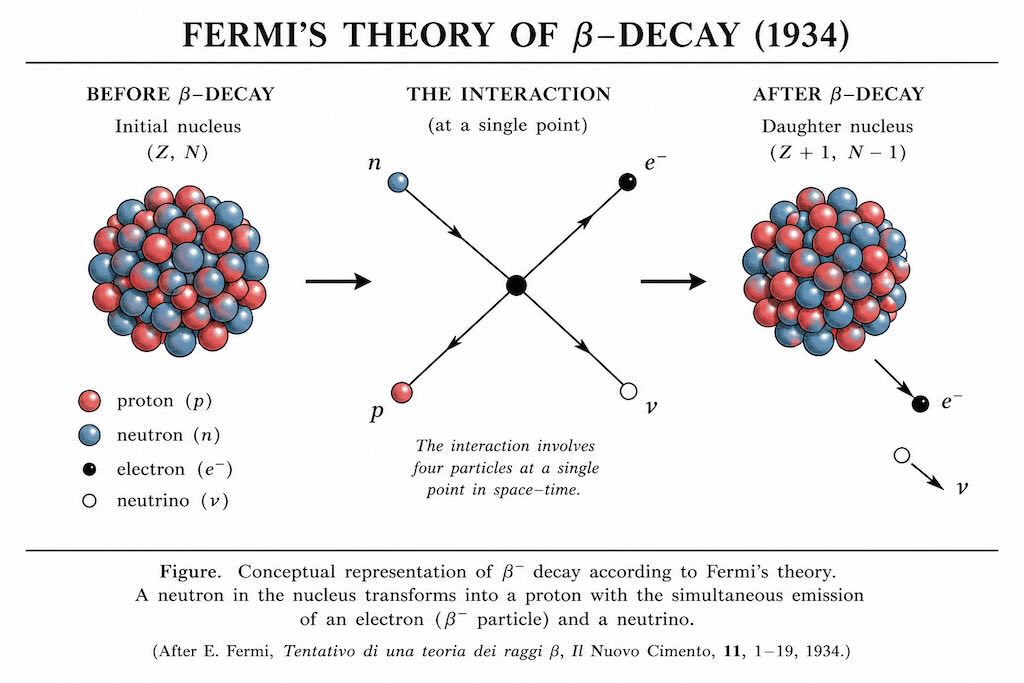
Perhaps even more remarkable was the simplicity of Fermi’s approach. Rather than proposing a complicated internal structure for the nucleus or introducing additional forces acting over finite distances, he assumed that the entire process occurred at a single point in space. Four particles, the neutron, proton, electron and neutrino, participated simultaneously in one elementary interaction. The probability that this interaction would occur could then be calculated using precisely the methods that had already proved so successful in describing atomic radiation.
Fermi himself openly acknowledged this analogy in his original paper. His theory was modelled deliberately upon Dirac’s treatment of the emission of electromagnetic radiation, replacing photon emission by the simultaneous creation of an electron and a neutrino. This was not merely a mathematical convenience. It represented the first successful application of quantum field methods to a nuclear process and introduced the revolutionary idea that elementary particles could be created and destroyed during fundamental interactions.
Looking back from the perspective of modern particle physics, it is easy to regard this idea as inevitable. At the time it was anything but obvious. The concept that particles need not exist before an interaction, but could instead be created during the interaction itself, fundamentally altered the way physicists viewed matter. Fermi’s theory therefore did much more than explain β-decay. It marked the transition from describing radioactive transformations phenomenologically to treating them as elementary quantum processes governed by universal physical laws.
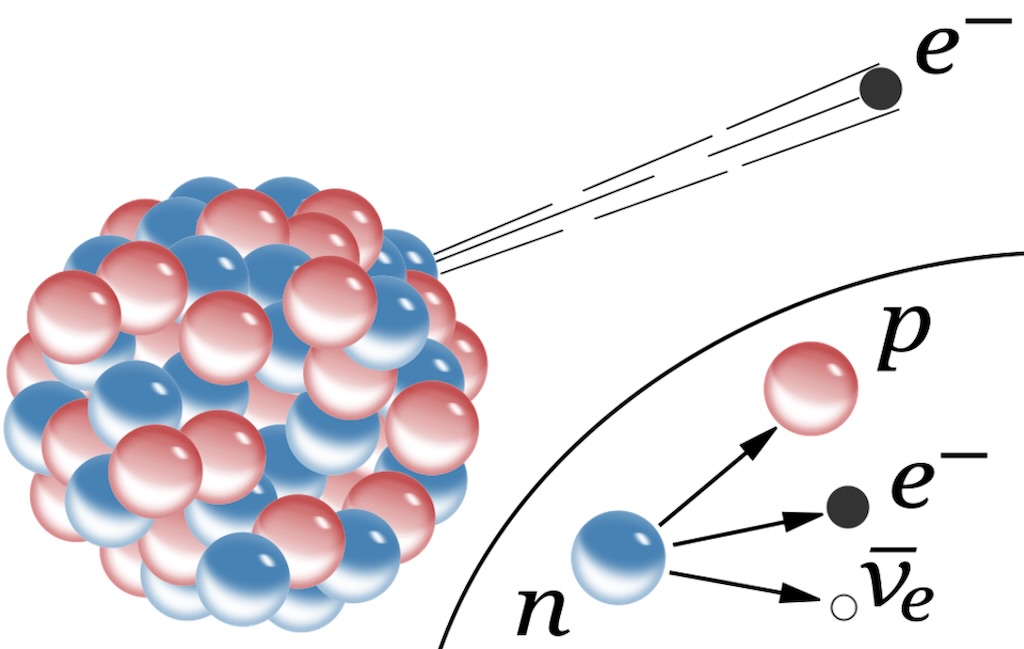
Above we have the graphic of β-decay as seen on Wikipedia, whereas below we have a graphic showing Fermi’s model.
The Wikipedia graphic, with its description, is actually a modern pedagogical representation of β⁻ decay, but is not a figure that Fermi himself would (or could) have drawn.
Below is exactly the physical process Fermi was proposing. Remembering that the neutron had only recently been discovered, the distinction between neutrino and antineutrino did not yet exist, the nucleus was not yet thought of in terms of quarks, and there was no W boson. Fermi imagine a neutron changing identity into a proton, while simultaneously an electron and neutrino simply appear. His theory was about the nucleus making a transition from one quantum state to another, and not a particular neutron changing. For Fermi, nothing travelled between the particles, nothing mediated the interaction, and everything happened at one point.
What is difficult to now appreciate is that until Fermi there was an idea that the electron was hiding inside the nucleus. He postulated that electron appeared as part of a decay at one point in space-time, with no mechanism, no intermediate object, just a probability that the four particles interact. This is why his theory became known as the four-fermion interaction. Only thirty years later did physicists realise that this point is actually a shorthand for the exchange of a massive W boson.
The mathematics of Fermi's theory
Fermi’s theory was not merely a verbal explanation of β-decay. Its importance lay in the fact that it gave a mathematical mechanism for the process and allowed measurable quantities, such as spectra and lifetimes, to be calculated. The central idea was to treat β-decay as a quantum transition caused by a small additional term in the energy of the system. This was the same general strategy already used in quantum mechanics to describe the emission of light by an excited atom. In the ordinary theory of radiation, an atom in an excited state can pass to a lower state by emitting a photon. Fermi now proposed that a nucleus could pass from one nuclear state to another by creating an electron and a neutrino.
The starting point was the Hamiltonian, the mathematical expression representing the total energy of the system. Fermi divided this into the energy of the heavy nuclear particle, the energy of the light particles, and a new interaction term. The heavy particle was the neutron-proton system. Following Heisenberg’s new nuclear theory, Fermi treated the neutron and proton as two possible states of the same heavy particle. One internal variable distinguished the two cases, in one state the particle behaved as a neutron, in the other as a proton. β-decay was then represented as a transition in which this heavy particle changed from the neutron state to the proton state.
The light particles were the electron and the neutrino. Fermi treated them using the method of second quantisation, meaning that the number of electrons and neutrinos was not fixed in advance. Electron and neutrino states could be empty or occupied, and the mathematical operators acting on those states could create or destroy particles. This was essential. In Fermi’s theory the emitted electron was not sitting inside the nucleus before decay. It was created during the transition. The same was true of the neutrino. This was one of the revolutionary features of the theory.
The new interaction term in the Hamiltonian had to do three things simultaneously. It had to convert a neutron state into a proton state, it had to create an electron, and it had to create a neutrino. Conversely, the same mathematical term also allowed the reverse process, in which a proton could be transformed into a neutron with the disappearance of an electron and a neutrino. This automatic inclusion of the reverse process was important because it made the theory symmetric at the level of the elementary interaction and ensured conservation of electric charge.
In modern terminology, Fermi’s interaction is described as a four-fermion interaction. Four fermions, the neutron, proton, electron and neutrino, participate simultaneously in a single point-like interaction. Fermi himself did not use this terminology, he described the process in terms of interacting quantum fields. Four fermions participated at the same point, i.e. the neutron, the proton, the electron and the neutrino. There was no intermediate particle carrying the interaction from one place to another. The interaction was assumed to occur directly at one point in space. This is why Fermi’s original theory is often described as a contact interaction. It was not yet a force mediated by a W boson, and it was not described in terms of quarks. Those ideas came much later. In 1934 the essential mathematical picture was simply that four particle fields met at one point, with a certain probability amplitude for the transition to occur.
Unlike the electric charge in electromagnetism, whose value was already known experimentally, the new coupling constant (g) had no previous physical interpretation. It represented an entirely new fundamental constant of nature associated exclusively with β-decay. This constant played a role similar to the electric charge in electromagnetic theory, but for β-decay. A larger value of (g) would mean a stronger interaction and therefore shorter lifetimes, and a smaller value would mean a weaker interaction and longer lifetimes. Fermi estimated its magnitude by comparing his formulae with observed β-decay lifetimes. The value he obtained showed immediately that the interaction responsible for β-decay was extremely weak compared with electromagnetic interactions. This weakness explained why β-decay could have half-lives ranging from fractions of a second to many years, while ordinary electromagnetic transitions are usually enormously faster.
To calculate the probability of β-decay, Fermi used time-dependent perturbation theory. The original nucleus was treated as an initial quantum state. The daughter nucleus, emitted electron and emitted neutrino formed possible final states. The new interaction term in the Hamiltonian provided the perturbation that connected the initial state to those final states. The probability of transition depended on the strength with which the interaction connected the initial and final quantum states. In modern quantum mechanics this quantity is represented by the square of the matrix element of the interaction Hamiltonian. If the nuclear wavefunctions overlapped strongly, the decay was relatively probable. If symmetry made the overlap vanish or nearly vanish, the transition was suppressed. This provided the basis for the selection rules governing β-decay and ultimately for the later classification of allowed and forbidden transitions.
The probability also depended on the number of possible final states available to the electron and neutrino. This is the phase-space factor. Even if the fundamental interaction strength were the same in two decays, the decay with more available final states would be more probable. In β-decay there is not just one final arrangement. For a given total decay energy, the electron can take one amount of energy and the neutrino another. The electron can also emerge in different directions and with different momenta, and the neutrino likewise. The total number of such possibilities determines the shape of the spectrum and the overall decay rate.
This is where the continuous β-spectrum emerges naturally. In a two-body decay, once the masses of the initial and final particles are fixed, conservation of energy and momentum determine a unique energy for the emitted particle. That is why α-particles from a given α-decay have a well-defined energy. But in β-decay there are three final products, the daughter nucleus, the electron and the neutrino. The daughter nucleus recoils only slightly because it is heavy, but the electron and neutrino can share the available energy in continuously varying proportions. Sometimes the electron takes almost all the available energy and the neutrino takes very little. Sometimes the neutrino carries away most of the energy and the electron emerges with much less. Most often the energy is divided somewhere between these extremes. The result is a continuous distribution of electron energies ending at a maximum value.
Fermi derived the mathematical form of this distribution. The number of emitted electrons with a given energy was proportional to two things. First, the probability amplitude for the nuclear transition, and second, the number of electron and neutrino states compatible with conservation of energy and momentum. Near the endpoint of the spectrum, where the electron has almost the maximum possible energy, the neutrino has very little energy left. The shape of this endpoint was especially important because it depended on the mass of the neutrino. Fermi showed that the observed spectra were consistent with a neutrino of zero mass, or at least one whose mass was negligible compared with that of the electron. This agreed with Francis Perrin’s almost contemporary conclusion.
Fermi showed that the probability of β-decay depends upon two independent factors. The first is the strength of the new interaction connecting the neutron, proton, electron and neutrino. The second is the number of final states available to the emitted electron and neutrino. The greater the number of ways in which the available energy can be shared, the greater the probability that the decay will occur. In modern notation these ideas are summarised by what later became known as Fermi’s Golden Rule, in which the transition probability is proportional to the square of the interaction strength multiplied by the density of accessible final states.
The formula expresses in compact form the central logic of the calculation. A decay is fast if the interaction connects the initial and final states strongly, and if there are many final states into which the system can decay.
Fermi did not present this result in the later textbook language of “Fermi’s Golden Rule”, but his β-decay calculation is a classic application of the same principle. He treated the β-interaction as a small perturbation, calculated the transition probability into a continuum of final electron and neutrino states, and obtained a decay rate proportional to the square of the interaction strength multiplied by a phase-space factor. This was precisely what was needed. The theory did not merely say that the neutrino carried away missing energy. It calculated how often the decay should occur, how the electron energies should be distributed, and why some β-transitions were much slower than others.
This mathematical structure was the decisive step. The continuous β-spectrum, which had once seemed to threaten energy conservation, became a direct consequence of ordinary quantum mechanics applied to a three-body final state. The long and variable lifetimes of β-emitting nuclei became evidence for a very weak interaction. The existence of allowed and forbidden transitions followed from the nuclear matrix element. The endpoint of the β-spectrum became a possible way of estimating the neutrino mass. In this way Fermi transformed β-decay from a collection of experimental puzzles into a quantitative theory.
In fact, perhaps the greatest success of the theory was that the same mathematical framework explained two apparently unrelated observations. It predicted both the continuous shape of the β-energy spectrum and the enormous range of observed radioactive lifetimes. These were no longer independent experimental facts but consequences of a single quantum-mechanical interaction.
What Fermi's theory explained
Fermi’s theory explained much more than the existence of the continuous β-spectrum. That spectrum had been the most visible puzzle, but it was only one part of a larger problem. Before Fermi, β-decay appeared to threaten several conservation laws at once. Energy seemed not to be conserved, momentum could not be balanced properly, angular momentum created difficulties, and the enormous range of radioactive lifetimes had no satisfactory theoretical explanation. Fermi’s achievement was to show that these were not separate mysteries. They were different aspects of one quantum process, a nuclear transition accompanied by the simultaneous creation of an electron and a neutrino.
The first and most famous success concerned the continuous β-spectrum itself. In α-decay the emitted α-particle usually emerges with a sharply defined energy because the decay is essentially a two-body process. Once the parent nucleus, daughter nucleus and emitted α-particle are specified, conservation of energy and momentum determine almost uniquely how the available energy is divided. β-decay was different. If only a daughter nucleus and an electron were emitted, the electron should also have had a fixed energy. Instead, experiments showed that β-electrons were emitted with every energy from very small values up to a definite maximum. This was the puzzle that had occupied physicists since Chadwick’s magnetic-spectrum measurements and had been made unavoidable by Ellis and Wooster’s calorimetric experiment.
Fermi’s theory made the continuous spectrum natural. The emitted electron was not alone. It was accompanied by a neutrino. The daughter nucleus was heavy and took only a small recoil energy, while the electron and neutrino shared almost all the available decay energy between them. In one decay the electron might carry away most of the energy and the neutrino very little. In another decay the neutrino might carry away most of the energy and the electron much less. Since there was a continuous range of possible ways to divide the energy and momentum between the two light particles, the electron spectrum was continuous. The endpoint of the spectrum corresponded to the special limiting case in which the neutrino carried almost no energy. Thus the continuous spectrum, which had once seemed to contradict conservation of energy, became one of the strongest arguments for the neutrino.
The conservation of energy was therefore restored without any weakening of the first law of thermodynamics. This was historically important because Niels Bohr had seriously considered the possibility that energy conservation might fail in nuclear processes. Fermi’s theory showed that such a radical step was unnecessary. The apparent missing energy was not destroyed; it was carried away by the neutrino. The reason it had seemed to disappear was simply that the neutrino interacted so weakly with matter that it escaped detection. This transformed the problem. Instead of asking why energy was not conserved in β-decay, physicists could ask how a nearly invisible particle could be detected experimentally.
Momentum conservation was restored at the same time. This point is sometimes less emphasised than energy conservation, but it was equally important. In a two-body decay the momenta of the daughter nucleus and emitted electron would have to be exactly related. The observed β-spectrum made that impossible. Once the neutrino was included, the final momentum could be shared among three bodies. The electron and neutrino could emerge in different directions with different momenta, while the daughter nucleus recoiled so that the total momentum remained conserved. Fermi’s theory therefore preserved not only the energy balance but the full mechanical consistency of the decay.
Angular momentum was also rescued. By the early 1930s spin had become an essential part of quantum mechanics. The proton, neutron and electron all had spin one-half, and Pauli had already argued that the missing particle in β-decay should also have spin one-half. Without such a particle, β-decay created severe difficulties for angular momentum conservation and for the statistics of nuclei. Fermi incorporated Pauli’s spin-one-half neutral particle directly into the theory. The emitted electron and neutrino together could carry the necessary angular momentum, while the nuclear state changed from its initial angular momentum to the final value allowed by the transition. This did not yet give the complete later theory of β-selection rules, but it provided the essential framework in which angular momentum conservation could be maintained.
Fermi’s theory also explained why β-decay is slow compared with ordinary atomic processes. Electromagnetic transitions in atoms are usually extremely rapid. β-decay, by contrast, could have half-lives ranging from fractions of a second to many years. Fermi accounted for this by introducing a new coupling constant measuring the strength of the β-interaction. When he compared his formulae with observed radioactive lifetimes, he found that this new interaction had to be extraordinarily weak compared with electromagnetism. The slowness of β-decay was therefore not accidental. It was evidence for a new and very weak fundamental interaction.
The same theory also explained why different β-emitting nuclei decay at such different rates. The decay rate depends not only on the strength of the fundamental interaction but also on the available decay energy and on the nuclear transition itself. A decay with a large energy release has many more possible final electron-neutrino states than a decay with a small energy release, and is therefore favoured by phase space. But even when the energy release is favourable, the transition can still be slow if the initial and final nuclear states are poorly connected by the interaction. In modern language, the decay probability depends both on phase space and on the nuclear transition matrix element. Fermi did not use all the later terminology, but the physical distinction was already present in his calculation.
This led naturally to the idea of comparing β-decays after removing the purely kinematic effect of the available decay energy. A measured half-life by itself is not enough to characterise a β-transition, because a nucleus with a large endpoint energy has more ways to decay than one with a small endpoint energy. The phase-space factor, usually denoted by (f), corrects for this difference. Multiplying it by the partial half-life (t) gives the comparative half-life, or (ft) value. This quantity became one of the most important tools in β-decay systematics, because it allowed different nuclei to be compared on a common scale. Transitions with similar (ft) values could be recognised as belonging to the same physical class, while unusually large (ft) values indicated transitions suppressed by angular momentum or parity constraints.
The comparative half-life concept is important historically because it shows how Fermi’s theory became an experimental tool rather than merely an explanation of one phenomenon. Once β-decays could be corrected for their available phase space, the remaining differences reflected the structure of the nuclear transition itself. This made it possible to distinguish relatively favoured transitions from inhibited ones and to test the selection rules of β-decay. The later work of George Gamow (1904-1968) and Edward Teller (1908-2003) extended this analysis by showing that Fermi’s original form of the interaction did not exhaust all possible β-transitions. Their 1936 theory introduced what are now called Gamow-Teller transitions, in which spin changes play a central role. But this later development built directly upon Fermi’s framework.
The achievement of Fermi’s theory was therefore not merely that it rescued energy conservation. It unified several facts that had previously appeared disconnected. It explained the continuous electron spectrum, restored conservation of energy and momentum, incorporated angular momentum through the spin-one-half neutrino, gave a method for calculating lifetimes, and provided the basis for comparing different β-decays through the phase-space corrected half-life. In doing so it transformed β-decay from a set of experimental anomalies into a quantitative branch of nuclear physics. Pauli had supplied the missing particle, but Fermi supplied the theory that made the particle indispensable.
Fermi studies the neutron
In Rome, Enrico Fermi decided to use the newly discovered neutron, rather than α-particles, to produce new radioactive elements. According to Emilio Segrè, Fermi “immediately saw that their work could be expanded tremendously by using neutrons as projectiles”. This was technically more challenging because, unlike α-particles emitted naturally by radioactive sources, free neutrons had first to be produced. And the available neutron intensities (about one hundred thousand times weaker than those of α-particles) made still doubtful the efficacy of those particles in inducing radioactivity. However, because neutrons are electrically neutral, they are unaffected by the Coulomb repulsion that prevents α-particles and protons from approaching a nucleus. They can therefore penetrate the nucleus much more readily, making them exceptionally effective projectiles for inducing artificial radioactivity. So what counts is the α-particles are rapidly adsorbed whereas, for neutrons, the true experimental limitation is due to the number of electrons, emitted in β-decay, able to come out of the irradiated sample and reach the detector. So the weak neutron intensity of the sources is partly counterbalanced.
Fermi and his group (Segré, Amaldi, Rasetti…) were able to obtain more than 20 new radioactive isotopes by this method (E. Fermi, Radioactivity induced by neutron bombardment, Nature 133 (1934) 757), known today as the powerful and very general method of neutron activation analysis.
Irène and Frédéric Joliot-Curie confirmed Fermi’s results for Ag, Si, Zn, I, Fe, and the decay periods agreed with those obtained by Fermi (I. Curie, F. Joliot, P. Preiswerk, Radioéléments créés par bombardement de neutrons. Nouveau type de radioactivité, C. r. hebd. séances Acad. sci. Paris 199 (1934) 2089).
In addition, other artificial transmutations of different types were promptly discovered. Some are produced by α-rays, by γ-rays, others by protons or deuterons, others by neutrons. The particles expelled when the nucleus disintegrates are protons, α-rays, or neutrons. Within a short period, a small family of a few dozens of radioactive elements found important applications as “tracers” in physics, chemistry, and biology. Also in medicine, radioactive tracers can be delivered to a particular place in the human body and help treating diseases. This technique had already been developed with natural radioactive elements as early as 1913 by Georg von Hevesy (1885-1966), who obtained the Nobel Prize for chemistry for that achievement in 1943. The discovery of new heavier elements, neutron-rich isotopes and proton-rich isotopes continues nowadays. Today, the heaviest element is oganesson, with the atomic number 118, named after Yuri Oganessian, from Dubna.
While studying the neutron-induced nuclear reactions, Fermi’s group made another important discovery. In the experiments on radioactivity induced on silver (Ag) by neutrons, a piece of paraffin a few centimetres thick was interposed between the source and the Ag sample. While the effect was expected to decrease if the neutron energy does not change, it increased (E. Fermi, E. Amaldi, B. Pontecorvo, F. Rasetti, E. Segré, Azione di sostanze idrogenate sulla radioattività da neutroni, Ric. Sci. II (7–8) (1934) 15).
As a little side-story, it is said that Amaldi and Bruno Pontecorvo (1913-1993) encountered an incomprehensible variability in their experimental results. It became apparent that the activation depended on the condition of irradiation. In particular there were certain wooden tables which had miraculous properties. As Pontecorvo noticed accidentally, silver irradiated on those tables gained more activity than when it was irradiated on the usual marble table. In order to clarify the situation, they started a systematic investigation.
In fact the plan was to analyse the effect of shielding of lead on the neutrons. However, Fermi hesitated for a long time in using some lead to filter the neutrons and, finally, he preferred to use paraffin, “with no conscious, prior, reasoning”. In this way he discovered that the radioactivity induced by neutrons in the silver sample increases, by the very use of paraffin. Amaldi recalls that the increase of the reaction cross section by reducing the velocity of the neutrons was at that time still contrary to expectations. Segré stated that they thought that the more energetic the neutrons the greater their effectiveness in producing reactions.
At the time there was a diffused idea about the weakening effects of charged particles when they slowed down. Amaldi, preferred to stress the importance of systematic experimentation. The article that Fermi and collaborators wrote the day of the discovery “that anomalies in the intensity of activation have been noticed, and a piece of paraffin some centimetres thick, interposed between the source and silver, makes the activation increase instead of reducing it”.
The conclusion was that slow neutrons have a stronger effect than fast neutrons. In particular, the cross-section of neutron absorption in nuclei largely increases when neutron velocity decreases. On the other hand, the coherent scattering of slow neutrons would result in an effective potential for neutrons traveling through matter (E. Fermi, Sul moto dei neutroni nelle sostanze idrogenate, Ric. Sci. 7 (2) (1936) 13), which appeared to be of major importance for applications of neutrons in research. Slow neutrons turned out to be important in another phenomenon called fission.
But that’s another story…
Annex - The first controlled nuclear chain reaction (1942)
Rather than develop an extensive history as see above on Fermi’s theory of β-decay, I offer a text describing Fermi’s work on
The Manhattan Project, and the World’s First Self-Sustaining Chain Reaction