“A Universe from Nothing” by Lawrence M. Krauss was one of the recommended readings for the 2026 Oxford University Summer School on the subject “Understanding Space and Time”.
It certain helps that this book has its own entry in Wikipedia, as does its author. We immediately learn that the book discusses modern cosmogony and its implications for the debate about the existence of God.
I will admit that when I first read the book, I was not especially impressed. At times I found it unnecessarily self-congratulatory, with rather too many references to “I” and “me”. Some reviewers described the book as being written “soberly and with grace”, while others praised it as “a spirited, fast-paced romp through modern cosmology”. My own reaction was different. I was often left more confused than enlightened.
Several critical reviewers argued that Krauss fails to address why the laws of physics themselves exist, while others suggested that he misuses the term “nothing”. My reservations were more straightforward, I simply felt that the book did not always explain its ideas in sufficiently clear and accessible language. At times it seemed to obscure concepts that could have been presented more directly.
On rereading the book, I decided to approach it differently and create this review in the form of personal revision notes. My aim has been to identify the key ideas and supplement them with videos that help explain many of the scientific concepts discussed by Krauss. Finding material at exactly the right level is not always easy. Some videos inevitably oversimplify the subject, while others assume a much higher level of prior knowledge, but I have tried to sequence them so that together they tell a coherent story.
I have also attempted to make each chapter summary reasonably self-contained, even at the cost of a small amount of repetition where necessary. This means that occasionally the same basic data might be represented in a slightly different format. In trying to do this I found the same idea appearing in several places in the book, making it difficult to see clearly a timeline on how results and interpretations evolved. Repetition maybe useful, but I felt that overall it made the “story” more complicated to understand.
My main interest here is to understand the foundations of cosmology rather than engaging in philosophical or theological debates about the existence of God. Readers looking for detailed discussions of religion versus science may therefore find that my review places greater emphasis on the underlying physics and cosmological ideas.
To clarify an important distinction that appears throughout the book:
- Cosmology studies the structure, nature, and evolution of the universe.
- Cosmogony focuses specifically on the origin or creation of the universe.
Preface
After briefly acknowledging the familiar question, “Who created the laws of physics?”, Krauss moves quickly to what is, in my view, the more productive scientific position, “the universe is the way it is, whether we like it or not“.
From there the discussion expands into deeper cosmological questions. Is the universe spatially infinite? Is it temporally infinite? Did it have a beginning? And perhaps most fundamentally of all – why is there something rather than nothing?
This final question lies at the heart of the book. Krauss attempts to show how modern science is approaching the problem of why anything exists at all. More controversially, he argues that under certain physical conditions it may be possible for “something” to emerge from “nothing”, and that aspects of modern cosmology suggest this may plausibly resemble the origin of our own universe.
“Plausible” is an important word here. The argument is not that such ideas have been proven beyond all doubt, but rather that contemporary physics no longer regards them as inherently impossible.
Much of the debate therefore depends on what is actually meant by the word nothing. Some philosophers define nothingness as complete nonbeing. Krauss, however, tends to use the term in a more physical sense, simply the absence of matter, particles, or classical structure. But even this immediately raises further questions.
- Is “nothing” simply empty space?
- Is it a quantum vacuum?
- Is it the absence of space and time themselves?
Or should “nothing” instead be understood in theological terms as the state preceding divine creation?
Krauss is explicit about his broader position. He argues that, when it comes to understanding how the universe evolves, religion and theology have historically contributed little to the development of predictive scientific models. Science, by contrast, proceeds by following evidence, testing ideas against observation and experiment, and rejecting explanations that fail those tests. In that sense, experiment becomes the ultimate arbiter of what we provisionally accept as true.
That methodological approach also underpins my own interest in this subject.
Above is a long 2009 lecture centred on the title idea behind A Universe from Nothing. In many ways, the lecture serves as an accessible companion to the book itself.
That said, I occasionally find Krauss both smug and prone to unnecessary snide remarks concerning religious interpretations of creation. Neither trait is particularly attractive in a teacher. Scientific arguments are strongest when they remain evidence-based, and intellectually disciplined.
For clarity, I should state that I am myself a passive non-believer in deities and broadly supportive of scientific pragmatism and critical thinking. Nevertheless, I still prefer scientific communication to avoid rhetorical dismissiveness whenever possible.
Even so, I found many of Krauss’s lectures highly effective in explaining how physicists approach difficult conceptual problems.
A Tour of The Universe | Lectures on Physics & Reality
The Gestalt of Physics | Magic Tools of Approximation and Dimensional Analysis
Before starting the book itself, the below introductory video is also useful because it provides a practical and intuitive introduction to Einstein’s theory of general relativity.
Chapter 1 - Beginnings
Chapter 1 introduces the key scientific principles and concepts for the book’s central question: How can a universe arise from “nothing”?
Firstly, the Universe is dynamic, not static, and is expanding. This comes from observations by Edwin Hubble showing that distant galaxies are moving away from us, implying the universe was denser and hotter in the past. That lead naturally to the idea of the Big Bang. Key implications are that the universe had a physical history, and that space itself expands.
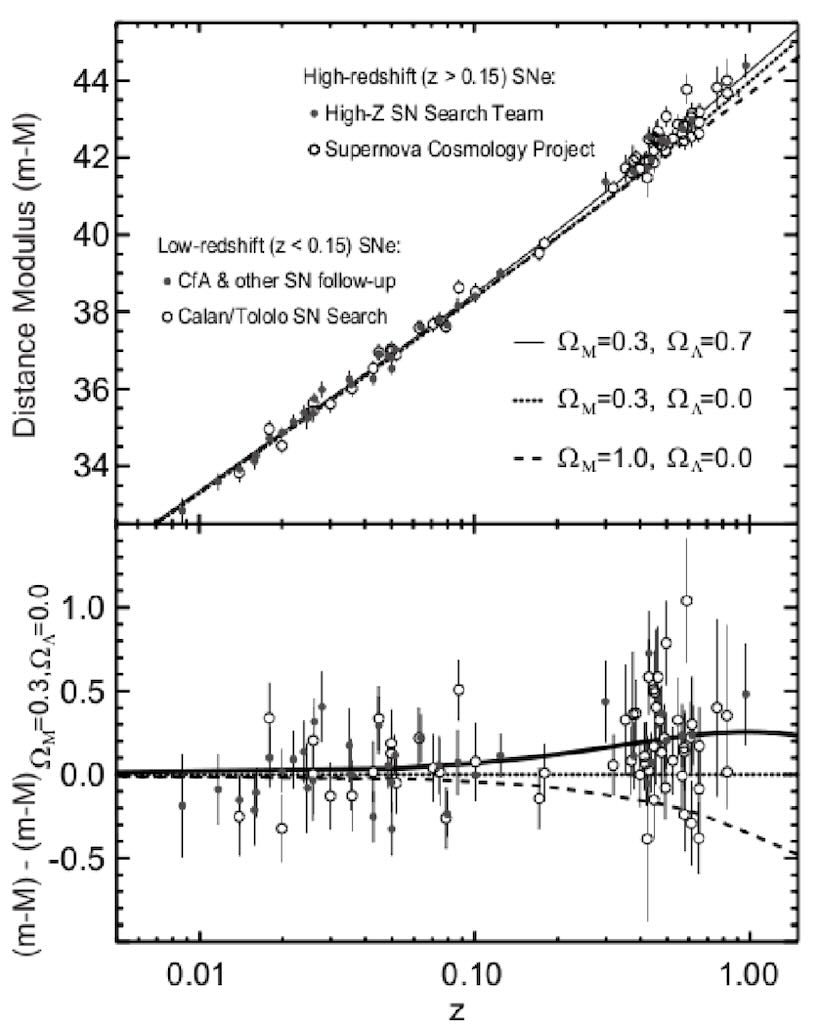
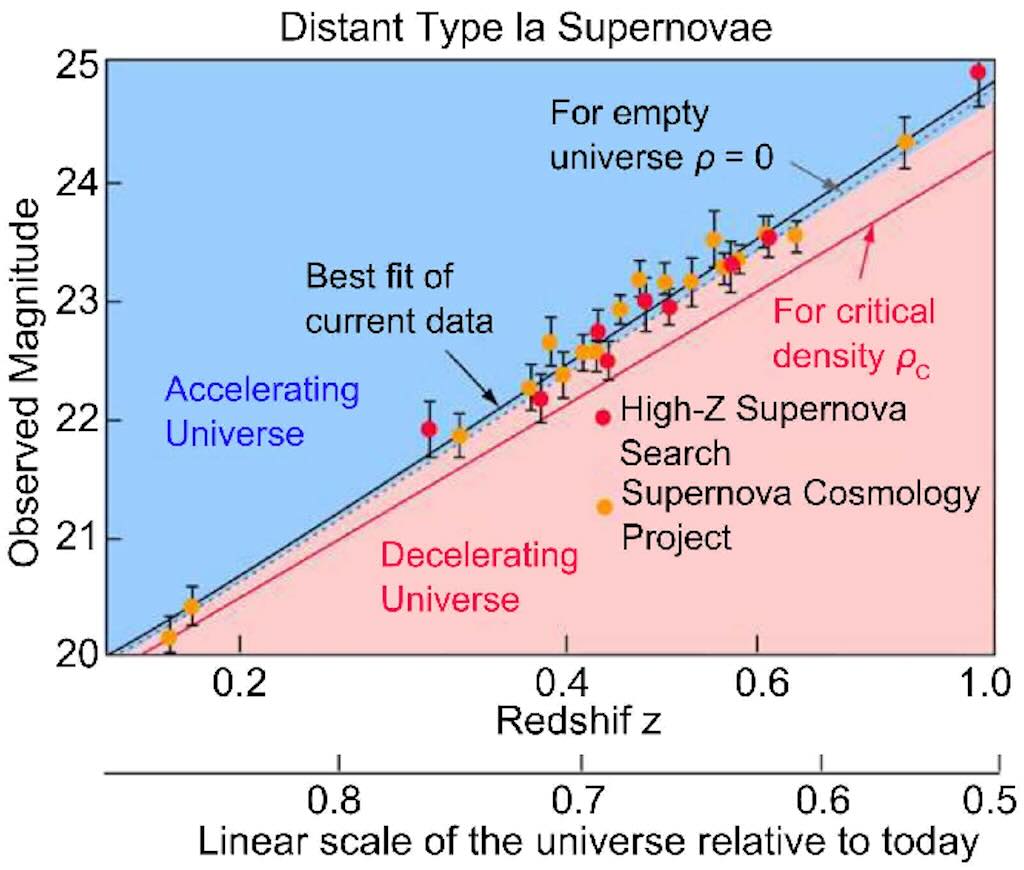
The cosmic acceleration was established empirically at the end of the 1990s when two independent teams, the Supernova Cosmology Project (website) and the High-z Supernova Search Team (website), succeeded in their attempt to measure the supernova Hubble diagram up to relatively high redshifts (z~1). Surprisingly, both teams found that the distant supernovae are ~0.25 mag dimmer that they would be in a decelerating universe, indicating that the cosmic expansion has been accelerating over the past ~7 Gyr.
In the upper panel there is the Hubble diagram of type Ia supernovae measured by the Supernova Cosmology Project and the High-Z Supernova Team. In the lower panel we have the residuals in distance modulus relative to an open Universe.
Secondly, gravity is not just a force between objects. According to Albert Einstein, mass and energy curve spacetime itself. The important conceptual point is that:-
- Matter tells spacetime how to curve
- Curved spacetime tells matter how to move.
This framework replaced Newtonian gravity and enabled modern cosmology.
Above is a simulation of curved spacetime due to massive objects. According to General Relativity, the gravitational effect between masses results from their warping of this spacetime. You can see the distortion of spacetime caused by different types of objects.
Thirdly, the Universe can have zero total energy. One of the book’s most famous ideas appears early, positive energy from matter may be balanced by negative gravitational energy. Krauss uses this to argue that creating a universe may not require violating conservation of energy.
This is one of the key stepping stones toward the “universe from nothing” argument.
Fourth, the chapter introduces the idea that “empty space” is not truly empty. According to Quantum Mechanics, quantum fields fluctuate, so particles can briefly appear and disappear, and even vacuum states contain energy. Krauss emphasises that nothing (empty space) has structure and physical laws.
Below we have a quantum vacuum fluctuation illustration showing virtual particle pairs emerging and annihilating.
Last, but not least, today cosmology is evidence-driven because it’s based upon observations, namely.-
Chapter 2 - Weighing the Universe
This chapter focuses on one of the central achievements of modern cosmology: determining the mass/energy of the universe and understanding how gravity governs cosmic evolution.
Krauss gradually leads the reader toward a striking conclusion, that the visible universe is only a tiny fragment of a much larger and stranger cosmic reality, i.e. most of the universe is invisible.
By the beginning of the twenty-first century, astronomers had concluded that the observable universe (containing all ordinary matter such as stars, planets, gas clouds, dust, and galaxies combined) accounts for only about 5% of the total mass–energy content of the universe.
The remainder appears to consist of:
- roughly 27% dark matter, an invisible form of matter detected through its gravitational effects,
- and approximately 68% dark energy, a mysterious property of space associated with the accelerating expansion of the universe.
These conclusions did not emerge from speculation, but came from decades of measurements involving galaxy motion, supernova explosions, and detailed observations of the cosmic microwave background radiation left over from the early universe.
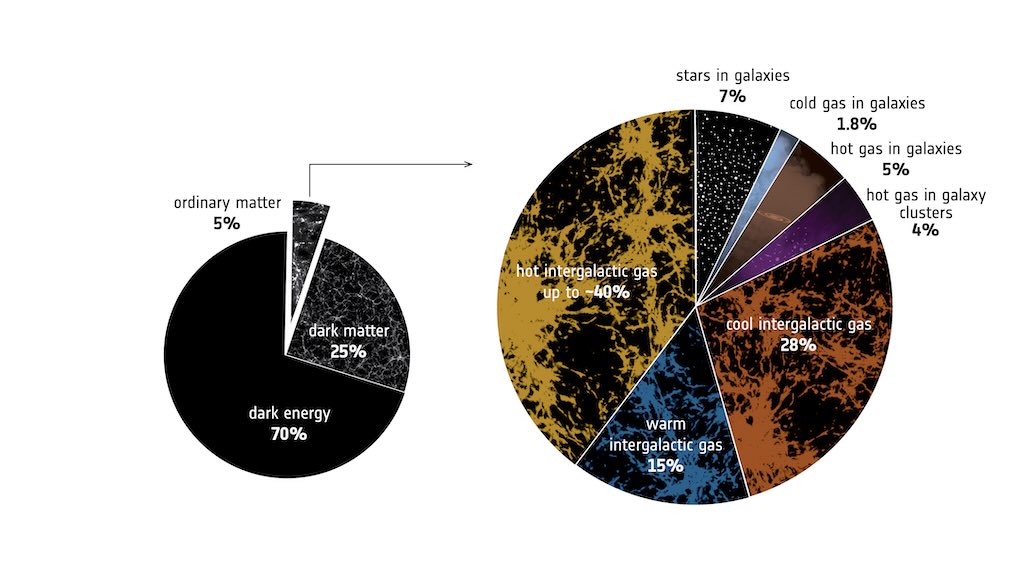
One of the most important discoveries discussed by Krauss is that galaxies rotate far too quickly to be held together by visible matter alone.
In a typical spiral galaxy such as the Milky Way, stars near the outer edge orbit the galactic centre at roughly 220 kilometres per second, even at distances of more than 50,000 light-years from the centre. According to the amount of visible matter present, those stars should move much more slowly. Instead, observations show that galaxies are embedded inside enormous halos of invisible matter extending far beyond the visible disk.
Modern estimates suggest that the Milky Way contains more than one trillion times the mass of the Sun, but most of that mass is dark matter rather than stars or gas.
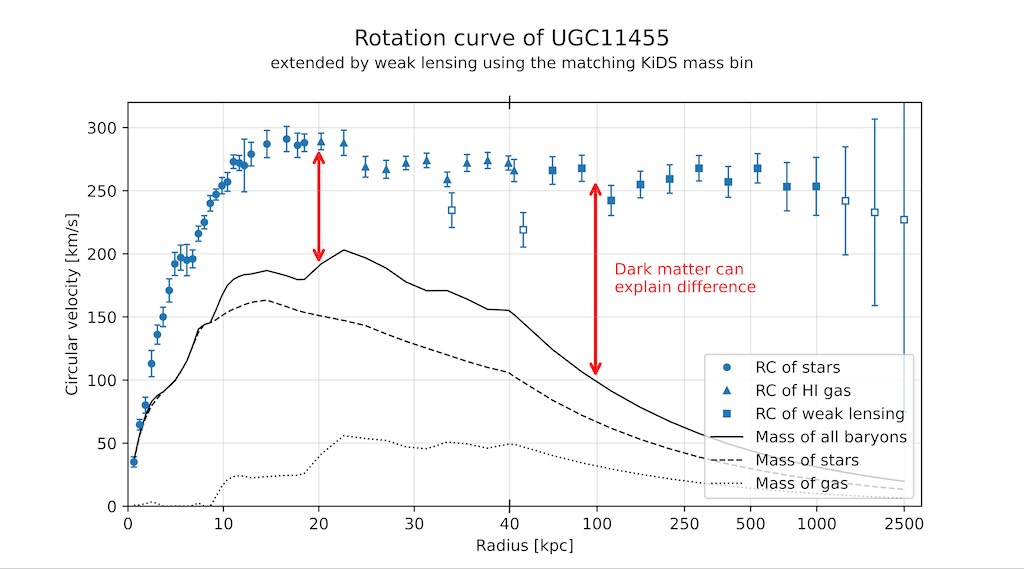
The observed rotation is shown as datapoints. The expected rotation from normal matter is shown using lines. The difference can be explained by the presence of dark matter.
Krauss also emphasises the scale of the observable universe to demonstrate how small human intuition becomes in cosmology. Light travels at nearly 300,000 kilometres per second, yet even at that speed it takes more than 8 minutes to reach Earth from the Sun. The nearest star system beyond the Sun, Proxima Centauri, is over 4 light-years away. Our galaxy alone contains between 100 and 400 billion stars and stretches about 100,000 light-years across. Beyond it lie hundreds of billions of other galaxies spread across an observable universe approximately 93 billion light-years in diameter. The immense scale of the cosmos means that gravity, acting over billions of years, becomes the dominant force shaping large-scale structure.
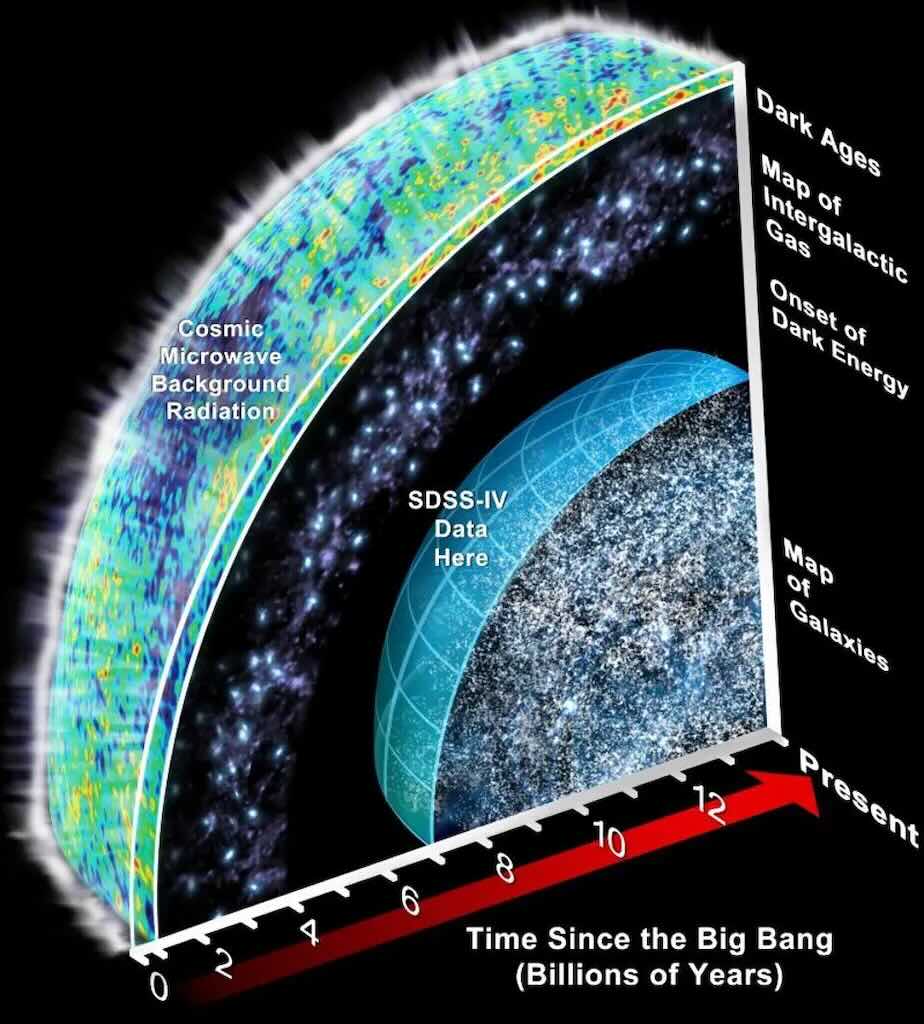
From objects within our Solar System to stars within our galaxy to distant galaxies as far as our telescopes can see, space is populated with objects at a specific location in space that emit light. We can only observe the light that is arriving right now, after journeying through the expanding Universe. However, the leftover light from the Big Bang, the cosmic microwave background radiation, was emitted from all locations at a specific moment in time. With each passing moment, light from a slightly more distant location than the previous moment arrives.
This graphic is taken from an excellent Big Think article Logarithmic View of the Universe.
Uchuu (meaning “Outer Space” in Japanese) is the largest and most realistic simulation of the Universe to date. The Uchuu simulation consists of 2.1 trillion particles in a computational cube an unprecedented 9.63 billion light-years to a side. For comparison, that’s about three-quarters the distance between Earth and the most distant observed galaxies. Uchuu focuses on the large-scale structure of the Universe: mysterious halos of dark matter which control not only the formation of galaxies, but also the fate of the entire Universe itself. The scale of these structures ranges from the largest galaxy clusters down to the smallest galaxies (individual stars and planets aren’t resolved).
Shortly after the Big Bang, the universe was extraordinarily smooth, but not perfectly uniform. Tiny density variations, differences smaller than one part in 100,000, were later detected in the cosmic microwave background by missions such as NASA WMAP Mission, and ESA Planck Mission.
Over approximately 13.8 billion years, gravity amplified those minute irregularities into galaxies, galaxy clusters, and enormous cosmic filaments stretching hundreds of millions of light-years across.
Every galaxy visible today ultimately formed because gravity slowly concentrated matter into regions that were initially only slightly denser than their surroundings.
Krauss uses observational evidence to show how scientists inferred the existence of invisible matter long before they understood its nature.
In the 1930s, Fritz Zwicky studied the Coma Cluster, located more than 300 million light-years away. He found that galaxies inside the cluster were moving so rapidly that the cluster should have flown apart unless it contained far more mass than astronomers could see.
Decades later, Vera Rubin measured the rotation of spiral galaxies and confirmed the same discrepancy on galactic scales. These observations established that invisible matter dominates the gravitational structure of the universe.
The chapter also explores how empty space itself possesses measurable physical properties. Quantum physics predicts that even a perfect vacuum is filled with fluctuating fields and transient particle activity.
Although these quantum fluctuations occur on subatomic scales, their effects can influence the universe on the largest scales imaginable. Modern observations indicate that space itself contains vacuum energy strong enough to accelerate cosmic expansion.
In 1998, two independent teams studying distant Type Ia supernovae discovered that galaxies are not merely moving apart, but that the expansion rate of the universe is increasing over time. Some of those exploding stars were billions of light-years away, meaning astronomers were effectively looking billions of years into the past while reconstructing cosmic history.
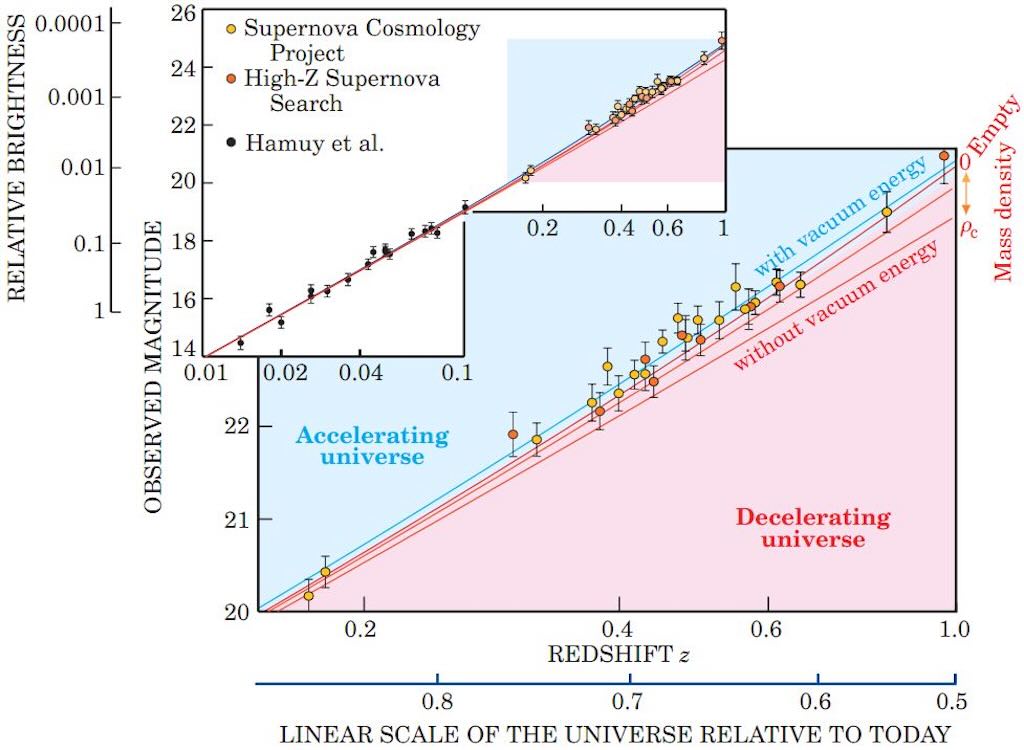
Observed magnitude versus redshift is plotted for well-measured distant and (in the inset) nearby type Ia supernovae. For clarity, measurements at the same redshift are combined. At redshifts beyond z = 0.1 (distances greater than about 109 light-years), the cosmological predictions (indicated by the curves) begin to diverge, depending on the assumed cosmic densities of mass and vacuum energy. The red curves represent models with zero vacuum energy and mass densities ranging from the critical density down to zero (an empty cosmos). The best fit (blue line) assumes ⅓ the mass density plus a vacuum energy density twice as large, implying an accelerating cosmic expansion.
Krauss ultimately wants readers to understand that modern cosmology is not philosophical storytelling but a quantitative science built from measurement. Astronomers can estimate the age of the universe to about 13.8 billion years, measure the temperature of the cosmic microwave background to approximately 2.7 degrees above absolute zero, and determine the composition of the cosmos with remarkable precision.
The deeper lesson of the chapter is that observation repeatedly forced humanity to abandon intuitive ideas about reality. The universe turned out to be vastly larger, older, darker, and more physically dynamic than anyone imagined a century ago.
Chapter 3 - Light from the Beginning of Time
For most of the universe’s history, light has traveled freely across space, carrying information from distant stars and galaxies toward Earth. However, during the first several hundred thousand years after the Big Bang, the universe was so hot and dense that light could not move freely.
Temperatures exceeded several thousand degrees Celsius, and matter existed as an ionised plasma of electrons and atomic nuclei. In this state, photons scattered continuously off free electrons, making the universe opaque in much the same way that light struggles to pass through the interior of the Sun.
Modern cosmology estimates that this opaque phase lasted for approximately 380,000 years after the beginning of cosmic expansion.
As the universe expanded, it cooled. Eventually temperatures fell to roughly 3,000 kelvin, low enough for electrons to combine with protons and form stable hydrogen atoms.
This event, known as recombination, dramatically reduced photon scattering and allowed light to travel freely through space for the first time. The radiation released during that era still exists today and fills the entire universe.
Because cosmic expansion stretched its wavelength over billions of years, this ancient light no longer appears visible to the human eye. It now exists primarily as microwave radiation with a temperature of about 2.725 kelvin above absolute zero.
The existence of this relic radiation was confirmed accidentally in 1965 by Arno Penzias and Robert Woodrow Wilson at Bell Labs. Using a microwave antenna originally designed for satellite communication experiments, they detected a faint background signal arriving uniformly from every direction in space.
The radiation persisted regardless of where the telescope pointed and could not be eliminated by accounting for instrumental noise, atmospheric effects, or even pigeon contamination inside the antenna. The signal matched theoretical predictions that the early universe should have left behind residual thermal radiation. Their discovery became one of the strongest observational confirmations of Big Bang cosmology.
The cosmic microwave background provides a direct observational window into the early universe. The light detected today began its journey nearly 13.8 billion years ago, long before galaxies, stars, or planets existed.
Modern satellites such as NASA COBE Mission, NASA WMAP Mission, and ESA Planck Mission mapped this radiation with extraordinary precision. Measurements revealed tiny temperature variations of roughly one part in 100,000 across the sky.
These fluctuations represent minute density differences present in the young universe and are believed to be the seeds from which galaxies and galaxy clusters later formed through gravitational attraction.
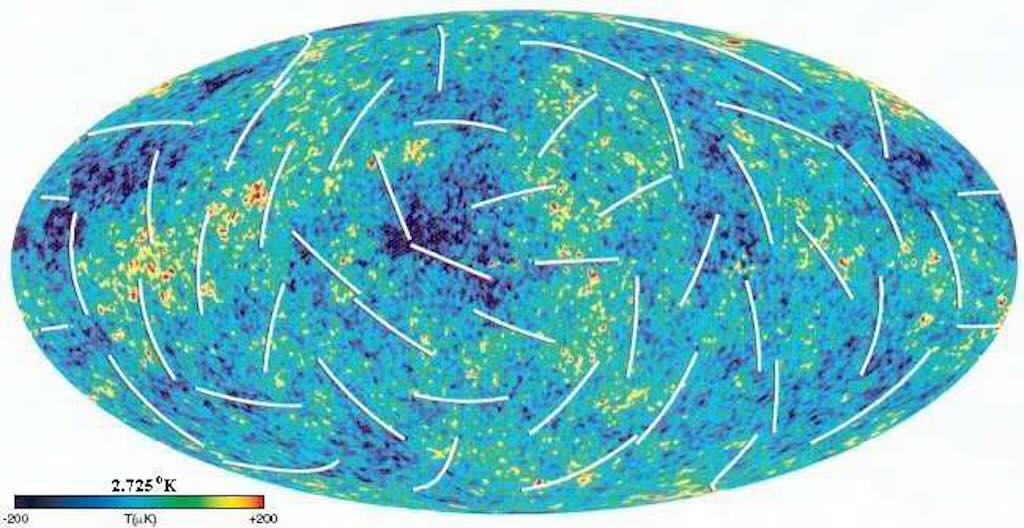
Above is the full-sky map of the cosmic microwave background radiation (CMB), as observed by the Wilkinson Microwave Anisotropy Probe (WMAP). It reveals subtle temperature differences marked by “warmer” (red) and “cooler” (blue) spots. These temperature fluctuations are indicative of a universal spin, potentially induced by cosmic textures-relics from the Big Bang. These textures, remnants of phase transitions in the early universe, might influence the observed spin through mechanisms analogous to the Coriolis effect in fluid dynamics. This effect, while traditionally associated with rotating fluid bodies on Earth, may similarly manifest at cosmic scales, influencing the spin and distribution of all particles, including gravitons, across the universe. Such a universal spin, shaped by the Coriolis-like dynamics, could be fundamental in understanding the chiral and fractal structure of spacetime, as it contributes to the clustering of vortices and the overall architecture of matter.
The chapter also emphasizes the enormous scale and uniformity of the observable universe. The cosmic microwave background appears remarkably isotropic, meaning its temperature is nearly identical in every direction. This observation implies that the early universe was extraordinarily smooth on large scales.
Yet the tiny irregularities detected in the radiation were critically important. Regions slightly denser than average exerted stronger gravitational attraction, gradually accumulating matter over billions of years.
Simulations of cosmic evolution show that these small primordial fluctuations eventually produced the vast filamentary structure of galaxies observed today, including galaxy clusters spanning millions of light-years.
One of the most significant scientific achievements connected to this radiation is the ability to measure the composition and geometry of the universe with high precision.
By analysing patterns in the microwave background, cosmologists determined that ordinary atomic matter constitutes only a small fraction of the cosmos. The data also support a universe that is geometrically very close to flat on large scales.
Combined with observations of distant supernovae and galaxy distributions, the cosmic microwave background became central evidence for the modern cosmological model describing a universe dominated by dark matter and dark energy.
Chapter 4 - Much Ado About Nothing
A more precise chapter title might be “The Physics of Empty Space”, because the chapter is fundamentally about how modern quantum physics transformed the scientific meaning of “nothing”. The actual scientific content is not about philosophical nothingness, but about the measurable physical properties of vacuum states, quantum fluctuations, and field energy in spacetime.
In this chapter, the central scientific idea is that empty space is not physically empty.
According to modern quantum field theory, every region of space is permeated by quantum fields associated with fundamental particles. Even when no particles are present, these fields still exist and possess residual energy.
The vacuum therefore becomes a physical system with measurable effects rather than a passive void. This was one of the major conceptual revolutions of twentieth-century physics, replacing the older classical idea that empty space was simply the absence of matter.
One of the key experimental foundations behind this idea is the Casimir Effect.
In 1948, Dutch physicist Hendrik Casimir predicted that two uncharged metal plates placed extremely close together in a vacuum would experience a small attractive force.
The effect occurs because quantum fluctuations are restricted differently between the plates than outside them, producing a measurable pressure imbalance.
Modern laboratory experiments confirmed this prediction with high precision at separations smaller than a micrometer.
The importance of the Casimir Effect is profound because it demonstrates that vacuum fluctuations are physically real rather than merely mathematical artifacts.
The chapter also explores how quantum mechanics differs fundamentally from classical physics.
In classical physics, a system can in principle possess exactly zero energy if completely motionless. Quantum mechanics forbids this.
Because of the uncertainty principle, particles and fields always retain a minimum residual energy, often called zero-point energy.
As a result, even apparently empty space contains fluctuating electromagnetic activity and transient quantum behaviour.
These fluctuations occur continuously throughout the universe on extremely small spatial and temporal scales.
Although individual fluctuations are microscopic, their cumulative effects may influence the evolution of the entire universe.
Krauss then connects these ideas directly to cosmology through the concept of vacuum energy.
Modern observations indicate that space itself possesses energy independent of matter or radiation. This conclusion emerged most dramatically from measurements of distant Type Ia supernovae during the late 1990s.
Two independent international research teams found that extremely distant galaxies appeared dimmer than expected, implying that cosmic expansion has been accelerating for several billion years rather than slowing under gravity alone.
The simplest interpretation is that empty space itself contains a persistent energy density now known as dark energy.
Current cosmological measurements suggest that dark energy contributes roughly 68% of the total mass–energy content of the universe.
Unlike ordinary matter, its density does not significantly dilute as space expands. This produces a long-term repulsive effect on cosmic scales, causing galaxy clusters to separate increasingly rapidly over time.
The acceleration is extremely weak locally but dominates over distances of hundreds of millions of light-years. On human scales the effect is undetectable, but across the observable universe it determines the large-scale future of cosmic evolution (see below the accelerated expansion of the Universe).
The chapter also discusses one of the greatest unsolved problems in theoretical physics, i.e. the enormous discrepancy between predicted vacuum energy and observed dark energy density.
Calculations from quantum field theory suggest that vacuum energy should be vastly larger than what astronomers actually measure, by factors sometimes estimated near 10120.
This mismatch is often described as the worst theoretical prediction in the history of physics.
Although quantum fluctuations are experimentally established, physicists still do not understand why the observable vacuum energy of the universe is so small compared with naive theoretical expectations.
Observational cosmology nevertheless provides strong evidence that vacuum energy is real. Measurements from the ESA Planck Mission, studies of galaxy clustering, and supernova observations all support a universe whose expansion is currently accelerating.
Combined with the cosmic microwave background, these measurements allow cosmologists to estimate the age of the universe at approximately 13.8 billion years and show that ordinary atomic matter forms only a minor component of cosmic reality.
Check out the 28 videos from the “Planck” Mission.
This chapter might be the most important in the book, because modern physics has transformed the vacuum from “empty nothingness” into one of the most physically active and conceptually difficult entities in science.
Chapter 5 - The Runaway Universe
A better title might be “Accelerating Expansion and the Future of the Universe”, because the scientific focus of the chapter is the observational discovery that the expansion of the universe is speeding up rather than slowing down.
The “runaway” behaviour refers to accelerated cosmic expansion driven by dark energy.
This chapter centres on one of the most surprising discoveries in modern cosmology, gravity does not appear to dominate the large-scale future of the universe in the way scientists once expected.
Throughout most of the twentieth century, astronomers assumed that the expansion of the universe, first observed by Edwin Hubble in 1929, should gradually slow over time because gravity pulls matter together.
Since galaxies contain enormous masses and gravity acts across unlimited distances, cosmologists expected the universe either to expand forever while decelerating or eventually collapse back inward in a “Big Crunch”.
However, observations in the late 1990s revealed something entirely different.
The key evidence came from studies of distant Type Ia supernovae, which are exploding white dwarf stars with highly consistent intrinsic brightness. Because these supernovae produce nearly uniform peak luminosities, astronomers can use them as “standard candles” to estimate cosmic distances.
By comparing intrinsic brightness with observed brightness, researchers can determine how far away the explosions occurred.
During the 1990s, two international teams, the Supernova Cosmology Project (website) and the High-Z Supernova Search Team (website), measured dozens of extremely distant supernovae located billions of light-years from Earth.
The results were unexpected. The distant supernovae appeared dimmer than predicted, implying they were farther away than standard cosmological models allowed.
The simplest interpretation was that the universe had expanded more rapidly during the time the light traveled toward Earth. In other words, cosmic expansion had been accelerating for several billion years.
This conclusion contradicted the long-standing expectation that gravity should steadily slow expansion after the Big Bang. The discovery became one of the most important observational breakthroughs in modern physics and earned Saul Perlmutter, Brian Schmidt, and Adam Riess the 2011 Nobel Prize in Physics.
The chapter explains that this acceleration is attributed to dark energy, a form of energy associated with space itself.
Unlike ordinary matter or radiation, dark energy does not become significantly diluted as the universe expands. As galaxies move farther apart, matter becomes increasingly spread out, weakening gravitational attraction on large scales.
Dark energy, however, remains approximately constant per unit volume of space. Over billions of years this allows dark energy to dominate the overall dynamics of the universe.
Current measurements indicate that dark energy contributes roughly 68 percent of the total mass–energy content of the observable universe.
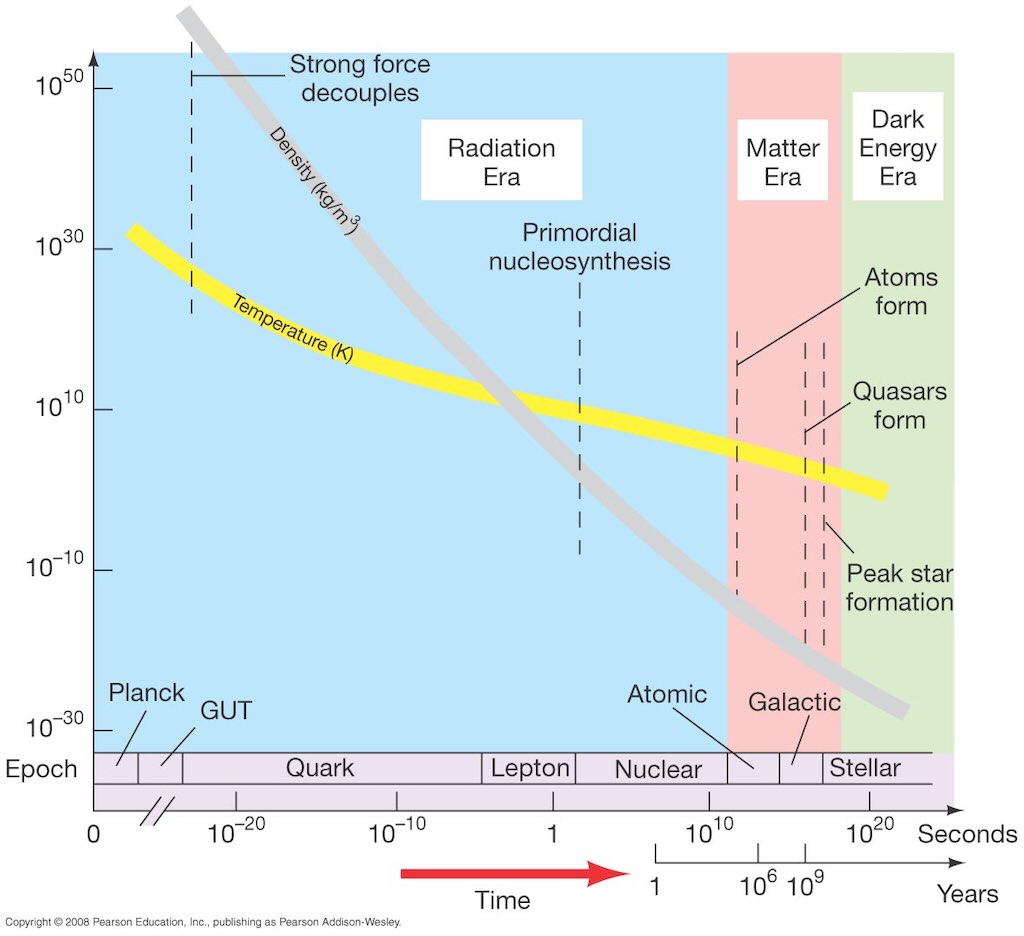
At the earliest times in the Universe, it was dominated by radiation. As the Universe expanded and cooled, eventually matter took over and dominated the evolution of the Universe. The crossover took place around 50,000 years after the Big Bang. As the Universe continued to expand and cool, dark energy took over and dominated the evolution of the Universe. This crossover occured 5 to 6 billion years ago.
We are still in the dark energy era. At early times, dark energy was less important than matter and radiation and so was ignored in the discussion of the very Early Universe. This statement carried a caveat, however, in that some repulsive force did act early on in the evolution of the Universe during what is called the Era of Inflation which took place at the end of the so-called GUT (Grand Unified Theory) era.
The scales involved are enormous. The observable universe extends approximately 93 billion light-years across and contains hundreds of billions of galaxies.
The Milky Way alone spans roughly 100,000 light-years and contains perhaps 100 to 400 billion stars.
Yet on scales larger than galaxy clusters, the expansion of space dominates gravitational attraction between distant systems. Galaxies not gravitationally bound to each other continue to recede as the fabric of spacetime expands. Some distant galaxies now move away effectively faster than the speed of light due to the expansion of space itself, not because they are traveling through space conventionally.
The chapter also discusses how multiple independent observations confirmed accelerated expansion. Measurements of the Cosmic Microwave Background by missions such as NASA WMAP Mission and ESA Planck Mission revealed that the geometry of the universe is very close to flat.
However, visible matter and dark matter together account for only about 32% of the density needed for flatness. The remaining contribution appears to come from dark energy. Observations of galaxy clustering and large-scale structure independently support the same conclusion, making dark energy one of the strongest components of the current cosmological model despite its unknown physical nature.
Another important theme of the chapter is the long-term future of cosmic evolution. If accelerated expansion continues indefinitely, distant galaxies will eventually disappear beyond the observable horizon as space expands faster and faster.
Over extremely long timescales, galaxy formation will cease because available gas becomes exhausted, stars will gradually burn out, and the universe may evolve toward a cold, dilute state sometimes called “heat death”.
Current cosmological estimates suggest ordinary star formation will decline dramatically over the next tens to hundreds of trillions of years.
Scientifically, the chapter demonstrates how observation forced cosmologists to revise their understanding of gravity and cosmic evolution. The universe was expected to decelerate under gravitational attraction, but precise astronomical measurements revealed acceleration instead.
This discovery transformed cosmology from a debate about whether expansion would stop into a deeper investigation of the physical properties of empty space itself. The major observational conclusion is now that most of the universe consists neither of visible matter nor dark matter, but of a poorly understood energy component driving accelerated expansion across cosmic distances.
For many years, astronomers believed that almost all Type Ia supernovae occurred when a carbon–oxygen white dwarf approached the Chandrasekhar limit, approximately 1.4M⊙, where M⊙ is a solar mass (2×1030 kg).
At this critical mass, the white dwarf was expected to undergo runaway thermonuclear fusion and explode in a highly uniform way. Because the explosions were thought to involve nearly the same mass and similar physical conditions each time, cosmologists assumed that their peak brightnesses would also be nearly identical. This apparent uniformity was one of the reasons Type Ia supernovae became such important “standard candles” for measuring cosmic distances.
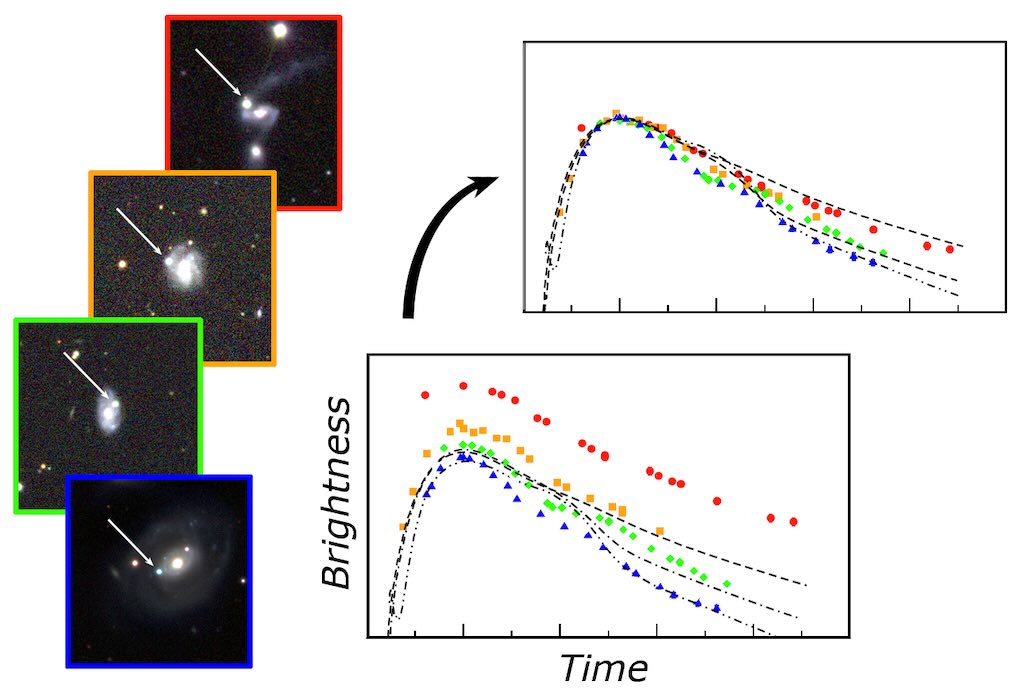
Type Ia supernovae result from the explosions of white dwarf stars. These supernovae vary widely in peak brightness, how long they stay bright, and how they fade away, as the lower graph shows. Theoretical models (dashed black lines) seek to account for the differences, for example why faint supernovae fade quickly and bright supernovae fade slowly. A new analysis by the Nearby Supernova Factory indicates that when peak brightnesses are accounted for, as shown in the upper graph, the late-time behaviours of faint and bright supernovae provide solid evidence that the white dwarfs that caused the explosions had different masses, even though the resulting blasts are all “standard candles”.
However, more recent observations revealed that the situation is more complicated.
Detailed studies showed that many Type Ia supernovae do not explode at exactly the Chandrasekhar limit. Some appear to originate from lower-mass white dwarfs, while others may involve mergers between two white dwarfs or even exceed the traditional Chandrasekhar mass.
In other words, there is likely more than one physical pathway capable of producing a Type Ia explosion.
The image above illustrates this problem very clearly.
The lower graph shows that different Type Ia supernovae can vary significantly in peak brightness, how quickly they brighten, and how rapidly they fade.
At first sight, this variability appears to undermine the idea that they are reliable standard candles. The crucial discovery, however, is that these differences are not random. Astronomers found empirical relationships between peak luminosity, colour, and the shape of the light curve. In general, brighter Type Ia supernovae fade more slowly, while fainter ones fade more rapidly.
Once these light-curve relationships are taken into account, the observed supernovae can be “standardised”. The upper graph shows how the corrected light curves become much more consistent after this calibration process.
This is why Type Ia supernovae remain valid cosmological tools.
They are not truly identical “standard candles” in the strict classical sense. Instead, they are more accurately described as standardisable candles.
Although the underlying explosions may arise from different progenitor systems and different white dwarf masses, the observable light curves contain enough information to correct for those variations and recover reliable intrinsic brightness estimates.
Modern calibration methods reduce the remaining uncertainty to a relatively small level, making Type Ia supernovae among the most powerful tools for measuring large cosmic distances.
So astronomers were able to use Type Ia supernovae successfully to discover accelerated cosmic expansion even before fully understanding all the physical mechanisms producing the explosions themselves. That is one of the reasons the discovery of dark energy remains such a remarkable achievement in modern science.
Chapter 6 - The Free Lunch at the End of the Universe
A more scientifically descriptive title for Chapter 6 would be “Cosmic Expansion, Vacuum Energy, and the Future Universe”, because the chapter focuses on how gravity, expansion, and vacuum energy interact over immense timescales, and how modern physics allows the total energy of the universe to be far less intuitive than classical physics suggests.
This chapter explores one of the most counterintuitive ideas in cosmology, that the total energy of the universe may be extremely small, and possibly even consistent with zero when gravitational energy is included.
In classical physics, creating a universe filled with hundreds of billions of galaxies, stars, and radiation would appear to require an enormous amount of energy.
Modern cosmology, however, treats gravity differently from ordinary forces.
Gravitational systems possess negative potential energy, meaning that the energy associated with gravitational attraction can offset the positive energy contained in matter and radiation.
Krauss uses this concept to explain how cosmic expansion and large-scale structure can emerge without violating known conservation laws.
The observable universe contains extraordinary amounts of matter and energy. Astronomers estimate that it includes roughly two trillion galaxies, each containing millions to trillions of stars.
The Milky Way alone contains approximately one trillion solar masses when dark matter is included. Across the observable universe there are likely more stars than grains of sand on all Earth’s beaches combined.
Yet despite this immense positive energy content, gravitational attraction contributes negative energy because work must be done to separate massive objects against gravity.
In cosmological models based on general relativity, these contributions may approximately balance.
The chapter also discusses how cosmic expansion changes the energetic structure of the universe over time.
Since the Big Bang approximately 13.8 billion years ago, space itself has expanded continuously. As the universe expands, radiation becomes stretched to longer wavelengths, reducing its energy density.
This effect is directly observed in the Cosmic Microwave Background.
When released roughly 380,000 years after the Big Bang, this radiation had a temperature near 3,000 kelvin. Due to cosmic expansion, it has cooled to only about 2.725 kelvin today and now fills all of space as faint microwave radiation.
A major scientific theme of the chapter is that the future universe will look radically different from the present one.
Modern observations indicate that dark energy dominates cosmic expansion. As space continues to expand at an accelerating rate, galaxies beyond the local gravitational neighbourhood will recede farther and farther away.
The Andromeda Galaxy, currently located about 2.5 million light-years from Earth, is moving toward the Milky Way because both galaxies are gravitationally bound and are expected to collide in roughly 4 to 5 billion years.
More distant galaxies, however, are generally moving away due to cosmic expansion and will eventually become unobservable.
Over extremely long timescales, accelerating expansion isolates gravitationally bound systems from the rest of the universe.
In tens of billions of years, observers inside the future merged Milky Way–Andromeda galaxy may no longer detect evidence that other galaxies ever existed because distant systems will have moved beyond the observable horizon.
The universe will appear darker and emptier as star formation gradually declines.
Current astrophysical models estimate that most star formation will cease within approximately 100 trillion years after interstellar gas supplies become depleted.
The chapter also addresses the thermodynamic evolution of the cosmos.
Stars generate energy through nuclear fusion, converting hydrogen into heavier elements over millions to billions of years. The Sun alone converts roughly 600 million tons of hydrogen into helium every second and is expected to remain stable for another 5 billion years.
Eventually, however, all stars exhaust their nuclear fuel. Massive stars explode as supernovae, while smaller stars become white dwarfs, neutron stars, or black holes.
Over immense timescales extending far beyond the current age of the universe, even these remnants may decay or evaporate through processes such as Hawking Radiation.
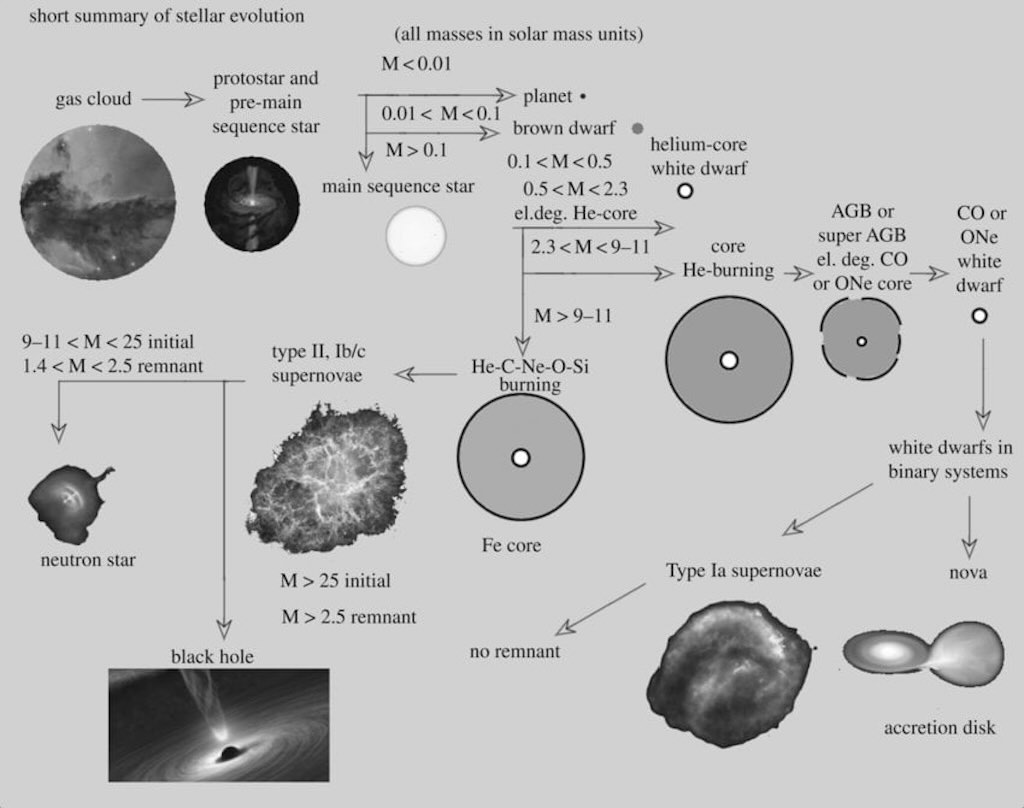
The above diagram is not the best graphic, but it does contain lots of key information on the general evolutionary paths of single stars, with different initial masses. The exact values of the mass ranges depend on the initial chemical composition and the details of the adopted element transport mechanisms.
The original reference is well worth a visit.
So gravity creates structure by pulling matter together into galaxies and stars, while cosmic expansion increasingly separates large-scale structures over time.
The balance between these processes determines the observable history and future evolution of the universe.
Observational evidence from supernova measurements, galaxy surveys, and microwave background studies strongly supports the conclusion that accelerated expansion will dominate the long-term future.
Scientifically, the chapter’s most important lesson is that the large-scale behavior of the universe emerges naturally from known physical laws operating over enormous scales of space and time.
Modern cosmology suggests that complex cosmic structure, including galaxies, stars, and planets, formed through gravitational amplification of tiny density fluctuations present in the early universe.
At the same time, the expansion of space continuously reshapes the universe’s energetic and observational structure.
The result is a universe that is not static, but evolving on every scale imaginable.
Chapter 7 - Our Miserable Future
A more scientifically descriptive title for Chapter 7 would be “Cosmic Isolation and the Disappearance of Observable Evidence”, because the chapter is fundamentally about how accelerated expansion will eventually erase much of the observable evidence astronomers currently use to understand the universe.
This chapter examines the long-term observational consequences of accelerated cosmic expansion. Modern cosmology depends heavily on evidence such as galaxy recession, the Cosmic Microwave Background, and the large-scale distribution of galaxies.
Krauss argues that in the extremely distant future, much of this evidence will disappear from view due to the continued dominance of dark energy. Future observers may inhabit a universe that appears static, isolated, and largely empty, making it difficult or impossible for them to reconstruct the true cosmic history known today.
The accelerating expansion of the universe was discovered through observations of distant Type Ia supernovae in the late 1990s.
Current measurements indicate that galaxies separated by very large distances recede from one another because space itself expands. The farther a galaxy lies from Earth, the faster it generally appears to move away.
Today astronomers observe hundreds of billions to perhaps two trillion galaxies across the observable universe.
However, only galaxies gravitationally bound to the Milky Way will remain observable over sufficiently long timescales.
The most important nearby galaxy for the future evolution of our local region is the Andromeda Galaxy, located approximately 2.5 million light-years away.
Unlike most distant galaxies, Andromeda is approaching rather than receding because the mutual gravitational attraction between the Milky Way and Andromeda overcomes cosmic expansion locally.
Simulations suggest the two galaxies will begin colliding in roughly 4 to 5 billion years and eventually merge into a larger elliptical galaxy sometimes informally called “Milkomeda”.
Smaller nearby galaxies belonging to the Local Group may also merge into this future structure.
Beyond the Local Group, however, expansion dominates.
Galaxies not gravitationally bound to us will continue moving farther away as spacetime expands. Over tens to hundreds of billions of years, nearly all external galaxies will move beyond the observable horizon.
Their light will become increasingly redshifted, stretched to wavelengths too long to detect effectively.
Future astronomers living inside the merged Local Group galaxy may see only their own isolated system surrounded by darkness.
The vast cosmic web of galaxies currently visible through modern telescopes will no longer be observable.
The chapter also discusses the eventual disappearance of the cosmic microwave background.
Today this relic radiation fills all space with a nearly uniform temperature of approximately 2.725 kelvin and provides direct evidence that the universe was once hot and dense.
The radiation originated about 380,000 years after the Big Bang and has traveled through space for nearly 13.8 billion years.
As cosmic expansion continues, however, its wavelength will stretch farther into the radio regime, eventually becoming too weak and diffuse to detect.
Future civilisations may lose access to one of the strongest observational foundations of Big Bang cosmology.
Krauss emphasizes that cosmology depends on living at a fortunate moment in cosmic history.
Modern astronomers can still observe distant galaxies, measure cosmic expansion, and detect relic radiation from the early universe. These observations allow scientists to estimate the age of the universe, determine its composition, and reconstruct its large-scale evolution.
In the distant future, much of this evidence will vanish. Observers may incorrectly conclude that their isolated galaxy constitutes the entire universe, much as astronomers once believed the Milky Way contained all cosmic structure before the twentieth century.
The chapter also connects cosmic evolution with stellar evolution and thermodynamics.
Star formation depends on reservoirs of cold hydrogen gas inside galaxies. Over time these reservoirs become depleted as stars form and consume available material.
Current astrophysical models suggest that most active star formation in galaxies will decline dramatically within roughly 100 trillion years.
Existing stars will gradually evolve into white dwarfs, neutron stars, and black holes. The universe will become progressively darker as luminous stars disappear and fewer new stars form.
Another important scientific theme is the relationship between observation and theory.
Many features of modern cosmology were discovered only because astronomers can currently access multiple independent forms of evidence simultaneously.
Measurements of galaxy recession, supernova brightness, element abundances, and microwave background fluctuations all reinforce the modern cosmological model.
The chapter argues that scientific understanding depends not only on physical laws but also on the observational conditions available to investigators at a particular cosmic epoch.
Chapter 8 - A Grand Accident?
A more scientifically descriptive title for Chapter 8 would be “Cosmic Fine-Tuning and the Physical Constants of Nature”. because the chapter focuses on how the values of fundamental physical constants determine the large-scale behaviour of the universe and whether complex structures can exist at all.
This chapter examines one of the central questions in modern cosmology and particle physics, why do the laws and constants of nature appear to permit the existence of long-lived stars, galaxies, planets, chemistry, and ultimately observers?
The universe is governed by a small number of measurable physical constants, including the strength of gravity, the electromagnetic force, and the masses of fundamental particles.
Small changes in many of these quantities would produce a universe dramatically different from the one observed today.
Krauss discusses how cosmic structure depends sensitively on these values and how modern physics attempts to explain this apparent fine-tuning scientifically rather than philosophically.
One of the most important examples involves gravity.
Gravity is extraordinarily weak compared with the electromagnetic force. A small refrigerator magnet can overcome the gravitational pull of the entire Earth on a paperclip.
Yet on cosmic scales gravity dominates because it always attracts and acts over unlimited distances.
If gravity were significantly stronger, stars would burn through nuclear fuel much more rapidly, shortening stellar lifetimes from billions of years to perhaps millions of years. Stable planetary systems and long-term chemical evolution might never develop.
If gravity were substantially weaker, matter might fail to condense efficiently into stars and galaxies at all.
The chapter also discusses the importance of nuclear physics in stellar evolution.
Stars generate energy through nuclear fusion inside their cores.
In the Sun, temperatures near the core reach approximately 15 million kelvin, allowing hydrogen nuclei to fuse into helium. The Sun converts roughly 600 million tons of hydrogen into helium every second and radiates about 4×1026 watts of energy. This process has remained stable for about 4.6 billion years and is expected to continue for another 5 billion years.
The precise balance between gravity and nuclear pressure inside stars depends critically on the strengths of the fundamental forces and the masses of elementary particles.
Another major topic in the chapter is the production of heavy elements (r-process).
The early universe after the Big Bang consisted primarily of hydrogen and helium, with trace amounts of lithium.
Elements such as carbon, oxygen, silicon, and iron formed later inside stars and supernova explosions.
Carbon is especially important because it forms the chemical basis of known biological systems. The formation of carbon depends on a highly specific nuclear resonance discovered by Fred Hoyle. Without this resonance, stars would produce far less carbon and oxygen, dramatically altering the chemistry available in the universe.
The chapter also explores the role of cosmic expansion and initial conditions.
Shortly after the Big Bang, the universe was extremely hot, dense, and remarkably smooth.
Tiny density fluctuations, i.e. variations smaller than one part in 100,000, were later detected in the Cosmic Microwave Background by missions such as NASA WMAP Mission and ESA Planck Mission.
If the early universe had been significantly smoother, gravity might never have amplified matter into galaxies and stars.
If it had been much more irregular, matter may have collapsed rapidly into black holes or dense structures hostile to stable galaxy formation.
Krauss also addresses the cosmological constant problem.
Observations indicate that dark energy currently dominates the expansion of the universe, accounting for roughly 68% of the total mass–energy density.
However, the observed vacuum energy density is extraordinarily small compared with naive predictions from quantum field theory.
If dark energy had been substantially larger in the early universe, accelerated expansion could have prevented matter from clumping into galaxies entirely.
The existence of large-scale structure therefore depends sensitively on the balance between cosmic expansion and gravitational attraction.
An important scientific theme of the chapter is the distinction between explanation and selection effects.
Modern cosmology does not necessarily conclude that the universe was deliberately designed for life. Instead, some physicists consider the possibility that many universes with different physical constants could exist, while observers naturally emerge only in universes where conditions permit stable structures and chemistry.
This reasoning is associated with anthropic arguments and certain interpretations of inflationary cosmology and string theory. However, these ideas remain theoretical and currently lack direct observational confirmation.
The chapter repeatedly emphasises how much of modern cosmology is now constrained by precision measurement.
Astronomers can estimate the age of the universe at approximately 13.8 billion years, measure the expansion rate of space, determine elemental abundances from stellar spectra, and map microwave background fluctuations across the entire sky. These observations show that the large-scale structure of the universe emerged from physical processes operating according to highly regular laws over billions of years.
Scientifically, the chapter’s central message is that complex cosmic structure depends on a delicate interplay between the laws of physics, the strengths of fundamental interactions, and the initial conditions of the early universe.
Stars, galaxies, chemistry, and planets are not inevitable outcomes under arbitrary physical laws.
Modern cosmology suggests that the observable universe occupies a narrow range of conditions compatible with long-term structure formation and thermodynamic evolution.
Whether this reflects deeper physical necessity, statistical selection, or undiscovered principles remains one of the major open questions in theoretical physics.
Chapter 9 - Nothing Is Something
A more scientifically descriptive title for Chapter 9 would be “Why Empty Space Has Physical Properties”, because the scientific core of the chapter is not philosophical “nothingness,” but the experimentally supported idea that vacuum states in quantum physics possess measurable structure, energy, and dynamical behaviour.
This chapter focuses on one of the major discoveries of twentieth-century physics, that is what appears to be empty space is actually governed by quantum fields permeating the universe.
In classical physics, a vacuum was considered a complete absence of matter and energy.
Modern quantum theory replaced this picture with a far more complex description.
According to quantum field theory, every fundamental particle corresponds to an underlying field extending throughout spacetime. Electrons arise from electron fields, photons from electromagnetic fields, and quarks from quark fields.
Even when no particles are present in a region of space, the fields themselves remain physically real.
The chapter emphasises that quantum fields cannot remain perfectly motionless.
Due to the uncertainty principle, fluctuations occur continuously even in vacuum states. These fluctuations are extremely small and short-lived, but they produce measurable physical consequences.
One of the best-known examples is the Casimir Effect, first predicted in 1948. When two conducting metal plates are placed extremely close together in a vacuum, typically separated by less than a micrometer, they experience a tiny attractive force caused by differences in allowed quantum fluctuations inside and outside the gap.
Modern experiments have repeatedly confirmed this effect with high precision, demonstrating that vacuum fluctuations are experimentally observable phenomena rather than abstract mathematical ideas.
The chapter also discusses how particle physics transformed scientific understanding of matter itself.
Atoms were once believed to be fundamental indivisible units. Later discoveries revealed that atoms contain electrons orbiting nuclei made of protons and neutrons, which themselves contain quarks bound together by gluons.
Most of the mass of ordinary matter does not come directly from the intrinsic masses of quarks. Instead, it arises largely from the energy associated with strong-force interactions inside atomic nuclei.
This means that much of the mass in familiar matter originates from dynamic quantum processes rather than solid material substance in the classical sense.
Krauss connects these ideas to cosmology by examining the energy of vacuum states.
Observations indicate that empty space itself contributes energy to the universe. This vacuum energy appears closely related to dark energy, the component currently driving accelerated cosmic expansion.
Modern measurements suggest that dark energy accounts for approximately 68% of the total mass–energy density of the observable universe. Unlike matter and radiation, whose densities decrease as space expands, vacuum energy remains approximately constant per unit volume. As the universe grows larger, the total amount of vacuum energy correspondingly increases.
The observational evidence for accelerated expansion emerged in the late 1990s through measurements of distant Type Ia supernovae. These exploding stars allowed astronomers to measure cosmic distances across billions of light-years.
Researchers found that distant galaxies were farther away than expected under models in which gravity alone slowed expansion. Additional evidence came from observations of the Cosmic Microwave Background and large-scale galaxy clustering. Together these measurements established the modern cosmological model in which dark energy dominates the large-scale dynamics of the universe.
Another major scientific theme of the chapter is that spacetime itself may not be fundamentally continuous at arbitrarily small scales.
Quantum gravity research attempts to unify general relativity with quantum mechanics, especially near conditions where both become important, such as inside black holes or during the earliest fractions of a second after the Big Bang.
At scales near the Planck length (approximately 1.6×10⁻³⁵ meters) physicists expect conventional descriptions of spacetime to break down. Although no complete experimentally confirmed theory of quantum gravity yet exists, many theoretical models suggest that spacetime itself may possess fluctuating microscopic structure.
The chapter also reviews how observations increasingly support the idea that the universe evolved from a much hotter and denser early state.
Measurements from NASA COBE Mission, NASA WMAP Mission, and ESA Planck Mission mapped the cosmic microwave background across the sky with extraordinary precision. The radiation, currently measured at approximately 2.725 kelvin above absolute zero, originated roughly 380,000 years after the Big Bang when the universe first became transparent to light. Tiny temperature fluctuations observed in this radiation correspond to primordial density variations that later evolved into galaxies and galaxy clusters under gravity.
Scientifically, the chapter’s main conclusion is that modern physics no longer treats “empty space” as physically trivial.
Quantum theory and cosmological observations both indicate that vacuum states possess measurable properties, fluctuating energy, and dynamical effects influencing the evolution of the universe.
Matter itself emerges from underlying fields and interactions rather than existing as permanently solid substance.
These ideas do not provide a complete explanation for the origin of the universe, but they fundamentally redefine the scientific meaning of physical emptiness in modern cosmology and quantum physics.
Chapter 10 - Nothing Is Unstable
A more scientifically descriptive title for Chapter 11 would be “Why Empty Space Can Change”, because the scientific content of the chapter centres on the fact that vacuum states in quantum physics are not necessarily permanent or stable.
Modern cosmology and particle physics both suggest that spacetime, vacuum energy, and quantum fields can evolve, transition, or fluctuate over time.
This chapter explores the scientific idea that vacuum states in nature may be unstable rather than eternal and unchanging.
In classical physics, empty space was assumed to be static and inert. Modern quantum field theory presents a different picture. Vacuum states correspond to the lowest accessible energy configuration of quantum fields, but the universe may contain multiple possible vacuum states with different energies and physical properties.
A vacuum that appears stable on ordinary timescales may in fact be only metastable, meaning it persists temporarily but could eventually transition into a lower-energy configuration.
The chapter connects this idea to the early evolution of the universe.
Cosmologists believe that shortly after the Big Bang, the universe existed in conditions of extremely high temperature and density. During the first fractions of a second, the fundamental forces of nature may have behaved differently from the way they do today.
As the universe expanded and cooled, phase transitions occurred, somewhat analogous to water freezing into ice as temperature drops. These transitions changed the behaviour of quantum fields and helped determine the present structure of matter and forces.
Modern particle physics suggests that the electromagnetic and weak nuclear forces were once unified at sufficiently high energies during the earliest stages of cosmic history.
One of the most important scientific ideas discussed in the chapter is cosmic inflation.
Inflation proposes that the universe underwent an extraordinarily rapid exponential expansion during the first tiny fraction of a second after the Big Bang, possibly around 10-36 to 10-32 seconds after expansion began.
During inflation, spacetime itself expanded by enormous factors, potentially increasing the size of microscopic quantum regions to astronomical scales.
This model helps explain several major observations, including why the observable universe appears geometrically flat and why the Cosmic Microwave Background is so remarkably uniform across vast distances.
The chapter also explains that inflation may have originated from the energy of a temporary vacuum state.
In inflationary models, a high-energy vacuum-like field dominated the early universe and produced repulsive gravitational effects, driving extremely rapid expansion.
When this unstable state decayed into a lower-energy configuration, enormous amounts of energy were released into particles and radiation, reheating the universe and initiating the hot Big Bang conditions from which galaxies and stars later formed.
This framework connects quantum field theory directly with large-scale cosmology.
Observational evidence supporting inflation comes primarily from measurements of the cosmic microwave background.
Satellite missions such as NASA COBE Mission, NASA WMAP Mission, and ESA Planck Mission revealed that the early universe contained tiny density fluctuations with highly specific statistical properties. These fluctuations differ in temperature by only about one part in 100,000 across the sky.
Inflationary theory predicts that quantum fluctuations stretched to cosmic scales during rapid expansion would later become the seeds for galaxies and galaxy clusters.
Modern observations strongly support this general picture, although details of the inflationary mechanism remain uncertain.
Another important scientific theme is vacuum decay. Some theoretical models suggest that the present vacuum state of the universe may not represent the absolute lowest possible energy state.
In principle, quantum tunnelling could someday trigger a transition to a lower-energy vacuum.
Such an event would alter the fundamental properties of particles and forces throughout space at nearly the speed of light.
Although this possibility emerges naturally in certain quantum field theories, there is currently no evidence that such a transition is imminent. Calculations based on known particle physics suggest that if vacuum decay is possible, the expected timescales may vastly exceed the current age of the universe, which is approximately 13.8 billion years.
The chapter also discusses the role of the Large Hadron Collider and modern particle physics experiments in understanding vacuum structure.
High-energy collisions allow physicists to probe conditions similar to those existing fractions of a second after the Big Bang.
Discoveries such as the Higgs Boson help scientists investigate how particles acquire mass and how vacuum fields influence the behavior of matter. The Higgs field itself fills all space, meaning that even ordinary empty space contains a nonzero background field affecting fundamental particle properties.
The chapter repeatedly emphasises that modern cosmology treats the universe as dynamic at every scale.
Galaxies evolve, stars form and die, black holes evaporate, and even vacuum states may change over immense periods of time. The large-scale structure of the universe emerged from quantum fluctuations amplified through cosmic expansion and gravity.
In this picture, stability is often temporary rather than absolute.
Scientifically, the chapter’s central message is that empty space in modern physics is not a passive background but an active physical system capable of transformation.
Quantum fields, vacuum energy, and phase transitions appear to have shaped the evolution of the universe from its earliest moments onward.
Observations of cosmic expansion, microwave background fluctuations, and high-energy particle interactions strongly support the idea that the universe evolved through changing vacuum conditions governed by quantum physics and general relativity.
Chapter 11 - Brave New Worlds
A more scientifically descriptive title for the final chapter would be “Modern Cosmology Beyond the Observable Universe”, because the chapter primarily discusses how inflationary cosmology and modern theoretical physics lead some scientists to consider the possibility that our observable universe may be only one region within a much larger physical reality.
This chapter examines how modern cosmology extends beyond the directly observable universe through theories based on inflation, quantum mechanics, and high-energy particle physics.
The observable universe is limited by the distance light has traveled since the Big Bang, approximately 13.8 billion years.
Because cosmic expansion stretches space while light travels, the observable region today spans roughly 93 billion light-years in diameter. However, most cosmologists believe the entire universe extends far beyond the observable horizon and may even be spatially infinite.
Observations cannot currently determine the total size of the cosmos, only the portion visible from Earth.
A central scientific theme of the chapter is cosmic inflation.
Inflation proposes that the early universe underwent a phase of extremely rapid expansion during the first tiny fraction of a second after the Big Bang, possibly between about 10-36 to 10-32 seconds after expansion began.
During this interval, spacetime expanded exponentially, smoothing irregularities and stretching microscopic quantum fluctuations to astronomical scales.
Inflation helps explain several important observations, including why the universe appears geometrically flat and why the Cosmic Microwave Background has nearly the same temperature in every direction.
The chapter explains that some versions of inflation naturally lead to the idea of “eternal inflation”.
In these models, inflation stops in certain regions of space while continuing elsewhere. Individual regions where inflation ends can evolve into universes with their own galaxies, stars, and physical conditions.
This process could produce an enormous collection of causally disconnected cosmic regions sometimes referred to as a multiverse. In such scenarios, our observable universe would represent only one local bubble embedded within a much larger inflating structure.
Krauss discusses these ideas primarily as theoretical implications of inflationary physics rather than established observational facts.
Inflation itself is strongly supported indirectly through observations of the cosmic microwave background and large-scale structure. Measurements from NASA WMAP Mission and ESA Planck Mission show that the early universe contained tiny density fluctuations with statistical patterns remarkably consistent with inflationary predictions. These fluctuations differed in temperature by only about one part in 100,000 and later evolved into galaxies and galaxy clusters under gravitational attraction.
The chapter also explores the possibility that different cosmic regions could possess different physical properties.
In some theoretical frameworks, quantities such as vacuum energy, particle masses, or force strengths might vary between different inflationary regions. This idea is partly motivated by unresolved problems in particle physics and cosmology, including the extremely small observed value of dark energy compared with theoretical expectations.
Some physicists investigate whether observed physical constants could reflect environmental selection effects within a much larger ensemble of possible universes.
The chapter repeatedly distinguishes between observable science and theoretical extrapolation.
Direct observational evidence currently exists for cosmic expansion, dark matter, dark energy, primordial nucleosynthesis, and the cosmic microwave background. Inflation itself has substantial indirect support because it explains several measured features of the universe simultaneously.
However, the existence of multiple universes beyond our observable region remains speculative because those regions may be permanently inaccessible to direct observation. The multiverse therefore remains a theoretical inference rather than an experimentally confirmed scientific fact.
Another important scientific topic in the chapter is the role of quantum fluctuations in generating cosmic structure.
Quantum mechanics predicts that microscopic fluctuations occur continuously in fields and particles. During inflation, these fluctuations would have been stretched from subatomic scales to astronomical dimensions. After inflation ended, slightly denser regions exerted stronger gravitational attraction and gradually accumulated matter over billions of years.
Modern simulations show how these initial fluctuations evolved into the cosmic web of galaxies observed today, with enormous filaments and clusters extending across hundreds of millions of light-years.
The chapter also discusses how cosmology increasingly overlaps with particle physics.
Facilities such as the Large Hadron Collider probe energies approaching conditions that existed shortly after the Big Bang. Discoveries such as the Higgs Boson provide insight into how fields permeating empty space influence the masses and interactions of particles.
Understanding these fields is important because inflation itself likely depended on vacuum-like field behavior during the universe’s earliest moments.
Scientifically, the chapter’s central message is that modern cosmology now studies not only the observable universe but also the physical mechanisms that may generate universes and large-scale cosmic structure.
Observations strongly support the idea that the visible universe emerged from quantum fluctuations amplified during rapid early expansion.
Beyond that, theories such as eternal inflation attempt to extend known physics into regimes that may lie permanently outside direct observation.
While many of these ideas remain speculative, they arise from attempts to apply established physical principles consistently to the earliest moments of cosmic evolution and the large-scale structure of spacetime itself.