My wife and I moved to Luxembourg in 1981-82. My wife passed away in Dec. 2023, and since then I have slowly realised that I don’t really know that well the modern-day Luxembourg. For this reason I have started to visit and re-visit many of the local institutions that in the past I took for granted.
This particular blog post simply collects interesting titbits about life in Luxembourg…
2026.05.17 Nationalities with just one resident in Luxembourg
There were almost 180 different nationalities living in Luxembourg at the start of this year, according to data released by national statistics office Statec last week, but a few countries have just a handful of residents living in the Grand Duchy.
The country’s population stood at 690,959 on 1 January 2026, with the share of foreign nationals falling slightly, from 47% to 46.6%, the data showed.
Over half of the foreign population in Luxembourg come from one of three nationalities – Portuguese, French and Italian – the report noted. In Luxembourg’s capital, around 70% of the population are foreign nationals.
While Portuguese nationals remain the largest foreign community across the country, accounting for 12.8% of the overall population, some nationalities – excluding those who are dual nationals – are represented by just a single resident in the Grand Duchy.
The island nation of the Seychelles, which had two representatives from 2018 to 2020, has had only one since 2021.
The Bahamas had no residents in Luxembourg since 2019. This is once again the case as of 1 January 2026, according to Statec data.
The same applies to Guyana, which had no residents between 2022 and 2025 and now has one as of 2026, according to Statec.
Since 2021, Saint Vincent and the Grenadines has consistently had just one resident in the Grand Duchy.
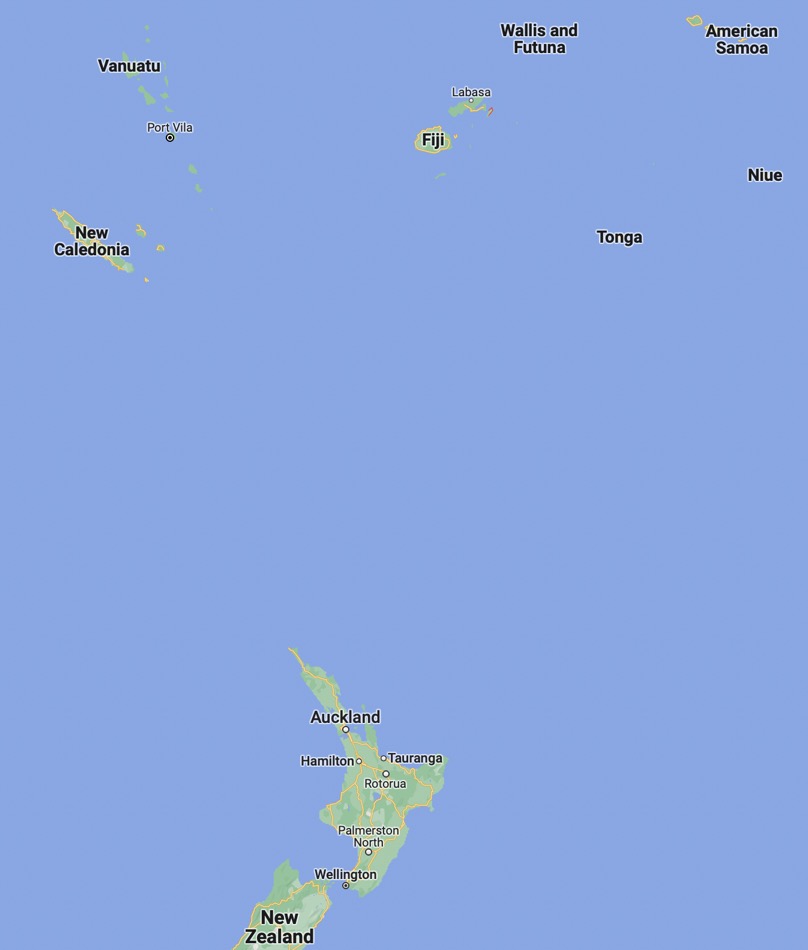
Samoa has had just one national in Luxembourg since 2017, as does Qatar, which has had one since at least 2016 – as Statec’s data does not go back any further in their table attached to their latest study.
Bahrain has seen its number of residents halve in a year. From two in 2025, only one remains in 2026, according to Statec.
Fiji still has only one national in the Grand Duchy this year, after its first resident citizen was registered last year.
Several countries have only two nationals on Luxembourg territory in 2026: San Marino, Botswana, Eswatini (formerly Swaziland), Barbados, Grenada, Saudi Arabia and Kuwait.
Bhutan and Oman, meanwhile, had three residents in the Grand Duchy as of 1 January 2026.
Among the countries with four representatives are Liechtenstein, Monaco, South Sudan and Antigua and Barbuda.
Further down the list, two countries had six nationals: North Korea and Saint Kitts and Nevis.
The United Arab Emirates, the Comoros and Malawi follow closely behind, with seven residents in Luxembourg.
Only one country – Dominica – has eight representatives in the Grand Duchy.
Luxembourg is also home to nine British overseas nationals – from territories such as Anguilla, Gibraltar, Bermuda or the Cayman Islands, for example, although more precise details are not provided by Statec – as well as nine nationals from Djibouti and Zambia.
There are ten residents each from Equatorial Guinea and Trinidad and Tobago.
Of the country’s 690,959 inhabitants, 268 are considered to be stateless or of unknown nationality, according to the latest Statec data.
2026.05.00 Luxembourg Banks
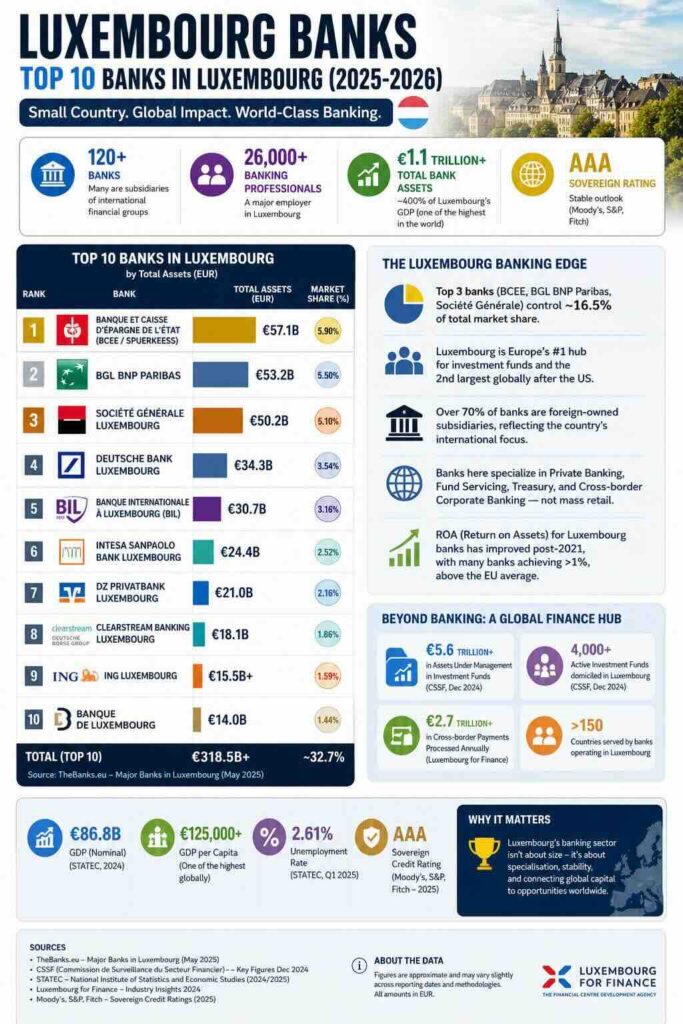
With 120+ international banks, a AAA-rated economy, and a dominant role in cross-border wealth & fund management, Luxembourg is one of the most strategic banking hubs in the world.
Top 10 Banks in Luxembourg (2025–2026)
1. Banque et Caisse d’Épargne de l’État (BCEE / Spuerkeess) €57.1B assets | ~5.9% market share
2. BGL BNP Paribas €53.2B assets | ~5.5% market share
3. Société Générale Luxembourg €50.2B assets | ~5.1% market share
4. Deutsche Bank Luxembourg €34.3B assets
5. Banque Internationale à Luxembourg (BIL) €30.7B assets
6. Intesa Sanpaolo Bank Luxembourg €24.4B assets
7. DZ PRIVATBANK Luxembourg €21.0B assets
8. Clearstream Banking Luxembourg €18.1B assets | ~1.86% market share
9. ING Luxembourg €15.5B+ assets
10. Banque de Luxembourg €14.0B assets | ~1.44% market share
 Source: TheBanks.eu, Luxembourg banking datasets
Luxembourg’s model is not retail-heavy, it’s driven by, private banking, fund servicing, and cross-border corporate banking.
Many players (e.g., J.P. Morgan, State Street, RBC) operate in Luxembourg primarily for custody, fund administration, and global flows, not domestic retail
Profitability has improved sharply post-2021, with some banks delivering >1% ROA, strong by European standards
Luxembourg is:-
Europe’s #1 hub for investment funds (second globally after the US)
A key node in cross-border payments and treasury flows
Strategic base for multinational banks servicing EU + global clients.
2026.04.15 Cross boarder salaries in Luxembourg
Luxembourg’s labour market remains structurally dependent on cross-border workers, and the most recent figures for 2025–2026 place their number at roughly 225,000 to 235,000, with a central estimate of about 230,000 daily commuters. This represents approximately 45% to 47% of the entire salaried workforce, meaning that close to one in every two workers in Luxembourg lives outside the country. The distribution is stable and well established, where the largest group comes from France (around 120,000–130,000), followed by Belgium and Germany, each contributing roughly 50,000 workers. Growth has continued in recent years, from just over 210,000 in 2021 to more than 230,000 today, but at a slower pace than before 2020, reflecting a maturing labour market.
In terms of earnings, the latest fully measured data (from 2022–2023 administrative sources) shows that cross-border workers earned on average about €65,500 gross per year, with clear variation by country of residence. Approximately €70,000 for Belgian and German commuters, and closer to €58,000 for French commuters. These figures remain the reference point in 2026, as detailed salary statistics are published with a delay. However, wages have increased since then through indexation and general wage growth. Taking into account observed increases in 2025 and forecasts for 2026, including a likely +2.5% indexation and overall wage growth of around 3% per year, a realistic current estimate places cross-border salaries in the range of €73,000 to €76,000 gross annually. This corresponds to roughly €65,000–€69,000 for French commuters and €77,000–€82,000 for Belgian and German commuters, depending on sector and role.
When compared with salaries in neighbouring countries, the advantage of working in Luxembourg remains substantial. Average gross salaries are typically around €39,000–€40,000 in France and about €50,000–€55,000 in Germany and Belgium. Against this background, a cross-border worker earning €73,000–€76,000 in Luxembourg is generally earning around 80–90% more than in France, and 30–40% more than in Germany or Belgium. This differential is persistent and reflects Luxembourg’s economic structure, which is heavily weighted toward high-value sectors such as finance, EU institutions, and specialised services.
The overall pattern is therefore consistent and stable. Cross-border workers earn less on average than Luxembourg residents, whose salaries are higher due to a greater presence in senior and high-pay sectors, but they earn significantly more than they would in their home countries. The 2026 picture is not one of structural change, but of a continued upward adjustment in salaries across the board, driven largely by indexation, within a labour market that remains uniquely dependent on, and highly attractive to, cross-border labour.
At the lower end of the scale, Luxembourg’s statutory minimum wage (salaire social minimum) remains one of the highest in Europe. As of 2025–2026, it is set at approximately €2,703 gross per month for unskilled workers and about €3,244 for skilled workers (defined as having a recognised qualification or experience), with automatic adjustments through indexation. This corresponds to roughly €32,000–€39,000 gross annually.
However, this level sits well below what is generally considered a “living salary” in Luxembourg. While there is no single official figure, various studies and social benchmarks suggest that a single adult typically requires at least €3,500–€4,000 net per month to cover housing, transport, and daily expenses at a modest but stable level, with significantly higher needs for families. In practice, this gap explains why minimum wage earners are far more likely to be cross-border workers or to rely on shared housing or subsidies, and why the majority of the workforce, both resident and cross-border, earns well above the statutory minimum.
Before delving into this subject its worth mentioning that the Grand-Duchy of Luxembourg has a total population around 700,000, and with a capital city of ~130,000 people, yet it manages more investment funds than London, Paris, and Frankfurt combined. Luxembourg has the highest proportion of cross-border workers in the European Union. The total workforce in Luxembourg is ~520,000, including ~225,000 cross-border commuters (~50% from France).
Today the Luxembourg financial sector employs roughly 73,000 people (but only ~23,000–25,000 workers are resident in Luxembourg). This total includes people working in legal, audit, consulting linked to funds, and support services (IT, reporting, compliance). Luxembourg therefore ranks among the largest global hubs for fund servicing and administration, even though the city itself is very small.
Holding fund assets does not mean the investment decisions happen in Luxembourg. What Luxembourg provides is the legal and administrative home of the fund, not necessarily the portfolio managers. So the country acts as infrastructure for international finance rather than as a domestic financial market. It specialised not in managing money, but in hosting the legal containers in which global money is invested.
As of 31 December 2025, the total net assets of undertakings for collective investment, comprising UCIs subject to the 2010 Law, specialised investment funds and SICARs (investissement à capital risque), amounted to EUR 6,199.370 billion compared to EUR 6,179.880 billion as at 30 November 2025, i.e. an increase of 0.32% over one month. Over the last twelve months, the volume of net assets increased by 6.52%. Between the ends of 2020 and 2025, total net assets grew by 22.8%. At the end of 2025 there were a total of 13,319 fund units active in the Luxembourg financial centre.
A UCI (Undertaking for Collective Investment) is an entity whose sole purpose is the collective investment (an investment fund) of capital raised from the public, investing it in financial assets (or other eligible assets) with risk spreading and managed on behalf of the investors. It allows collective investment schemes to operate freely throughout the EU on the basis of a single authorisation from one member state. This concept is widely used in the European Union, particularly in Luxembourg, where UCIs are a major part of the financial sector. Under Luxembourg law the UCI universe is usually split into two groups, UCITS (Undertakings for Collective Investment in Transferable Securities) funds and non-UCITS retail funds. So a UCITS is one specific regulated species of UCI. As far as I understand things this means that if a fund invests in listed equities, government bonds, or money market instruments (e.g. certificate of deposit, Eurodollar deposit, Federal funds, Treasury bills, etc.) it must follow UCITS rules. If a fund invests in real estate, commodities or private assets (including private equity and venture capital, real estate, infrastructure, farmland and forestry) it would follow the rules of a UCI. It is also my understanding that because UCITS dominate the Luxembourg market, people often refer to them as “UCI funds” when they actually mean UCITS.
My understanding is that investment funds is the largest financial sector in Luxembourg, followed by private banking and wealth management (e.g. managing assets of wealthy individuals), and corporate & structured finance (e.g. holding companies, securitisation vehicles). For comparison the Luxembourg private banking sector holds ~€600–700 billion.
Luxembourg’s total investment fund industry exceeded €7.3 trillion in assets. In addition to the UCIs, there are also Alternative Investment Funds (AIFs), which covers any asset class, excluding capital stocks, bonds, and cash. So this includes tangible assets, real estate, hedge funds, exchange funds, venture capital, financial derivatives, and even cryptocurrencies.
A smaller, but important legally separate sector, is insurance-based investments (e.g. life insurance) with ≈ €200–240 billion under management.
Luxembourg is the largest investment-fund centre in Europe and second in the world after New York with ~€25–30 trillion. Luxembourg is widely considered the main European legal domicile for private-asset funds.
Luxembourg is mid-tier in private banking, but still significant in Europe. It sits behind Zurich/Geneva, Hong Kong, Singapore and London.
Finally Luxembourg’s insurance market is small globally but very specialised, focusing on wealth-management insurance wrappers (private placement life insurance).
In fact the latest consolidated figures for end-2025 show that Luxembourg-domiciled funds reached €8.2 trillion, spanning funds, insurance, capital markets and digital finance. This makes it the worlds second biggest fund market behind the US ~$30–40+ trillion (Mutual Funds and Exchange-Traded Funds).
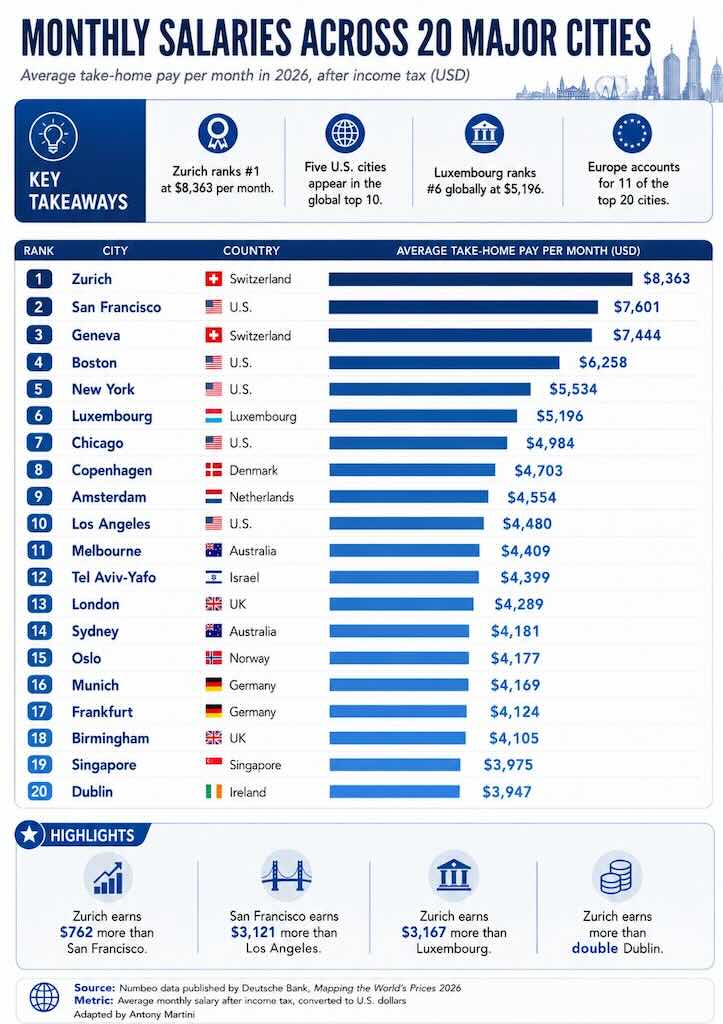
2026.00.00 Monthly Salaries Across 20 Major Cities
It’s great to see Luxembourg considered a major city, but I hope we don’t acquire all the defects of those same cities, e.g. traffic, pollution, crime, …
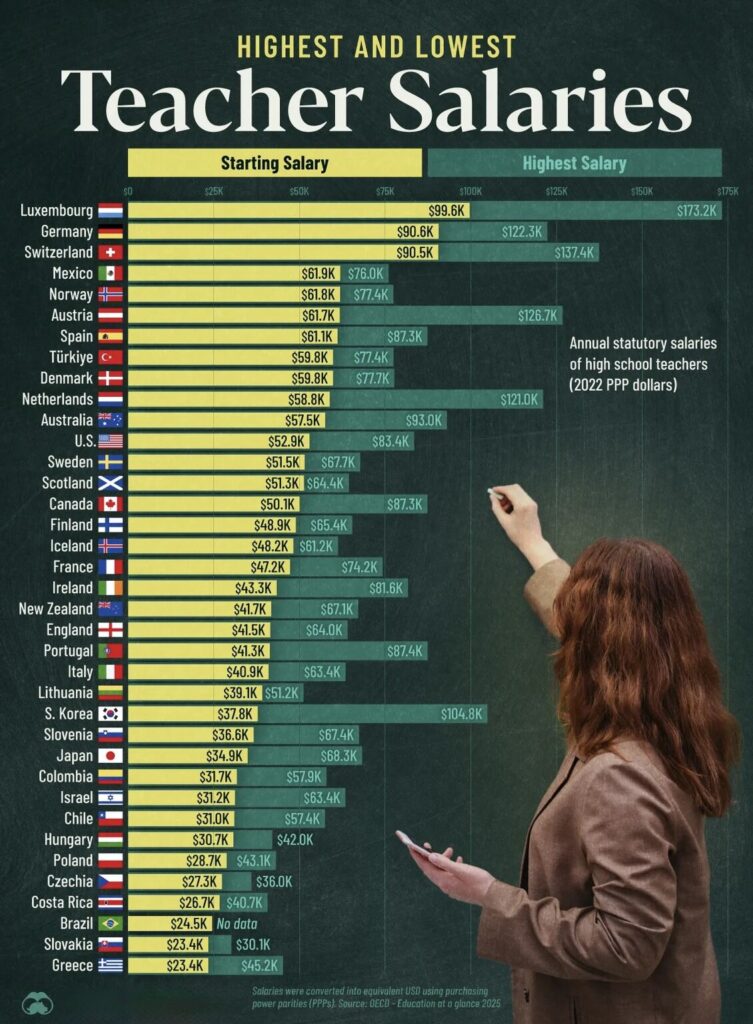
2026.00.00 Teacher Salaries
2025.00.00 Which Country Drinks the Most Coffee?
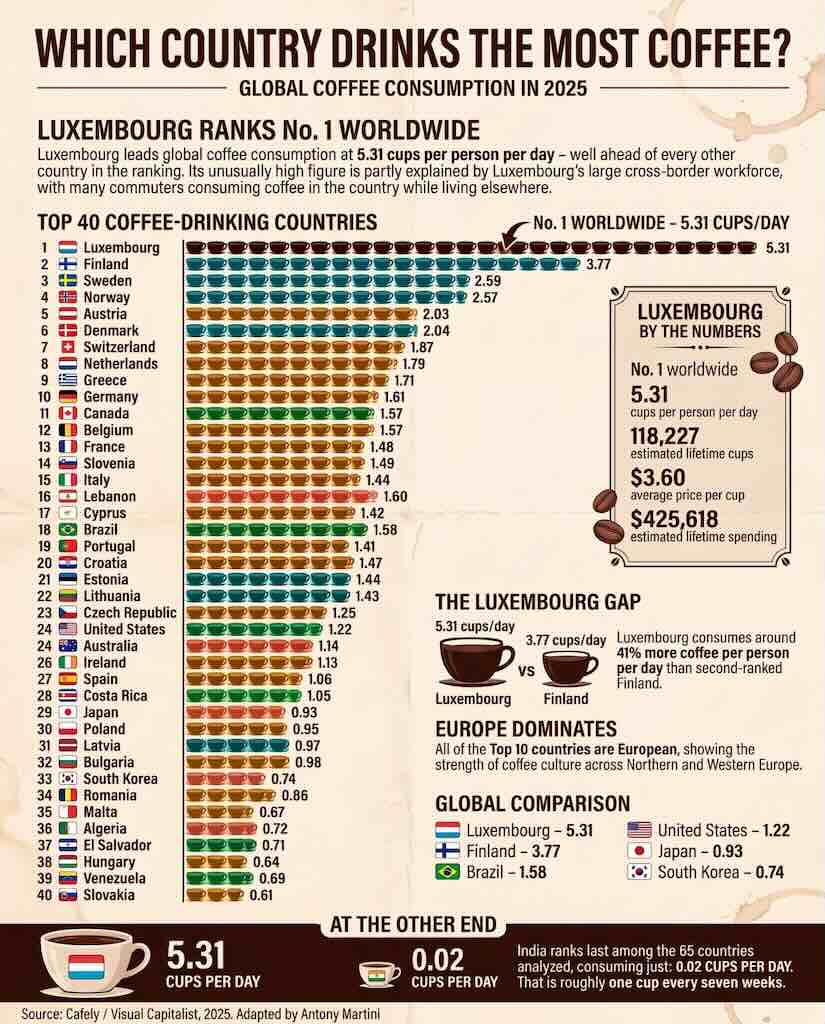
You see this graphic appear in the press at different times. The problem is that Luxembourgers don’t drink an excessive amount of coffee. It’s simply that the cross-boarder consumption of petrol, tobacco, alcohol, and coffee, etc. produce odd looking data. Nor is it because cross-border workers drink more coffee than other people. But it is true that if you divide total consumption, by the local population (ignoring the >200,000 people who work in Luxembourg, but live in Germany, France or Belgium,) you get higher figures.
PS When working I would drink at least 4-5 cups of coffee a day, and I once lived in Italy and drank 7-10 expresso’s per day. Now, retired, I’m down to 3-4 cups per day (milk, no sugar).