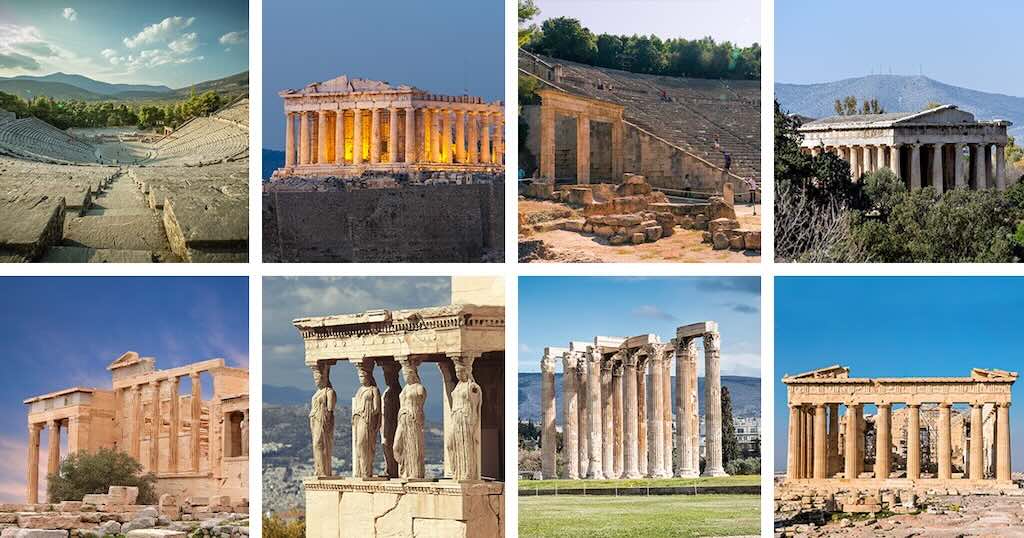
I had decided to follow an Oxford University Summer School (2026) on the subject “The Architectural Secrets of Oxford’s Classical Buildings”.
One of the recommended reading was “Ancient Greek Architects at Work”, by J.J. Coulton.
I decided to create this book review along the lines of personal revision notes. I’ve tried to hit the key points, and I’ve added some links to videos describing some of the key buildings and features mentioned in the book.
What the reviewers wrote?
Most reviewers emphasised that Coulton’s major contribution was shifting attention away from purely aesthetic appreciation toward how Greek buildings were actually designed and constructed. Instead of presenting temples as static masterpieces, he reconstructs the practical challenges architects faced, e.g. load-bearing, roofing spans, stone transport, column spacing, and structural experimentation. Academic reviewers especially admired this “working architect” perspective.
Well-written, rigorous and convincing, come to mind. But some people found the book too technical, too focused on mechanics and design logic, and giving insufficient attention to political symbolism, religion, or social meaning.
However, reviewers generally stressed that the core analytical framework remained highly valuable.
What did I think of the book?
The first thing I appreciated was the incredible detail in the book, which made creating revision notes almost impossible. The book reads like revision notes, it’s so detailed. For a neophyte like myself, it’s a fantastic treasure trove. I would create a chapter review summary, and then worry about all the important details I had not mentioned.
I like the fact that Coulton appears less interested in admiring temples than in understanding how they came into existence. How did Greek architects solve practical problems of design, structure, labour, transport and construction. I really appreciated that the book approaches Greek architecture as an engineering and management problem, more than an artistic one. The shift from building stone forms to shaping spatial experience is maybe the deepest idea in the book. It will certainly make me look differently at Greek monuments in the future.
I do wonder about the economics of Greek architecture, in terms of material costs and manpower effort. One weakness of this book is that it does not really look enough at the social, economic, and business life of a typical Greek architect of the time.
Not directly related to this book, but I would note that the topic is very poorly supported by scientific and technically oriented, high quality video and graphic material. There are a few exceptions, but much more could be done to inspire people to learn more about the foundations of architecture as a science.
My Pet Rant
One of the biggest distortions in architectural history is survivorship bias. This book studies the best Greek buildings because they survived, were admired, copied, measured, written about, excavated, and preserved.
But I guess a lot of Greek architecture was poor. I understand even ancient writers themselves criticised buildings and their architects.
Vitruvius (1st century BC) repeatedly discussed poor proportions, badly chosen sites, incompetent architects, and buildings that looked impressive but functioned badly.
In fact, thousands of Greek temples must have existed, but we spend our time mentioning only a handful of them, e.g. Parthenon, Temple of Hephaestus, Temple of Apollo Epicurius, and the Temple of Zeus at Olympia.
When archaeologists measure Greek temples they find enormous differences. The Parthenon contains no perfectly straight horizontal lines, and the columns lean inward. In fact, it’s famous because it bends and curves.
Obviously every stone was individually cut, with more or less precision. We know that several temples were rebuilt after structural problems, e.g. the Temple of Olympian Zeus took centuries to finish and underwent multiple redesigns.
I would like to think that the Greeks themselves probably regarded many buildings as second-rate, barely acceptable, or just uninspiring (a temple was supposed to be the house of a god).
I guess, we rarely hear those judgments because written criticism has largely disappeared. Or did they re-write history?
One argument that I think Coulton would have appreciated, is that most Greek building were far from perfect. That’s why there was continual experimentation as the Orders evolved, e.g. Doric to Ionic to Corinthian.
Shame someone doesn’t write about the failures of boring Greek architecture.
Who was a Greek Architect?
The Greek architect was not just a ἀρχιτέκτων (arkhitéktōn), or master builder. Nor was he an architect in the modern sense (i.e. a designer of buildings). It’s true we don’t know exactly what an architect did in those days. But it would appear that the architect had to design, survey, and project manage, e.g. for example he supervised and authorised payment for the labour, after controlling all the measurements (such as each course of stone, and the tightness of each joint). In addition he had to coordinate quarrying and transport, and onsite he also had to indicate how the heavy blocks should be moved and lifted. He managed sequencing of the construction, the making of the foundations, the operation of the cranes, etc.
Coulton repeatedly points out that Greek architects did not attend architectural schools. They learned through an apprenticeship, practical experience in workshops, and probably also through family traditions. That’s what I liked about Coulton’s analysis, a Greek architect learned by building walls, homes, and occasionally a temple.
Also I did not know that the distinct concept of engineer only appeared in the late 4th century BC (e.g. probably after the completion of the Parthenon in 432 BC, and certainly well after the completion of the Temple of Artemis at Ephesus (one of the Seven Wonders of the Ancient World), completed around 550 BC.
This anticipates Coulton’s argument summarised below, that Greek architecture evolved more through practical problem-solving, and less through design aesthetics.
Chapter 1 - Architect, Patron, and Project
I think it’s important to highlight immediately some key messages that are a foundation for Coulton’s analysis.
A Greek architect was a bit of an engineer, designer, surveyor, project manager, and even builder-contractor, all rolled into one. He was not a studious academic, he was a builder by trade. By working on projects, he acquired a reputation and a patrons confidence, not through qualifications and certificates. His reputation created his authority.
Coulton mentions some important Greek architects, namely:-
- Ictinus was active in the mid 5th century BC. Ancient sources identify him and Callicrates as co-architects of the Parthenon. He is quoted as the architect of the Temple of Apollo at Bassae, where the temple was Doric on the exterior, Ionic on the interior, and incorporated the earliest known Corinthian capital in a major Greek building. As one of the architects of the Parthenon he was certainly involved in the development of optical refinements such as columns swelling slightly (entasis), columns leaning inward, the stylobate curving upward, and thickened corner columns (all dealt with later in the book).
- Callicrates was, with Ictinus, one of the architects of the Parthenon. An inscription also identifies him as the architect of “the Temple of Nike” on the Acropolis of Athens, considered one of the most elegant small temples in Greece.
- Mnesikles was active in the mid 5th century BC, and is said to have designed Propylaea, the monumental gateway to the Acropolis. Unlike a temple, this was not a simple rectangular building. It sat on a steeply sloping site, had to link to an existing road, and allow processions, pedestrians, animals and carts to pass through. On top of that it had to connect different levels of the Acropolis, and create a monumental entrance worthy of Athens. I think Coulton liked Mnesikles because he was the complete example, dealing with an awkward terrain, unruly circulation, a bit of aesthetics, certainly a touch of politics, and in the end delivering a ceremonial statement, all in one building.
- Theodorus of Samos was a 6th-century BC ancient Greek sculptor and architect from the Greek island of Samos. He is important because he appears at the point where Greek building begins to move from a traditional craft towards a form of technical engineering. Unlike Iktinos or Mnesikles, he is not remembered primarily for a famous building, but because ancient writers repeatedly associate him with measurement, metalworking, and engineering techniques. Theodorus was active around 550–530 BC, roughly a century before the Parthenon. He is associated with the early Heraion of Samos, one of the largest temples in the Greek world. As such he was forced to deal with some new challenges, such as foundation settlement, transporting large stone blocks, maintaining alignment over long distances, as well as the usual column spacing, roof loads, etc. Because the site of the Heraion was marshy, the builders created artificial foundations using charcoal layers. compacted materials, and timber elements to stabilise the ground. Ancient writers mention him as being an architect, metalworker, and inventor. He is said to have also been one of the earliest Greek architects to have written about architecture (although his works are lost now). He was often credited with the invention of ore smelting, the craft of casting, a type of water level, a carpenter’s square, a lock and key and even a turning lathe. Any one of these would merit a mention in this list.
- Pytheos was a Greek architecture theorist, and sculptor of the 4th century BC. His name is associated with both the Temple of Athena Polias in Priene, and the Mausoleum at Halicarnassus, one of the Seven Wonders of the Ancient World. As such he is important because he did not just work on temples. Like Theodorus, Pytheos is known to have written architectural treatises (his works are also lost, but Vitruvius, repeatedly mentioned him).
The chapter has a focus on the architect as someone who ran building projects, but this also meant that he would be responsible for maintaining the accounts, including recording expenditure, labour payments and stone purchases. Coulton didn’t just look at buildings, he studied the available written accounts of the day-to-day practices of architects of the time. Some documents also show that an architect had to deal with magistrates (e.g. authorising expenditure, approving contracts, supervising public funds, reporting progress to political leaders, and ensuring legal procedures were followed), civic boards (e.g. they expected to see the contractors that were hired, materials purchased, payments made, as well as checking completed work and that proper accounts were kept), and temple committees who would check religious compliance and the protection of sacred objects.
One of Coulton’s themes is that Greek architects were less independent than many people imagine.
The Logical Structure of Coulton’s Argument
Coulton builds his case step-by-step.
Firstly, Architecture Begins with Patronage, Not Artistic Inspiration
Tyrants, aristocrats, city-states, sanctuary authorities, kings, and wealthy elites, first commissioned monumental buildings.
The architect almost never originates the project independently.
Because the funding, political authority, and religious purpose all come from patrons, architects were constrained from the beginning. They had to satisfy collective civic/religious priorities, not private artistic expression.
He who controls the money, controls the design priorities. So tradition dominated innovation.
Secondly, Greek Architecture Was Public and Religious Before It Was “Art”
Most monumental Greek buildings were temples, stoas (covered walkways or porticos), treasuries, and civic buildings. This meant that the building had symbolic obligations. For example, temples had to appear appropriate to the gods, civic buildings had to embody political dignity, sanctuaries required continuity with tradition.
Thus architects had to stick to existing proportional systems, canonical Orders, and what people expected to see.
Any architectural deviation could threaten ritual and civic legitimacy itself.
So conservatism was structurally built into Greek architecture.
Thirdly, The Architect’s Status Was Ambiguous
Architects occupied an unstable middle ground between intellectual professionalism and skilled craftsmanship.
Architects were not just builders. In part because they handled planning, structural coordination, measurement systems, contracts, logistics, and design problems.
Architects were not artistic geniuses. Because public committees often supervised work, their finances were monitored, specifications could be very rigid, and because architects lacked total authority over a building project.
The architect was an expert, but did not have creative freedom.
Fourthly, Architecture Was Administrative and Logistical
The architect was responsible for sourcing stone, organising labour, coordinating transport, sequencing construction, ensuring structural stability, handling costs, and meeting deadlines.
This meant he had to master lifting techniques, stone transport, proportional systems, roofing problems, column spacing, and how to make the building look “right” (i.e. optical refinements).
So Greek architecture actually evolved through solving constraints, not through imagining new structures.
Fifth, Innovation Was Difficult and Therefore Incremental
Coulton argues Greek architecture developed slowly because architects worked within overlapping constraints:-
- Religious tradition discourage radical change
- Patron’s expected conventual forms
- Structural limitations restricted experimentation
- Public accountability punished failure to meet expectations
- Massive construction costs favoured proven methods.
Therefore innovation could only emerged gradually.
This explains why the Doric Order evolved incrementally, why temple plans remained conservative for centuries, and why refinements were subtle rather than revolutionary.
Sixth, Greek Architecture Prioritised Refinement Over Novelty
However, creativity did exist in refinements, proportions, building precision, spatial adjustments, improved visual harmony, and technical problem-solving.
But not in radical reinvention. Greek architects had to demonstrate their skills through optimising inherited systems, not abandoning them.
This explains the extraordinary subtlety of Greek temples, as seen in the way architects treated entasis, curvature, corner contraction, and proportional modulation. In fact these are not decorative additions. They are systematic optical and structural corrections designed to make a building appear more perfect to the human eye.
Greek architects discovered a mathematically perfect building does not necessarily look visually perfect. So they began subtly altering geometry itself to compensate for human visual distortion, perspective effects, and structural constraints.
Entasis is the application of a convex curve to a surface for aesthetic purposes, or increasing strength. Its best-known use is in certain Orders of Classical columns that diminish in a very gentle curve, rather than in a straight line as they narrow going upward.
Instead of being perfectly straight, Greek columns widen subtly in the middle, then taper toward the top. The effect is extremely small, often only a few centimetres, but visually important. The reason is that if a very tall column is perfectly straight, the human eye tends to perceive it as thinner in the middle, weak, and slightly concave.
This means that each drum of the column had a slightly different diameters, subtly changing curvature, and precise alignment requirements. This required advanced geometry, careful stone-cutting, and great precision.
For example the Parthenon columns are not identical based upon a template, each was individually calculated and carved.
Curvature refers to the subtle upward bending of supposedly “horizontal” lines in Greek temples. This includes the stylobate (platform), entablature, roofline, and other horizontal architectural members.
This is because a perfectly straight horizontal line viewed across a long distance appears to sag in the middle. So the built horizontal lines are not truly straight, e.g. the Parthenon platform rises several centimetres toward the centre.
So nothing in the building is truly rectangular. Many elements curve slightly, tilt subtly, or shift incrementally. And this means that every stone block had unique dimensions, every measurement had to be recalculated, and geometric consistency had to be maintained across the entire structure.
Corner contraction is the deliberate narrowing of spacing between columns at the corners of a Doric temple. The corner columns are slightly closer together than the others.
The “Doric Corner Conflict” is where the triglyphs in the frieze had to align visually with columns. But at corners, a strict regular spacing created an awkward visual misalignment.
So Greek architects slightly reduced the final intercolumn spacing. This strengthened the corner visually, preserved triglyph alignment, and prevented the corner from appearing stretched or fragile.
Proportional modulation refers to the careful adjustment of ratios throughout the building so that all parts relate harmoniously to one another.
Greek architects believed beauty emerged from measured relationships, numerical harmony, and geometric coherence. This did not mean “equal”, but that every dimension was adjusted. Examples are column height relative to diameter, spacing relative to column thickness, temple width relative to length, pediment angle relative to roof mass.
Greek proportions were rarely rigid formulas. Architects adjusted ratios depending on viewing distance, lighting, building scale, structural load, and the effect on the viewer.
Seventh, and last, Coulton’s Implicit Critique of Modern Architectural History
Coulton is quietly criticising older art historians who treated Greek buildings mainly as aesthetic objects.
He instead treats architecture as not just an issue of taste. Coulton repeatedly demonstrates that Greek architecture emerges from interactions among materials, labour, religion, politics, patronage, inherited forms, and structural necessity.
Without this framework, Greek temples might just be considered as static monuments of beauty. But in reality, they are solutions to highly specific technical and social problems. Greek architecture is really continuous problem-solving under constraint.
Chapter 2 - The Problem of Beginning
This chapter is one of the most important in the book because it explains how Greek architects confronted the practical difficulties of creating large stone buildings. In simple terms, this meant how to use the post-and-lintel construction (already used in Neolithic times), and build large, stable, visually harmonious monumental buildings.
Coulton shows that Greek architecture did not emerge suddenly as a perfected classical system. Instead, it developed through centuries of experimentation, adaptation, inherited traditions, and structural problem-solving.
It’s rather obvious that big temples didn’t just appear ready-built, but Coulton details how Greek architects developed column arrangements, roofing techniques, and structural refinements.
A good starting point is to check out this video “Early Temples Built of Wood and Stone: New Finds from Kalapodi (Phokis)“. and the webpage “Greek temples made of wood“.
The Greeks inherited timber construction traditions (also dating back to Neolithic times), mudbrick architecture (used since 9000 BC), Mycenaean precedents (second millennium BC), and Near Eastern/Egyptian influences. So how (and why) did they migrate to monumental stone constructions, and overcome many completely new engineering challenges?
They started with post-and-lintel construction, e.g. vertical supports (columns) and a horizontal beam (architraves). Unlike arches or vaults, lintels are structurally weak under tension, especially when made from stone (it fractures under bending stress).
Because stone beams could only span limited distances, columns had to be spaced carefully, roofs had to remain relatively narrow, and interior spaces were constrained.
Wood was easier to work with, it’s lighter, more flexible, easier to cut, and can span larger distances.
Stone is extremely heavy, brittle, and difficult to transport.
But timber rots, can be attacked by insects, affected by moisture (including warping), and is a fire risk. Remember Greek temples housed oil lamps and ritual fires.
Given that Greek sanctuaries were sacred long-term spaces, the idea that a temple could rot and decay became politically and religiously unacceptable.
Stone offered permanence, and was better at projecting state power, permanence, and civic prestige.
And Greek temples were houses for the gods, and stone physically embodied permanence, i.e. the link between the city and the god would endure forever.
And each Greek city-state wanted to demonstrate its power through prestige projects, which were a form of political propaganda. A massive marble sanctuary showed the city was wealthy, technologically advanced, and favoured by the gods.
Of course they already knew about the Egyptian stone temples, with their gigantic stone columns, and durable masonry architecture,
And of equal importance, stone could be carved precisely, polished, mathematically shaped, and permanently fixed (whereas wood changed shape over time).
The extraordinary refinements of the Parthenon would have been practically impossible in timber.
So stone solved some problems, but created entirely new ones.
Greek stone architecture often preserves shapes originally developed for timber buildings, namely triglyph patterns, beam-like entablatures, mutules, roof detailing, and column forms.
Mutule was a rectangular block under the soffit of the cornice of the Greek Doric temple, which was studded with guttae. It was supposed to represent the piece of timber through which the wooden pegs were driven in order to hold the rafter in position, and it follows the sloping rake of the roof.
Coulton argues these were fossilised structural memories of timber construction, i.e. the stone temple preserved the logic of an earlier wooden system even after the material changed.
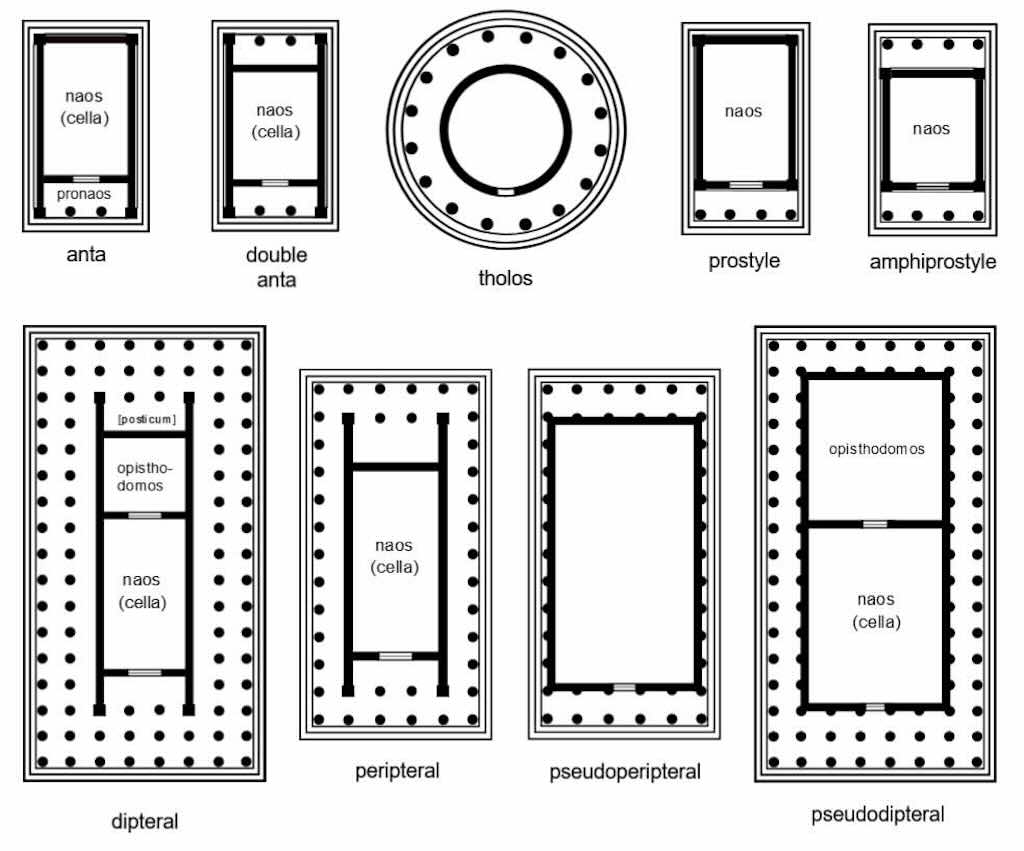
Before we move on, it’s useful to have a look at how Greek temple floor plans evolved over time (see above).
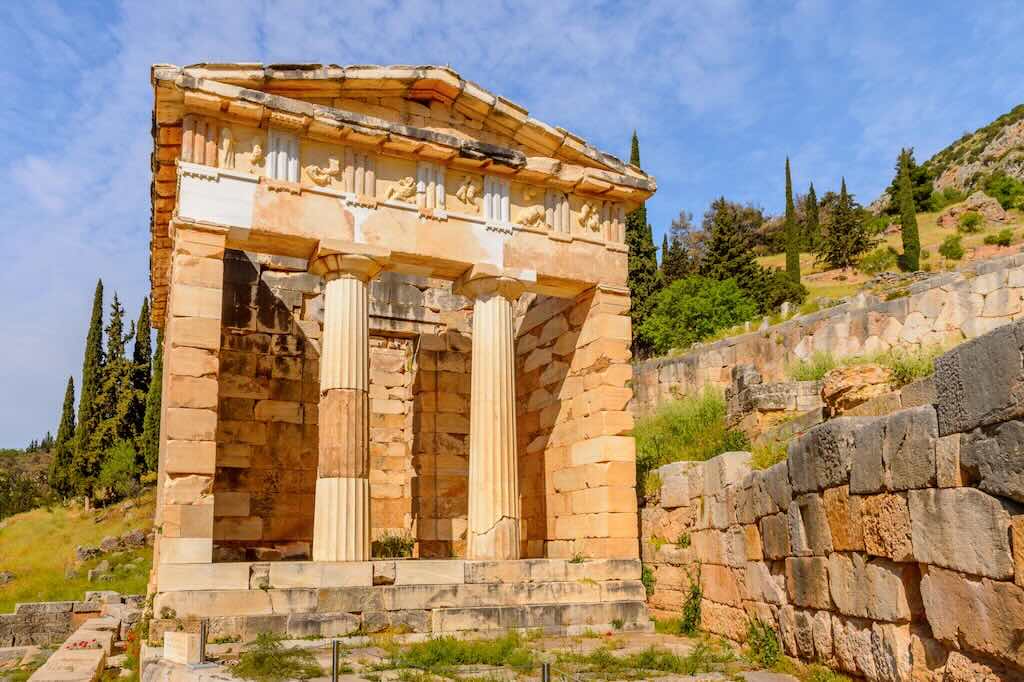
A distyle in antis denotes a compact temple with the side walls extending to the front of the porch and terminating with two antae, the pediment being supported by two columns or sometimes caryatids. This is one of the earliest and simplest types of temple structure in the ancient Greek world. It evolved directly from the Mycenaean megaron, an earlier rectangular hall with a central room and front porch.
An anta (possibly from ante, “before” or “in front of”), describe the posts or pillars on either side of a doorway or entrance of a Greek temple, the slightly projecting piers which terminate the side walls (of the naos). A cella (Latin for ‘small chamber’) or naos (from Ancient Greek naós or ‘temple‘) is the inner chamber of an ancient Greek or Roman temple (the main sacred chamber housing the cult statue). It derives from a hermit’s or monk’s cell, but is also at the origin of the biological cell.
This is from the Geometric (900-650 BC) to Archaic Period (800-480 BC). And a good example (shown above) is the Siphnian Treasury in Delphi (ca. 525 BC).
The double anta temple extended an anta to both front and rear. This evolution dated from the Late Archaic to Classical period (ca. 510-323 BC), with the Temple of Hephaestus (ca. 449–415 BC) being a good accessible example (although historians tend to quote it as fine example of a peripteral temple, one surrounded by a portico with columns).
A tholos is a circular temple or sanctuary building surrounded by columns. The name comes from the Greek for conical roof or dome, and it is a form of building that was widely used in the Greco-Roman world. It is a round structure with a circular wall and a roof, usually built upon a couple of steps (a podium), and often with a ring of columns supporting a conical or domed roof. Generally, a peristyle is a continuous porch formed by a row of columns (a colonnade) surrounding the perimeter of a building or a courtyard. The Tholos of Delphi (ca. 380 BC) is a good example.
A prostyle temple had a free-standing colonnade only at the front façade (i.e. no side walls extending to the front of the porch). It dated from the Archaic through Classical Periods (ca. 650–400 BC). The independent front columns created an increased visual drama, and a more ceremonial entrance.
The Amphiprostyle temple was a prostyle temple with columned porches at both front and rear, but not along the sides. It dated from Classical Period (ca. 500–323 BC), and the Temple of Athena Nike (ca. 427–424 BC) is a good example.
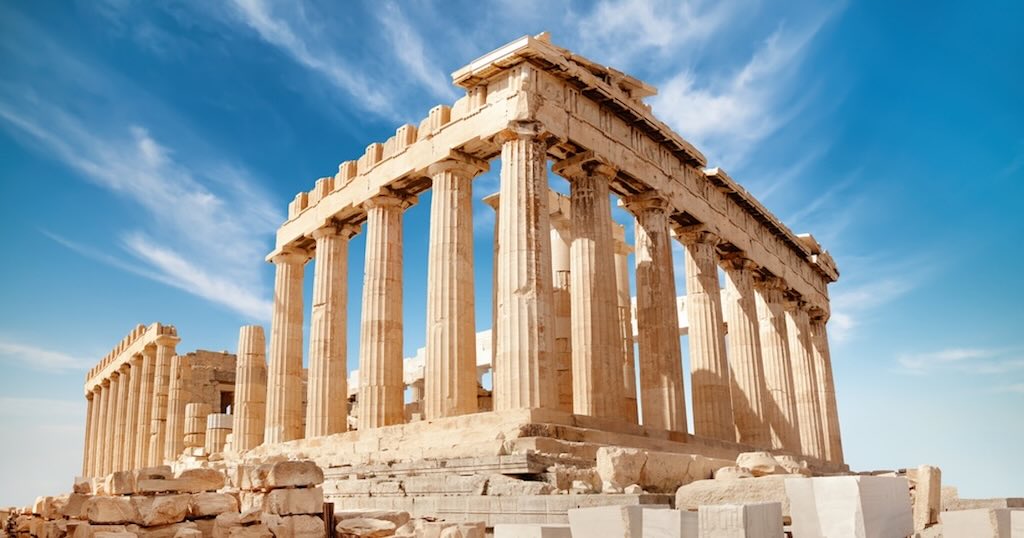
A peripteral temple surrounds the naos with a single continuous row of columns, e.g. a peristasis or surrounding colonnade.
With its processional circulation, it became the canonical Greek temple form.
The peripteral plan also helped distribute heavy roof loads more effectively.
The Parthenon (ca. 447–432 BC) is the most famous example.
A dipteral temple surrounded the naos with two complete rows of columns. The two rows created a deep processional zone, which emphasised its imperial monumentality.
This form was especially popular in Ionic Asia Minor sanctuaries, and a good example was the Temple of Artemis at Ephesus (in the version funded by the people of Ephesus, ca. 356–323 BC).
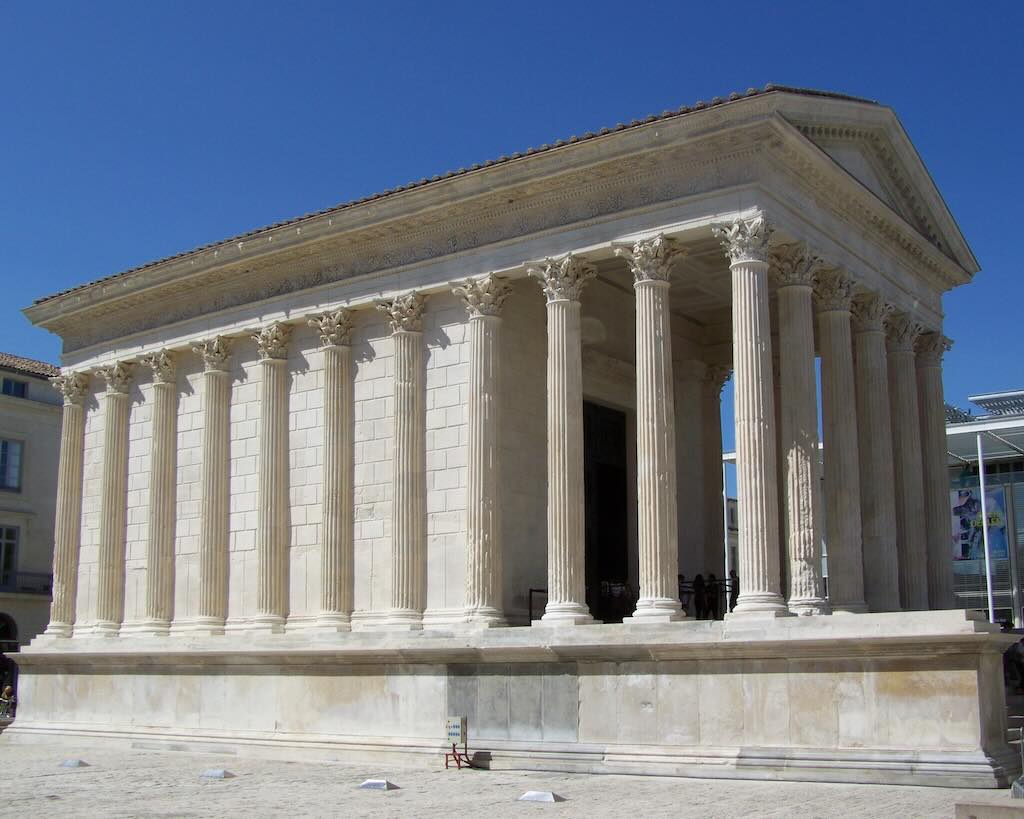
A pseudoperipteral temple (meaning “false peripteral”) imitates a peripteral colonnade, but the side columns are attached to the wall.
The illusion of a surrounding colonnade reduced structural complexity, kept the strong frontal emphasis, and was a important economical adaptation.
This temple type was found during the period ca. 200 BC–300 AD, and an excellent example is the wonderfully preserved Maison carrée in Nîmes.
A pseudodipteral temple uses only one row of columns, but spaces it as if a second row existed.
This temple style retained the broad ambulatory spaces, but reduced the construction cost. One example was the Temple of Artemis Leukophryene (ca. 2nd century BC). It now only exists as foundations and archaeological ruins at Magnesia on the Maeander (an ancient Greek city in Ionia).
So as temples became larger, the architects encountered escalating difficulties.
Bigger temples meant heavier roofs, longer spans, greater lateral pressures, transportation problems, and visual imbalance.
Coulton repeatedly emphasises that scale magnified structural weakness. A smaller temple design could not simply be enlarged proportionally. for example, the roof weight was already massive because they used marble or terracotta tiles, large timber frameworks, stone architectural members.
As the roof loads increased they needed to increase column density, thicken supports, and reduce unsupported spans. New temple designs emerged partly from load management.
Coulton shows how Greek architects gradually refined column spacing, height-to-diameter ratios, and intercolumniation.
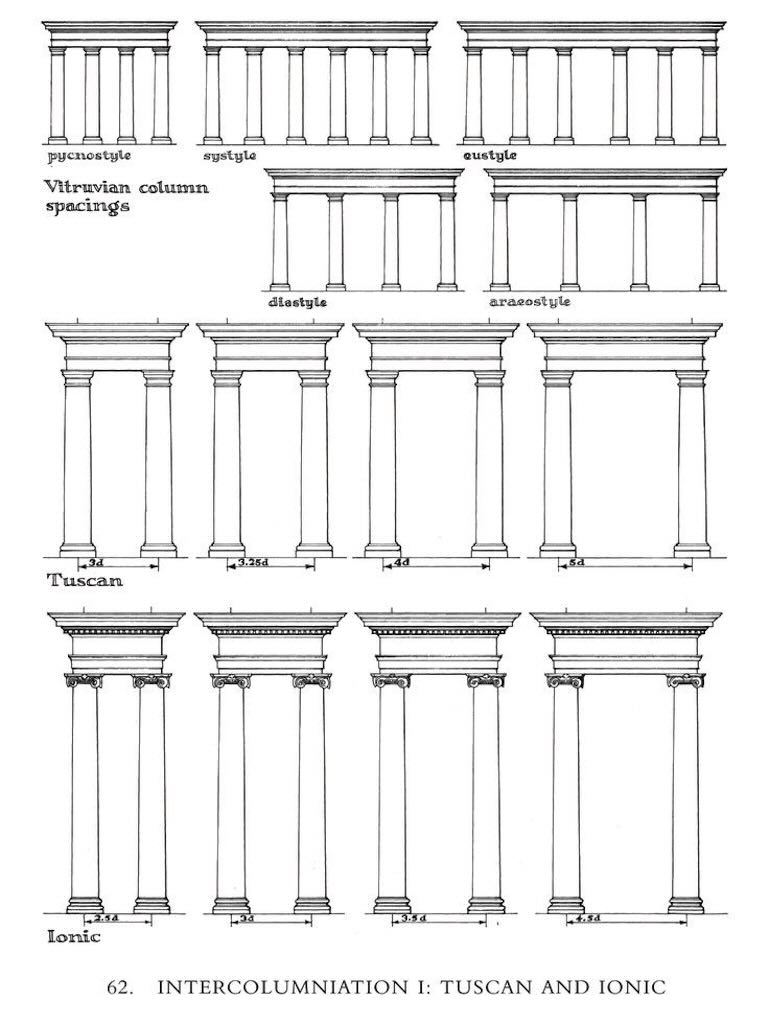
Early temples often appeared heavy and crowded. Over time architects had to reduce visual heaviness, widen spacing safely, and create a larger, more elegant interior space.
It sounds simple, but one of the major technical problems was how far apart could columns stand safely?
If too far apart architraves would crack, roof loads became unstable, and the building might collapse.
Greek architects preferred incremental optimisation, not revolutionary invention. They adjusted proportions, spacing, support systems, and load distribution. This is where many famous “Classical” refinements originate.
But the architects realised that structurally logical forms did not always appear visually harmonious.
This led to entasis, curvature, corner contraction, proportional modulation (as mention in Chapter 1).
Coulton repeatedly argues that Greek architects became innovative precisely because they worked within severe constraints.
They had limitations involving material behaviour, lifting technology, labour organisation, stone transport, roof engineering, and finally visual coherence.
So the problem was one of relentless optimisation. This is the core intellectual principle of the chapter. Greek architecture evolved through optimisation under constraint. Greek architectural harmony was not accidental. It evolved from repeated problem-solving, standardisation, modular planning, and controlled proportional systems. Every element, e.g. columns, beams, roof, spacings, and proportions, had to evolve simultaneously.
The Greeks did not possess advanced theoretical structural mechanics in the modern sense. They lacked calculus, stress analysis, mathematical elasticity theory. So it was all down to empirical observation, accumulated experience, geometric reasoning, and practical experimentation.
Structural necessity itself generated what we see today. The Parthenon did not suddenly appear, it was the result of a long process of disciplined architectural problem-solving.
There is a separate suggestion that the geometric regularity of the columns across different temples produced consistent acoustic shielding effects, particularly when colonnades were aligned to prevailing wind directions. This is consistent with Vitruvius’ recommendations in De Architectura to orient buildings in ways that minimise the impact of dominant winds for health and comfort.
Before moving to Chapter 3, it’s worthwhile stressing that Coulton also looked at the evolution of detailed building practices.
Modern visitors tend to focus on columns, pediments, and sculptures, but it was the roof that often posed the most difficult engineering problem.
Greek temples carried extremely heavy roofs, consisting of massive timber trusses, purlins, rafters, terracotta or marble tiles, and decorative acroteria.
Architects were cautious because they did not yet fully understand the limits of large roofs, so they preferred relatively narrow spans, and many columns.
Already in the 7th century BC they had introduction fired clay roof tiles, that were waterproof, fire resistant, and durable, but heavy. So walls, columns, beams, and rafters, had to be reinforced. Over time they developed the cover tile and the pan tile that were easier to overlap, and better at shedding water.
The most important invisible development was probably the timber framework. Architects gradually improved beam sizing, load paths, rafter spacing, and roof bracing.
Some prestigious temples, such as the Parthenon, later used marble roof tiles. But they were even heavier, and demanded improved support and column placement.
On top of that the roof also became increasingly decorative and elaborate, e.g. roof corners and ridges (acroterion), tile ends (antefixes), and gutters (simas).
Another evolution was in the way building blocks were fitted and interlocked. A temple contained thousands of stone blocks. In the earliest stone buildings they were just stacked, relying on gravity, careful shaping, and friction, to keep the structure intact against wind, roof thrust, thermal expansion, settlement, and even earthquakes.
The Greeks became skilled at dressing stone surfaces, so that joints became extremely thin, contact areas became larger, and loads were more evenly distributed.
Dowels, firstly wood, then stone and metal, were used to maintain alignment, and prevent movement during construction (in particular vertical dowels).
Then came iron clamps between adjacent blocks. A shallow recess was cut into both stones, and the clamp bridged the joint. But since iron rusts and expands, they covered the iron clamps in lead (modern restoration uses titanium connectors). The Parthenon contains hundreds of clamps, dowels, and precision joints.
There are three additional elements that I personally would have given more space to.
Surveying, measurement and geometric control
For example, the Parthenon is around 69 metres in length, but column lines, wall alignments, and platform dimensions had to remain consistent across the entire structure. They achieved this without steel tapes, optical levels, or modern surveying equipment. Instead, builders relied on measuring rods, calibrated cords, plumb bobs, and sighting techniques. Right angles could be established using simple geometric principles, including the well-known 3-4-5 triangle. Layout lines were marked directly onto prepared foundations, allowing column centres and wall positions to be transferred accurately across the site. Many surviving Greek temples exhibit dimensional deviations of only a few centimetres over distances exceeding 50 metres. Such accuracy required not only careful measurement but constant checking throughout construction.
What was hidden on the building site
Visitors saw only the finished temple, but every major sanctuary first required a temporary infrastructure. Before columns could be erected, architects had to organise quarry roads, storage yards, workshops, lifting areas, and transport routes. Marble blocks weighing several tonnes were often hauled on wooden sledges from nearby quarries and moved using teams of men, animals, rollers, ropes, and earth ramps. Large temple sites probably contained carpentry workshops for roof timbers, stone-dressing areas where blocks were finished before installation, and storage compounds for tools, metal fittings, and prepared architectural members. Temporary ramps and timber lifting frames were constructed solely to facilitate building operations and were later removed. In many cases, the invisible construction infrastructure represented an engineering project almost as complex as the temple itself.
The architect as project manager
On a major project the architect functioned as planner, procurement officer, scheduler, engineer, and site supervisor. Hundreds of workers might be involved, including quarrymen, hauliers, masons, sculptors, carpenters, metalworkers, and labourers. Materials arrived from multiple sources and often had to be prepared in a specific sequence before construction could proceed. Roof timbers could not be installed before columns and architraves were in place. Sculptors worked alongside masons, and transportation schedules had to match the pace of construction. Surviving inscriptions from major sanctuaries show that large building programmes generated extensive accounts, contracts, and payment records. Coulton repeatedly stresses that successful Greek architecture depended not only on design skill but on the architect’s ability to coordinate labour, materials, finance, and construction over periods that could extend for many years.
Chapter 3 - The Problem of Design
A simplistic review of this chapter might conclude that it was about how Greek architects actually decided what a temple should look like. But in reality the chapter is focussed on what dimensions must the temple have, and how those dimensions were related to one another?
This chapter gets into some detail about design. So I’m going to list six videos on “Elements – The Classical Orders”, and another two videos on “Proportion & Geometry”. They can be viewed as a sequence, but the third video is probably the most relevant to this chapter on design.
So in this chapter Coulton turned away from the overall length of a temple, and began with the column diameter.
The lower diameter of the column became a practical design module.
Once column diameter was chosen, many other dimensions followed, for example, intercolumniation (column spacing), column height, stylobate dimensions, and entablature proportions could all be expressed relative to column diameter.
Column diameter controlled three major things simultaneously. Firstly, a thicker column can carry greater load. Thicker columns were heavier, more archaic, but more powerful looking. Whereas thinner columns appeared lighter and more elegant. But the bigger the temple, the bigger the columns (although proportion and visual effect remained important considerations).
One of the clearest evolutionary trends was column height-to-diameter ratios. Early Archaic Doric (750–480 BC) columns were often 4–5 diameters high, and looked squat and heavy.
Classical Doric columns were 5.5–6.5 diameters high, and looked taller and more elegant (e.g. the Parthenon).
Ionic columns were even more slender, with heights of 8-9 diameters. Corinthian columns often reached 10 diameters or more.
Intercolumniation was also important. If the distance between columns was too narrow, the building would be dark inside, and look crowded. Too wide it would look weak and structurally dangerous (the stone architrave could bend and even crack).
A change of only a few centimetres repeated around a temple could alter completely the total length and the visual mass.
One of the most technical design issues were the corners. In Doric architecture, triglyphs should align above columns, and should also occur at corners.
This is called “The Doric Corner Conflict“. Because triglyphs were expected to align both with column centres and with building corners, a purely regular spacing could not satisfy both requirements simultaneously. Greek architects therefore reduced the corner intercolumniation, producing the phenomenon known as corner contraction.
One of the major design decisions was the temple length. First came the façade column count, e.g. hexastyle (6 front columns), or octastyle (8 front columns).
The side column count then typically follows the relationship, twice the number of front columns (plus 1).
Coulton did not see evidence that Greek architects universally used some kind of Golden Ratio or sacred geometry, or even secret mathematical formulas. All he saw were simple rational ratios.
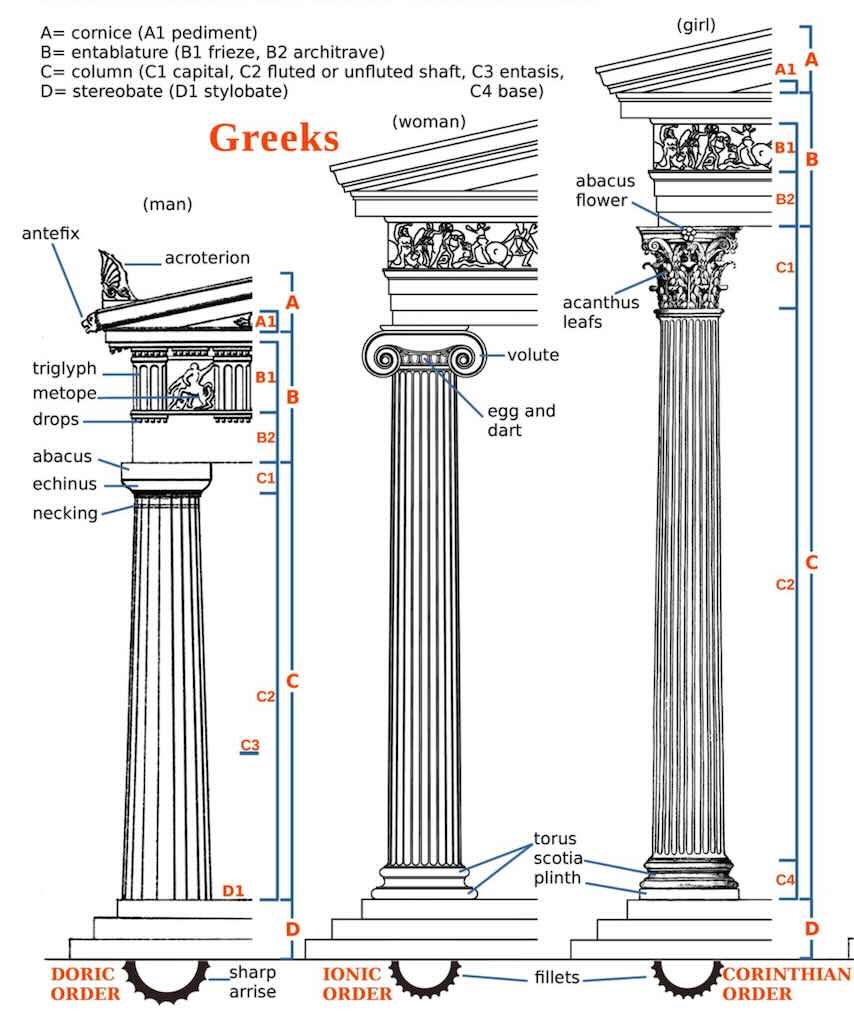
The Entablature Problem, was the fact that architects had to decide on the architrave height (B2), frieze height (B1), and cornice height (in the gap between A1 and B1). If too large, the building became top-heavy. If too small, the roof appeared unsupported. Because different regions and periods showed different solutions, Coulton saw gradual refinement.
In Doric architecture, the architrave was just a plain beam resting on columns, the frieze was home to triglyphs (the early wooden beam ends) and metopes (rectangular panels, sometimes left plain and sometimes filled with sculpture), and the cornice was a projecting upper crown carrying the roof edge. The entire entablature typically accounted for about 20–30% of the column height.
What was “decided” was a gradual movement from heavier entablatures in Archaic temples to lighter, more integrated entablatures in Classical temples.
For example, in the Early Archaic Solution (ca. 650–550 BC), the Temple of Apollo, Ancient Corinth (ca. 540 BC) looked massive, with very thick columns, heavy architraves, tall friezes, and deep cornices. The column height/diameter was ~4.5:1, and the entablature height was ~35–40% of the column height.
In the Classical Refinement (ca. 500–430 BCE), the Parthenon (447–432 BC) seems lighter and taller, with thinner architraves, friezes more balanced (e.g. triglyphs larger and dominant, and metopes a bit small), and cornices more refined (e.g. projection reduced, and mouldings more precisely cut usually based on a template). Here the column height/diameter was ~5.5:1, and the entablature height was ~31–32% of the column height.
One of Coulton’s recurring arguments is that architects did not begin with a blank sheet. They inherited regional traditions, local temple types, established proportions, and knowledge about previous successful buildings. He stressed that Greek architects gradually learned to coordinate column diameter, column height, spacing, façade width, building length, entablature dimensions, roof pitch, pediment size, into a unified proportional system. Fortunately they did not design every dimension independently. Instead, a relatively small number of controlling dimensions generated many of the remaining measurements. For example, once column diameter became the module, dozens of independent dimensions became related, thus reducing design complexity. This modular approach simplified planning, facilitated construction, and helped maintain visual consistency across increasingly large buildings.
However, this evolution was slow, given that building a smallish temple with local stone and limited sculpture, could take 2-5 years, and larger temples 5-10 years (the Parthenon took 9 years, and 15 years including the sculptures).
Chapter 4 - The Problem of Scale
The chapter is about the practical consequences of building bigger temples and the specific techniques developed by Greek architects.
Why does a temple (15 metres by 8 metres) work, but a temple (70 metres by 30 metres) doesn’t? The problem is that scale changes almost every engineering parameter. In the first case the roof span would be about 5–6 metres, whereas for the larger temple the roof span would be perhaps 15–20 metres.
The beam does not simply need to be three times stronger. It becomes much heavier, much more likely to sag, and is much harder to transport. Assuming it’s possible to find an 18 metres long straight wood beam. And even then you need to season and transport it, lift it, and stop it from twisting. This is why the Parthenon had an exterior colonnade, and in the interior two-storey colonnades, just to help support the roof (they also helped frame the cult statue and organise the interior).
In addition to the main timber beams a Greek temple roof consisted of purlins, rafters, terracotta or marble tiles, ridge tiles, sima (gutters), and acroteria. In the Parthenon the roof tiles alone probably weighed more than 300 tonnes.
The 46 exterior columns, each composed of 10-12 drums (each 7-10 tonnes), probably weighed around 3,000 tonnes of marble. Including the walls, the two-storey internal Doric colonnades surrounding the cult statue chamber, and the entablature, the total Pentelic marble used probably weighed in excess of 12,000 tonnes, not counting the foundations and crepidoma (stereobates and stylobates).
And not forgetting that Pentelic marble is found on Mount Pentelicus, only about 24 km from Athens (plus elevation change), but the marble had to be quarried, roughly shaped, transported, and then lifted onto the Acropolis (150 metres above sea level).
Many Classical blocks still have “Lewis holes” (special lifting recesses), for lifting into place with a crane (520–500 BC) or winch (windlass). Iron chains and chain blocks came later (but they did have hemp ropes).
They also had lifting bosses, projections left on blocks to assist handling.
The Parthenon was not the largest temple in the Greek world. Ionic sanctuaries such as the Temple of Artemis at Ephesus (destroyed in 401 AD) demonstrated that Greek architects were also tackling buildings on an even larger scale. This was 115 metres long and 55 metres wide (compared to the Parthenon of 69.5 by 30.9). Ancient sources mention 127 columns, each approximately 18 metres high (compared to 10.4 metres).
Scaling is not just multiplying. A 0.5 metres cornice projection, will not double to a 1 metres projection. Large buildings required proportion adjustments, not just multiplying everything by the same factor.
Unlike the Romans, Greek monumental architecture remained overwhelmingly committed to post-and-lintel construction rather than relying on arches, vaults or concrete as primary structural solutions. So everything had to be achieved with columns, beams, and lots of stone blocks.
Coulton stresses that Greeks built larger temples by improving surveying, quarrying, transport, lifting, roofing, proportional control, and construction precision. But as temples increased in size, structural, logistical, financial and visual problems all grew simultaneously. A successful solution at one scale could not simply be enlarged. It’s worth stressing again, that every increase in size was an empirical challenge, forcing architects to reconsider foundations, column spacing, roof spans, transport methods, lifting techniques and proportional relationships.
Chapter 5 - Form, Mass and Space
So far the book covered materials, construction, scale, and many engineering constraints.
This chapter asks how did Greek architects manipulate the physical form of a building to create particular visual effects?
The chapter is concerned with three measurable architectural variables, form, mass and space.
Form is the geometric shape of the building.
Mass is about how heavy or light the building appears.
Space is how the building encloses, defines, or creates spatial experience.
I found it amazing that I could not find a decent video about how Greek architects viewed, manipulated, and lived with these three architectural variables.
So I’ve decided to add below some videos about modern-day views on these three variables. Viewing them is optional…
In the above videos, we moved beyond the foundations of Greek architecture to examine how modern architects continue to manipulate the same fundamental variables of form, mass and space. These range from the simple geometric forms of Tadao Ando, through the architectural mass of Peter Zumthor and the monumental geometry of Louis Kahn, to the sculptural volumes of Álvaro Siza, the transformed masses of Herzog & de Meuron, the disciplined proportions of David Chipperfield, and the fluid spatial compositions of Zaha Hadid.
Greek architects could control the form (dimensions) of a building by varying length, width, height, roof pitch, and column count and proportions. The key parameter was the column height/diameter ratio that initially was 4.0 to 4.5 (e.g. Temple of Hera I, Paestum built around 525 BC) up to 8 to 9 (e.g. the Ionic Order Temple of Athena Polias in Priene built around 350 BC).
Mass is the visual heaviness of the building, where again the columns often were the determinant factor. A building with thick columns, dense spacing and heavy entablature appeared massive. Simply increasing the height of the columns reduced significantly visual mass.
Then increasing the intercolumniation (column spacing), created a building that appeared more open, more transparent, and of a lighter appearance.
The entablature also contributed to visual mass, where a large entablature would appear to dominate the columns. A smaller entablature would allow the columns to dominate.
Coulton argued that Greek architects increasingly learned to manipulate empty space.
Firstly the peristasis, the four-sided porch or hallway of columns surrounding the cella (naos), was used to create an exterior space which allowed priests to pass round the cella (along a pteron) in processions.
In addition, in larger temples, the cella was typically divided by two colonnades into a central nave flanked by two aisles. Again creating more space inside the temple. This colonnade zone defined a space without enclosing it completely. The two options provided additional visibility, movement, and a controlled access.
This was architecture through the creation of space, rather than mass. In fact, the creation of a pseudodipteral (e.g. Temple of Artemis Leukophryene), and removing the inner colonnade, resulted in less stone and less cost. Designing larger open spaces, proved to be economically and logistically a better practical option.
Coulton stresses that understanding the practical management of mass (e.g. stone, columns, roofs) was the first thought of Greek architects.
Then increasingly space became more important. How to facility movement, and create a visual experience (e.g. slender columns, wider spacing).
So despite the Parthenon being bigger and using more stone, the amount of visible mass was reduced, and the building looked (and was) more spacious.
That shift from building stone forms to shaping spatial experience is maybe the deepest idea in the book. It will certainly make me look differently at Greek monuments in the future.
The Parthenon
I know that throughout this book-review/revision-notes, I’ve mentioned numerous times the Parthenon. And I will continue to do so.
Now it’s time to just collect together a few fantastic links.
The official museum responsible for the Parthenon sculptures in Athens has a website, and the below video introduction.
There is also a series of videos (below) that look specifically at the Parthenon marbles.
Also the untold stories of the blocks of the frieze, e.g. block II from the north Parthenon frieze, and the chiseling process.
UNESCO hosts a webpage on Acropolis, Athens.
The British Museum also has a webpage dedicated to the Parthenon Sculptures.
The Parthenon Frieze was developed by the Acropolis Museum, the Acropolis Restoration Service and the National Documentation Centre -EKT.
On Friday 16 September 2022 there was an international meeting titled ‘Parthenon and Democracy’ . This meeting was held on the occasion of the General Assembly of the International Association for the Reunification of the Parthenon Sculptures which took place the previous day at the Acropolis Museum.
https://www.youtube.com/watch?v=3yAZn6NWxP8 is a record of the meeting, but is mostly in Greek (playback has been disabled).
Chapter 6 - Some Later Problems with the Orders
The Doric, Ionic and Corinthian Orders are often presented as the perfected outcome of Greek architecture.
In reality, once the Orders became established, architects faced a series of practical and design problems. Some arose directly from geometry, some from increasing complexity, and some from the tension between structural reality and visual appearance. Many of these problems occupied architects for centuries and influenced architecture from ancient Greece to Renaissance Europe and beyond.
The Doric Corner Problem, was one of the most famous technical difficulties in classical architecture. A Doric entablature contains alternating triglyphs (vertically channeled tablets) and metopes (a decorative band). Triglyphs were traditionally positioned above the centre of each column. However, a triglyph was also expected to sit at the outer corner of the building.
The two requirements are geometrically incompatible.
If a triglyph sits over every column centre and also occupies the corner, the spacing between triglyphs becomes irregular.
Greek architects developed several solutions:-
- narrowing the corner column spacing (corner contraction)
- widening certain metopes
- slightly adjusting triglyph positions.
I’m certain that some modern thinkers of the time proposed to simply put the triglyphs somewhere else. But the reality was that they were part of the inherited Doric system, and architects were constrained by tradition, and had to meet the expectations of both their patrons and the temple’s faithful.
The Parthenon employs substantial corner contraction. The spacing between the corner column and the adjacent column is roughly 0.6–0.7 metres smaller than the normal intercolumniation. The existence of this adjustment demonstrates that even the most celebrated Greek temple required compromises to maintain visual order.
Second problem was the increasing slenderness of columns.
As Greek architecture evolved, columns became progressively more slender. Approximate height-to-diameter ratios went from 4.5-5.0 : 1 (early Doric) to 9-10 : 1 for Corinthian.
The Parthenon’s columns are about 5.5 : 1
Slender columns appear elegant, but they introduce visual and structural challenges, namely greater apparent thinness, increased sensitivity to settlement and stronger optical distortions.
One solution was entasis, a subtle outward swelling of the shaft. Typical maximum bulge was only a few centimetres but dramatically affected perception.
The three Orders differ dramatically in complexity. A Doric capital consists essentially of echinus (a convex decorative moulding profile) and an abacus (a flat slab on the top). The Ionic column added volutes (the spiral, scroll-like ornament), carved mouldings, and more elaborate profiles.
The Corinthian column had two rows of acanthus leaves, volutes, helices (small spiral tendrils that emerge from the upper foliage), and a bit of extra floral ornamentation. So a Corinthian capital could contain hundreds of individual carved details. This increased complexity brought prestige but also higher cost, longer construction time, and greater dependence on specialist craftsmen.
Originally every component of the Order had a structural role, but over time many elements survived as highly decorative features, even when their original function disappeared.
The Problem of Rules refers to the way the classical Orders gradually became systems of proportional rules.
Roman architect Vitruvius described relationships between column diameter, column height, entablature height, moulding dimensions.
During the Renaissance these relationships became increasingly codified. Architects such as Andrea Palladio (1508-1580) and Giacomo Barozzi da Vignola (1507-1573) produced proportional systems governing almost every architectural element.
The advantage was consistency, but the disadvantage was rigidity. A building could easily become an exercise in following rules rather than responding to site, function, climate, or structure.
Doric Decline and Corinthian Dominance simply means that in the Roman period the Corinthian Order became overwhelmingly popular.
Doric had its difficulties (e.g. triglyph complications, strict spacing requirements, visually heavy appearance, fewer opportunities for ornaments), and tastes changed. Whereas Corinthian had adaptable proportions, richer decoration, easier integration into Roman façades, and greater visual prestige.
By the 1st century AD, many prestigious Roman buildings employed Corinthian columns almost exclusively. The Order became the architectural equivalent of luxury goods.
This highlighted another trend, the Orders became just another decoration.
Originally, Greek columns were structural, and columns supports real loads. Roman architecture gradually changed this relationship, with buildings increasingly relied on concrete walls, brick construction, and arches and vaults.
Columns often became attached to walls as decorative features. The most famous example is the Colosseum, with its façade of the Doric/Tuscan Order at ground level, Ionic Order above, and Corinthian Order above that. Yet the true structure is largely concrete and masonry.
The Orders survive, but their engineering role was diminished. As the Orders became increasingly sophisticated, architects gained a richer design vocabulary but lost some freedom. Every new refinement introduced additional constraints that later architects had to accommodate. This marked one of the most significant turning points in architectural history.
Chapter 7 - Aspects of Structure and Technique
Greek temples appeared simple, just columns supporting horizontal stone beams. In reality they required highly sophisticated solutions in quarrying, transport, lifting, stone cutting, geometry, and construction management.
The Parthenon is not simply a work of art. At the time of its construction, it was among the most sophisticated stone structures ever built.
Greek temples use a post-and-lintel system, just a horizontal beam sitting on vertical columns.
The main building sequence was:-
Foundations – Most Greek temples were built on a foundation consisting of prepared ground (stereobate), compacted fill, rough stone courses, and dressed upper courses.
The crepidoma was the foundation of one or more steps on which the superstructure of a building was erected. The stylobate was the top step of the crepidoma, the stepped platform upon which temple columns were placed (it is the floor of the temple). The lower levels of the crepidoma were called the stereobate, i.e. the remaining steps of the platform beneath the stylobate and just above the levelling course. This course was called the euthynteria and was uppermost course of a building’s foundations, partly emerging from ground-line.
The Greeks did not generally use deep foundations in the modern sense. Instead, they sought competent bedrock or firm subsoil and spread the load across a large area, e.g. the Parthenon sits directly upon carefully prepared rock with additional masonry courses above. The Greeks relied on precise stone fitting (often measured in only a few millimetres), mass and gravity, rather than mortar. Many foundation blocks were dry-jointed.
Stylobate – Is the uppermost visible step upon which the columns stand. More than just a platform, it was a carefully engineered surface. For example, with the Parthenon the stylobate was deliberately curved. It rose approximately 60 mm on east and west fronts, and approximately 110 mm on north and south sides.
Most ancient builders sought level surfaces. Whereas Greek architects deliberately built a non-level surface to achieve visual perfection. This curvature continued throughout the structure above.
Columns – Each column consisted of stacked marble drums, joined using carefully cut central dowels and metal fittings, often protected by lead. Entasis is the application of a convex curve to a surface for aesthetic purposes. So columns were not straight, and each shaft swells slightly near the middle. Maximum swelling was only a few centimetres.
Also columns were not vertical, they leaned slightly inward. If extended upward the north and south colonnades would meet roughly 2 km above the building.
Greek architects deliberately avoided both straightness and verticality. The goal was visual perfection rather than geometric purity.
Architraves – Is the principal horizontal is the lintel or beam resting directly upon the columns.
In Greek architecture it transfers load from the frieze, cornice and roof, to the columns.
Whilst stone is strong in compression, it’s weak in tension. Therefore span lengths are limited. The Parthenon column spacing are approximately 4.3 metres, which is close to the practical limits of large marble beams.
Frieze – Sitting above the architrave, it includes triglyphs and metopes (in the Doric Order), and is a continuous sculptured bands (in the Ionic Order).
On the Parthenon the Ionic frieze is approximately 160 metres long (and 1 metre high), and weighted 220–250 tonnes. It contained 115 blocks with 378 human figures and more than 220 animals. It is the Panathenaic Procession, the most important religious festival in Athens, held in honour of the goddess Athena.
The frieze contributes relatively little structurally, and its primary purpose is visual and symbolic.
It is situated about 12 metres above the ground, and i understand it was designed to be viewed as such. Firstly, the carving is not uniformly deep, which creates stronger shadows and improves visibility from below. Secondly, certain upper parts of figures are subtly enlarged, compensating for foreshortening. Thirdly, the horsemen, drapery folds and limbs are often arranged to create clear silhouettes rather than intricate detail.
Cornice – It projects beyond the wall and column line, and was designed to throw rainwater clear and protect the sculptures. It also creates strong horizontal shadows that change throughout the day. This was especially important with the strong Mediterranean sunlight.
Timber Roof Structure – Consisted of timber beams, purlins and rafters (i.e. all in wood).
Roof Tiles – Consisted of terracotta or marble tiles. The Parthenon used Pentelic marble roofing elements, which added hundreds of tonnes to the structure.
Greek roofing included cover tiles, pan tiles, ridge elements and drainage spouts (many in the form of lion heads).
Typical pan-and-cover terracotta tiles would weigh roughly 8–15 kg (pan tile) and roughly 3–8 kg (cover tile) for a combined roof weight of typically 40–70 kg/m². Marble tiles are much denser, and a individual marble tiles could wight 20–50 kg each. So a roofing system could weigh typically 100–150 kg/m².
The Greeks transformed a practical roofing system into part of the artistic programme (even rainwater became sculptural).
Unlike Roman architecture, arches played little role in major Greek temple construction, and there were no vaults, and no domes. Loads travel almost entirely through compression.
The largest Greek temples required thousands of tonnes of stone, and the Parthenon was constructed almost entirely from Mount Pentelicus marble. Pentelic marble fine grain, had high compressive strength, included a slight golden tint caused by iron content, and it developed a warm honey-coloured appearance with age.
The quarry was about 20 km from Athens, and the technique involved manually cutting channels around blocks, inserting wooden wedges, then wetting them to separate stone from bedrock.
Quarrying and transport often represented the largest component of construction cost.
Once onsite the stone blocks had to be lifted into place. One of the most important developments in Greek construction was the crane. Archaeological evidence suggests lifting devices appear in Greece by approximately 520–500 BC, although the shadoof, was a crane-like device used in Mesopotamia around 3000 BC.
Distinctive cuttings (e.g. lifting holes, bosses, and tong groves) begin appearing in Greek temple stone blocks during the late sixth century BC. With a crane, smaller blocks became practical, construction became more flexible, and precision improved.
The architrave was the most structurally demanding stone element. The Temple of Artemis at Ephesus had a marble architrave of 8.74 metres long, weighing approximately 24 tonnes (and set 20 metres above ground). Remember for the Parthenon the individual architrave blocks span about 4.3 metres, and they were set at about 10 metres above the ground.
The Parthenon demonstrates extraordinarily precise stone cutting. Because of stylobate curvature, entasis, inward column inclination, and corner contraction, almost no blocks were interchangeable, each block had its unique dimensions. Not one architrave block was a simple rectangular prism, so every stone had a specific position in the structure. This implied advanced surveying, accurate stone templates, and strict quality control.
You may have noted in this review that the Parthenon was built between 447-432 BC. Fifteen years is remarkably quickly, even if the sculptural programme was completed shortly afterwards. This certainly implies a large labour force, and a continuous supply of pre-cut stone. The architect and on-site project manager coordinated an exceptionally complex build, pulling together planning, surveying, quarrying, precision stone cutting, transport, and lifting systems into a single integrated process.
The extraordinary achievement of Greek architecture was not simply that some temples survived. It was that they achieved levels of geometric precision, structural sophistication and visual refinement that remained influential for more than two thousand years. And we should never forget that Greek architecture was not merely art. It was an extraordinary combination of engineering, geometry, logistics, craftsmanship and construction management.