The general idea for a trip to Canada was maturing for sometime, but was catalysed by a friend who was often in Toronto.
Initially the trip was to take the VIA Rail’s The Canadian from Vancouver to Toronto, and then spend a few days there visiting the sights.
Then it seemed obvious, even to the uninitiated, that I could drive back through the Canadian Rockies and British Columbia towards Vancouver, and pickup my return flight to Europe. This proved more complicated than first envisioned, but equally far more interesting.
The result was a four-day train ride, a 5-day stay in Toronto, then a flight back to Calgary, and a very slow and comfortable 16-day drive through the Canadian rockies, including a visit to Victoria.
The train ride and road-trip back are covered in different postings, so this post looks at basic planning.
My trip ran from 26 September to 25 October 2026, and involved several quite different forms of travel and weather conditions.
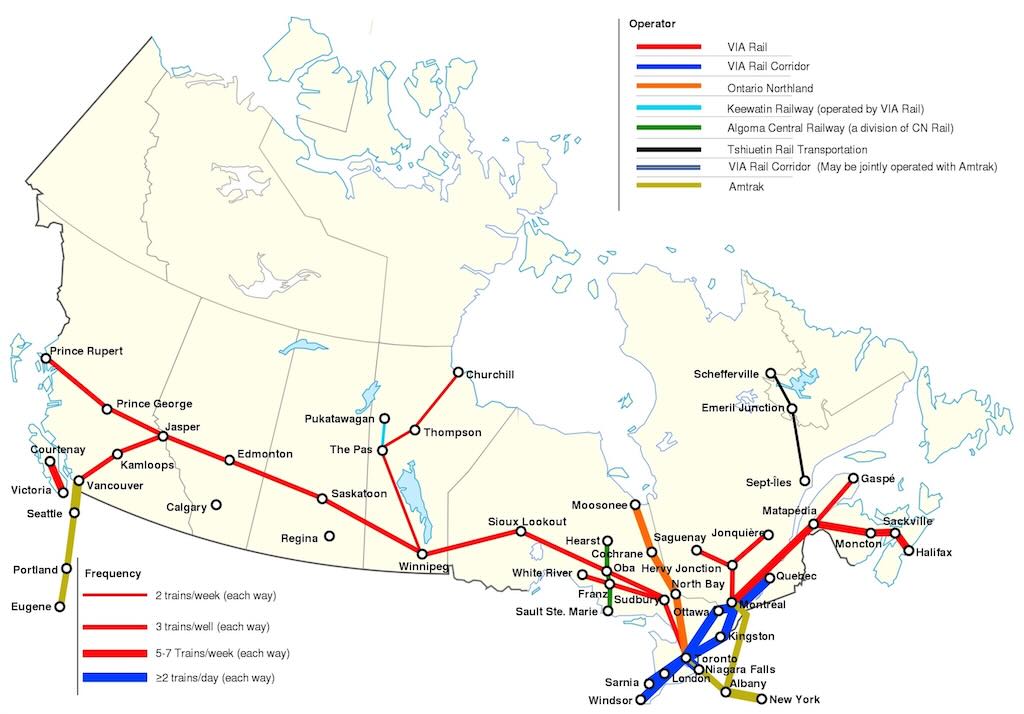
Canadian Railways
eTA or Travel Authorisation
As a Luxembourg passport holder I needed to apply for eTA or travel authorisation, and pay C$7 (≈ €4.36). At 20:25 I received conformation of my application, and a tracking number. At 20:28 I received confirmation that my application was complete, and no further action from me was required. At 20:30 I received approval.
As mentioned above, the Canadian eTA (Electronic Travel Authorization) is not a visa, but it authorised me, as a visa-exempt traveller, to board a flight to Canada.
My approved eTA is electronically linked to the passport I used when applying.
So the airline scans the passport and its system confirms the eTA.
It is valid for up to 5 years, or until that passport expires, whichever happens first.
I can travel to Canada repeatedly while the eTA remains valid, and it normally permits a visit of up to 6 months on each entry, although the Canadian border officer determines the actual period of validity.
Replacing or renewing a passport invalidates eTA, which is matched to the old passport.
The eTA doesn’t technically give a right of entry. It gives permission to travel to Canada by air. The border officer still decides, and may ask the purpose and length of the visit and potentially about bookings and funds.
An eTA is required when flying into Canada, not when entering Canada by land or sea, although they still need the appropriate passport and must satisfy the normal entry requirements.
CBSA Customs and Immigration Declaration
The eTA is needed to board an aircraft flying to Cananda, whereas the CBSA declaration is part of the process by which Canada decides what happens when a person actually arrives.
Arriving at Vancouver International Airport (YVR), there were two choices.
One option is to complete an Advance CBSA Declaration electronically through ArriveCAN, beginning up to 72 hours before your arrival in Canada.
Importantly, ArriveCAN is an advance declaration, not quite the final legal declaration. When arriving at Vancouver, I scanned my passport at a Primary Inspection Kiosk. The system retrieved the declaration linked to my passport. I reviewed my entries (can make changes), and then certify and submit the final declaration at the kiosk.
Had I not used ArriveCAN beforehand, I could have simply made the declaration at the airport kiosk after landing. Vancouver is one of the Canadian airports equipped with these kiosks.
The Inspection Kiosk gave me the go-ahead with a small paper receipt with a number on it. I then progressed to waiting lines, which I guess were controls and customs. There were lines for Canadian citizens, and a separate line for US and foreign passport holders. I took this second line which was empty and there was a person who simply looked at my receipt number and waved me to the baggage claim area.
It took about 15 minutes for the baggage to start arriving.
It’s important to keep the receipt from the Inspection Kiosk, although this was not mentioned, and could easily have been thrown away.
However, the receipt had to be collected when leaving the baggage claims area.
It was not difficult to find a Yellow Cab.
Medical and Health Information
Firstly, as a visitor to Canada, I assumed that Canadian public healthcare would not cover me. So I would have to count on employer/private/travel policies, and I would need to consider:-
Emergency medical treatment and hospitalisation, which can rapidly become very expensive for an uninsured visitor.
Medical evacuation/repatriation, including transport from a relatively remote part of the Rockies to an appropriate hospital and, if medically necessary, back to Luxembourg.
No problematic age restriction, e.g. at 75, some policies change their limits, excesses or pre-existing-condition rules.
Ordinary tourism and the road trip should be covered.
Preferred 24-hour assistance number and direct hospital payment/guarantee of payment.
I’m retired, but I still have an employer reimbursement scheme for medical costs, and including a private supplementary scheme, and a separate accident insurance.
However, I also have a separate assistance contract with Europ Assistance, with annual worldwide coverage. This covers medical costs up to €1.25 million, repatriation costs without limit, and any associated medical costs.
Europ Assistance require notification on the same day or within 48 hours at the latest.
24-hour assistance +32 2 533 75 75
This is the assistance centre and is available 24 hours a day, 7 days a week.
Medical information is also available 24/7, whereas the general information service is only Monday–Saturday, 09:00–20:00.
Personal Medication
Normally a visitor can bring personal medications into Canada, but they must be kept in their original, pharmacy-labeled containers and only up to a 90-day supply for personal use can be carried. Prescription drugs must be kept in their original bottles or packaging with the official pharmacy label showing the persons name. Also bring the prescriptions, or a letter from the doctor detailing medical conditions and the necessity of the medications. This can be useful when asking for a refill or receiving emergency care.
Travel in forested areas brings the risk of exposure to tick-borne diseases. Ticks are very common in country areas and are most active from spring to autumn. Take precautions against insect bites, including the use of insect repellent.
Mandatory Winter Tire Regulations
The law is clear, drivers must have tires displaying either the M+S (Mud and Snow) or the 3PMSF (Three-Peak Mountain Snowflake) symbol, with a minimum tread depth of 3.5 mm.
Major routes out of the interior and mountain passes, including the Trans-Canada Highway (Highway 1) and the Coquihalla Highway (Highway 5), are strictly monitored. Driving without them risks a $121 fine and being turned around at checkpoints.
Renting a car in Calgary (Alberta does not have a mandatory tire law), it’s important to stress that vehicles must be equipped with compliant winter or all-weather tires from the rental agency before driving into British Columbia.
Rental Car Checks
At the rental desk, before accepting the vehicle:-
- Confirm it is genuinely AWD or 4×4, not simply an SUV-shaped 2WD vehicle.
- Confirm the rental agreement permits the Calgary to Vancouver one-way journey, and that the Vancouver Airport return location is correct.
- Confirm what insurance/waiver is included and, particularly, your excess/deductible and what is excluded (windscreen, tyres, underside, etc.).
- Ask what to do in the event of breakdown, puncture, accident or windscreen damage, and save the 24-hour assistance number in your phone.
- Check the fuel/charging return rule.
- Make sure you have the registration/rental documentation required for the vehicle.
Check the tyres
Physically look at the sidewall of all four tyres. Look for 3PMSF — the Three-Peak Mountain Snowflake symbol  . Don’t accept statements such as “they are all-season tyres”.
British Columbia has a legal minimum on designated winter routes which is actually M+S or 3PMSF, with at least 3.5 mm tread depth. However, the British Columbia government itself states that 3PMSF tyres provide better snow-and-ice traction. For a mountain itinerary, the request was made for 3PMSF, rather than merely meeting the M+S minimum.
British Columbia winter-tyre requirements apply on most designated routes from 1 October, including mountain routes.
Also visually check:-
- all four tyres are the same appropriate type
- reasonable and broadly even tread
- no obvious cuts, bulges or sidewall damage
- tyre-pressure warning isn’t illuminated
- preferably check the spare wheel, or establish whether the car has a repair kit/run-flat tyres instead (including a car jack).
Walk around the car — photograph it
Before moving it, I took a complete phone video around the car, then photographs of anything questionable.
I checked bumpers, doors, wings, wheel rims, windscreen, mirrors, roof and lower bodywork. I photographed every existing scratch, dent, stone chip or wheel scrape and make sure significant damage was recorded on the rental company’s condition report.
I also photograph the dashboard showing mileage and fuel level.
I didn’t overlook the windscreen. A tiny existing stone chip can become a cracked windscreen later, particularly with temperature changes.
Sit in the driver’s seat — before leaving the car park
I started the engine and checked:-
- no warning lights remain illuminated
- headlights, indicators and hazard lights
- front and rear wipers
- windscreen washers
- heating and windscreen demisting/defrosting
- mirrors and seat adjustment
- parking brake
- reversing camera/sensors
- USB/USB-C connection and/or 12-V socket
- navigation/CarPlay.
I also check there was included a proper ice scraper/snow brush and washer fluid suitable for freezing conditions.
Before the first serious mountain section, always check:-
- Full fuel
- Water and snacks
- Warm/waterproof clothing accessible in the cabin rather than in luggage
- Gloves/hat/proper shoes
- Offline maps
Finally, I always checked road/weather conditions each morning. Mobile reception cannot be assumed throughout the mountain sections.
Heightened Fall Wildlife Risks
- Elk Rutting Season: In areas like Banff and Yoho National Parks, October marks the tail end of the aggressive elk mating season. Male elk are highly volatile and unpredictable. Keep at least 30 meters (3 bus lengths) away from them.
- Hyperphagia (Active Bears): Grizzly Bears enter a state of extreme eating right before winter hibernation. Parks Canada routinely issues late-season bear warnings for popular trail areas. Useful to carry bear spray, and keep it accessible, not inside a backpack. Read the instructions.
Money Matters
- Major credit networks (Visa, Mastercard, American Express) and debit cards are accepted almost everywhere, from hotels and petrol stations to remote cafes along the Trans-Canada Highway.
- Well over half of all transactions in Canada are made via tap-to-pay, e.g. Apple Pay, Google Wallet, or contactless physical cards.
- The Tap Limit for a single contactless “tap” transaction is $250 CAD. Anything above this amount the card must be inserted and the PIN code used.
- Some parking meters, national park kiosks, and upmarket coffee shops are completely cashless, and will only accept card or mobile payments.
Canada does not use 1-cent pennies, and cash transactions are rounded to the nearest 5 cents.
There are distinct 1-$ and 2-$ coins (CAD of course), that are nicknamed as the “Loonie” (featuring a loon bird) and the “Toonie”.
The US$ is not routinely accepted. It’s best to carry perhaps C$200–300 in Canadian notes, and use credit card/Apple Pay for most expenditure.
Remember, home bank cards charge foreign transaction fees, applied to every purchase.
ATMs are widely available at gas stations and banks along the route.
If an ATM offers the option to be charged in a home currency or local currency, always choose local currency (CAD) to avoid predatory conversion rates.
If you bring physical cash across the border into Canada, you must legally declare any amount totalling $10,000 CAD or more (or its foreign equivalent) to border customs.
The Culture of Tipping
In Canada, tipping is deeply embedded in the service culture and is structurally identical to tipping customs in the United States. Service workers often rely on tips to make a livable wage, and leaving a gratuity is standard practice for sit-down meals and personal services.
- 15% (Standard): The baseline for good, attentive service.
- 18% to 20% (Excellent): For outstanding service, or when dining at upscale restaurants.
- 10% to 12% (Below Average): Reserved for situations where the service was visibly lacking or poor.
- Completely skipping a tip is seen as a major insult and should only happen if the service was genuinely unacceptable.
- The Card Terminal Prompt: When paying by card, the portable payment machine will automatically present a tipping screen before inserting PIN or tap.
- The machine will ask the customer to select either a percentage (usually offering preset buttons like 15%, 18%, or 20%) or a specific dollar amount.
- There is a so-called Tip Jar Exception. At casual fast-food counters or coffee shops, where some money might go into a tip jar, the machine may still prompt for a tip. Tipping here is entirely optional, and clicking “No Tip” or “Skip” is perfectly acceptable.
- Hotel Staff: It is customary to leave $2 to $5 CAD per night for the housekeeping staff (left in the room on check-out day) and $2 to $3 CAD per bag for a porter or bellhop who carries luggage.
- Valet Parking: $5 CAD given to the attendant when they return a vehicle.
- Taxis and Rideshares (Uber/Lyft): 10% to 15% of the final fare.
- Guided Tours: With an organised excursion or wildlife tour, a tip of $10 to $20 CAD per person for the guide is highly appreciated.
Personal Safety
Passport, cards, cash and phone
Carry passports, credit cards and phone securely and close to the body. In Canada you see more often zipped inside pocket or secure cross-body bags rather than the traditional money belt.
Do not keep everything together, e.g. carry a second credit card separately.
Carry only a modest amount of cash. Canada is highly card-oriented, so there is little reason to carry a large quantity of Canadian dollars.
Keep electronic copies of passports, ID cards, driver licences, travel insurance/assistance details, driving licence and important bookings where they can be accessed independently on the phone. Keep separately the passport number and the telephone numbers for cancelling bank cards.
Leave unnecessary valuables and expensive jewellery at home.
Hotels
Use the room safe for your passport, spare credit card and other valuables when they are not needed.
Do not leave valuables unattended in hotel reception areas, restaurants or bars. A bag hanging from the back of a chair is particularly easy to take without being noticed.
Lock luggage when leaving it in hotel luggage rooms.
VIA Rail and public transport
Keep passport, wallet, phone and medication, rather than leave in checked or unattended luggage.
On trains and at stations, pay particular attention to possessions while boarding and leaving the train, when attention is naturally divided between luggage, tickets and finding seats or cabin.
Do not leave phone, wallet or other valuables on a table or seat.
An apparently helpful stranger, someone asking a question or creating a commotion, can provide an opportunity for another person to take a bag or other belongings.
Walking in Vancouver, Toronto, Calgary and other cities
There is no general reason to avoid walking in Canadian cities after dark, but use normal city precautions.
Stay on reasonably busy, well-lit streets and avoid taking shortcuts through deserted parks, alleys, industrial areas or unfamiliar neighbourhoods late at night.
If somewhere feels uncomfortable or unexpectedly deserted, turn back or take a taxi/rideshare rather than continuing simply because it is the shortest route.
Don’t show the phone when not needed. Looking continuously at a phone or map makes for an easy target.
Rental cars are not secure places for valuables.
Never leave passport, wallet, phone, camera, iPad or other important items in the vehicle.
Whenever possible, take luggage into the hotel rather than leaving it overnight in the car.
During sightseeing stops, do not leave bags, coats, electronics or other attractive items visible through the windows.
If luggage must remain in the vehicle during a travelling day, keep it completely out of sight in the boot.
Always lock the vehicle, even for a very short stop at a viewpoint, petrol station or café.
At remote viewpoints and trailheads, carry a small bag containing passport, wallet, phone and other essentials, rather than leaving them in the car.
Personal safety in the Rockies
The principal personal-safety risks outside the cities are more likely to arise from weather, road conditions, remoteness and wildlife than from crime.
Do not making significant walks away from populated areas. Do not rely on continuous mobile-phone reception.
Carry warm and waterproof clothing in the passenger compartment of the car, together with water and some food, rather than having everything inaccessible under luggage.
Do not approach or attempt to photograph wildlife at close range. Remain particularly cautious around bears, elk and other large animals, including animals encountered beside the road.
Before leaving the vehicle at a remote location, consider the conditions and how far you are actually going. A short sightseeing stop can become considerably more serious if the weather deteriorates unexpectedly.
If something is stolen
If a passport, wallet, phone or other important item disappears, first establish whether it has genuinely been lost or stolen, then act quickly.
Report theft to the local police and obtain a report/reference number where possible. Immediately block stolen bank cards and use the phone’s remote location/locking facility if appropriate.
Keep travel-insurance and assistance contact details somewhere that remains accessible without the phone.
Always carry passport, phone, and primary card. Keep spare card and reserve funds separately. Never leave valuables visible or unattended in the rental car.
Packing
The basic idea was to have one relatively compact set of luggage capable of dealing with Canadian autumn weather, supplemented by specific arrangements for the train and the driving sections.
The journey started in late September and continued well into October, so conditions were expected to become progressively more autumnal as the trip progressed.
Vancouver and the Pacific coast can be relatively mild but wet, while Alberta and the Rockies can be considerably colder (frost and snow are possible).
In Vancouver it was best to plan for highs around 18°C to 20°C (lows around 10°C to 12°C), in late September, and around 12°C to 14°C (lows 6°C to 8°C) in mid-late October. Rainfall was expected to increase significantly heading into October.
In Toronto, early October would normally be 15°C to 18°C (lows 5°C to 8°C).
In the Canadian Rockies (e.g. Banff) temperatures could be anywhere between 13°C but could drop to as low as 5°C (lows could range from 3°C to -4°C). So cold with a chance of early mountain snowfalls.
Life aboard VIA Rail’s The Canadian to Toronto can be unpredictable. Sleepers are generally comfortable, and there are extra blankets. Skyline and Dome Cars run notoriously cool or even cold due to the powerful air conditioning fighting the overhead sun. The connection hallways between the passenger cars are uninsulated and draughty.
Dress code
Fairmont Hotels and Resorts have no formal or strict dress code, but smart casual is preferred. Individual dining venues frequently enforce rules. The famous Fairmont Afternoon Tea requires a smart casual to elegant dress code (e.g. trousers, collared shirts, or blazers, often just called “Tea Room Attire”). Signature dining typically requires smart casual or business casual attire. However, the Historic Castles (e.g., Fairmont Banff Springs, Fairmont Chateau Lake Louise, Fairmont Chateau Whistler) have a more relaxed dress code (e.g. hiking boots, flannel shirts, fleece jackets, or ski gear during the day), but some people still dress up (a bit) for dinner.
Packing Lists
Given that the journey involved cities, hotels, trains and a car. The best option was a good layering system rather than a large collection of heavy winter clothes.
The most useful system is three layers:-
- Base layer – normal shirt or long-sleeved shirt.
- Warm layer – jumper, fleece or light sleeveless warmer layer.
- Outer layer – windproof and waterproof jacket.
The three can be worn independently or together. This provided much greater flexibility than taking a heavy winter coat which might have be unnecessary for most of the journey.
A slightly warmer reserve layer might be considered for the Rockies, without becoming part of the normal daily clothing.
Documents, money & essentials
- Passport (was renewed)
- Canadian entry documentation/authorisation as applicable
- Travel insurance certificate and emergency contact details
- Flight/e-ticket details
- VIA Rail reservation and accommodation details
- Hotel reservations
- Car-rental documentation for the driving section
- Driving licence and any additional documentation required by the rental company
- Paper copy of passport, etc.
- Copies of insurance and important travel documents
- Copies stored on phone/cloud
- Emergency contact details
- Credit card
- Back-up card stored separately
- Some Canadian dollars
- Wallet/small secure pouch for passport, cards and money.
The important principle is that the documents needed to continue the journey should not all be kept in one place. The essential information should be available both electronically, and independently of the phone.
Medication & small medical kit
Canada does not require the more specialised medical precautions needed for remote parts of Uzbekistan, but a small personal kit is still sensible, particularly because the journey is almost a month long.
- Regular prescription medication
- Sufficient medication for the whole trip plus a small reserve
- Medication in original labelled packaging where appropriate
- Copy of prescriptions
- Normal painkiller/anti-inflammatory
- Paracetamol
- Indigestion/antacid treatment
- Anti-diarrhoea treatment
- A few oral rehydration/electrolyte sachets
- Antihistamine
- Plasters/Band-Aids
- Blister plasters
- Small antiseptic wipes
- Any usual cold/throat medication
- Elasticated knee support
- Folding walking stick if still considered useful
There is no reason to carry an elaborate expedition first-aid kit. The purpose is primarily to have familiar medication immediately available rather than having to find a pharmacy for every minor problem.
Hygiene & toiletries
- Toothbrush/toothpaste
- Deodorant
- Shampoo/shower gel as required
- Shaving equipment
- Comb
- Wet wipes/travel wipes
- Hand sanitiser
- Tissues
- Lip balm
- Nail clippers
- Laundry bag for dirty clothing
- A few small zip-lock bags
Because this trip lasted almost a month, toiletries were bought as necessary.
Clothes
The basic wardrobe consisted of:
- Mix of short- and long-sleeved shirts
- 3–4 pairs of trousers/chinos
- Underwear
- Normal everyday socks
- Several warmer pairs of socks
- Sleepwear
- Belt
- One slightly smarter shirt/outfit for dinners
- One jumper/fleece
- One additional light warm or sleeveless layer
- Windproof/waterproof outer jacket
- Warm hat
- Light gloves
The emphasis should be on clothes that work in several combinations rather than individual garments intended for one particular temperature.
Laundry during the journey was essential, so there was little point carrying four weeks of shirts, underwear and socks.
Footwear
- Well broken-in, comfortable walking shoes
- Preferably water-resistant
- Good grip for wet pavements and mountain stops
- Second pair of comfortable shoes/trainers
- Lightweight indoor/hotel footwear if useful
Heavy walking or mountaineering boots should not be necessary for the planned itinerary. The priority is a solid comfortable shoe that could cope with long city walks and short stops on wet or uneven ground.
Rain & cold
- Waterproof/windproof jacket
- Compact umbrella for cities
- Warm hat
- Light gloves
- Warm socks
- Fleece/jumper
- Light additional insulating layer
These items provide the reserve needed for the Rockies without turning the entire suitcase into winter luggage.
Electronics
- iPhone
- iPad
- Chargers and cables
- Headphones/earbuds
- Canadian Type A/B plug adapter
- Small binoculars (optional, but useful)
The iPhone remained my principal camera. The small binoculars were particularly worth having on The Canadian and during the mountain journey, without introducing the complication of carrying substantial photographic or optical equipment.
Before leaving
- Download offline maps for the principal Canadian regions being visited
- Download airline tickets
- Download VIA Rail tickets/reservations
- Download hotel reservations
- Download car-rental documentation
- Download insurance documents
- Photograph passport and important documents
- Store emergency numbers in phone
- Check credit/debit cards for Canadian use
- Check roaming/eSIM arrangements
- Check all chargers accept Canadian 120 V supply
- Check the weather forecasts for Vancouver, Toronto, Calgary and the Rockies immediately before final packing
The last point was particularly important. There was little advantage in deciding the precise cold-weather clothing several weeks in advance when the final weather forecasts would determine whether the warmer reserve clothing was actually necessary.
Daypack
The normal daypack should remain deliberately light:
- Water
- Phone
- Sunglasses
- Tissues
- Hand sanitiser
- A couple of plasters/blister plasters
- Essential medication
- Light warm layer as appropriate
- Waterproof jacket as appropriate
- Small amount of cash
- Credit card
- Passport/copy as appropriate
- Binoculars when useful
The contents can obviously change according to the day.
Hand luggage on flights
- Passport/documents
- Money/cards
- All essential medication
- Phone/charger
- iPad
- MacBook
- Power bank, as permitted by airline rules
- Binoculars
- Valuable electronics
- Glasses/spare glasses
- One change of essential clothing
Anything that would seriously disrupt the journey if the checked suitcase were delayed should travel in the hand luggage.
The Canadian — separate packing
The four nights aboard The Canadian need their own packing arrangement.
Try to keep separate the clothes used through to arriving in Toronto, principally those for the train.
Calgary–Vancouver drive — separate packing
The clothing needed for cold or wet roadside stops should be immediately accessible in the vehicle, rather than packed at the bottom of the suitcase.
When Arriving in Each New Hotel
Upon arriving in a new hotel room, immediately check the heating/air-conditioning, shower/hot water, toilet, electrical sockets and room safe. If something isn’t working, report it while checking in rather than discovering the problem late in the evening.
Also identify somewhere sensible to charge the phone and other electronics, and check the arrangements for breakfast, departure and luggage before going to bed.
Weather Forecasts
26 September – 2 October: Vancouver → Toronto on The Canadian
Close to arriving in Vancouver it was possible to have a reliable weather forecast. The forecast was for around 16–17°C by day, but it felt much warmer in the sun, and 8–9°C overnight (again I thought it was a little warmer). Showers are often mention for this time of years, but no showers, and the weather was clement.
Once the train moves inland, there were larger day/night differences. Through the Rockies and then across Alberta/Saskatchewan/Manitoba, it was best to assume roughly 10–18°C during daylight and 0–7°C overnight/early morning. We had a walk around on one stop, and the weather was clear, fresh, but perfectly acceptable.
2–7 October: Toronto
Once in Toronto I expected about 15–21°C by day and 7–12°C at night. The days were pleasant but it was best to be covered, and at night it could be cold.
From 7 October: Calgary → Rockies → BC
Those are sensible planning ranges, rather than forecasts this far ahead. The official 1991–2020 October normals illustrate the contrast rather well: Calgary averages 11.1°C / −1.3°C (daily max/min); Revelstoke 10.5/3.1°C; Kamloops 13.6/3.5°C; Victoria Airport 14.3/6.0°C; and Vancouver Airport 13.5/7.0°C.
Lake Louise is the outlier. Parks Canada gives October averages of only 7.9°C by day and −5.3°C at night, with an average 24.4 cm of October snowfall. Banff itself is somewhat milder at 10.1°C / −1.1°C, but still averages 18.9 cm of October snow.
The warning I would take seriously
Your Calgary-to-Revelstoke section should be treated as an early-winter drive, even if Calgary happens to be sunny and 15°C when you collect the car.
At Lake Louise, Rogers Pass and the higher sections of the Trans-Canada, you can encounter 0°C, wet snow, slush and ice while the valleys on either side are 8–12°C. The temperature displayed in Calgary or Revelstoke therefore isn’t sufficient for deciding what the road will be like.
This reinforces the decision we already made about your rental SUV: AWD/4×4 plus proper winter-rated 3PMSF tyres, rather than relying simply on tyres described as “all-season.” I would regard that as important for your October route, not an optional luxury.
The other change comes once you descend towards the Pacific. Cold ceases to be the principal issue; rain becomes the issue. Vancouver’s October normal is about 13.5°C/7°C, while Victoria is a little milder/drier in feel. Your lightweight hooded feather jacket plus a genuinely waterproof outer shell is therefore a very good combination. You don’t need a bulky winter coat.
What I would actually pack for temperature
For this particular journey, I’d work on a −8°C to +23°C envelope. You probably won’t experience both extremes, but both are credible enough that the clothing should cope with them.
Your feather jacket is a good choice. Add a light waterproof shell, two warm mid-layers/fleeces or jumpers, long-sleeved shirts, normal shirts/T-shirts, comfortable trousers, and one pair of gloves plus a light wool hat specifically for the Rockies. You don’t need expedition clothing or heavy snow boots. Waterproof walking shoes with decent grip are much more useful.
One other point: the current drought situation in southern BC means that late-season wildfire/smoke cannot yet be completely dismissed, although by October the risk normally declines substantially. Canadian monitoring currently shows significant dry conditions in southern BC, and BC’s own history notes that wildfire activity can extend into September and beyond.
So, in one sentence: Vancouver/Toronto should mostly feel like autumn (10–20°C); Calgary and the Rockies can feel like winter (−8 to +12°C); and Victoria/Vancouver at the end should return you to mild but wetter autumn (7–16°C).
CANADA — FINAL PACKING CHECK
ON YOU / HAND LUGGAGE
- ☐ Passport
- ☐ Wallet
- ☐ Driving licence
- ☐ Credit cards + debit/ATM card
- ☐ Some Canadian dollars if you already have them — otherwise ATM on arrival
- ☐ Travel/medical insurance details
- ☐ Regular medication — entire trip + several spare days
- ☐ Glasses / reading glasses
- ☐ Sunglasses
- ☐ iPhone 16
- ☐ iPad
- ☐ AirPods/headphones
- ☐ Power bank
- ☐ Charging cables
- ☐ North American plug adapter
- ☐ Flight / hotel / VIA Rail / car reservations accessible on phone
- ☑ ArriveCAN installed and declaration done
CLOTHING — MAIN CASE
- ☐ Lightweight hooded feather/down jacket
- ☐ Warm jumper or fleece
- ☐ 2–3 long-sleeved shirts
- ☐ 3–4 ordinary shirts/polos/T-shirts
- ☐ 3–4 pairs trousers
- ☐ Underwear
- ☐ Socks — include a couple of warmer pairs
- ☐ Sleepwear
- ☐ Light gloves
- ☐ Wool/warm hat
- ☐ Belt
- ☐ Comfortable water-resistant walking shoes with grip
- ☐ Second pair of shoes
TOILETRIES / HEALTH
- ☐ Toothbrush / toothpaste
- ☐ Razor + charger
- ☐ Comb/brush
- ☐ Deodorant
- ☐ Personal toiletries
- ☐ Small medication kit — painkiller, stomach upset, plasters etc.
- ☐ Any prescription documentation you normally carry
ELECTRONICS
- ☐ MacBook Pro — only if you actually want it for the month
- ☐ MacBook charger
- ☐ Samsung T9 — if taking MacBook/photo backup
- ☐ T9 cable
- ☐ iPad charger/cable
- ☐ iPhone cable
- ☐ Apple Watch + charger, if taking
- ☐ Check every cable against the device before closing case
- ☐ Spare North-American adapter
TRAIN — KEEP SEPARATE AND ACCESSIBLE
- ☐ Small overnight/train bag
- ☐ 4 nights’ underwear/socks
- ☐ Change of shirt
- ☐ Toiletries
- ☐ Medicines
- ☐ iPhone/iPad + chargers
- ☐ Headphones
- ☐ Your Canadian viewing notes/cheat sheet
- ☐ Feather jacket accessible for stops
- ☐ Reading material
- ☐ Water bottle
Don’t overpack the train bag — you’re in Sleeper Plus, not camping.
CALGARY → ROCKIES → VANCOUVER
- ☐ Driving licence easily accessible
- ☐ Sunglasses
- ☐ Gloves and hat moved into car, not buried in suitcase
- ☐ Feather jacket accessible
- ☐ Phone charging cable for car
- ☐ Offline maps downloaded before mountain section
- ☐ Check rental SUV is AWD/4×4
- ☐ Physically check tyres for 3PMSF mountain/snowflake symbol
- ☐ Roadside-assistance/rental contact saved on phone
- ☐ Water/snack in car for mountain sections
BEFORE LEAVING HOME
- ☐ iPhone fully charged
- ☐ iPad fully charged
- ☐ Power bank charged
- ☐ Canadian eSIM/roaming arrangement checked
- ☐ Bank cards usable in Canada
- ☐ PINs known
- ☐ Emergency/contact information accessible offline
- ☐ Key reservations downloaded, not just stored in email
- ☐ Check-in completed when available
- ☐ Home keys
- ☐ Luxembourg keys/parking/etc. dealt with
- ☐ Luggage identification tag
- ☐ Weigh main suitcase
Things we have deliberately removed
No umbrella — Fairmont guest umbrellas.
No binoculars — iPhone 16 is adequate and records the image.
No heavy winter coat — feather jacket + layers.
No snow boots — sensible water-resistant shoes with grip.
No month’s worth of clothes — use hotel laundry.
Physically check just before you close the front door:
PASSPORT — WALLET — MEDICINES — iPHONE — DRIVING LICENCE.