During a trip to Canada I drove from Calgary to Vancouver (arriving 11 – leaving 13 Oct. 2026), stopping in several different Fairmont Hotels on the way, namely Calgary, Banff, Lake Louise, Jasper, Whistler, and Vancouver.
The Fairmont name itself originated in the United States, with the Fairmont San Francisco, which opened in 1907. In 1999, Canadian Pacific Hotels acquired a controlling interest in Fairmont Hotels, and in 2001 the combined hotel business adopted the Fairmont Hotels & Resorts name. It subsequently became independent of Canadian Pacific.
Ownership changed again in 2006, when the business was acquired by investors led by Colony Capital and Kingdom Hotels International, associated with Saudi Arabian investor Prince Alwaleed bin Talal. Fairmont was combined with Raffles and Swissôtel under Fairmont Raffles Hotels International. In July 2016, the French hotel group Accor acquired the business, bringing all three brands into its international portfolio. Fairmont remains part of Accor today, although individual hotel buildings can have separate property owners.
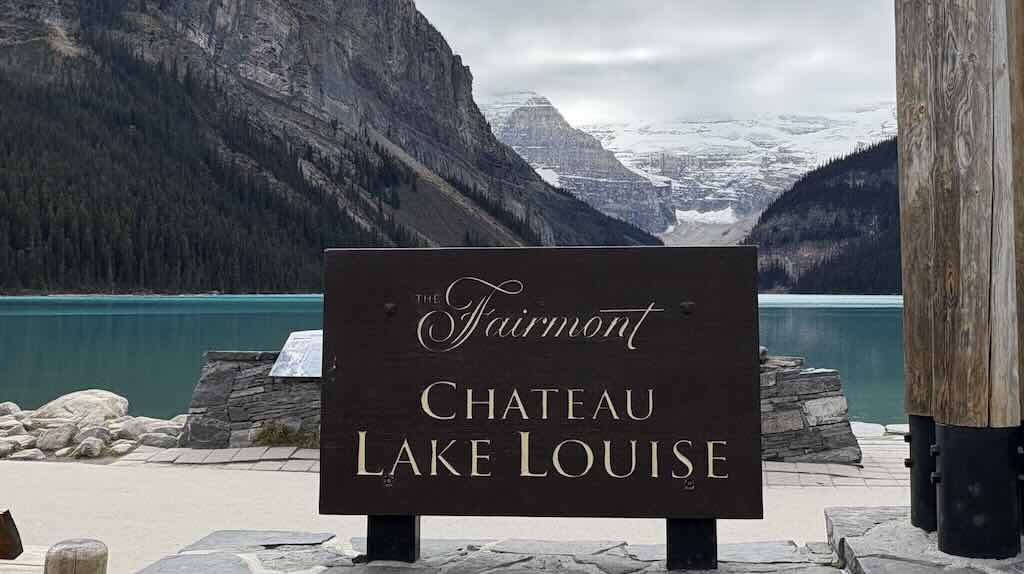
The Fairmont Chateau Lake Louise is a historic luxury hotel situated directly on the eastern shore of Lake Louise, at an altitude of approximately 1,750 metres, within Banff National Park in Alberta. The hotel overlooks the turquoise glacial lake towards Mount Victoria and the Victoria Glacier, approximately 3 km away at the head of the valley. It is located about 5 km uphill from Lake Louise village, 57 km northwest of Banff and approximately 185 km west of Calgary.
The original hotel was commissioned by William Cornelius Van Horne, the general manager of the Canadian Pacific Railway, who recognised that tourism could generate additional passenger traffic on the railway completed across Canada in 1885. Van Horne had already promoted construction of the Banff Springs Hotel, which opened in 1888. Lake Louise offered a different attraction: a relatively remote alpine lake surrounded by mountains and glaciers, suitable for mountaineering, walking and summer holidays.
The first establishment, known as Chalet Lake Louise, was a modest single-storey log building measuring approximately 15 by 9 metres, with a veranda, sitting room, kitchen and accommodation for just 12 guests. It was intended principally for outdoor enthusiasts and mountaineers rather than as a grand luxury hotel. Only about 50 guests stayed overnight during its first summer season.
The original chalet was destroyed by fire in 1893 and replaced the following year, using C$2,500 received from the railway’s insurers. A second storey was added in 1896, increasing accommodation capacity. The railway also improved the road connecting the lake with its station in the Bow Valley, enabling visitors to travel the final distance by horse-drawn carriage.
During the early 20th century, the property underwent substantial enlargement. Architect Francis Rattenbury, also responsible for the British Columbia Parliament Buildings in Victoria. His work introduced the steeply pitched roofs and decorative gables characteristic of the expanding hotel. By 1911 the establishment had developed into a substantial mountain resort, with approximately 120 guest rooms in the Rattenbury-designed accommodation.
A further major extension was designed by Walter S. Painter, the Canadian Pacific Railway’s architect, and constructed in 1912–1913. Unlike the earlier timber buildings, Painter’s wing was built in reinforced concrete and adopted an Italianate architectural style. It included substantial public rooms, notably the Victoria Dining Room and Sun Room. This is the oldest surviving part of the present hotel.
On 3 July 1924, a serious fire broke out in the cooks’ quarters and rapidly spread destroying much of the hotel. Reconstruction began almost immediately. The Montreal architectural firm Barott & Blackader designed a large new wing in a style compatible with Painter’s surviving building. Construction continued through the severe Rocky Mountain winter, with temporary heated enclosures allowing concrete to be poured at temperatures that sometimes fell to −40°C. The replacement wing opened on 1 June 1925. The hotel, now known as Chateau Lake Louise, had approximately 400 guest rooms and 425 summer employees. The Painter and Barott wings still form the historic core of the present building.
The hotel also played an important role in the development of mountaineering in Canada. Following the fatal fall of American climber Philip Stanley Abbot on Mount Lefroy on 3 August 1896, Canadian Pacific began employing professional Swiss mountain guides. The first guides arrived in 1899 and helped establish climbing routes, mountain huts and guided excursions. The hotel became a principal centre for exploring the surrounding high mountains, including Mount Victoria, Mount Lefroy and the Valley of the Ten Peaks.
For most of its early history, the Chateau operated only during the summer, generally from June to September. This changed in 1982, when the building was winterised to allow year-round operation. The conversion coincided with the growth of skiing in the Lake Louise area. The Glacier Wing, added in 1987, provided approximately 140 additional rooms, while the Mount Temple Wing, opened in 2004, increased the hotel’s conference and event facilities.
Welcome
I arrive around 13:00, and my room was not ready. This was not surprising. Firstly Fairmont Chateau Lake Louise is certainly one of the most popular hotels in Canada. In addition I arrived on the 11 Oct. and left on the 13 Oct., and the Monday 12th October 2026 was Canadian Thanksgiving (the second Monday in October).
The hotel has The Lounge where it offers coffee/tea for those waiting for their rooms. I received my key around 16:30, but I had actually pre-booked an afternoon tea.
Afternoon Tea in the Fairview Restaurant
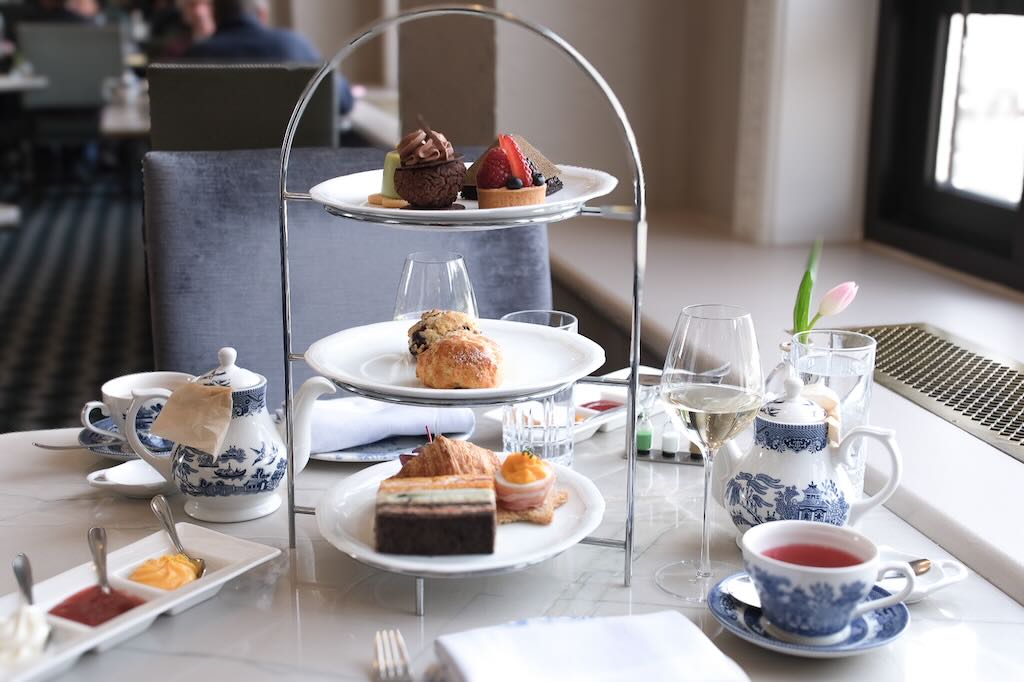
The famous Afternoon Tea is served in the Fairview Restaurant. Access is through the Fairview Bar, which also provides access to the Lakeview Lounge.
The restaurant (and Lounge) occupies one of the hotel’s principal lake-facing spaces, with large windows overlooking Lake Louise towards Mount Victoria and Victoria Glacier. The attraction is therefore as much the setting as the tea itself. Guests sit in the comfort of a luxury hotel, looking across one of the best-known mountain landscapes in the Canadian Rockies, having a glass of bubbles and afternoon tea.
The luxury experience
Afternoon Tea at the Chateau follows the English aristocratic tradition established in the 1840s, generally associated with Anna Russell, the seventh Duchess of Bedford. Originally a light meal taken between luncheon and a late dinner, afternoon tea developed into a fashionable social occasion among the British upper classes. The Canadian Pacific Railway’s grand hotels subsequently adopted aspects of this British tradition, presenting refined hospitality as part of the experience of travelling through the Canadian Rockies. The Chateau continues this tradition, although the present service is a contemporary luxury-hotel interpretation rather than an unchanged 19th-century ceremony.
The service includes a selection of Fairmont’s 35 teas, delicate savoury sandwiches, freshly baked scones accompanied by Devonshire cream, preserves and lemon curd, and individually prepared pastries and desserts.
The “basic” tea is offered with a glass of house sparking wine, for a standard cost of C$125 per person.
It possible to have a glass of Veuve Clicquot Brut for C$165, and C$38 for an additional glass of Champagne. A glass of Henry of Pelham, Cuvee Catherine Rose Brut, would be an additional C$27.
Tea could be served with a glass of Benjamin Bridge Brut, Nova Scotia, for C$140 per person (additional glass C$25).
There was also A Celebration Afternoon Tea, served with a glass of Moet & Chandon Dom Perignon 2015, for C$230 per person (additional glass C$110).
The cake stand itself included:-
Savoury & Sandwiches – East Coast Crab Roll, Pacific Smoked & Candied Salmon, Cream Cheese, Avocado, Alfalfa & Chicken Mini-Croissant, Baby Cucumber, Dill & Sour Cream, and Beefsteak, Tomato & Buffalo Mozzarella.
House-made Scones – White Chocolate & Saskatoon Berry, and Traditional, served with Classic Lemon Curd and Devonshire Cream, and a Signature Strawberry Jam.
Spring Inspired Sweets – Wild Rose & Raspberry (raspberry compote, raspberry compote-filled choux & rose whipped ganache), Pineapple & Passionfruit (pineapple compote, passionfruit mousse on a vanilla shortbread), .Matcha & Yuzu (mochi jelly, chantilly & yuzu crémeux on a matcha sablé), and Cherry, Chocolate & Salted Caramel Tart (dark chocolate ganache, salted caramel chocolate ganache, cherry whipped ganache, cherry compote).
You could also add for a C$250 a Chilled Lobster & Caviar Tower, with Nova Scotia Lobster Salad Stuffed Vol-au-Vent, and Mountain River Sturgeon Caviar with Blini, Egg, Crème Fraîche.
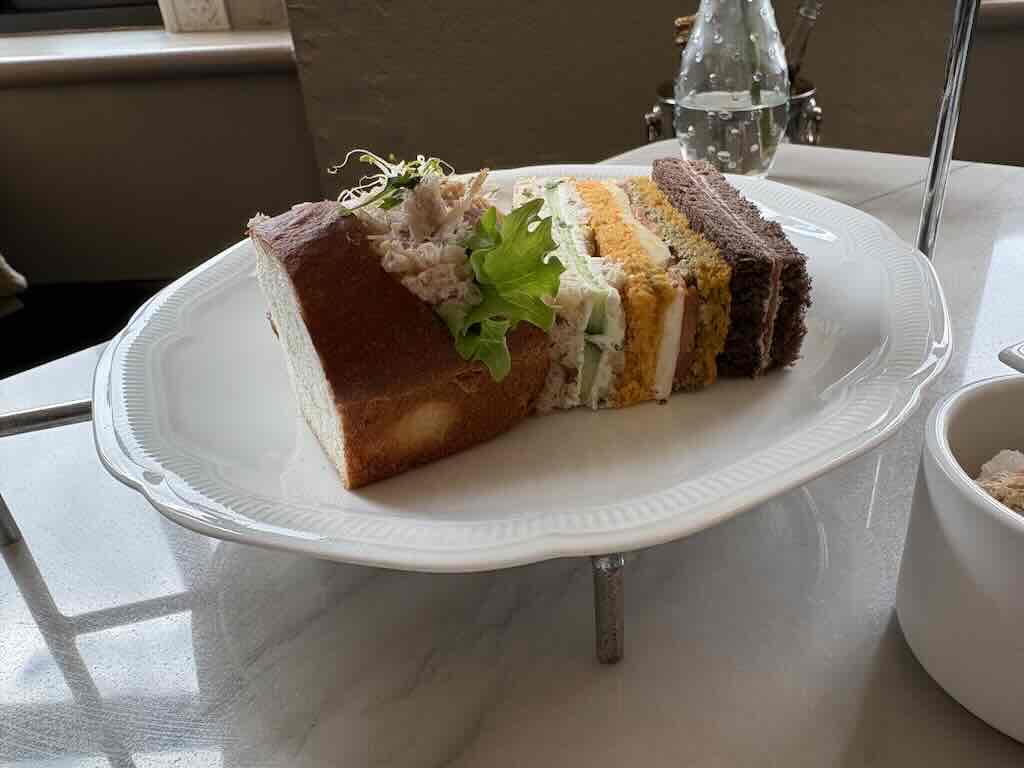
The Savoury & Sandwiches presented well, and the tastes were three, except perhaps for the Beefsteak Tomato & Buffalo Mozzarella, which was a little dry and tasteless (I have left that to the end).
I was looking forward to the house-made Scones. With my sister, our holiday treat was often a “cream tea” with scones, clotted cream and strawberry jam. There were two small scones in a tea-towel. The first problem was that they were small and broke-up when cut. Otherwise it was a nice “little” treat, that did not match my memories of summers past. With the lemon curd, cream and jam serviced in little bowls, it just did not have that sense of abundance.
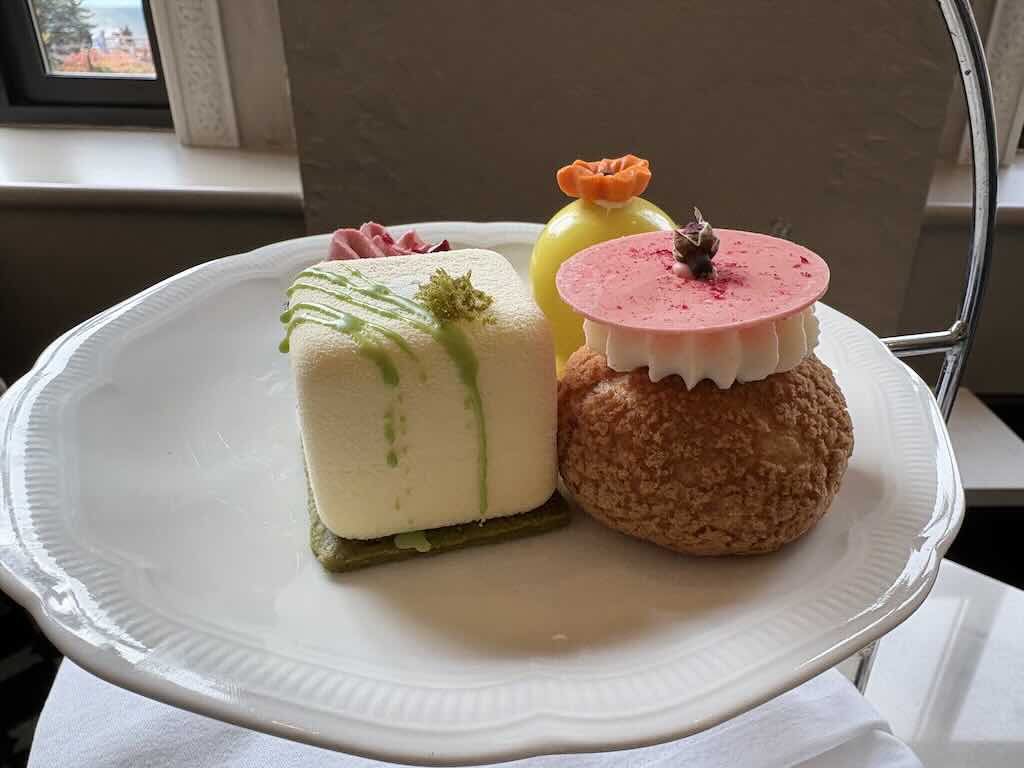
However, the “Spring Inspired Sweets” looked abundant, even in October. I tried each in part. Firstly, I found them all slightly over-sweet. But my main problem was with the constantly similar texture. The tastes were different but the sensation in mouth was very similar.
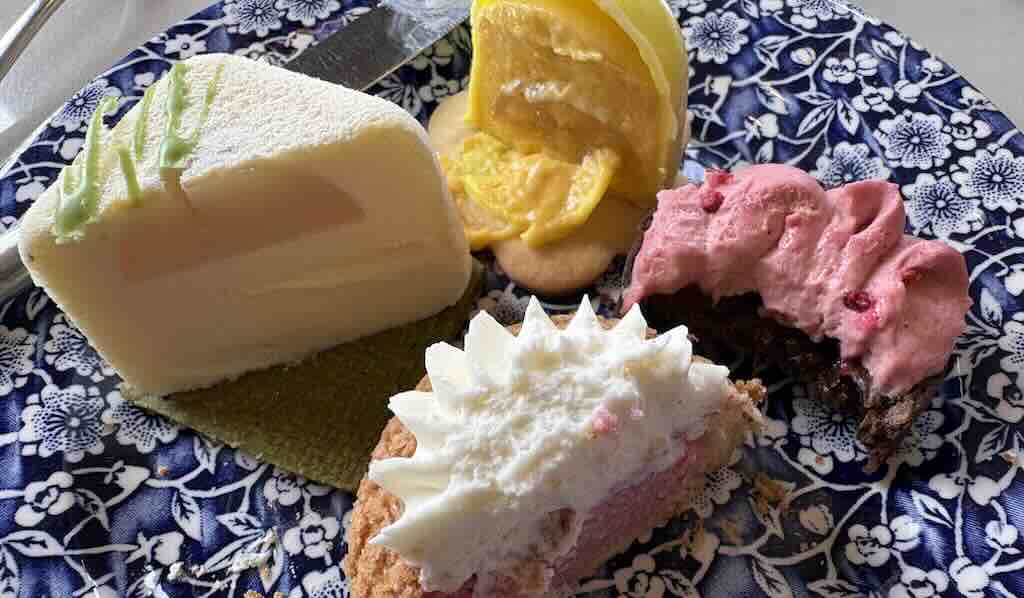
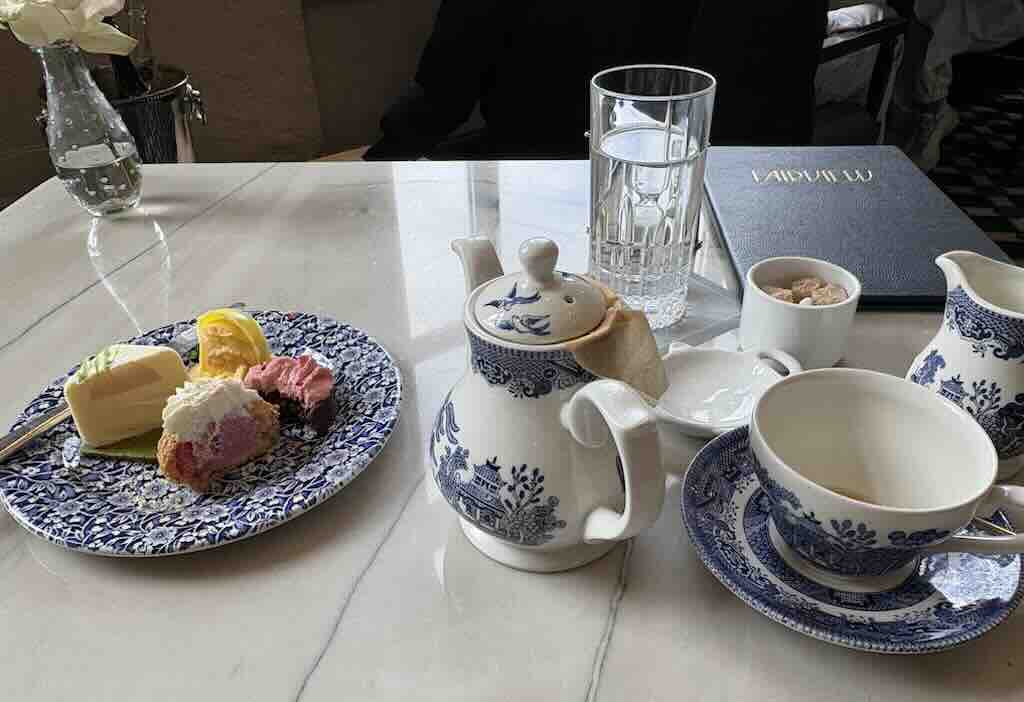
So I left my sweets unfinished. They didn’t care. One person occupying a table for two, they were happy to see my back.
This kind of luxury has a different flavour when consumed alone. My mind turned to Monique, and I’m sure she would not have finished the sweets either. But it would have made no difference, we would have enjoyed the moment together.
The Economics of Manufactured Luxury
The hotel’s published menu lists afternoon tea at C$125 per person, including sparkling wine, rising to C$230 with Dom Pérignon.
The ingredients themselves, tea, flour, cream, preserves, bread and relatively small quantities of premium fillings, cannot account for the full price. Of course the price also covers skilled preparation, staffing, service, restaurant space, operating costs and the economics of running a remote luxury resort.
More importantly, the customer is purchasing something that cannot easily be replicated elsewhere, i.e. the experience of taking afternoon tea in a historic Canadian railway hotel overlooking Lake Louise and Victoria Glacier.
This is a classic example of experiential luxury, in which the perceived value of a product is determined as much by its setting, reputation, ritual and exclusivity as by its intrinsic material value. The traditional presentation, premium branding, dress expectations and Champagne options help transform a relatively simple meal into a high-priced occasion.
At Lake Louise, the mountain scenery is genuinely exceptional, but I might have enjoyed more a pizza in my room. As we will see below I had an even better view over Lake Louise and Victoria Glacier.
Bedroom
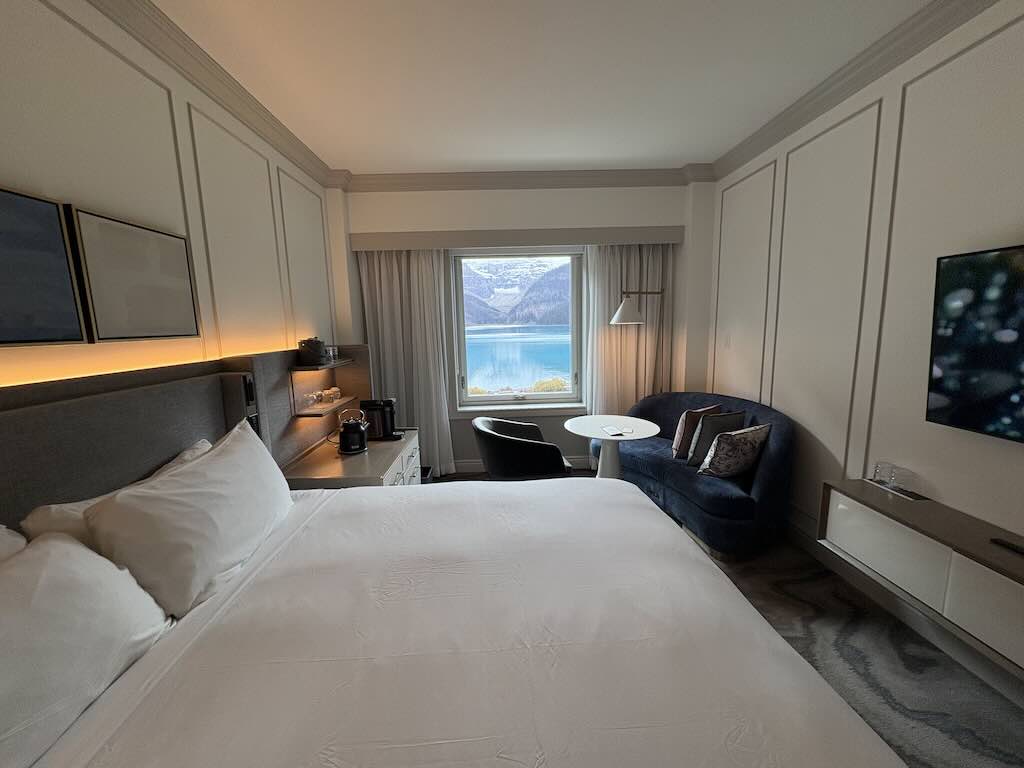
Finally around 16:30 I received the key to my bedroom. Not particularly big, but comfortable looking. The sheets were good and mattress good as well, even if it was one of the few times I woke with a slight backache.
Bathroom
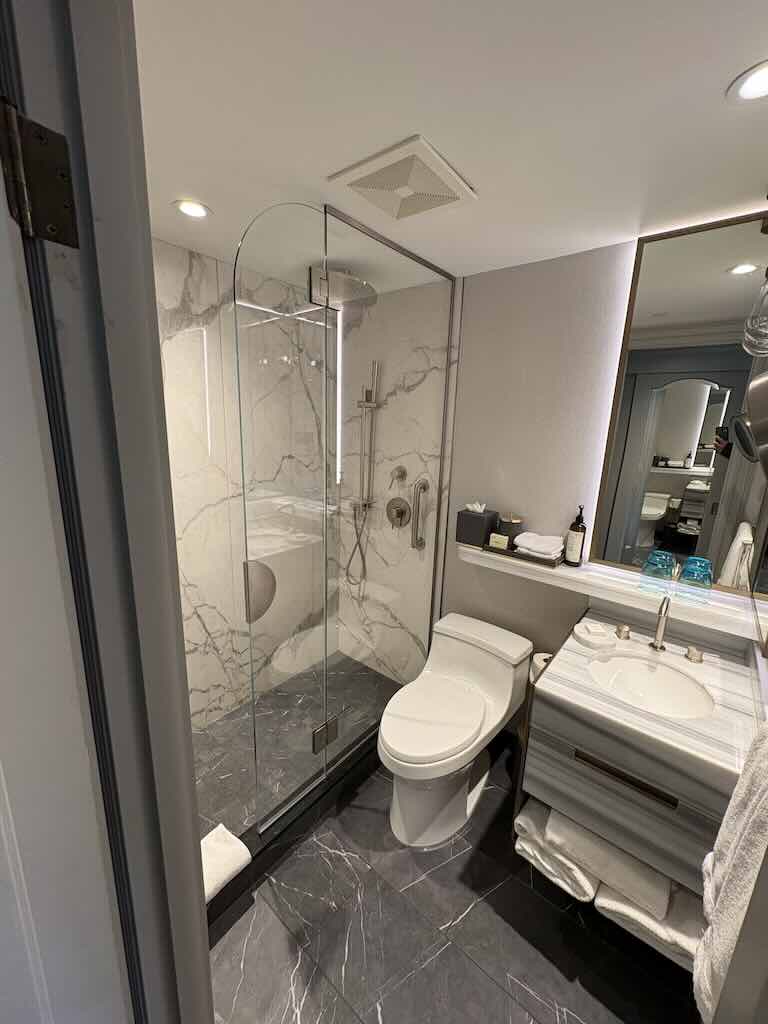
The bathroom was compact, but the walk-in shower was perfect. And the towels were excellent.
The View
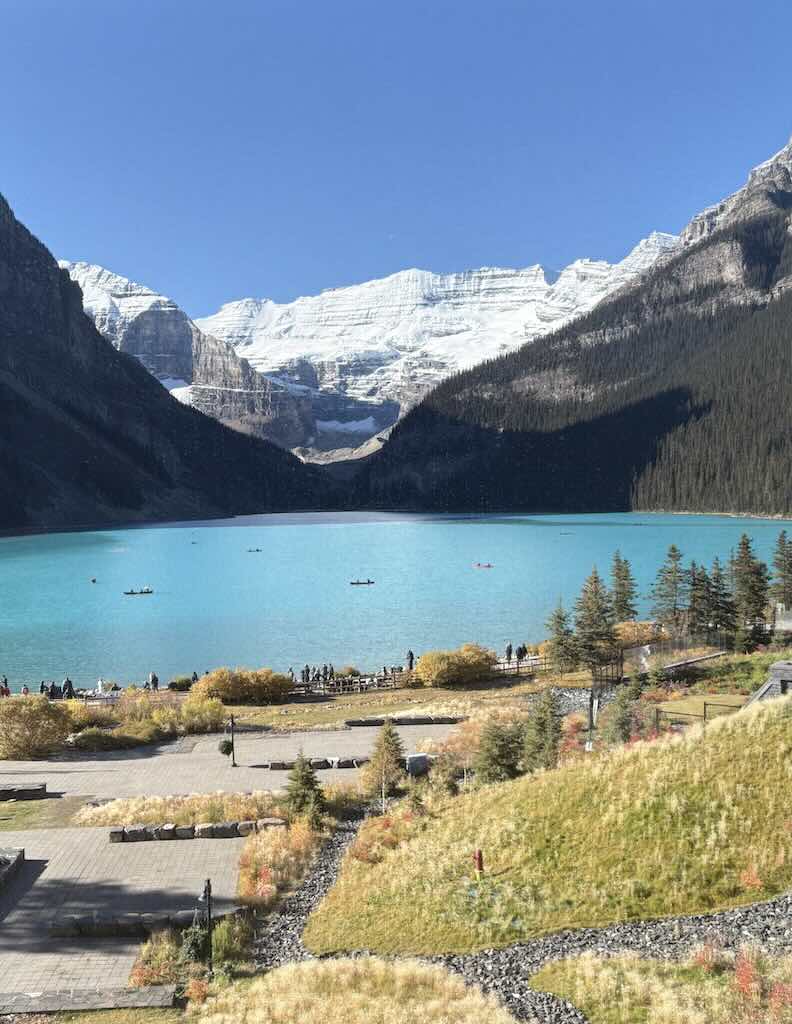
This is the view from my bedroom. Like I wrote, I would have enjoyed a pizza and this view, more than afternoon tea downstairs.
The window itself actually had an insect screen, which made the view slightly duller when the sun was not shinning (something to do with the way my iPhone focussed). In any case this view was what people came to see.
My two-day stay was taken up with the view, the exterior hot pool, and walking along the lakeside. Remembering that the 12 Oct. was a Canadian national holiday, and the walks were more like obstacle courses.
What Are We Looking At?
The basin can be explored via the Plain of Six Glaciers Trail, which begins near the Chateau, follows the northern shore of Lake Louise and continues into the valley beyond the lake. The trail gradually climbs towards the glaciers, providing increasingly close views of the surrounding mountains, glacial moraines, exposed bedrock and retreating ice. The route also illustrates the changing relationship between the glaciers and the lake, which continues to receive sediment transported by glacial meltwater.
Approximately 5.5 km from the hotel, at an elevation of around 2,100 metres, stands the historic Plain of Six Glaciers Tea House. Constructed in 1927 by Swiss mountain guides using timber and stone, the two-storey building provided refreshments for hikers and mountaineers exploring the valley. I didn’t manage to make the entire hike, but it was a nice day out, followed by a good cold beer (and the hot pool).