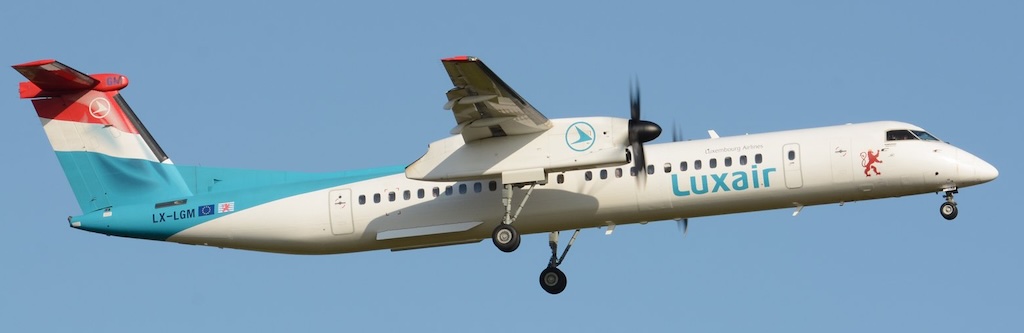
This post described a trip in a Luxair De Havilland Q400 between Linate (Milan) and Luxembourg, on 24 April 2026.
Being resident in the Grand Duchy of Luxembourg I have used the national carrier Luxair many times. In the past I remember taking De Havilland’s, but this is my first (and hopefully last) report on this plane.
The De Havilland Canada Dash 8 “Q400” is a high-speed, narrow-body, twin-engine turboprop designed for short-haul regional routes and manufactured by De Havilland Canada. It first flew in 1998 and entered service with Scandinavian Airlines in 2000. As of 2025, the Q400 and wider Dash 8 family have accumulated over 1,200 deliveries across all variants.
For example, the Q400 seats ~78 passengers, and has a range of ≈2,000 km.
The earliest models were the Dash 8-100/-200 introduced in 1984, designed for short regional routes with excellent short-field performance. The Dash 8-300 followed in the late 1980s, offering a stretched fuselage and increased capacity.
The Dash 8-400 (Q400) was introduced in the late 1990s with more powerful engines, higher cruise speed, and a modernised cabin. It is the largest and fastest variant of the Dash 8 family, capable of near-jet speeds while maintaining turboprop efficiency.
The “Q” (for Quiet) series introduced active noise and vibration suppression, improving passenger comfort compared to earlier turboprops.
De Havilland Canada was bought by Boeing in 1986, then by Bombardier in 1992, then by Longview Aviation Capital in 2019, who then revived the De Havilland Canada brand. Today this aircraft is no longer being built (the old production line in Toronto was shut down in 2022), but De Havilland still supports, sells, and refurbishes Q400 aircraft, and there is ongoing demand for them. In 2022, De Havilland announced a brand-new manufacturing site called “De Havilland Field” in Alberta, Canada (planned for ~2028).
On some tracking software, this type of aircraft is still called a Bombardier.
Travelling Linate (Milan) to Luxembourg
I had planned a trip to Naples, flying with Lufthansa. However a strike meant that I had to first find another flight to Naples, and then subsequently find my way back to my home city Luxembourg.
The return was Naples-Milan (Linate), and a connecting flight with Luxair (and a De Havilland Q400).
Milan Linate Airport
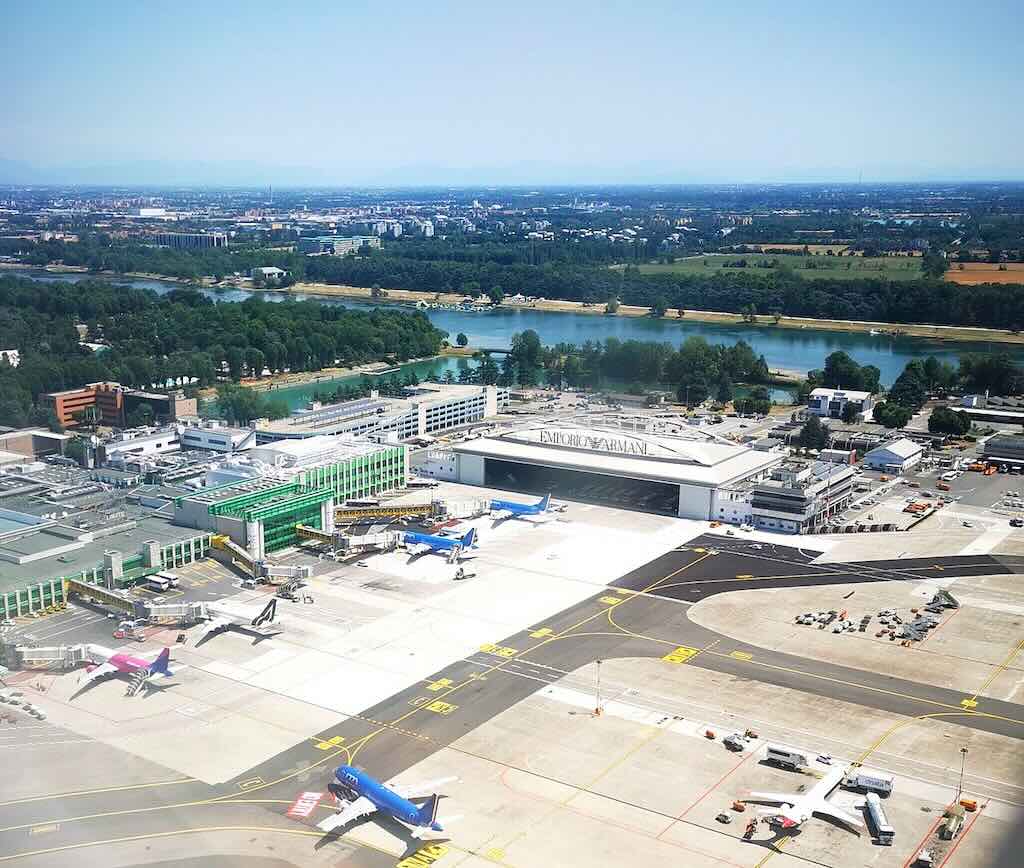
Wikipedia tells us that Milan Linate Airport is a city airport located in Milan, the second-largest city and largest urban area of Italy (its official name is Airport Enrico Forlanini). The airport served 10.6 million passengers and recorded 118,060 aircraft movements in 2024, making it one of the busiest airports in Italy. It is the third-busiest airport in the Milan metropolitan area in terms of passenger numbers, after Malpensa and Bergamo, and the second busiest in terms of aircraft movements.
In late 1974 I moved to Italy, near Varese, and not far from Milan. With my wife we only really left the region in 1984. During that period the only Milan airport was Linate. And the only way was to use the motorway, with part of the A8 called the Autostrada dei Laghi. Because the tangenziali (outer ring highways) had not been completed, we had to take the Cerchia dei Bastioni (the “Spanish walls” ring) or the Cerchia dei Navigli, the innermost ring following the old canal line. Usually we took the outer ring, and there was always a risk of heavy fog on the motorway (and at the airport). And naturally Linate was right across the other side of the city. It was a trip of about 80km, but could easily take 2 hours with the traffic.
As we drove towards Milan, there was a second airport, near Gallarate, on the motorway. Even in the 50s and 60s it was being developed as a major airport, but European carriers such as British Airways, Air France, Lufthansa and Alitalia had already moved the majority of their services to Linate Airport. By the mid-1980s Linate Airport had reached its saturation point. So it was downgraded, and Malpensa became Milan’s major airport. Everyone thought that it might be mistaken given the fog in the region.
Malpensa means “bad land” or “poor farmland”, largely due to its marshy and humid land. And fog was a big problem. Malpensa had historically more delays and diversions than Linate, which was slightly less fog-prone. However, ILS (Instrument Landing Systems) now allow planes to land even in very low visibility, so it’s less of a problem today.
So this trip gave me the opportunity to revisit Linate. I had check through my baggage, and I already had my new boarding card. So I just went through transit, and I found a compact, but very comfortable and efficient looking departure area. Security was very well organised, and the air-side facilities and services looked modern and excellent.
Ground-side, I could imagine that it could get crowded, but I landed mid-afternoon, and it looked very quiet. Air-side it has won “Best Airport in Europe (5–10M passengers)”, and I’m not surprised.
Luxair De Havilland LX-LGM
I had found a way back from Naples to Luxembourg, via Linate.
The aircraft LX-LGM left Linate at 16:52, 7 minutes late, and landed in Luxembourg at 17:57, 12 minutes ahead of schedule.
On the 24th April this aircraft also made a return trip to Balice (Krakow Int’l) before a return trip to Linate, and later it would make a round trip to Schonefeld (Berlin-Brandenburg).
LX-LGM was delivered to Luxair on 18 November 2012 (its test registration was C-GRSE). At least according to one registry this particular aircraft is (or was originally) owned by ELLEGÉ S.A. (or ElleGé S.A.) a public limited company (société anonyme) in Luxembourg for leasing aircraft and aviation equipment. It was founded 25 July 2012, just before the purchase of two similar aircraft. There is also a separate firm ELLEGÉ LGIT S.A., specialising in air cargo transport.
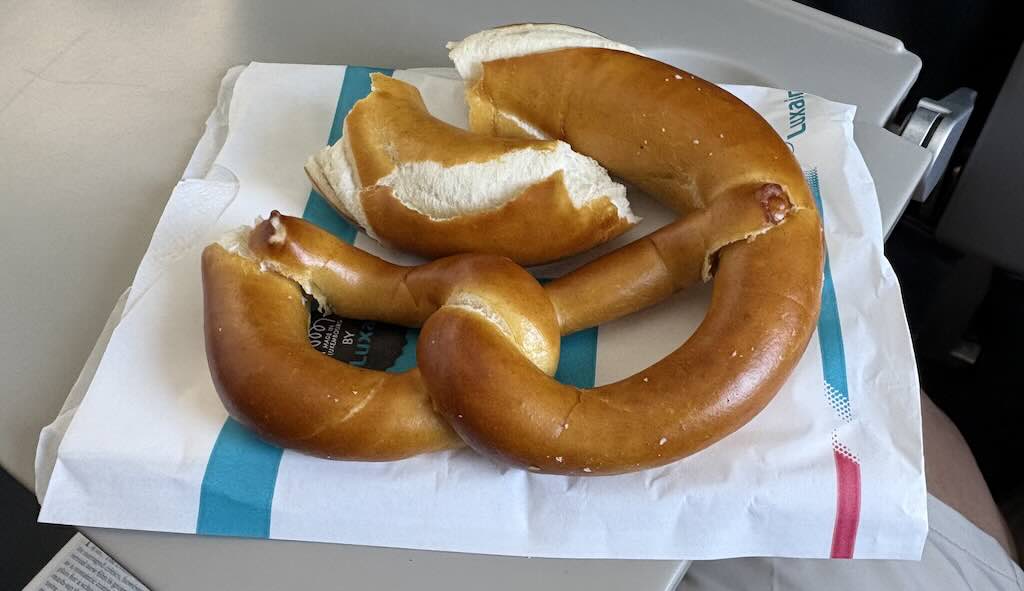
My seat was 21F, and the aircraft was perhaps 90% full. 21F is a window seat on the last row, at the back. The steward was very pleasant, and even he admitted that the pretzel (see above) was abysmal (the water was fine).
I did check on the safety record of this type of aircraft, and it’s comparable to other turboprop aircraft in its category. What surprised me was the additional statement that over decades of operation, fatalities across all Dash 8 variants are relatively low (roughly a few hundred total), especially given the large number of flights. It’s positive, but takes time to digest (like the pretzel).