For the moment this post just logs my collection of books about the history, development and interpretation of artistic creation and material culture, from antiquity to the present, irrespective of geographical origin.
That means it covers painting, sculpture, architecture, decorative arts, furniture, ceramics, textiles, jewellery, artistic craftsmanship, historical design, manuscripts, book illustration, bookbinding and the history of artistic movements. It includes studies of individual artists, artistic schools and periods such as the Renaissance, Baroque and Impressionism.
So this includes the historical development, creation, techniques and interpretation of works of art and material objects, and the studies of artists, artistic movements, styles, workshops and the historical evolution of design.
What is excluded are political, economic and social history, geographical histories of countries and regions, everyday living conditions, customs and social practices not principally concerned with artistic production, practical manuals on crafts, decoration or restoration, and histories of science and technology not primarily concerned with art or design.
Also excluded are books principally concerned with the ownership, use, enjoyment or social significance of objects in everyday life, rather than their artistic creation and historical development.
1872-1875 Eugène-Emmanuel Viollet-le-Duc – Dictionnaire raisonné du mobilier français de l'époque carlovingienne à la Renaissance
Although Eugène-Emmanuel Viollet-le-Duc (1814–1879) is principally remembered as an architect and restorer of medieval buildings, this particular publication is concerned with the physical objects of medieval civilisation, namely furniture, utensils, jewellery, clothing, weapons, musical instruments, tools and equipment.
The work examines their construction, function, decoration and historical development. It is therefore much broader than a history of furniture, despite its title.
His major restoration projects included the basilica of Vézelay, Notre-Dame de Paris (with Jean-Baptiste Lassus), the fortified city of Carcassonne and the Château de Pierrefonds.
These projects were undertaken during a period when France was reassessing its medieval heritage. The destruction and neglect of monuments during the Revolution and subsequent decades had stimulated interest in preservation, while Romantic historians and writers helped transform attitudes towards Gothic architecture.
Viollet-le-Duc belonged to this intellectual movement, but he approached medieval architecture through construction and engineering as much as through aesthetics. He believed that a building or object could be understood by examining its materials, structural principles and intended functions.
This approach informed his two monumental dictionaries:
Dictionnaire raisonné de l’architecture française du XIe au XVIe siècle, published in ten volumes between 1854 and 1868.
Dictionnaire raisonné du mobilier français de l’époque carlovingienne à la Renaissance, published in six volumes between 1858 and 1875.
Together, they constitute one of the 19th century’s most ambitious attempts to reconstruct the physical civilisation of medieval France.
The Dictionnaire du mobilier first appeared in 1858, with the publication of the section devoted to furniture. The work subsequently expanded into other categories of objects and continued appearing until 1875. The Bibliothèque nationale de France’s Catalogue collectif de France describes the complete publication as eight parts in six volumes, illustrated in black and colour, published between 1858 and 1875.
The purpose of the dictionary
The word mobilier is central to understanding the publication. Today, French mobilier generally suggests furniture. Viollet-le-Duc employed the term much more broadly, to describe the movable objects associated with human life.
His dictionary is therefore an attempt to reconstruct medieval civilisation through its material remains. It includes the furniture of houses, castles and churches, vessels and utensils, objects made from precious metals, musical instruments, clothing and personal ornaments, and the weapons and protective equipment of medieval warfare.
The work covers approximately the Carolingian period through the Renaissance, although the surviving evidence is considerably richer for the later Middle Ages.
Viollet-le-Duc’s method was analytical rather than merely descriptive. He was interested in why objects assumed particular forms, how they were manufactured, what materials were used and how their design changed. For example, a medieval chest was not simply an example of decorative carpentry. Its construction, locks, iron fittings, portability and use within domestic life were all relevant to understanding its historical development.
This explains the expression dictionnaire raisonné. The articles do more than define objects, they attempt to explain their history and underlying logic.
The six volumes and their contents
The opening volume deals with medieval furniture and furnishings. It examines objects such as chests, cupboards, seating, beds, tables and ecclesiastical furnishings, using surviving examples and historical representations.
This is perhaps the most directly relevant volume for the history of furniture and decorative arts. It also reveals the close relationship between medieval furniture, carpentry and architectural design.
The second volume considerably expands the scope of the dictionary. It examines household equipment, precious metalwork, musical instruments, games, recreational objects and tools.
It is especially important because it treats both luxury objects and more utilitarian equipment. Medieval material civilisation was not restricted to the possessions of kings, nobles and ecclesiastical institutions.
These two volumes concern dress, personal ornaments and bodily presentation. They examine the development of clothing and accessories, including distinctions of period, rank and function.
Their importance lies partly in the sources used to reconstruct historical costume, namely manuscript illuminations, sculpture, tomb monuments and surviving objects. They are also relevant to the history of fashion, although the evidence must be interpreted carefully.
The final two volumes deal with medieval weaponry and protective equipment. They examine swords, lances, shields, helmets, armour and related military equipment, paying particular attention to their construction and evolution.
Here Viollet-le-Duc’s interest in mechanical function is especially apparent. Weapons and armour were technical objects whose design reflected changing military requirements, manufacturing methods and materials.
The general index at the end of Volume VI is an important feature of the complete publication, allowing the six volumes to function as a reference work rather than simply as a sequence of illustrated studies.
The illustrations and their historical importance
One of the greatest attractions of the dictionary is its extensive illustration.
Viollet-le-Duc made effective use of drawings integrated into the text, supplemented by separately printed plates, including colour illustrations. His drawings often isolate an object’s construction or particular details, making it easier to understand how it was manufactured and used.
The illustrations served several purposes. They documented historical evidence, clarified technical explanations, compared objects from different periods and sometimes reconstructed missing or incomplete features. This was an important development in 19th-century historical publishing. The illustrations were not merely decoration, they formed part of the author’s argument.
The scholarly biography of Viollet-le-Duc at the Institut national d’histoire de l’art specifically draws attention to this integration of text and image. It also warns that the reconstructed and idealised objects could create an impression of historical authenticity stronger than the surviving evidence justified. A drawing may accurately record an existing medieval object, but it may also represent Viollet-le-Duc’s interpretation of how that object originally appeared.
For that reason, the illustrations are valuable in two different ways, firstly, as evidence concerning medieval material culture and secondly, as documents of 19th-century historical interpretation.
The relationship with his architectural dictionary
The Dictionnaire du mobilier should be considered alongside the much larger Dictionnaire raisonné de l’architecture française du XIe au XVIe siècle.
The architectural dictionary examines the buildings and structural systems of medieval France, its churches, castles, houses, fortifications and their constituent architectural elements.
The dictionary of furniture and objects examines what occupied those buildings and what their inhabitants wore, handled, used and manufactured.
The two works are complementary, but they also share a particular intellectual outlook. Viollet-le-Duc believed that medieval forms could be understood rationally through their construction, function and historical development. He rejected the idea that Gothic architecture was simply an ornamental style. That conviction informed his restorations, his historical writing and his influence on subsequent architectural theory.
The dictionaries therefore represent more than an accumulation of antiquarian information. They form part of a coherent attempt to explain medieval design as a rational system.
Viollet-le-Duc and the problem of restoration
The greatest reservation concerning Viollet-le-Duc’s historical method arises from his philosophy of restoration. He believed that restoring a monument could involve bringing it to a coherent completed state, even where that state had never existed at one particular moment in history.
This approach could produce impressive architectural results, but it also introduced elements of reconstruction and interpretation. His work at Carcassonne and Pierrefonds remains central to debates about architectural restoration.
The same intellectual tendency is visible in the Dictionnaire du mobilier. His illustrations sometimes present medieval objects in an idealised or reconstructed form. Modern archaeological and art-historical scholarship places greater emphasis on distinguishing surviving evidence from hypothetical reconstruction.
Consequently, the dictionary should not be treated as the final authority on the precise appearance or chronology of every medieval object.
Its historical importance, however, is not diminished by this limitation. Indeed, the interpretative nature of the work makes it particularly valuable for understanding nineteenth-century medievalism.
The work’s place in the history of scholarship
The dictionary belongs to a period when the study of medieval objects was becoming increasingly systematic.
During the 19th century, the development of archaeology, public museums, historical preservation and the publication of illustrated reference works encouraged scholars to examine objects that had previously received relatively little attention. Medieval artefacts were no longer considered merely curiosities or examples of craftsmanship. They became evidence for reconstructing historical societies.
Viollet-le-Duc contributed to this transformation by treating furniture, costume, utensils and weapons as subjects worthy of detailed historical analysis. His work anticipated certain concerns of modern material-culture studies, although his methods and conclusions cannot be equated with those of present-day archaeology.
1874 Paul Lacroix – Les Arts au Moyen Âge et à l'époque de la Renaissance
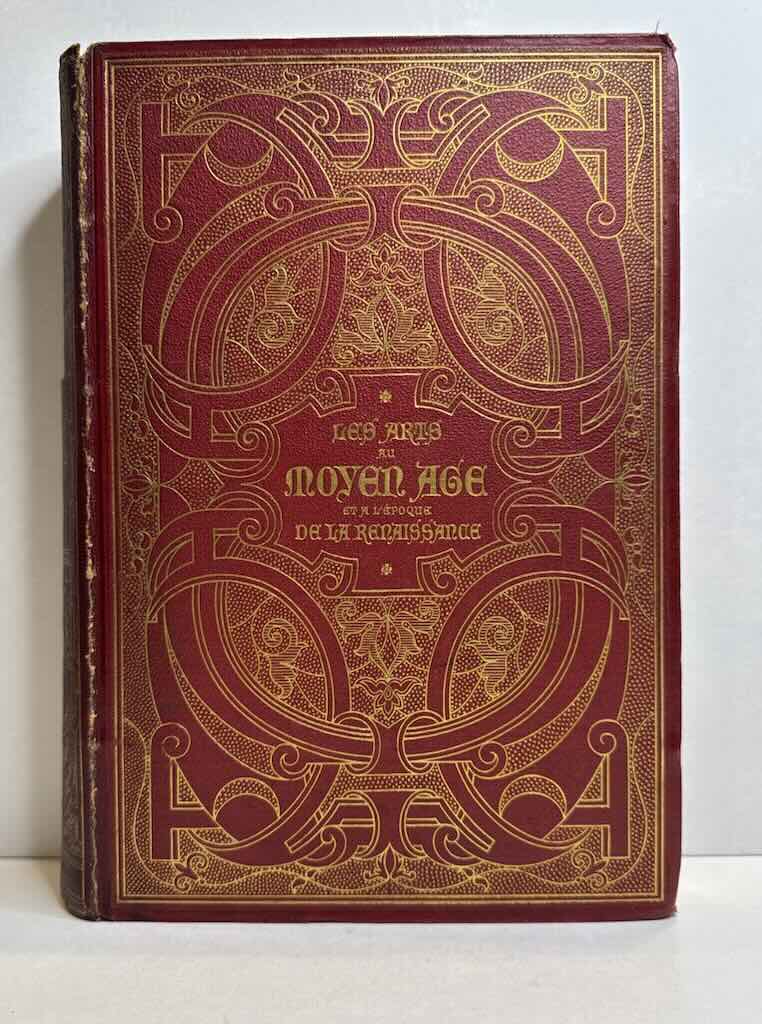
Les Arts au Moyen Âge et à l’époque de la Renaissance is one of the major illustrated historical works of Paul Lacroix, better known by his literary pseudonym Bibliophile Jacob. Published by the Parisian house of Firmin Didot, it belongs to a larger series devoted to the institutions, customs, arts and intellectual achievements of European civilisation from the Middle Ages to the 19th century.
The work is especially interesting because its conception of art is considerably broader than the modern division between fine art and applied art. Lacroix examines not only architecture, sculpture and painting, but also furniture, tapestries, ceramics, metalwork, armour, clocks, musical instruments, manuscripts, bookbinding and printing.
His subject is therefore the history of artistic production in its widest material sense, i.e. how objects were conceived, manufactured, decorated and used, and how artistic techniques developed over several centuries.
The volume deserves examination on three levels, firstly, as a study of medieval and Renaissance art, secondly, as a product of 19th-century historical scholarship, and thirdly, as a substantial achievement of illustrated book production.
Paul Lacroix and the historical culture of 19th-century France
Paul Lacroix was born in Paris on 27 February 1806 and died there in October 1884. He was a historian, novelist, bibliographer and librarian, whose exceptionally prolific career extended across literary history, the history of customs, bibliography and the study of earlier European civilisation.
His pseudonym, Bibliophile Jacob, originated in his early literary career. In 1829 he published Les Soirées de Walter Scott à Paris, introducing the fictional persona of an elderly, supposedly exceptionally learned bibliophile. The pseudonym subsequently became inseparable from his identity as a scholar and author.
Lacroix’s early historical interests were closely connected with the Romantic movement’s fascination with the Middle Ages. He frequented the literary gatherings of Charles Nodier at the Bibliothèque de l’Arsenal, where writers including Victor Hugo and Alexandre Dumas participated in the Parisian Romantic milieu.
His early career was primarily literary, with historical novels and plays. Over time, however, his activities increasingly concentrated on historical research, bibliography and the study of documents.
A decisive event occurred in 1855, when he was appointed conservator at the Bibliothèque de l’Arsenal in Paris, replacing Adam Mickiewicz. The position provided institutional stability and access to a major historical library.
The Bibliothèque nationale de France preserves a substantial Paul Lacroix archive, including manuscripts, correspondence and bibliographical material. Its institutional biography is an especially valuable source for reconstructing his career.
However, Lacroix was not an art historian in precisely the modern academic sense. His work combined documentary research, literary narrative, antiquarian scholarship and historical illustration. This combination is fundamental to understanding Les Arts au Moyen Âge.
He was interested in objects not simply as aesthetic achievements but as evidence of the civilisation that produced them. An illuminated manuscript could demonstrate the development of painting, but also the history of writing, religious practice, patronage and the manufacture of books.
Similarly, a suit of armour belonged simultaneously to the history of warfare, metalworking, decorative design and aristocratic society.
The result was a historical method in which objects and images helped explain the larger development of civilisation.
The intellectual background: the 19th-century rediscovery of the Middle Ages
To understand why Lacroix’s book was published, it is necessary to consider the changing reputation of medieval art in Europe.
During much of the 18th century, the Middle Ages were frequently contrasted unfavourably with classical antiquity and the Italian Renaissance. Gothic architecture, medieval ornament and manuscript painting did not always enjoy the artistic standing later assigned to them.
This began to change substantially in the late 18th and 19th centuries. The Romantic movement encouraged interest in medieval literature, architecture, national traditions and historical monuments. In France, the publication of Victor Hugo’s Notre-Dame de Paris in 1831 helped bring Gothic architecture and the preservation of medieval monuments into wider public discussion.
At the institutional level, the French government established the position of Inspector General of Historical Monuments in 1830, followed by the Commission des monuments historiques in 1837.
The restoration of medieval monuments became an important cultural undertaking, associated particularly with Eugène Viollet-le-Duc (1814–1879).
Lacroix’s work developed within this environment of renewed historical interest. But his approach differed from a study devoted exclusively to Gothic architecture or monument restoration. He attempted to describe the entire artistic and material world of medieval and Renaissance Europe.
This wider perspective is one of the book’s most important characteristics.
The importance of decorative arts
The 19th century also witnessed increasing attention to the relationship between artistic design and industrial manufacture.
International exhibitions, notably London’s Great Exhibition of 1851 and the Paris exhibitions of 1855 and 1867, stimulated discussion about the quality of manufactured objects, the teaching of design and the relationship between craftsmanship and industry.
Historical examples of metalwork, ceramics, textiles, furniture and ornament became important sources for artists, manufacturers and designers.
Lacroix’s book participated in this larger cultural movement by making a wide range of historical objects accessible through illustrations and descriptive text. But it was not a technical manufacturing manual. Its purpose was historical and educational, but its subject matter overlapped considerably with contemporary interests in the decorative arts.
The organisation of Les Arts au Moyen Âge is revealing because Lacroix does not arrange the work simply as a succession of famous artists or artistic schools. Instead, he examines major categories of objects, materials and artistic activity.
Architecture and monumental decoration
Architecture provides one of the most visible expressions of medieval and Renaissance artistic development.
The historical period covered by Lacroix encompasses Romanesque building, the development of Gothic architecture, the great cathedral-building programmes of medieval Europe and the later adoption of Renaissance architectural forms.
Churches, monasteries, palaces, castles and civic buildings required the collaboration of many crafts, e.g. masonry, sculpture, carpentry, glazing, metalworking and decorative painting.
This relationship between architecture and the other arts is essential. Medieval monumental construction was not simply the work of an architect in the modern sense. It involved networks of patrons, builders, craftsmen and workshops.
Lacroix’s broad treatment of the arts makes it possible to understand architecture as part of a larger material and artistic system.
Sculpture, painting and engraving
The chapters on sculpture and painting address the development of figurative art and decoration across the medieval and Renaissance periods.
Religious imagery occupies an important place because churches, monasteries with their devotional manuscripts, were major centres of artistic patronage.
Sculpture was frequently integrated into architecture, particularly through portals, capitals, tombs and monumental decoration.
Painting appeared in many different forms, e.g. wall paintings, panel paintings, manuscript miniatures and decorative objects.
The Renaissance introduced important changes in artistic theory, representation, perspective and the social standing of artists, although these developments differed substantially between regions.
The inclusion of engraving is particularly relevant to the history of artistic reproduction and the wider circulation of images.
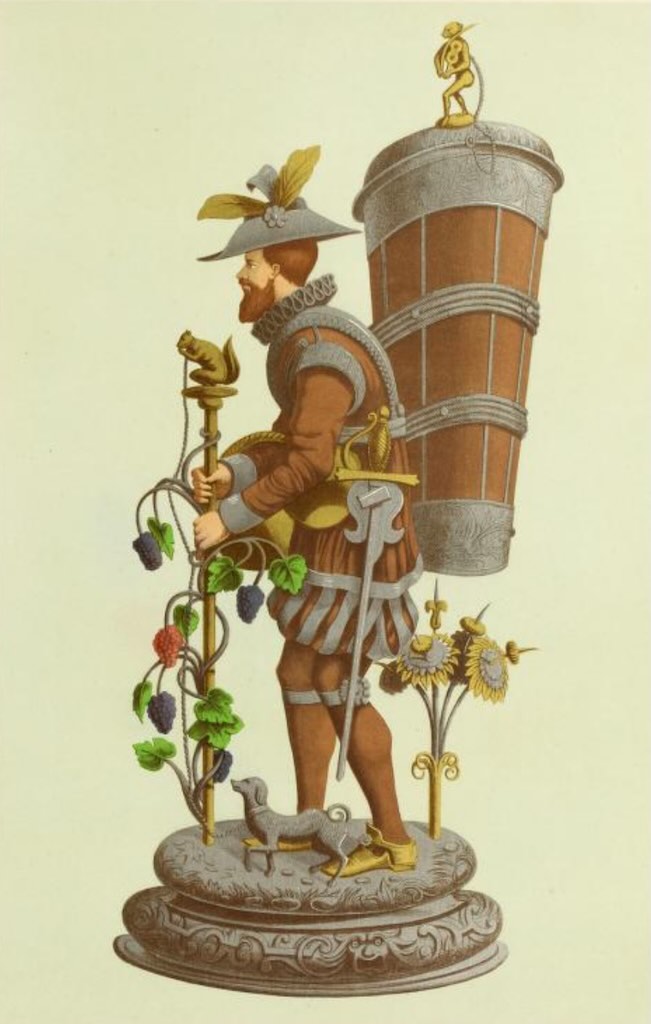
Above we have a Servant de Drageoir, which was a servant who carried a basket-like container called a drageoir. In French dining history, a drageoir was a specialised luxury vessel or box used to serve dragées (sugared almonds) and other fine table sweets at the end of a feast.
Furniture and domestic objects
Lacroix includes furniture intended for both religious and secular settings. This subject is important because furniture provides evidence about how interiors were organised and used.
Chests, cupboards, tables, chairs, beds and ecclesiastical furnishings could serve practical purposes while also displaying elaborate carving, metal fittings and decorative painting. Their design reflected available materials, manufacturing techniques, wealth, social status and changing habits of domestic life.
For medieval furniture, however, the surviving evidence is uneven. Objects made for wealthy institutions and individuals are disproportionately represented, while ordinary household furniture has survived much less frequently.
That limitation affects any historical reconstruction based primarily on surviving museum objects.
Textile production also involved extensive commercial networks, connecting raw materials, dyeing, weaving and trade. The study of textiles therefore links artistic design with economic history and the organisation of labour.
Ceramics, glass and stained glass
Ceramics and glass demonstrate the close relationship between technological development and decorative art.
Pottery production required control of clay preparation, firing, glazing and decoration. Renaissance ceramics, particularly Italian maiolica, developed highly elaborate painted surfaces.
Stained glass was especially important in medieval religious architecture. Its production required specialised knowledge of coloured glass, cutting, leading and painted detail.
The large stained-glass programmes of Gothic churches combined architectural function, religious imagery and decorative colour.
Lacroix’s inclusion of these crafts reflects the 19th-century recognition that the history of art could not be restricted to painting on canvas or sculpture in stone.
Goldsmithing, jewellery and metalwork
Goldsmithing occupied an important position in medieval and Renaissance artistic production. Precious-metal objects could serve religious, ceremonial, domestic and personal functions.
Reliquaries, chalices, crosses, jewellery, vessels and decorative fittings often combined several techniques, including casting, engraving, enamelling and stone setting. Such objects were frequently commissioned by wealthy patrons or religious institutions and could embody both artistic craftsmanship and considerable intrinsic material value.
Their survival is particularly selective, since precious metals were often melted down and reused.
Armour, weapons and military equipment
The inclusion of armour may initially seem surprising in a history of art. It is nevertheless entirely consistent with Lacroix’s conception of craftsmanship.
Armour-making required sophisticated metalworking, shaping, joining and finishing. Ceremonial and aristocratic armour could also carry elaborate etched, engraved or embossed decoration. Weapons and military equipment therefore belonged both to the practical history of warfare and to the decorative arts.
This subject connects directly with another Lacroix volume, Vie militaire et religieuse au Moyen Âge et à l’époque de la Renaissance. The difference is one of emphasis, where the military volume concerns the institutions and practices of warfare, while Les Arts considers the artistic and technical production of the objects themselves.
Clocks, musical instruments and other specialised crafts
The treatment of clocks and musical instruments further extends the book beyond conventional art history. Clockmaking combined mechanical design, metalworking and decorative craftsmanship. Medieval and Renaissance clocks were also associated with developments in the measurement and public representation of time.
Musical instruments similarly involved specialised woodworking, metalworking and decorative techniques. These objects demonstrate how the history of technology and the history of art overlap.
Lacroix’s inclusion of playing cards is particularly revealing. Even comparatively modest printed or decorated objects could be treated as evidence of artistic techniques and historical customs.
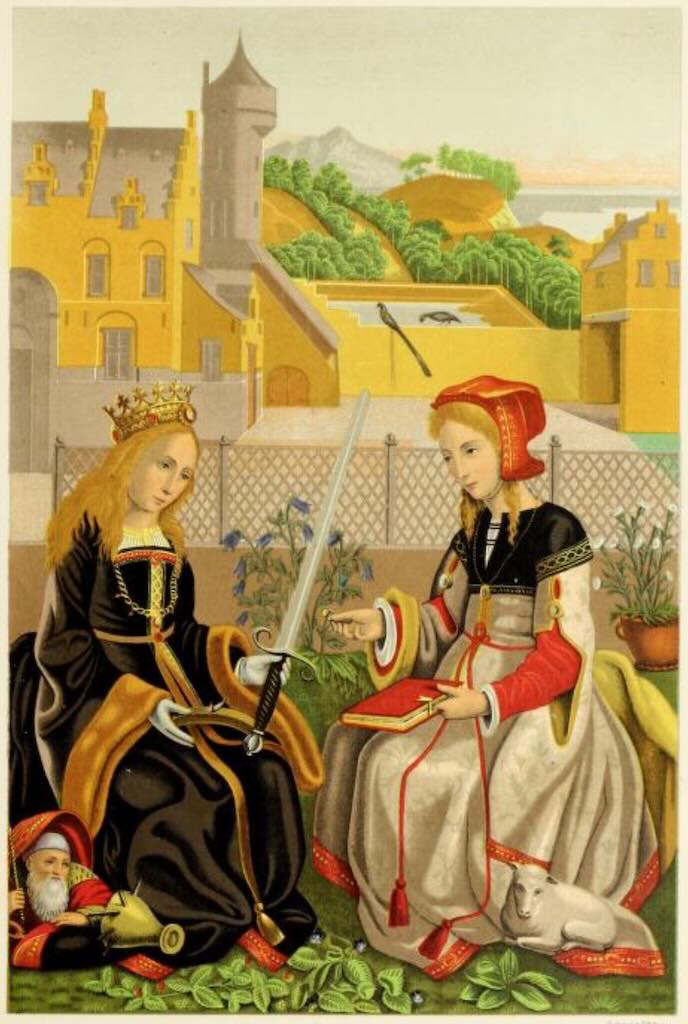
Above we have Saint Catherine of Alexandria (left) and Saint Agnes of Rome (right), two of the most celebrated female saints of medieval Christianity. They are shown together not because they knew one another, but because they shared a particular religious identity, they were both young women who, according to Christian tradition, refused to renounce their faith or their commitment to virginity, and both suffered martyrdom. The sword between them is particularly important. It is primarily the identifying attribute of Saint Catherine, who was traditionally said to have been executed by beheading.
Manuscripts, illumination, bookbinding and printing
This is perhaps the most interesting part of the work from a bibliographical perspective. Lacroix gives considerable attention to the history of writing materials, manuscript production, illumination, binding and printing.
These subjects are closely connected but represent different stages in the history of the book.
Parchment, paper and manuscript production
Before the widespread adoption of printing in Europe, books were reproduced by hand. Parchment, prepared from animal skin, was an important writing material throughout the medieval period. Paper gradually became increasingly significant, especially in the later Middle Ages.
Manuscript production required the preparation of writing supports, ruling, copying, decoration and binding. The work could involve several specialists, particularly for elaborate illuminated manuscripts. Monasteries were important centres of manuscript production, although commercial and urban workshops also became increasingly significant.
Manuscript illumination
Illumination combined writing with painted decoration, initials, borders and miniature illustrations. The most elaborate manuscripts could be extraordinarily expensive objects, commissioned by rulers, aristocrats, wealthy merchants and religious institutions.
Books of hours became especially important examples of private devotional manuscripts during the later Middle Ages. Their illustrations provide valuable evidence for religious imagery, costume, architecture, ornament and artistic technique.
Bookbinding
Bookbinding was both a practical craft and a decorative art. Bindings protected manuscripts and printed books, but could also communicate wealth, institutional ownership and personal taste. Medieval bindings included wooden boards covered with leather, while particularly luxurious examples might incorporate precious metals, enamel, ivory or other decorative materials.
During the Renaissance, leather bindings decorated with gold tooling became increasingly prominent in elite European collections.
For a modern collector of historical books, Lacroix’s discussion is especially interesting because it places binding within the longer history of artistic craftsmanship.
Printing
The introduction of European printing with movable metal type in the mid-15th century transformed book production. But printing did not immediately eliminate manuscript production, nor did printed books instantly abandon manuscript conventions.
Early printed books often retained features familiar from manuscripts, including decorated initials, rubrication and layouts derived from scribal practice.
Woodcuts and, subsequently, other reproductive techniques enabled illustrations to circulate in much larger numbers.
Lacroix’s discussion of printing is therefore part of a broader account of how artistic production moved between manuscript craftsmanship and increasingly reproducible forms.
Kellerhoven and the production of the plates
The title page credits the chromolithographic plates to Franz Kellerhoven (1814–1872), who was a German-born illustrator and lithographer associated with Parisian illustrated publishing.
Firmin-Didot and the importance of the book as a publishing achievement
The books were designed to offer extensive historical texts together with hundreds of engravings and carefully printed colour plates. Their large quarto format provided sufficient space for substantial illustrations without requiring the exceptionally large dimensions of an atlas or folio.
The relationship between text and image
One of the notable characteristics of the series is the extensive use of wood engravings within the text. Wood engraving was particularly suitable for illustrated books because the engraved blocks could be printed together with letterpress type.
The chromolithographs, by contrast, were produced separately and inserted into the bound volume. This explains why the presence and completeness of the colour plates are important when assessing a surviving copy of this type of book.
It also explains the book’s distinctive appearance, e.g. monochrome illustrations integrated into the historical narrative, supplemented by larger coloured reproductions.
Historical reliability and the limitations of Lacroix’s scholarship
The historical importance of Les Arts au Moyen Âge should not be confused with the reliability of every individual attribution or interpretation.
Lacroix wrote during a period when medieval and Renaissance art history was developing rapidly. Many objects had not yet been systematically catalogued, archaeological methods were still evolving, and the dating and attribution of manuscripts, sculpture and decorative objects were often uncertain.
His book consequently requires critical reading, and three limitations are especially relevant.
First, the surviving objects available for illustration were disproportionately associated with wealthy patrons, religious institutions and important collections. Ordinary objects used by poorer members of society were less likely to survive or to attract 19th-century scholarly attention.
Second, the illustrations sometimes reproduce objects through earlier drawings or interpretations rather than direct modern photographic documentation.
Third, the book reflects 19th-century concepts of artistic progress, historical periods and national artistic traditions.
These limitations do not diminish its importance as a historical publication. They help define the appropriate way to use it.
Today the work has two complementary functions. Firstly, it provides a broad illustrated introduction to medieval and Renaissance material culture, and secondly, it documents how 19th-century scholars and collectors understood that material.
It’s useful to see this volume alongside Lacroix’s other volumes. For example, Mœurs, usages et costumes au Moyen Âge examines the organisation of social life, customs, clothing and material practices. Vie militaire et religieuse au Moyen Âge concentrates on two major institutions of medieval society, namely military organisation and religion. Les Arts au Moyen Âge examines the objects, artistic practices and craftsmanship associated with the same broad historical period.
The 18th-century volumes extend this historical approach into a later period, examining institutions, customs, literature, science and the arts.
Lacroix was not producing a continuous chronological history in the conventional sense. He was dividing the history of civilisation into complementary fields, each capable of receiving a substantial illustrated treatment. So the value of possessing several volumes is that they can be read together.
A subject such as medieval armour, for example, can be approached through its manufacture and decoration in Les Arts, and through its military function in Vie militaire et religieuse.
Similarly, illuminated manuscripts can be studied as artistic objects in Les Arts, while the wider development of learning and written culture belongs to the companion Sciences et lettres.
This makes the group considerably more coherent than a miscellaneous collection of 19th-century historical books.
1875 Paul Lacroix — XVIIIe siècle : Institutions, usages et costumes
This is the second edition of Paul Lacroix‘s substantial illustrated study of 18th-century France, published in Paris in 1875. It is an important companion to his works on medieval and Renaissance civilisation, but differs from them in one essential respect, namely its subject is specifically France between 1700 and 1789, rather than European civilisation generally.
This is not simply a history of 18th-century costume or aristocratic life. Its three-part title indicates a much more ambitious undertaking, he wanted to look at the institutions governing French society, the customs through which that society functioned, and the clothing and material surroundings that expressed its social distinctions.
It belongs to the 19th-century tradition of illustrated histories of civilisation, combining political and institutional history with social observation, historical images and material culture.
The illustrated publication as a commercial object
An unusually useful contemporary source is a Firmin-Didot advertisement published in La Mode illustrée on 16 December 1877, promoting the publisher’s books as New Year gifts for 1878.
It gave two prices for Lacroix’s work. Either unbound, in wrappers for 30 francs, or bound, morocco spine, gilt edges, for 40 francs. These are contemporary advertised prices, not modern equivalents. They demonstrate that the publisher offered the work in more than one physical presentation.
This is perhaps the clearest contemporary description of what the book was intended to achieve. It was designed as a descriptive and illustrated history of French civilisation, rather than another chronological account of reigns, battles and political crises.
Paul Lacroix and his historical programme
Paul Lacroix (1806–1884), who published extensively as the Bibliophile Jacob, was a French historian, bibliographer, novelist and librarian. His interests extended well beyond conventional political history. He was particularly concerned with the history of everyday practices, historical documents, literature, artistic production and the objects through which earlier societies could be reconstructed.
In 1855 he became conservator at the Bibliothèque de l’Arsenal in Paris, a position that provided access to an exceptionally rich collection of historical and literary material.
His work belongs to a 19th-century movement that sought to recover the past through the study of institutions, monuments, manuscripts, costumes and material objects. This was a period of expanding historical scholarship, antiquarian collecting, museum development and illustrated publishing. Lacroix occupied an interesting position between specialist historical research and the popular presentation of history to an educated readership.
Lacroix was not primarily attempting to establish new economic theories or to write a systematic political history. His particular talent lay in assembling and explaining historical material across a wide range of subjects.
The relationship with your other Lacroix volumes
His medieval volumes examine social customs, military and religious life, and the development of the arts. His 18th-century publications apply a related approach to a much later period.
The resulting collection is intellectually coherent as a 19th-century author’s attempt to reconstruct earlier European civilisation through its institutions, customs, artistic production and material evidence.
France in the 18th century: the historical setting
The period 1700–1789 encompasses the final decades of the reign of Louis XIV, the Regency of Philippe d’Orléans, the reign of Louis XV and most of that of Louis XVI, ending with the beginning of the French Revolution.
These eighty-nine years saw major changes in French society, despite the survival of the monarchy and many institutions of the Ancien Régime.
At the beginning of the century, France remained an overwhelmingly rural kingdom governed through a complex structure of royal, provincial, municipal, ecclesiastical and seigneurial authorities.
Society was legally divided into three estates, the clergy, the nobility, and the Third Estate. However, these formal divisions concealed substantial differences of wealth, occupation, education and political influence within each estate.
The 18th century witnessed the growth of commercial activity, changing patterns of consumption, an expanding market for printed material and the increasing cultural influence of wealthy urban groups.
Paris was particularly important as a centre of publishing, intellectual debate, artistic patronage and luxury manufacture. The development of the Enlightenment brought new criticism of inherited authority, religious intolerance, legal inequality and established political institutions. By 1789, the monarchy faced a severe financial and political crisis, while demands for institutional reform had become increasingly difficult to contain.
This provides the background to Lacroix’s study. But his principal interest was not the sequence of events leading to the Revolution. It was the society that existed before it, and how people were educated, governed, entertained, dressed and accommodated within the established social order of that time.
Institutions: the organisation of French society
The first word of Lacroix’s title, Institutions, deserves emphasis. It distinguishes the book from a simple illustrated account of fashion or domestic life.
The institutional history of 18th-century France involves several overlapping systems of authority.
Monarchy and royal government
The French monarchy was the central political institution of the kingdom, but royal authority operated through a complicated administrative structure. The king’s councils, ministers, provincial intendants and numerous other officials exercised responsibilities that varied according to subject and region.
The royal court at Versailles was both a residence and a centre of political influence. Access to the monarch, ceremonial precedence, appointments and court offices were closely connected with the distribution of power and patronage. Court etiquette was therefore not merely decorative. It formed part of the practical operation of the monarchy.
Justice and legal institutions
18th-century France did not possess a single uniform legal system. Customary law remained particularly important in northern France, while the written-law traditions of the south drew heavily on Roman law.
The parlements were sovereign courts of justice, not representative legislative assemblies in the modern sense. Their power to register royal legislation and issue remonstrances gave them a significant role in conflicts between the monarchy and established judicial elites.
Legal privileges, corporate rights and differences between provinces formed part of the institutional complexity of the kingdom.
Religion and the Church
The Catholic Church remained a major institution in French society. It possessed substantial property, operated educational and charitable establishments, and exercised considerable influence over social and cultural life.
The relationship between monarchy and Church was shaped by Gallican traditions, while conflicts involving Jansenism and other religious controversies contributed to 18th-century political debate.
The Church also played a central role in the recording of baptisms, marriages and burials before the establishment of revolutionary civil registration.
Education and intellectual life
Education was provided through a mixture of religious, municipal, private and royal institutions. Colleges, universities, military schools and specialised establishments served different sections of society. The 18th century also saw the growth of scientific academies, learned societies and new forms of intellectual exchange.
Education remained highly unequal, with substantial differences according to sex, social position, occupation and location.
Usages: customs, social behaviour and daily life
The second part of the title, Usages, broadens the subject considerably.
Social customs in 18th-century France were shaped by rank, wealth, occupation, religion, geography and the distinction between urban and rural life.
Court society and aristocratic behaviour
The court of Louis XIV had established an elaborate culture of etiquette and ceremonial conduct. Although court practices evolved during the 18th century, rank and precedence remained important.
Ceremonial clothing, formal visits, public entertainments and the regulation of access to influential people helped maintain social distinctions.
The aristocracy also participated in a wider culture of private residences, country estates, salons and fashionable urban life.
Bourgeois society and domestic consumption
Wealthy merchants, financiers, officials and professionals formed an increasingly influential market for domestic furnishings, fashionable clothing, books and luxury objects.
The 18th century witnessed changes in domestic interiors, including the development of more specialised rooms, greater attention to comfort and the production of furniture designed for particular uses. Furniture-making, porcelain, silverware, clocks and decorative textiles became important expressions of wealth and taste. These developments also help explain the prominence of decorative objects in 18th-century visual culture.
Popular customs and rural life
Most French people continued to live in rural communities. Their lives were shaped by agricultural production, seasonal employment, local markets, religious observances and obligations associated with landholding.
Popular festivals, fairs, marriage customs and regional dress varied substantially across the kingdom. It is important not to confuse the richly documented culture of aristocratic and wealthy urban society with the experience of the population as a whole.
This is a significant limitation of many 19th-century illustrated histories, including works of Lacroix’s type. The surviving visual evidence is particularly abundant for court society, wealthy households and the urban professions, while the material life of poorer rural households is much less fully represented.
Costumes: clothing as social evidence
The final word of the title, Costumes, refers to much more than changing fashions. Dress in 18th-century France communicated rank, profession, wealth, occupation and sometimes institutional authority.
Court dress was subject to conventions that differed from ordinary domestic clothing. Military uniforms, clerical garments, legal robes and official costumes expressed membership in particular institutions.
Regional clothing traditions also remained important, although their representation in historical illustrations must be treated cautiously.
Fashion and the 18th-century economy
French luxury production played a major role in the development of European fashion. Silk weaving, embroidery, lace-making, tailoring, millinery and the manufacture of accessories supported specialised trades.
Lyon was particularly important for silk production, while Paris became an influential centre of fashion and luxury consumption.
Changing styles reflected not only artistic taste but also commercial activity, technological developments and competition among producers. The history of costume therefore connects artistic production with economic and social history.
The limitations of costume illustrations
Many 18th-century costume images represent idealised or fashionable appearances rather than statistically representative clothing. Portraits frequently show sitters in formal or carefully selected garments.
Fashion prints were intended to display styles, not necessarily to document what most people wore. Consequently, Lacroix’s illustrations should be read as historical evidence of dress and representation, rather than as a complete record of everyday clothing.
The illustrations: an exceptional source of 18th-century visual culture
One of the book’s principal attractions is the extensive programme of illustrations derived from 18th-century artists. The selection of names on the title page is significant because it brings together artists associated with several different forms of representation.
Antoine Watteau (1684–1721) is especially associated with the fête galante, theatrical subjects and the representation of fashionable society.
Jean-Baptiste-Siméon Chardin (1699–1779) is known for still lifes and scenes of domestic life.
François Boucher (1703–1770) represents another aspect of 18th-century artistic culture, particularly courtly, mythological and decorative painting.
Jean-Baptiste Greuze (1725–1805) became associated with moralising domestic subjects and expressive portraiture.
The engravers and draughtsmen associated with the book are equally important. Charles-Nicolas Cochin, Augustin de Saint-Aubin, Jean-Michel Moreau le Jeune and Pierre-Philippe Choffard and their contemporaries participated in the sophisticated French culture of book illustration, printmaking and the representation of social life.
Moreau le Jeune’s designs for Le Monument du costume, for example, are especially relevant to the representation of fashionable 18th-century society.
The book’s illustrations therefore constitute a substantial visual archive of 18th-century France as interpreted and reproduced in the 19th century.
However, there is an essential distinction between an original 18th-century print and a 19th-century reproduction of that print. Lacroix’s illustrations are valuable historical reproductions, but they should not automatically be described as original 18th-century engravings.
Chromolithography and wood engraving
The 21 chromolithographs were produced using 19th-century colour-printing techniques. Chromolithography enabled publishers to reproduce paintings, costumes and decorative objects in colour without relying on individual hand-colouring of every impression.
The 350 wood engravings supplied the more extensive monochrome illustration programme. Wood engraving was particularly suited to large illustrated books because images could be printed with the letterpress text.
Together, the two processes made possible a publication combining substantial narrative text with hundreds of illustrations. But for a collector, the colour plates are especially important when establishing completeness, condition and value.
Lacroix’s method and its historical limitations
Lacroix’s method combined historical narrative, antiquarian research and visual documentation. Its strength was the ability to assemble a broad picture of an earlier society from different kinds of evidence.
His books were intended to be accessible to educated readers while retaining a substantial historical foundation. Nevertheless, they must be interpreted as products of 19th-century scholarship.
A descriptive rather than analytical history
Lacroix was particularly interested in reconstructing the visible and institutional features of past societies. He did not employ the quantitative methods later developed by economic and social historians. His work is therefore less suitable for questions involving the distribution of income, demographic change, agricultural productivity or long-term movements in wages and prices.
It is much more useful for understanding how 19th-century historians represented earlier institutions, customs and material culture. But the prominence of aristocratic culture, artistic achievement and elaborate costume reflects both the availability of surviving sources and the tastes of 19th-century readers.
The French Revolution also provided an implicit historical boundary. Writing after 1789, Lacroix could examine the institutions of the Ancien Régime as elements of a vanished social order. That retrospective gave his work coherence, but it could also encourage the presentation of 18th-century society as a unified world awaiting its disappearance. Modern historians are more likely to emphasise regional differences, social conflict, economic structures and the uneven pace of change.
The book should therefore be regarded as an important historical synthesis of its period, rather than a definitive modern interpretation of 18th-century France.
1902 Eugène Müntz – Le Musée d'art
Le Musée d’art. Galerie des chefs-d’œuvre et précis de l’histoire de l’art depuis les origines jusqu’au XIXe siècle, published in Paris by Librairie Larousse under the direction of Eugène Müntz (1845-1902), is an ambitious illustrated survey of world art at the beginning of the 20th century.
The publication is interesting for two reasons. It was conceived as an accessible but substantial history of art, bringing together works from different periods and civilisations. It is also a historical document in its own right, revealing how French art historians around 1900 understood the development of artistic civilisation, which traditions they considered important and which masterpieces they selected to represent them.
My copy has been rebound and no longer retains its original cover. And I only have the first volume, and not the complementary volume devoted to the 19th century, published after Müntz’s death.
Although frequently offered as a two-volume set, the second volume was prepared under different editorial direction and appeared several years after the first.
Eugène Müntz and the development of art history
Eugène Müntz was a French art historian, born at Soultz-sous-Forêts in Alsace on 11 June 1845 and deceased in Paris on 30 October 1902. He was one of the important French scholars responsible for establishing the historical study of Renaissance art on a documentary and archival foundation.
This background is important when considering Le Musée d’art. The book belongs to the period when art history was becoming a recognised academic discipline, with increasing emphasis on chronology, stylistic development, historical attribution and comparative study.
The conception of Le Musée d’art
The title should not be understood as referring to an actual museum or to the catalogue of a particular collection. The intention was to create an imaginary museum of the world’s artistic masterpieces, bringing together reproductions of important works from different civilisations and historical periods within a single publication.
This was an ambitious undertaking at the beginning of the 20th century. International travel was expensive, original artworks were dispersed across museums, churches, palaces and private collections, and good photographic reproductions were not readily available to the general public.
Illustrated art books offered the possibility of examining works that would otherwise require visits to many different countries and collections.
The subtitle expresses the book’s two complementary purposes. Galerie des chefs-d’œuvre identifies the visual selection of recognised masterpieces, while précis de l’histoire de l’art describes the accompanying historical narrative.
The publication was therefore neither simply an illustrated album nor a specialist academic monograph. It was designed to present a coherent history of art through a combination of scholarly explanation and extensive visual documentation.
The involvement of Larousse is significant. The publisher had established a reputation for encyclopaedic and educational publications, particularly through its illustrated dictionaries and reference works. Le Musée d’art belongs to this tradition of making substantial bodies of knowledge accessible through carefully organised text and images.
Historical coverage and intellectual structure
The first volume surveys art from its ancient origins through the 18th century, stopping at the threshold of the 19th century.
The ancient civilisations provide the starting point for an account of the development of artistic expression. Egyptian, Mesopotamian, Greek and Roman traditions form part of the historical foundations from which later European art is examined.
Classical antiquity occupies an important position in this historical conception. Greek sculpture and architecture, followed by Roman artistic production, were regarded by many 19th-century scholars as fundamental achievements in the development of Western artistic ideals.
The medieval period introduces the transformation of artistic production under Christianity, with the development of religious architecture, sculpture, mosaics, manuscript illumination and other forms of ecclesiastical decoration.
The Renaissance then becomes one of the central episodes in the historical narrative. The recovery of classical antiquity, the development of perspective, the study of human anatomy and the emergence of new forms of artistic patronage are among its defining characteristics.
Given Müntz’s own scholarly interests, the importance attached to Renaissance art is particularly understandable. He had repeatedly explored the artistic achievements of Florence, Rome and other Italian centres, as well as the contributions of individual artists and their patrons.
The later sections extend the survey through the 17th and 18th centuries, encompassing the artistic developments generally associated with the Baroque, Rococo and Neoclassical periods.
The illustrations and their importance
One of the most striking features of the publication is the quantity of illustrations, with approximately 900 reproductions incorporated into the text and 50 additional plates.
At the time, reproducing artworks accurately and economically was a substantial technical undertaking. The development of photomechanical printing processes during the 19th century had made it possible to incorporate increasing numbers of images into books without relying entirely on individually engraved reproductions.
This development transformed the publication of art history. Illustrations could become an integral part of the historical argument rather than occasional decorative additions.
The distinction between the illustrations printed within the text and the separate plates is bibliographically important. Plates were often printed on different paper and could employ processes or reproduction standards better suited to presenting works of art.
Their physical separation also makes them vulnerable to loss.
The illustrations also have historical interest beyond their immediate educational purpose. They document the photographic and printing conventions of the period and, in some cases, may preserve earlier appearances, attributions or presentations of artworks that have subsequently changed.
Nevertheless, they should not be confused with modern colour reproductions. Early 20th-century printing could not consistently reproduce the tonal and chromatic subtleties of paintings to contemporary standards.
The value of the illustrations is therefore partly visual and partly documentary.
How should the historical interpretations be understood today?
One of the most interesting aspects of Le Musée d’art is that it represents the state of art-historical knowledge and interpretation around 1900.
The selection of masterpieces was necessarily influenced by the prevailing European understanding of artistic achievement. Classical antiquity, the Italian Renaissance and the major European schools of painting and sculpture occupied privileged positions in much 19th-century scholarship.
The concept of a chef-d’œuvre was itself central to this approach. Art history was frequently presented through the achievements of exceptional individuals and outstanding works, rather than through the broader study of visual culture, artistic labour or the social uses of objects.
Modern art history has considerably expanded this framework. It pays greater attention to artistic traditions outside Europe, to women artists, to workshop organisation, to the circulation of objects and to the relationship between art, trade, religion and political power.
Some attributions, chronologies and interpretations accepted around 1900 have also been revised by subsequent research.
These differences do not make Müntz’s publication obsolete in every respect. They give it an additional historical dimension. It can be read both as a survey of art and as evidence of how that survey was constructed at a particular moment in the development of the discipline.
Müntz’s own outlook illustrates this historical character. Camille Enlart’s 1903 biographical notice describes his particularly high regard for Italian Renaissance art and Raphael, reflecting an intellectual tradition in which the Renaissance was often treated as a culminating moment in European artistic development.
1972 Marie-Madeleine Gauthier — Émaux du Moyen Âge occidental
Émaux du Moyen Âge occidental by Marie-Madeleine Gauthier (1920-1998), is a large-format illustrated book. The publication received a prize from the Académie des Inscriptions et Belles-Lettres.
There is a mention that from 1989 there is an unauthorised reprint in which the original colour illustrations were reproduced within the text rather than in their original arrangement.
The author and the origins of the research
Her research was closely associated with the development of the Corpus des émaux méridionaux, a project to record and study surviving medieval enamels, including works dispersed among museums, churches and private collections.
This background is fundamental to understanding the 1972 book, since it was not conceived merely as a general illustrated introduction. It drew upon years of direct examination of objects, archival research and comparative study.
The contemporary art historian Alain Erlande-Brandenburg, reviewing the book in Bulletin monumental in 1973, specifically emphasised Gauthier’s extensive international research and her systematic work on the Limoges corpus. In the book Gauthier sought to place Western medieval enamelling within the wider history of European art over approximately a millennium.
What is enamelwork?
Enamel is a glassy material fused to a metal support through firing. The process involves applying finely prepared glass, usually coloured by metallic oxides, to a metal surface and heating the object until the glass softens and bonds to the support. The resulting surface can be intensely coloured, translucent or opaque, depending on the materials and technique.
Medieval enamelling required the collaboration of several skills, namely metalworking, preparation of glass, design, engraving, firing and finishing. The technical challenges were considerable, given that different materials expand and contract at different rates when heated, and the enamel could crack, detach or discolour if the process was poorly controlled.
However the artistic possibilities were equally considerable. Enamel allowed craftsmen to introduce brilliant, durable colour into objects made of gold, silver, copper and other metals.
It became particularly important for reliquaries, crosses, liturgical vessels, book covers, altar furnishings and other objects associated with religious and aristocratic patronage.
The history of medieval enamelwork is therefore inseparable from the history of precious metalworking and the development of Christian material culture.
The principal techniques
Gauthier’s treatment begins with the origins and techniques of enamelling, before following the development of different methods across successive periods.
The principal technical distinctions are essential to understanding the history.
Thin metal strips are attached to a metal support to create compartments, or cloisons, into which coloured enamel is placed. The technique was particularly important in early medieval luxury metalwork, including objects associated with Byzantine, Carolingian and Ottonian artistic traditions.
Recesses are cut, engraved or otherwise formed in a metal support and filled with enamel. The technique became particularly important in Romanesque Europe, notably in Limoges, where enamelled copper objects were produced in considerable quantities and exported widely.
Translucent enamel on silver
During the Gothic period, particularly from the late 13th century, craftsmen developed increasingly sophisticated methods of applying translucent enamel over engraved or low-relief silver surfaces. The underlying metal reflected light through the enamel, producing subtle effects of colour and depth.
These methods were not simply successive inventions that replaced one another. Different techniques coexisted, and their use depended on geographical traditions, available materials, workshop practices and the intended function of the object.
This is an important distinction in a history of craftsmanship. Technical developments do not necessarily follow a simple progression from primitive to sophisticated.
The historical development of Western medieval enamels
The book follows the changing relationship between enamelling techniques, artistic styles and the materials used by medieval craftsmen.
Its principal divisions are origins and techniques, the early Middle Ages and gold, Romanesque enamelwork and copper, the period around 1200 and Gothic art. the Trecento and silver, and the final medieval centuries.
The early Middle Ages: gold and the prestige of colour
In the early medieval period, enamelling was particularly associated with luxury objects made from precious metals.
Gold provided an ideal support for elaborate cloisonné work. Its prestige also made it appropriate for objects connected with royal authority, aristocratic patronage and religious institutions.
The Carolingian and Ottonian periods witnessed the development of important traditions of ecclesiastical metalwork. Enamelled objects were frequently associated with relics, altars, ceremonial crosses and precious book covers.
Byzantine craftsmanship also played a major role in the transmission of enamelling techniques and artistic models to Western Europe. The relationship between Byzantine and Western production was complex. Objects circulated through diplomatic exchanges, religious institutions, trade and the movement of craftsmen.
Stylistic resemblance does not always prove that an object was manufactured in the same geographical region as the works it resembles. This makes the identification of workshop traditions and the examination of materials especially important.
Romanesque Europe: copper and the expansion of production
One of the most significant developments in medieval enamelwork was the widespread adoption of champlevé enamelling on copper. Copper was less expensive than gold and silver and could be worked into comparatively large objects. The development of enamelled copper therefore allowed coloured metalwork to be produced on a much greater scale.
The workshops associated with Limoges became particularly important during the twelfth and thirteenth centuries. Their products included reliquaries, crosses, candlesticks, plaques, book-cover fittings and other ecclesiastical objects.
Limoges enamelwork was distributed across much of Western Europe. Surviving examples are found in churches, museums and collections far beyond southwestern France. This international distribution raises important historical questions. The presence of a Limoges enamel in an English, German or Scandinavian church does not establish that the object was made locally. Equally, not every enamelled copper object resembling Limoges production can automatically be attributed to a Limousin workshop.
The identification of regional production centres requires careful examination of technique, ornament, construction and historical evidence. Gauthier’s long involvement with the Corpus des émaux méridionaux gave her particular authority in addressing these problems.
Around 1200: enamelwork and the emergence of Gothic art
The transition from Romanesque to Gothic art was not a single event occurring simultaneously throughout Europe. Around 1200, craftsmen were increasingly experimenting with more naturalistic figures, complex drapery and new relationships between metal surfaces and coloured enamel.
Enamelwork participated in these wider artistic developments. Religious objects were especially important because they brought together sculptural figures, architectural forms, ornamental metalwork and coloured surfaces.
The relationship between enamel and architecture was sometimes particularly close. Reliquaries could resemble miniature buildings, incorporating arches, columns, gables and other architectural elements. Such objects demonstrate the artificiality of rigidly separating medieval sculpture, architecture and decorative arts. They were often conceived as integrated artistic compositions.
The Trecento: silver and translucent enamel
During the 13th and 14th centuries, translucent enamel on silver became increasingly important.
Italian goldsmiths made particularly distinguished contributions to this development. The technique commonly known as basse-taille involved engraving or working a low-relief design into a metal surface, then covering it with translucent enamel.
Light passing through the coloured glass was reflected by the underlying metal, creating effects that differed considerably from the opaque colours characteristic of many earlier champlevé objects.
The technique allowed for increasingly subtle modelling and tonal variation.
It also required exceptional control of the relationship between the metal surface, enamel thickness and firing.
The development of translucent enamel was closely connected with the sophistication of Gothic goldsmithing. Italian centres, including Siena, became important in the production of elaborate liturgical and secular objects.
The history of these works also demonstrates the close relationship between painting and metalwork. Some painters and goldsmiths shared visual conventions, ornamental patterns and approaches to figure representation.
The later Middle Ages: jewellery, precious objects and new techniques
During the later medieval centuries, enamelling continued to develop alongside changing fashions in jewellery, goldsmithing and luxury objects.
Translucent enamel remained important, while other techniques allowed craftsmen to experiment with increasingly pictorial effects. The development of painted enamel on copper became especially significant toward the end of the Middle Ages and during the Renaissance. This later production should be distinguished from the medieval champlevé enamels for which Limoges had previously become famous.
Although both traditions are associated with the same city, their materials, techniques, artistic purposes and historical markets were not identical.
The transition toward Renaissance painted enamel therefore represents a substantial change in artistic practice rather than merely the continuation of an unchanged medieval industry.
Why the maps matter
The inclusion of maps is particularly useful for understanding medieval enamelwork.
Objects could be manufactured in one region, purchased or donated elsewhere, and eventually transferred to collections hundreds of kilometres from their original destination.
Mapping the distribution of surviving works helps demonstrate the international circulation of luxury craftsmanship.
But the distribution of surviving objects is not necessarily identical to their original distribution. Medieval churches were destroyed, collections dispersed and objects repeatedly transferred.
This is an important methodological limitation in any attempt to reconstruct medieval artistic trade.
Strengths and limitations
The first and most important strength is the author’s scholarly authority. Gauthier’s research was grounded in extensive examination of surviving medieval enamels and the systematic identification of objects dispersed among international collections.
Second, the book combines technological and artistic history. The distinctions between gold, copper and silver are not merely material classifications, they help explain changes in production, patronage, cost and artistic possibilities.
Third, rather than restricting the subject to Limoges, Gauthier examines the broader development of Western European enamelling and the relationships between regional traditions.
Fourth, the catalogue, maps and illustrations give the book continuing reference value.
There are nevertheless limitations.
The book was published in 1972. More than fifty years of subsequent research have produced new attributions, technical investigations, conservation findings and revised interpretations of medieval workshops.
Its colour photography, although impressive for the period, cannot reproduce the precision of modern digital imaging.
The book is also primarily a history of Western medieval enamelwork. It is not a comprehensive treatment of Byzantine enamels or of enamelling across all world cultures.
Finally, some of the distinctions between regional schools and workshops established by 20th-century scholarship have subsequently been reconsidered.
These limitations are important, but the book continuing value lies in its historical synthesis, extensive documentation and position within the development of the discipline.
1973 Bernard Andreae – L'Art de l'ancienne Rome
L’Art de l’ancienne Rome by Bernard Andreae is published by Éditions d’art Lucien Mazenod, as part of their series Collection L’Art et les Grandes Civilisations. This series is conceived as a collection of scholarly surveys combining historical interpretation, extensive photographic documentation and detailed reference material.
Although published as an illustrated art book, Andreae’s work is considerably more ambitious than a conventional collection of photographs of Roman monuments. Its principal historical and analytical text is accompanied by documentation of archaeological sites, illustrations, bibliography and reference material.
The author and his intellectual background
Bernard Andreae (1930-) is a German classical archaeologist and historian of ancient art. His scholarly work has concentrated particularly on Roman sculpture, funerary monuments, the transmission of Greek artistic traditions and the interpretation of ancient artworks within their historical settings.
Among his important publications are Studien zur römischen Grabkunst (1963), Das Alexandermosaik aus Pompeji(1977), Die römischen Jagdsarkophage (1980) and Laokoon und die Gründung Roms (1988).
Andreae belongs to a generation of German classical archaeologists for whom close examination of surviving monuments, stylistic analysis, archaeological context and the reconstruction of artistic traditions were fundamental methods of historical research.
His particular expertise in sculpture is important because one of the central problems in Roman art history concerns the relationship between Roman artworks and their Greek predecessors. Many famous Greek sculptures are known principally through Roman copies or adaptations. Determining what these objects reveal about Greek art, and what they reveal about Roman artistic preferences, is therefore a fundamental archaeological question.
Andreae’s book extends beyond this specialised problem to provide an integrated account of Roman artistic production, including architecture, urbanism, sculpture, painting, mosaics and funerary art.
Roman art as an independent artistic tradition
The central intellectual argument of L’Art de l’ancienne Rome concerns the distinctive character of Roman art.
For much of the history of classical scholarship, Greek art occupied a privileged position. Greek sculpture was frequently regarded as the expression of an artistic ideal, while Roman sculpture was judged largely by its success or failure in reproducing Greek models.
This approach tended to undervalue the originality of Roman artistic production. Andreae instead examines Roman art as the expression of a particular civilisation, shaped by its political institutions, social organisation, religious practices, economic resources and imperial ambitions.
The influence of Greek and Hellenistic art remains fundamental, but the Romans adapted inherited artistic forms to purposes that were often different from those of their predecessors.
A Greek sculpture representing an idealised human figure might become, in a Roman setting, an object of private collecting, an expression of cultivated taste, a decoration for a villa or part of an imperial programme of representation. The artistic form might remain recognisably Greek, while its social function and cultural meaning changed substantially.
Roman originality therefore cannot be judged simply by identifying new artistic forms. It must also be understood through the transformation of existing forms and their integration into Roman society. This distinction is one of the principal strengths of Andreae’s interpretation.
Art, politics and the development of Roman society
A second major characteristic of Andreae’s approach is the relationship he establishes between artistic production and historical circumstances.
Roman art developed within a civilisation whose political organisation changed profoundly over time, from the Republic (c. 509-27 BC) to the imperial (27BC to 480AD) system and eventually to the transformations of Late Antiquity (250-750).
These changes affected the commissioning, location, subject matter and public functions of artworks.
Under the Republic, portraiture and commemorative monuments could express family ancestry, public service, civic status and political authority.
Under the Empire, the representation of the emperor acquired a central importance. Sculpture, architectural monuments, reliefs and inscriptions became instruments through which imperial power was communicated throughout an enormous territory.
The reign of Augustus (27BC to 14AD) is particularly significant in this context. Artistic production contributed to the construction of a new political order, combining references to Roman tradition with images of stability, legitimacy, victory and renewal.
Imperial portraiture also demonstrates how a recognisable individual could be represented through an idealised and politically meaningful visual language.
Andreae’s historical approach helps explain why Roman art cannot be separated from the institutions and ambitions of the society that produced it. The monuments were not simply decorative objects. They participated in the public life of Rome and its provinces.
Sculpture and portraiture
Sculpture occupies a particularly important position in the study of Roman art, partly because of the enormous quantity of surviving material and partly because of its close relationship with Greek artistic traditions.
Roman portraiture developed distinctive methods of representing individuals, ranging from the pronounced facial characteristics associated with certain Republican portraits to the idealised images of emperors and members of the imperial family. These differences are not merely stylistic. They reflect changing expectations about ancestry, authority, dignity, public identity and the representation of power.
The Roman practice of reproducing, adapting and collecting Greek sculpture presents a further problem. A Roman marble statue may reproduce a Greek bronze original that has disappeared. It may also incorporate modifications introduced by the Roman sculptor, reflect the preferences of a particular patron or combine elements from several earlier models.
Such objects cannot automatically be treated as transparent copies of lost Greek masterpieces. They must be examined as Roman works in their own right.
Andreae’s specialist background makes this aspect of the book particularly valuable. His treatment belongs to a tradition of archaeological scholarship concerned with identifying artistic models, reconstructing lost works and understanding the historical development of sculptural forms.
Modern scholarship has become more cautious about some reconstructions of lost Greek originals, but the underlying questions remain central to the study of classical art.
Architecture and the Roman city
Roman architecture is another essential component of the book. The Romans inherited architectural forms from Greek and Etruscan traditions but developed construction methods and building types suited to the requirements of a large, urbanised and administratively complex empire.
Temples, basilicas, theatres, amphitheatres, baths, aqueducts, triumphal arches, forums and residential buildings served different religious, political, economic and social purposes.
Roman architecture was therefore not merely a matter of monumental appearance. It was closely connected with the organisation of public life.
The development of concrete construction, vaulting and domes made possible increasingly ambitious interior spaces and large-scale public buildings.
The architectural history of Rome also illustrates the relationship between imperial patronage and urban transformation. Successive rulers altered the appearance of the capital through building programmes intended to commemorate victories, provide public amenities, demonstrate generosity and express political authority.
Beyond Rome, the establishment and development of cities throughout the provinces created opportunities for the transmission and adaptation of Roman architectural forms.
The book’s archaeological documentation is particularly valuable here. Its concluding material examines major sites geographically, beginning with Rome and proceeding through Italy and Sicily, the western provinces, the eastern provinces and North Africa.
This arrangement enables the reader to move beyond individual monuments and consider the wider distribution of Roman architecture and urban culture.
Painting, mosaics and decorative arts
Roman painting and mosaics provide a different perspective on artistic production, particularly the decoration of private and public interiors. The surviving wall paintings of Pompeii and Herculaneum are especially important because the eruption of Vesuvius in AD 79 preserved unusually extensive evidence of domestic decoration.
They reveal the use of architectural illusion, mythological subjects, landscapes, still-life and ornamental compositions. Such paintings demonstrate that Roman artistic culture extended far beyond the monumental sculpture and public architecture traditionally emphasised in histories of classical art.
Mosaics likewise provide evidence of changing decorative preferences, regional workshops, domestic environments and the circulation of artistic motifs throughout the Empire. Their subjects range from geometric patterns and mythological scenes to hunting, animals, landscapes and representations of everyday activities.
These works also raise questions about the relationship between artistic production and social status. The decoration of houses and villas could express wealth, education, familiarity with Greek culture and the personal interests of their owners.The study of Roman decorative arts therefore contributes to a broader understanding of material civilisation.
Rome and the provinces
One of the important features of Andreae’s book is its geographical breadth.
Roman art was not produced exclusively in the capital. The Empire encompassed territories with different artistic traditions, languages, religious practices and historical experiences.
The western provinces, eastern Mediterranean and North Africa each contributed to the development of Roman visual culture. The resulting artistic production cannot be understood as a uniform style imposed without variation from Rome. Local workshops, materials, patrons and established traditions influenced the appearance and function of monuments. The eastern provinces were particularly important because of their longstanding Greek and Hellenistic artistic traditions.
In North Africa and the western provinces, Roman urban institutions and monumental architecture developed alongside regional forms of artistic expression.
Andreae’s geographical documentation provides a useful basis for comparing these different environments.
At the same time, this is an area in which scholarship has evolved considerably since 1973. Modern studies increasingly question simple distinctions between Roman influence and local resistance, preferring to examine the complex interaction of identities, artistic practices and cultural choices within the Empire.
The provincial material in Andreae should therefore be read as an important scholarly synthesis of its period rather than the final interpretation of Roman artistic diversity.
The illustrations and archaeological documentation
The scale of the visual material is one of the book’s most substantial advantages. With 891 illustrations, including 158 in colour, Andreae offers a visual record extending across numerous categories of Roman artistic production.
The photographs permit comparison of sculptural types, architectural monuments, relief compositions, painting, mosaics and archaeological remains.
Architectural plans and drawings provide information that photographs alone cannot supply. They help explain the organisation of buildings, the relationships between individual structures and their surroundings, and the spatial development of archaeological sites.
The 21 folding plates are an additional feature of the physical publication.
The book consequently serves two related purposes, firstly, it presents a historical interpretation of Roman art and secondly, it provides an extensive illustrated reference collection.
A general narrative of Roman history can readily be replaced by more recent publications, but a carefully organised body of photographic and architectural documentation retains practical value.
The illustrations also have their own historical interest. They record monuments and archaeological sites as they were documented in the early 1970s, before subsequent excavations, conservation campaigns, restorations and changes in presentation.
This does not make the photographs more accurate than modern documentation, but it gives them an additional value for comparison.
Contemporary scholarly reception
The book received a substantial review from Charles Delvoye in L’Antiquité classique, who emphasised the systematic character of Andreae’s treatment and the scholarly rigour of its historical analysis.
He particularly recognised the importance of establishing the distinctive nature of Roman art while acknowledging its dependence on Hellenistic artistic traditions. He also noted the attention given to the political, social and economic circumstances within which Roman artistic production developed.
The review distinguishes Andreae’s work from a more speculative type of art-historical writing, recognising its foundation in archaeological evidence and specialist research.
Delvoye’s comments are especially useful because they provide an independent contemporary assessment of the book rather than relying on the publisher’s description. The review also documents the substantial editorial work involved in producing the French translation.
Historical limitations and subsequent scholarship
The book was published in 1973, and its interpretation necessarily reflects the archaeological knowledge and intellectual priorities of that period. Since then, research into Roman art has developed in several important directions.
New archaeological discoveries have expanded the available evidence. Advances in conservation and scientific examination have also changed the understanding of materials, techniques, surface treatments and the original appearance of ancient artworks.
Research into ancient polychromy, for example, has challenged the familiar modern perception of classical sculpture as predominantly white marble.
Studies of Roman portraiture increasingly examine the relationship between images, viewers, public spaces and social identities.
The interpretation of Roman copies of Greek sculpture has also become more nuanced, with greater attention to Roman adaptation, selection and artistic agency.
Meanwhile, scholarship on the provinces has moved beyond models that treat Roman culture principally as something transmitted from the capital to passive provincial populations.
These developments do not invalidate Andreae’s historical analysis, but they qualify its conclusions.
A further limitation is the sheer breadth of the subject. Roman artistic production extended over many centuries and across an enormous geographical area. No single volume, however substantial, can provide exhaustive treatment of every region, period, medium and archaeological problem.
Andreae’s book is best understood as a major synthesis rather than a substitute for specialised monographs. Its greatest continuing value lies in its coherent interpretation, scholarly foundations and visual documentation.
1973 Marcel Brion and Aline Jacquiot – Quatre siècles de surréalisme - L'Art fantastique dans la gravure
Quatre siècles de surréalisme is a particularly interesting study of the fantastic imagination in European art, tracing its manifestations through several centuries of engraving and printmaking. Its central proposition is that the imagery commonly associated with 20th-century Surrealism, e.g. dreams, nightmares, impossible creatures, distorted bodies, irrational landscapes and the transformation of ordinary reality, had a much longer artistic history.
The title is deliberately provocative. Surrealism, as an organised movement, emerged in the 1920s under André Breton, but the book looks backwards to explore artistic traditions in which imagination, fantasy and the supernatural had already challenged the representation of the visible world.
Its particular importance lies in concentrating on engraving and graphic art, rather than painting. Printmaking offered artists a means of developing intricate imaginary worlds, often with a freedom of invention that differed from the demands of large-scale religious, historical or commissioned painting.
Marcel Brion (1895–1984) was a French writer, novelist, essayist and historian of art. He was elected to the Académie française in 1964. His writings explored European Romanticism, German culture, Italian art and the relationship between artistic creation, imagination and the irrational. Among his important works were L’Art romantique and studies devoted to Michelangelo, Leonardo da Vinci and other major European artists. Brion was particularly interested in the psychological and imaginative dimensions of art. His approach was not confined to formal stylistic analysis, he also considered the symbolic, spiritual and emotional meanings of artistic creation.
Aline Jacquiot was responsible for the notes and descriptive commentary accompanying the reproductions. Her contribution is essential to the book’s value as a reference work. The illustrations are not presented merely as a collection of unusual images, they are accompanied by information that allows the reader to identify and situate the individual works.
Why four centuries of surrealism?
The most interesting aspect of the title is its apparent historical contradiction.
Surrealism was formally established as a literary and artistic movement in Paris in 1924, when André Breton (1896–1966) published the first Manifeste du surréalisme. The movement developed out of the intellectual and artistic upheavals surrounding the First World War, including Dada, experimental poetry, psychoanalysis and the rejection of conventional rationalism.
Breton defined Surrealism in terms of psychic automatism and sought to explore forms of thought beyond the restrictions imposed by conscious reasoning.
Yet artists had been creating images of dreams, monsters, impossible events and supernatural experiences for centuries.
The title Quatre siècles de surréalisme deliberately extends the word beyond its strict historical meaning. It suggests that the 20th-century movement did not invent the fantastic imagination but gave a new theoretical identity to something that had existed in European art for a very long time.
The subtitle, L’Art fantastique dans la gravure, is therefore more precise than the main title. The subject is not four centuries of Surrealism as an organised movement, but several centuries of fantastic, visionary and sometimes irrational imagery in European printmaking.
So the artists represented in the book were not Surrealists in the historical sense, nor were they necessarily pursuing the same philosophical or artistic objectives. What connects them is the use of visual imagination to represent subjects beyond ordinary experience.
The first centuries: Renaissance fantasy and the world turned upside down
Nevertheless, their visual language, i.e. impossible events rendered with extraordinary precision, establishes one of the recurring characteristics of fantastic art.
The 16th century also witnessed the development of grotesque and satirical imagery, particularly in northern Europe.
Pieter Bruegel the Elder (1525–1569) produced designs for prints populated by strange creatures, hybrid beings, distorted human figures and elaborate allegorical scenes. His imagery was influenced by the earlier work of Hieronymus Bosch, whose fantastic inventions had become widely known through painted works and reproductive prints.
In Bruegel’s prints, imaginary monsters and grotesque transformations frequently served moral or satirical purposes. They could represent human folly, religious anxiety, vice or the instability of the world.
This is an important distinction from 20th-century Surrealism. The strange imagery of the Renaissance often had a recognisable allegorical function, whereas Surrealism deliberately sought to destabilise conventional interpretation.
Yet the visual similarities are sometimes remarkable. The combination of meticulous observation and impossible subject matter, characteristic of both Bosch and Bruegel, would later become one of the visual strategies associated with Surrealist painting.
The 17th and 18th centuries: fantasy, allegory and the supernatural
The development of fantastic imagery did not follow a single uninterrupted artistic movement. During the 17th and 18th centuries, European printmaking continued to accommodate religious visions, allegorical compositions, representations of witchcraft, scenes of death and imaginary architecture.
The Baroque period encouraged dramatic contrasts of light and shadow, emotional intensity and the representation of extraordinary events. Printmaking was particularly suitable for such subjects because artists could employ intricate line, dense cross-hatching and strong tonal contrasts to create atmospheric effects.
The distinction between the real and the imagined could become deliberately uncertain. A particularly important figure in the later 18th century was Giovanni Battista Piranesi (1720–1778), whose Carceri d’invenzione (imaginary prisons) presented vast architectural interiors filled with staircases, bridges, platforms and obscure mechanical structures.
Although Piranesi’s prints belong to a different artistic tradition from the grotesque inventions of Bruegel, they share the ability to create a coherent visual world that could not exist in ordinary reality. Their architectural spaces appear simultaneously convincing and impossible. Piranesi’s imaginary prisons became important reference points for later discussions of dreams, psychological confinement and fantastic architecture.
The broader historical connection is clear, that is that fantastic art could emerge not only through monsters or supernatural figures but also through the distortion of space itself.
Francisco Goya: the fantastic becomes psychological
The best-known image, El sueño de la razón produce monstruos (The Sleep of Reason Produces Monsters) shows a sleeping figure surrounded by nocturnal creatures. The print has frequently been interpreted as an expression of the relationship between reason, imagination and irrationality.
Goya’s imagery differs fundamentally from the religious visions of Dürer or the moral allegories of Bruegel. His monsters are often inseparable from the fears, follies and cruelties of human society. The fantastic becomes a means of exposing psychological and social realities.
His later series, particularly Los Disparates, also known as Los Proverbios, moves even further towards enigmatic imagery. Figures appear in strange situations whose meanings are not always recoverable through conventional allegorical interpretation.
For the history of fantastic art, Goya represents a decisive moment, where the imaginary world becomes increasingly ambiguous, disturbing and psychologically charged. It is therefore understandable that 20th-century Surrealists regarded him as an important precursor.
The 19th century: Romanticism, nightmares and the imagination
The 19th century witnessed an extraordinary expansion of fantastic imagery in European literature and art. Romanticism encouraged interest in dreams, the supernatural, medieval legends, folklore, the irrational and the darker aspects of human experience. The fantastic was no longer necessarily a religious or moral allegory. It could become an exploration of individual imagination and psychological experience.
Eugène Delacroix (1798–1863) contributed to this tradition through dramatic compositions and illustrations inspired by literature, particularly Goethe’s Faust. His lithographs for Faust, published in 1828, translate literary episodes into images of supernatural encounters, demonic figures and intense emotional conflict.
The 19th century also saw the development of illustrated books as a major artistic medium.
Gustave Doré (1832–1883) produced some of the most influential illustrated interpretations of literary and religious subjects, including Dante’s Divine Comedy, Milton’s Paradise Lost and the Bible. His images often present immense imaginary landscapes, supernatural beings, infernal architecture and dramatic contrasts between human figures and overwhelming environments. Doré’s illustrations were reproduced through wood engraving, allowing complex compositions to reach a wide readership.
His importance lies partly in the dissemination of fantastic imagery. The imaginary worlds of literature could now be encountered through large numbers of printed illustrations, establishing visual conventions that influenced subsequent generations.
Odilon Redon and the approach to modern Surrealism
The Belgian artist James Ensor (1860–1949) represents another important development in the history of fantastic imagery. His paintings, drawings and prints frequently depict masked figures, skeletons, grotesque faces and strange theatrical scenes.
Ensor’s masks are particularly significant because they transform ordinary social life into something disturbing and unfamiliar. The human face becomes a disguise, and the distinction between appearance and identity is deliberately unsettled.
His work combines satire, social criticism, personal anxiety and an often aggressive sense of the grotesque.
Unlike Redon’s frequently solitary and dreamlike visions, Ensor’s fantastic world is populated by crowds, theatrical encounters and distorted social relationships. His work influenced the development of modern Expressionism and contributed to the broader visual culture from which Surrealism later emerged.
Quatre siècles de surréalisme identifies the illustrated sequence as extending from Dürer to Ensor, suggesting that the book’s main historical argument culminates with artists whose work immediately preceded or overlapped the emergence of modernism, rather than with the Surrealist painters themselves.
Why engraving is particularly important to this history
The choice of engraving as the subject of the book is more significant than it may initially appear. Painting was often dependent upon wealthy patrons, religious institutions, courts or public commissions. Printmaking, by contrast, allowed images to be reproduced and circulated among a much wider audience.
This did not mean that engravers enjoyed complete artistic freedom, but the medium offered important opportunities for experimentation. Prints could be issued as individual sheets, collected in portfolios, incorporated into books or circulated as illustrations. They were especially well suited to fantastic subjects because detailed linework could describe the most improbable creatures and environments with apparent precision.
Several different techniques contributed to this tradition.
Woodcut, particularly important during the fifteenth and sixteenth centuries, allowed images to be printed alongside movable type and was widely used for religious and popular publications.
Engraving, using lines cut into a metal plate, permitted extraordinary precision and subtlety of detail.
Etching, in which acid bites lines drawn through a protective ground, gave artists greater freedom of movement and encouraged spontaneous, expressive effects.
Aquatint made it possible to create tonal areas rather than relying exclusively on lines, an important characteristic of Goya’s prints.
Lithography, developed at the end of the 18th century, offered new possibilities for reproducing the qualities of drawing and became particularly important during the nineteenth century.
The book’s French term gravure is therefore best understood in its broad art-historical sense of printmaking, rather than as a reference exclusively to prints produced by cutting lines into metal.
The variety of techniques helps explain why the history of fantastic imagery is so closely associated with graphic art.
The relationship with 20th-century Surrealism
The relationship between the historical artists represented in the book and the Surrealist movement requires some qualification. Breton and his contemporaries were interested in artists who appeared to have explored the irrational, the unconscious or the fantastic before Surrealism had acquired its name. They admired figures such as Bosch, Goya and Redon because their imagery seemed to challenge conventional distinctions between reality and imagination.
However, similarities of appearance do not necessarily imply similarities of intention. Dürer’s apocalyptic visions belong to a Christian religious tradition. Bruegel’s grotesques frequently express moral or social criticism. Goya’s monsters are associated with Enlightenment concerns about superstition and human irrationality. Redon’s strange figures emerge from the Symbolist exploration of imagination and interior experience.
The Surrealists, by contrast, developed an explicit programme influenced by Freud, dreams, automatism and the desire to transform the relationship between thought and reality.
The historical continuity is therefore principally visual and imaginative, rather than doctrinal. This is both the attraction and the limitation of the book’s title. It invites the reader to recognise recurring forms of artistic invention across several centuries, but risks suggesting a continuous Surrealist tradition where there were actually distinct artistic movements, beliefs and historical circumstances.
Read with this distinction in mind, the historical comparison is particularly rewarding.
The book as a publication of 1973
The date of publication is itself significant. By 1973, Surrealism had become an established subject of art history. Breton had died in 1966, and the movement’s influence was recognised across painting, sculpture, photography, cinema and literature.
The idea of identifying historical precursors to Surrealism was therefore familiar to critics and historians. The book belongs to this period of retrospective interpretation, when earlier fantastic art was increasingly reconsidered in the light of twentieth-century developments.
Its emphasis on black-and-white reproductions also suits its subject. Many of the original prints were monochrome, and the absence of colour allows the reader to concentrate on line, composition, tonal contrast and the invention of forms.
The publication is consequently more than an illustrated collection of unusual images. It is an attempt to construct a historical relationship between artistic traditions that are generally studied separately.
There is nevertheless a methodological limitation. The book’s organising principle is thematic rather than a comprehensive history of European printmaking. It selects works for their fantastic qualities and does not attempt to represent every important development in the medium.
Its value lies in the selection and comparison of imagery, not in providing an exhaustive account of graphic art.
1979 Andrew Wilton — J. M. W. Turner: His Art and Life
This book by Andrew Wilton is about Joseph Mallord William Turner (1775–1851) and his place in art history. Born in London on 23 April 1775, Turner entered the Royal Academy Schools in 1789, exhibited a watercolour at the Royal Academy in 1790, and became a full Royal Academician in 1802.
His career extended across more than sixty years, during which British landscape painting developed from a relatively subordinate genre into one capable of expressing historical, poetic and even philosophical ideas.
Turner worked in both oil and watercolour, and the relationship between these media is essential to understanding his achievement. His watercolours were not simply preparatory studies for larger paintings. They were a major field of experimentation in their own right.
His subjects ranged from British topography and architectural views to Alpine landscapes, classical mythology, historical disasters, maritime subjects and the increasingly atmospheric compositions of his final decades.
Turner died in Chelsea on 19 December 1851. His bequest to the British nation included an enormous body of works, notably thousands of drawings and watercolours. This material eventually became central to the Turner collection at the Tate.
Andrew Wilton and the scholarly context
Andrew Wilton is particularly associated with the study of Turner’s drawings and watercolours. His work belongs to a major phase in Turner scholarship during the 1970s, when researchers were systematically reconsidering the relationship between the artist’s exhibited paintings, private studies, sketchbooks and finished watercolours.
This matters because Turner’s immense output creates a fundamental problem for art historians. His reputation was largely established through public exhibitions of oil paintings, while much of his artistic experimentation took place in works on paper. So a study concentrating only on the famous paintings cannot adequately explain his development.
This publication followed Martin Butlin and Evelyn Joll’s The Paintings of J. M. W. Turner (1977), the major catalogue raisonné of the oil paintings. Wilton’s distinctive contribution was the systematic treatment of the finished watercolours.
The Turner Society‘s specialist bibliography identifies Wilton’s 1979 work as including the first methodical listing of Turner’s finished watercolours. That is a more significant scholarly achievement than simply assembling a large number of illustrations.
Structure and contents
The book combines an interpretative study of Turner’s life and artistic development with extensive catalogue sections.
The published contents identify chapters dealing with his emergence as an artist, the relationship between oil and watercolour, his ambitions in historical painting, Switzerland, Italy, his changing use of colour, British landscapes and his late work. These are followed by catalogues of paintings and watercolours and additions to the watercolour catalogue.
Early development and artistic ambition
Turner’s early work was rooted in the British topographical tradition. Architectural subjects, picturesque scenery and the careful observation of natural forms provided the foundation for his professional career.
However, Turner increasingly sought to elevate landscape painting beyond the accurate description of places.
His engagement with Claude Lorrain (c. 1600-1682) and 17th-century landscape painting is particularly important. Turner adopted elements of classical landscape composition while developing his own approach to atmosphere, light, movement and historical narrative.
The paintings Dido Building Carthage (1815) and Snow Storm: Hannibal and his Army Crossing the Alps (1812) demonstrate two different ambitions: the classical organisation of landscape and the representation of overwhelming natural forces.
These works also show why Turner cannot be understood merely as a painter of picturesque scenery.
Travel and the transformation of landscape
Wilton gives particular attention to Turner’s journeys, including his travels through Britain, Switzerland and Italy.
His first visit to Switzerland in 1802 exposed him to Alpine scenery on a scale unfamiliar from his earlier British subjects. Mountains, precipices, storms and changing atmospheric conditions became important elements of his visual language.
His first journey to Italy in 1819 was equally significant. Rome, Venice and the Italian landscape offered new opportunities to explore architecture, classical history and the effects of Mediterranean light.
Venice, The Mouth of the Grand Canal
The catalogues of paintings and watercolours
This is the feature that most clearly distinguishes Wilton’s publication from an ordinary artist monograph. The book includes a title catalogue of Turner’s paintings and a comprehensive catalogue of his finished watercolours, accompanied by extensive black-and-white illustrations.
A description of the 1979 Rizzoli edition records 60 colour plates and approximately 1,520 black-and-white illustrations. The exact counting convention varies between bibliographic descriptions, but the exceptionally extensive visual documentation is beyond doubt.
The catalogue material allows the reader to follow Turner’s development chronologically, compare related compositions, identify subjects and trace his treatment of particular landscapes.
For the watercolours, this is particularly important. Turner repeatedly returned to certain locations and subjects, sometimes developing several distinct compositions from related sketches.
The book therefore has two complementary functions, firstly, it presents an interpretation of Turner’s artistic development and secondly, it supplies a reference against which that interpretation can be examined.
There is, however, an important bibliographical distinction. Wilton’s catalogue of watercolours is not a complete inventory of every drawing and watercolour in the Turner Bequest. That much larger body of material was inventoried by A. J. Finberg in 1909 and is now extensively documented through the Tate’s collection research.
Strengths and limitations
The principal strength is the combination of historical interpretation and systematic documentation. Wilton examines Turner as a painter working across different media, rather than separating the famous oil paintings from the much larger body of works on paper.
The illustrations are not merely decorative. They allow comparisons between periods, subjects and techniques, making the volume useful for studying individual works as well as the artist’s career.
The book is also an important document in the history of Turner scholarship. Published in 1979, it reflects a period when the systematic cataloguing of his enormous output was advancing substantially.
There are nevertheless limitations.
First, the catalogues must be treated as historical scholarly references, not as the final authority on attribution, dating or identification. Research undertaken since 1979 has expanded and revised the documentary record.
Second, the reproduction technology of the period cannot match modern high-resolution digital photography, particularly when examining the delicate tonal variations of Turner’s watercolours.
Third, the book predates several decades of research into Turner’s materials, technical methods, exhibition history and commercial relationships.
These limitations do not make Wilton obsolete. The appropriate way to use the book is as a major scholarly reference whose conclusions can be compared with subsequent research.
1993 Claire Frèches-Thory and Ursula Perucchi-Petri — Nabis, 1888–1900
This substantial exhibition catalogue examines one of the most original artistic groups to emerge in France during the final decades of the nineteenth century.
The Nabis were active as a recognisable group for a relatively short period, approximately 1888–1900, but their significance extends beyond painting. They sought to overcome the distinction between fine art and decorative art, applying their artistic ideas to furniture, textiles, ceramics, prints, book illustration, theatrical design and domestic interiors.
That ambition makes the catalogue particularly relevant to the history of art and material civilisation. It examines a moment when artists were questioning not simply how paintings should look, but what role art should occupy in everyday life.
Unlike a general history of Post-Impressionism, this publication concentrates on a defined group, a specific historical period and the artistic relationships that connected its members.
1. Bibliographic identification
Frèches-Thory, Claire, and Ursula Perucchi-Petri, editors. Nabis, 1888–1900: Pierre Bonnard, Maurice Denis, Henri-Gabriel Ibels, Georges Lacombe, Aristide Maillol, Paul-Élie Ranson, József Rippl-Rónai, Ker-Xavier Roussel, Paul Sérusier, Félix Vallotton, Jan Verkade, Édouard Vuillard.
Munich: Prestel; Paris: Réunion des musées nationaux, 1993.
512 pages, illustrated in colour and black and white. Large-format hardcover, approximately 32 cm high, with dust jacket.
ISBN 2-7118-2679-1.
Bibliography on pages 500–506; index.
These details are confirmed by the Bibliothèque nationale de France and the Bibliothèque municipale de Grenoble.
The catalogue accompanied an exhibition organised by the Musée d’Orsay and the Kunsthaus Zürich.
The exhibition was presented at the Kunsthaus Zürich from 28 May to 15 August 1993, and subsequently at the Grand Palais in Paris from September 1993 to 3 January 1994. The Louvre’s exhibition archive also records a further presentation at the Musée d’Orsay from 11 January to 13 February 1994.
The exhibition’s curators were Claire Frèches-Thory, chief curator at the Musée d’Orsay, and Ursula Perucchi-Petri, deputy director of the Kunsthaus Zürich.
The catalogue contains 284 individual exhibition notices, a particularly important feature distinguishing it from a conventional illustrated history of the movement.
2. The origins of the Nabis
The word Nabi derives from the Hebrew word for prophet.
The name was adopted by a group of young artists in Paris who considered themselves participants in a renewal of painting.
The immediate origins of the group are associated with Paul Sérusier (1864–1927) and his encounter with Paul Gauguin at Pont-Aven in Brittany in 1888.
Under Gauguin’s guidance, Sérusier painted a small landscape on the lid of a cigar box, subsequently known as Le Talisman.
Le Talisman, 1888, by Paul Sérusier, Musée d’Orsay.The painting became an important reference point for the young artists associated with the Académie Julian in Paris.
Its significance was not simply its subject, a landscape in Brittany, but the way the landscape had been transformed into an arrangement of relatively flat areas of colour.
Rather than attempting to reproduce the visible world through conventional perspective and tonal modelling, the painting emphasised the relationships between colours and forms.
The Nabis adopted this approach as part of a broader rejection of purely naturalistic representation.
The movement was influenced by Gauguin’s Synthetism, Symbolism and the growing European fascination with Japanese prints.
Its members were not united by a rigid doctrine, and their artistic development soon followed different directions. Nevertheless, they shared an interest in the expressive and decorative possibilities of simplified forms and colour.
3. The principal artists
The group brought together artists with markedly different personalities and artistic interests.
Pierre Bonnard (1867–1947)
Bonnard developed an intimate pictorial language centred on domestic interiors, figures, gardens and everyday life. His early Nabi work is especially important for its flattened forms, decorative patterning and relationship to Japanese prints. He subsequently became one of the most original colourists of twentieth-century painting.
Édouard Vuillard (1868–1940)
Vuillard explored domestic interiors, textiles, wallpaper and the relationships between figures and their surroundings. His paintings often merge people with the patterns of the rooms they inhabit, making the domestic environment an integral part of the composition.
Maurice Denis (1870–1943)
Denis was one of the movement’s principal theorists. In 1890 he formulated the celebrated proposition that a painting is fundamentally a flat surface covered with colours arranged in a particular order. His work combined Symbolism, religious subjects, decorative composition and an increasingly classical artistic outlook.
Félix Vallotton (1865–1925)
The Swiss-born Vallotton became especially important for his woodcuts, characterised by bold contrasts between black and white, simplified forms and sharp observation of contemporary society. His graphic work contributed substantially to the renewal of printmaking during the 1890s.
Other members included Paul-Élie Ranson, Ker-Xavier Roussel, Georges Lacombe, Henri-Gabriel Ibels, Jan Verkade, József Rippl-Rónai and Aristide Maillol.
The inclusion of these less frequently studied artists is an important strength of the 1993 catalogue.
A book devoted solely to Bonnard or Vuillard cannot adequately explain the movement’s collective development, its internal differences or the exchange of ideas among its members.
4. Painting and the rejection of conventional representation
The Nabis developed an approach to painting that emphasised colour, surface, pattern and expressive simplification.
They were influenced by Gauguin’s rejection of straightforward naturalism and by Japanese woodblock prints, whose compositions frequently employed flattened forms, unusual viewpoints, strong outlines and asymmetrical arrangements.
The importance of Japonisme should not be exaggerated into a claim that the Nabis simply imitated Japanese art.
Rather, Japanese prints provided alternative compositional possibilities that could be combined with European painting, Symbolist ideas and contemporary decorative design.
The Nabis also questioned the conventional hierarchy between major historical subjects and scenes of everyday life.
Domestic interiors, gardens, family life and private social settings became important subjects.
The apparent modesty of these subjects concealed considerable artistic experimentation.
In paintings by Bonnard and Vuillard, for example, wallpaper, clothing and upholstery may be as visually prominent as the human figures.
This treatment challenged the traditional distinction between figure and background and gave decorative pattern an increasingly independent role.
5. The relationship between fine art and decorative art
This is perhaps the most interesting aspect of the Nabis for a library concerned with material civilisation.
The group sought to restore a close relationship between painting, craftsmanship and the decoration of everyday surroundings.
The Musée d’Orsay’s description of the 1993 exhibition explicitly identifies their work in fans, folding screens, stained glass, tapestries, wallpaper, prints and illustrated books.
The significance of these objects is not simply that painters occasionally produced decorative designs.
The Nabis questioned whether an easel painting should enjoy a higher artistic status than an object designed for a domestic interior.
A folding screen could become a pictorial composition. A wall decoration could form part of an architectural environment. A printed illustration could be treated as an independent artistic creation.
This ambition connected the Nabis with broader developments in European decorative arts, including the Arts and Crafts movement in Britain and the emergence of Art Nouveau.
However, the movements were not identical.
The British Arts and Crafts movement placed particular emphasis on craftsmanship and the social consequences of industrial production. The Nabis were more directly concerned with pictorial language, symbolism and the integration of painting into decorative environments.
Their contribution was nevertheless important in challenging the separation between fine art and applied art.
6. The Nabis and the printed image
The development of lithography, wood engraving and illustrated periodicals provided the Nabis with opportunities to reach audiences beyond galleries and private collectors.
Their involvement with La Revue blanche, founded by the Natanson brothers, was particularly significant.
The journal became an important centre of literary and artistic experimentation in Paris during the 1890s.
Artists associated with the Nabis produced illustrations, prints, posters and other graphic works connected with the periodical and its wider intellectual circle.
These activities placed the movement within the developing culture of modern publishing and commercial graphic design.
The relationship between painting and printed imagery was reciprocal.
Techniques associated with prints, including simplified outlines and broad areas of colour, influenced painting. Conversely, artistic ideas developed in painting were adapted for lithography, posters and book illustration.
This is another reason the 1993 catalogue has broader relevance than a conventional study of late nineteenth-century painting.
7. Patronage and private interiors
The Nabis’ decorative ambitions were closely connected with the patronage of wealthy private individuals.
The Natanson circle was especially important.
Alexandre and Thadée Natanson were associated with La Revue blanche, and Thadée’s wife, Misia, became an important figure in the artistic and social life of Paris.
Commissions for private interiors allowed Nabi artists to create decorative ensembles intended for particular architectural spaces.
This relationship between patron, artist and interior is essential to understanding their work.
A decorative panel designed for a dining room or salon was not necessarily conceived as an isolated painting. Its dimensions, composition and visual effect could depend upon its intended surroundings.
When such works subsequently entered museum collections, they were often separated from their original architectural context.
The reconstruction of those contexts is therefore an important part of the historical study of Nabi decorative art.
The 1993 exhibition’s inclusion of decorative projects, drawings and related works makes the catalogue useful for examining these relationships.
8. The 1993 exhibition and its scholarly importance
The exhibition was organised almost a century after the Nabis’ principal period of collective activity.
By 1993, Bonnard and Vuillard had long been recognised as major artists, but the wider Nabi movement was less familiar to the general public.
One of the exhibition’s important achievements was to present the Nabis as a collective artistic phenomenon rather than merely as a preliminary stage in the independent careers of several celebrated painters.
Its chronological limits, 1888–1900, were significant.
The exhibition concentrated on the years during which the artists shared ideas, participated in overlapping artistic and social circles, and experimented with related approaches to painting and decoration.
It did not attempt to encompass the entire subsequent careers of Bonnard, Vuillard or Denis.
The catalogue’s 284 notices provide a substantial documentary foundation for this approach.
The Louvre’s exhibition archive confirms that the catalogue included drawings and decorative projects alongside more familiar paintings. Among the recorded exhibits were Bonnard’s studies for lithographs and a decorative scheme for a dining room.
This is important because an exhibition catalogue can preserve relationships between works that are normally dispersed among different museums and private collections.
The 1993 publication therefore records not simply individual objects, but a scholarly reconstruction of an artistic movement at a particular moment in its history.
9. Strengths and limitations
The catalogue’s greatest strength is its combination of historical concentration and artistic breadth.
It examines a relatively short period but brings together painting, drawing, prints, sculpture and decorative arts.
Its second strength is its treatment of the Nabis as a group. The inclusion of artists such as Ibels, Ranson, Verkade and Rippl-Rónai provides a more complete understanding of the movement than studies concentrating exclusively on Bonnard and Vuillard.
Third, the catalogue preserves documentation of 284 exhibited works, making it a useful reference for identification, attribution, dating and provenance.
Fourth, its substantial illustrations permit comparison between artistic media and between the different members of the group.
The principal limitation is its publication date. More than thirty years of subsequent research have produced new interpretations of the movement, its patronage and its relationship to decorative art.
The catalogue also reflects the selection made for a particular exhibition. It should not be regarded as a complete inventory of every work produced by the Nabis between 1888 and 1900.
Its chronological concentration is both a strength and a limitation. It is excellent for understanding the group’s formation and collective activity, but less useful for following the later careers of its members.
Finally, its considerable physical size must be justified against other specialist works in the library.
In this case, the justification is persuasive.
10. Bibliography and further research
Principal publication
Frèches-Thory, Claire, and Ursula Perucchi-Petri, editors. Nabis, 1888–1900. Munich: Prestel; Paris: Réunion des musées nationaux, 1993. 512 pp. ISBN 2-7118-2679-1.
Catalogue of the exhibitions at the Kunsthaus Zürich and the Grand Palais, Paris, organised with the Musée d’Orsay.
Bibliography, pp. 500–506; index.
Verified references:
Earlier and complementary studies
Frèches-Thory, Claire, and Antoine Terrasse. Les Nabis. Paris: Flammarion, 1990. 319 pp.
A substantial study published shortly before the 1993 exhibition. It provides a useful point of comparison for the exhibition catalogue’s broader documentary material.
Fossier, François. La Nébuleuse nabie: les Nabis et l’art graphique. Paris: Bibliothèque nationale / Réunion des musées nationaux, 1993. 303 pp.
A particularly relevant companion publication concentrating on the graphic arts. It complements the broader exhibition catalogue rather than simply duplicating it.
Groom, Gloria, editor. Beyond the Easel: Decorative Painting by Bonnard, Vuillard, Denis, and Roussel, 1890–1930. Chicago: Art Institute of Chicago, 2001. 289 pp.
An important subsequent exhibition catalogue extending the investigation of decorative painting beyond the principal years of the Nabi group.
Its treatment of the relationship between painting, decoration and architectural interiors makes it especially relevant for comparison with the 1993 publication.
Jeancolas, Claude. La Peinture des Nabis. Paris: FVW, 2002. 214 pp.
A later study concentrating more specifically on the group’s painting.
Foucher Zarmanian, Charlotte, editor. Femmes chez les Nabis: de fil en aiguille. Dijon: Éditions Faton; Pont-Aven: Musée de Pont-Aven, 2024. 223 pp.
A more recent exhibition catalogue examining the representation and participation of women within the Nabi artistic world.
The bibliographic details of these publications are included in the Bibliothèque nationale de France’s specialist bibliography:
BnF — Les Nabis, selected bibliography (PDF).
Primary sources and historical context
Denis, Maurice. “Définition du néo-traditionnisme.” Art et Critique, 23 August 1890.
A foundational theoretical statement concerning the relationship between painting, colour and the picture surface.
La Revue blanche (1889–1903).
An important contemporary literary and artistic periodical associated with the Nabi circle, particularly through the Natanson family.
These sources are essential for understanding the artistic ideas and cultural environment in which the group developed.
11. Assessment for the library
Classification: Books – History of Art and Material Civilisation, under artistic movements and Post-Impressionism.
Placement: Luxembourg.
Decision: KEEP — high priority.
The principal reason for retaining this catalogue is that it documents a movement whose historical significance extends across several artistic disciplines.
The Nabis were not simply a group of painters working between Impressionism and modern art. Their attempts to integrate painting with decorative objects, printed imagery and domestic interiors form an important chapter in the history of European material culture.
The book is particularly valuable because it brings together artists whose subsequent reputations have developed very differently.
A substantial monograph on Bonnard or Vuillard would not replace the historical and documentary treatment of the group as a whole.
Nor would a general history of Post-Impressionism provide comparable coverage of the movement’s decorative activities.
The 284 catalogue notices and extensive bibliography also give the publication a continuing reference function.
There is one qualification for the second-round selection: the catalogue is large, and its retention should ultimately depend on whether its specialist treatment provides enough additional value alongside other publications on Post-Impressionism, Symbolism and Art Nouveau.
I believe it does.
Compared with the books recently reviewed, I would place Nabis, 1888–1900 among the stronger works deserving space in Luxembourg. It is less narrowly specialised than Costamagna’s Pontormo, but its treatment of an entire artistic group and several different media gives it an unusually broad intellectual value.
I would retain it ahead of most general histories of nineteenth-century painting, and ahead of a shorter illustrated survey of the Nabis.
Final recommendation: KEEP — Luxembourg.
Research qualification: The bibliographic identification, exhibition history, curatorship, catalogue size and documented scope have been checked against the BnF, Musée d’Orsay and Louvre records. I have not inspected the complete 512-page volume, so the discussion of individual artists and the movement’s history is contextual analysis rather than a claim to reproduce particular chapters of the catalogue.
1994 Philippe Costamagna — Pontormo. Catalogue raisonné de l'œuvre peint
Large-format illustrated hardcover, approximately 29.5 × 26.3 cm, 384 pages. ISBN 2-07-015017-8. The volume includes colour and black-and-white reproductions, a catalogue raisonné of the paintings, a documentary register, bibliography and indexes.
Published in 1994, the five-hundredth anniversary of Pontormo’s birth, this is a substantial scholarly reference work rather than a general illustrated biography. Its central purpose is to establish, document and examine the painted oeuvre of one of the most original artists of the Florentine Renaissance.
The corresponding Italian edition, Pontormo. L’opera completa, was published by Electa in Milan in the same year. The French edition is recorded in the bibliographic collections of the Institut national d’histoire de l’art.
Pontormo and the transformation of Renaissance painting
Jacopo Carucci, known as Pontormo (1494–1557), was born at Pontorme, near Empoli, on 24 May 1494. He spent most of his artistic career in Florence, where he became one of the principal figures associated with the emergence of Mannerism.
His training was rooted in the artistic culture of the High Renaissance. Giorgio Vasari, in his Lives of the Artists, records his association with several Florentine workshops, including those of Leonardo da Vinci, Piero di Cosimo, Mariotto Albertinelli and Andrea del Sarto. The precise circumstances of some of these early relationships remain uncertain, but Andrea del Sarto’s influence is clearly visible in Pontormo’s early work.
Pontormo belonged to the generation that followed Leonardo, Michelangelo and Raphael. These artists had established extraordinarily sophisticated approaches to anatomy, perspective, composition and the representation of human emotion. Their achievements presented younger painters with the challenge of developing an individual artistic language without simply repeating established models.
Pontormo’s response was increasingly unconventional. His paintings explored elongated figures, unusual colour relationships, compressed or ambiguous spaces, expressive gestures and complex psychological relationships between figures.
Together with Rosso Fiorentino, he became one of the principal artists subsequently associated with Florentine Mannerism.
The term itself requires qualification. Mannerism was not a formally organised movement to which Pontormo consciously belonged. It is an art-historical category used to describe a range of artistic developments during the sixteenth century, particularly those that departed from the balance and classical harmony associated with the High Renaissance.
Pontormo’s career also coincided with a period of exceptional political instability in Florence. The expulsion and restoration of the Medici, the siege of Florence in 1529–1530, and the establishment of ducal government under Cosimo I formed part of the environment in which he worked.
These circumstances are important, but they do not justify interpreting every unusual feature of his paintings as a direct expression of political or religious anxiety.
The development of Pontormo’s art
Early work and the Florentine tradition
Pontormo’s early paintings demonstrate his assimilation of the artistic language of Andrea del Sarto, particularly in the modelling of figures, the organisation of compositions and the treatment of colour.
His fresco of the Visitation in the Chiostrino dei Voti at Santissima Annunziata, generally dated around 1514–1516, is an important example of this early development.
Although still closely related to the Florentine Renaissance tradition, the work already displays an increasing interest in expressive gestures and complex relationships between figures.
The Joseph paintings for the Borgherini bedroom
Around 1515–1518, Pontormo contributed paintings illustrating the biblical story of Joseph to the decoration of the bedroom of Pierfrancesco Borgherini and Margherita Acciaiuoli.
Several of these panels are now preserved in the National Gallery, London.
Joseph in Egypt is particularly remarkable for its complex narrative arrangement. Several episodes are represented within a single composition, organised around an elaborate architectural setting with staircases, elevated platforms and shifting viewpoints.
The painting demonstrates Pontormo’s willingness to experiment with space and narrative long before the development of his mature religious style.
The Certosa del Galluzzo
During the 1520s, Pontormo worked on frescoes depicting scenes from the Passion of Christ at the Certosa del Galluzzo, south of Florence.
These paintings reveal the influence of northern European art, particularly the prints of Albrecht Dürer.
The circulation of prints across Europe was an important means by which artists encountered compositions and visual ideas developed outside their immediate geographical surroundings.
The frescoes have suffered considerable deterioration, making historical descriptions, drawings and photographic documentation especially important for their study.
The Capponi Chapel at Santa Felicita
Pontormo’s most celebrated surviving religious painting is the large altarpiece generally known as the Deposition, Entombment or Transport of Christ, executed around 1525–1528 for the Capponi Chapel in the church of Santa Felicita, Florence.
It is one of the defining paintings of Florentine Mannerism.
The composition consists of an intricate group of figures arranged in a shallow, ambiguous space. There is no clearly defined landscape or architectural setting, and the figures appear almost suspended rather than firmly supported by the ground.
The colours are equally extraordinary: pale blues, pinks, greens and delicately modelled flesh tones create a visual structure that departs from conventional naturalism.
The emotional intensity of the painting emerges through gestures, expressions and the physical relationships between the figures.
Even the precise subject remains open to interpretation. The absence of an unmistakable tomb or cross complicates its traditional identification as either a Deposition or an Entombment.
The Capponi Chapel is particularly important for understanding Pontormo’s achievement because it combines his mastery of figure painting with a radical reorganisation of pictorial space.
Portraiture
Pontormo was also an accomplished portraitist, capable of producing works of remarkable psychological concentration.
His Portrait of a Halberdier, now in the J. Paul Getty Museum, is among his most celebrated portraits.
The identity of the sitter has been debated, with Francesco Guardi and Cosimo I de’ Medici among the proposed identifications.
The painting is distinguished by its direct presentation, controlled composition, restrained background and carefully observed costume.
Pontormo’s portraiture demonstrates that his originality was not confined to the unusual compositions of his religious paintings. He could also achieve exceptional expressive force through relatively simple arrangements.
The lost frescoes of San Lorenzo
Pontormo’s final major undertaking was the decoration of the choir of the church of San Lorenzo in Florence.
The commission was undertaken during the government of Cosimo I de’ Medici, and Pontormo worked on the project from 1546 until his death in 1557.
The frescoes were subsequently destroyed during eighteenth-century alterations, generally associated with work undertaken in 1738.
Their destruction represents one of the most significant losses in the history of Florentine Renaissance painting.
Surviving preparatory drawings and historical descriptions provide evidence for the compositions and the religious programme, but cannot reproduce the original appearance of the completed frescoes.
The interpretation of these lost paintings has generated considerable scholarly debate, particularly concerning their theological meaning and possible relationship to religious controversies of the sixteenth century.
The catalogue raisonné
The principal scholarly value of Costamagna’s publication lies in its systematic examination of Pontormo’s painted oeuvre.
A catalogue raisonné differs fundamentally from an ordinary illustrated book about an artist. Its purpose is to establish which works can reasonably be attributed to the artist, examine their chronology and documentation, and distinguish accepted paintings from doubtful or rejected attributions.
The French edition organises its catalogue material into three principal categories:
Accepted works. Paintings considered authentic, examined through attribution, dating, provenance, historical documentation and artistic analysis.
Rejected works. Paintings previously associated with Pontormo but excluded from the accepted oeuvre.
Unidentified works. Paintings recorded in historical inventories or documents but which cannot now be securely associated with surviving objects.
This distinction is especially important for Pontormo.
His surviving painted oeuvre is relatively limited, while important frescoes have disappeared, other works have been damaged, and attributions have changed over time.
The catalogue therefore provides more than a collection of reproductions. It establishes the scholarly boundaries of the artist’s known work as understood in 1994.
The rejected-attribution section is particularly useful because it demonstrates how the accepted oeuvre has been distinguished from works by contemporaries, followers and later imitators.
The section dealing with unidentified paintings preserves historical evidence without treating uncertain identifications as established facts.
These are important qualities in a serious reference work.
Documentary sources and the artist’s life
The volume also includes a documentary register, or regesto, together with an extensive bibliography.
The documentary register brings together historical evidence relating to Pontormo’s career, commissions and artistic activity.
Such documents are essential because stylistic analysis alone cannot always establish the date, patronage or original purpose of a painting.
Pontormo’s surviving diary provides another unusual source of information about his life.
Covering principally the years 1554–1556, it records details of food, health, weather, daily activities and work.
The diary is not a conventional autobiography. It contains relatively little sustained reflection on artistic theory or the meaning of his paintings.
Nevertheless, it offers a rare direct insight into the everyday existence of a sixteenth-century artist.
It has also contributed to Pontormo’s reputation as an eccentric or psychologically isolated figure, an interpretation that requires caution.
Giorgio Vasari’s biography similarly combines valuable historical information with personal judgements that reflect the literary and artistic conventions of his time.
Modern scholarship must distinguish documentary evidence from interpretations derived from Vasari’s narrative or from later psychological speculation.
Costamagna’s contribution to Pontormo scholarship
Costamagna’s catalogue was published during a period of renewed scholarly attention to Pontormo and the origins of Florentine Mannerism.
Earlier interpretations frequently described Mannerism as a reaction against the harmonious ideals of the High Renaissance, sometimes associating its unusual forms with political instability, religious uncertainty or psychological tension.
Such interpretations remain historically significant, but they can become excessively general.
A catalogue raisonné offers a different approach by concentrating on the evidence associated with individual works.
Questions of attribution, chronology, provenance, commission and artistic development can be examined separately before being brought together in a broader historical interpretation.
Costamagna’s study is particularly valuable in this respect because it provides a systematic framework for examining Pontormo’s paintings.
The publication also belongs to the important body of scholarship produced around the five-hundredth anniversary of the artist’s birth in 1994.
Its value therefore extends beyond the interpretation of Pontormo himself: it documents the state of research and attribution at a significant moment in the development of Renaissance art history.
Strengths and limitations
The book’s principal strength is its concentration on a clearly defined artistic oeuvre.
Rather than surveying an entire period or movement, it examines the paintings of a single artist in substantial detail.
Its second strength is the systematic catalogue, which distinguishes accepted paintings, rejected attributions and works known only through historical documentation.
Third, the documentary register and extensive bibliography provide a foundation for further research.
Fourth, the large-format illustrations make the volume useful for examining compositions, comparing paintings and following the development of Pontormo’s style.
The principal limitation is its publication date.
Research into Pontormo has continued since 1994, including new exhibitions, technical studies, conservation work and reconsiderations of individual attributions.
The catalogue must therefore be regarded as an important historical scholarly reference rather than the final authority on every painting.
Another limitation is its concentration on the painted oeuvre. Pontormo’s drawings constitute an exceptionally important part of his artistic achievement, but the volume is not a comprehensive catalogue raisonné of those drawings.
The lost San Lorenzo frescoes present a further unavoidable difficulty. Surviving documentary and preparatory evidence permits scholarly reconstruction and interpretation, but not the recovery of the paintings themselves.
Finally, photographic reproduction has advanced considerably since 1994, particularly in the documentation of colour, surface condition and technical details.
These limitations do not undermine the book’s importance. They establish the need to consult later research where questions of attribution, dating or conservation are critical.
Bibliography
Principal publication
Costamagna, Philippe. Pontormo. Catalogue raisonné de l’œuvre peint. Paris: Gallimard–Electa, 1994. 384 pages. ISBN 2-07-015017-8.
Corresponding Italian edition: Costamagna, Philippe. Pontormo. L’opera completa. Milan: Electa, 1994. 379 numbered pages. ISBN 88-435-4766-6.
Primary historical sources
Vasari, Giorgio. Le vite de’ più eccellenti pittori, scultori e architettori. Florence: Giunti, 1568. Includes Vasari’s biography of Pontormo, an essential but critically interpreted source for the artist’s life and reputation.
Pontormo, Jacopo da. Diario, 1554–1556. Surviving manuscript record of the artist’s final years, published in various modern editions.
Further scholarship
Forlani Tempesti, Anna, and Alessandra Giovannetti. Pontormo. Florence: Octavo, 1994.
Ciardi, Roberto Paolo, and Antonio Natali, editors. Pontormo e Rosso: atti del Convegno di Empoli e Volterra, progetto Appiani di Piombino. Florence and Venice: Giunta regionale toscana / Marsilio, 1996.
Firpo, Massimo. Gli affreschi di Pontormo a San Lorenzo: eresia, politica e cultura nella Firenze di Cosimo I. Turin: Einaudi, 1997.
Bibliographic and institutional references
-
Institut national d’histoire de l’art — Costamagna, Pontormo
-
Fondazione Arnoldo e Alberto Mondadori — Electa historical archive
Assessment for the library
Classification: Books – History of Art and Material Civilisation, under individual artists and Italian Renaissance painting.
Location: Luxembourg.
Decision: KEEP — high priority.
Costamagna’s Pontormo is precisely the kind of specialist publication that justifies space in a selective art-history library.
It is not another general introduction to Renaissance painting. Its subject is clearly defined, its scholarly purpose identifiable, and its catalogue provides documentary information that cannot be replaced by a conventional illustrated history of art.
The combination of artistic analysis, attribution research, documentary evidence and extensive bibliography gives it continuing reference value.
It also complements broader studies of the Renaissance and Mannerism without simply duplicating their contents.
The book’s size is justified by the depth of its treatment and the systematic nature of its documentation.
The principal reason for retention is not Pontormo’s historical importance alone, but the quality and specialised purpose of this particular reference work.
It belongs among the stronger individual-artist publications in the collection and should be retained in Luxembourg, subject only to comparison with any substantially more recent catalogue raisonné that might offer genuinely superior coverage.
1996 Ingo F. Walther – Les Maîtres de la peinture occidentale
Les Maîtres de la peinture occidentale. Une histoire de l’art en 900 études de tableaux, du gothique à l’époque contemporaine. Under the direction of Ingo F. Walther, with a French translation by Wolf Fruhtrunk. Two large-format illustrated volumes, approximately 760 pages in continuous pagination, with numerous colour reproductions.
The original two-volume edition was published in Taschen’s Jumbos Doubles collection, in cloth bindings with illustrated dust jackets and a publisher’s slipcase.
The two volumes are organised chronologically:-
Volume I – Du gothique au néo-classicisme. Principal contributors include Robert Suckale (1943-2020), Manfred Wundram and Andreas Prater.
Volume II – Du romantisme à l’époque contemporaine. Principal contributors include Barbara Eschenburg, Ingeborg Güssow and Christa von Lengerke.
The work also includes biographical notices of artists and an index of illustrations.
Ingo F. Walther (1940–2007) was a German art historian, author and editor who studied literature and art history in Frankfurt and Munich. He specialised in the history of European painting and was responsible for numerous illustrated art publications, particularly those issued by Taschen. His subjects included Vincent van Gogh, Pablo Picasso, Impressionism, medieval illuminated manuscripts and twentieth-century art.
The book is a collective work written by specialists in different historical periods, rather than a single continuous account by Walther himself. The work itself covers approximately six centuries of Western painting, from the late medieval Gothic tradition to the artistic developments of the 20th century.
Its defining characteristic is its organisation around approximately 900 individual paintings. Rather than constructing a continuous narrative interrupted by occasional illustrations, it places the artworks themselves at the centre of the historical account.
Each selected painting becomes an opportunity to examine the artist, subject, composition, technique, historical circumstances and artistic significance. Taken together, these studies provide a chronological history of Western painting, showing how artistic conventions and methods changed over successive periods.
This approach makes the work both an illustrated history and a substantial reference collection of individual paintings.
Volume I – Du gothique au néo-classicisme
The first volume traces the development of European painting from the late Middle Ages through the Renaissance, Baroque, Rococo and Neoclassical periods.
The Gothic period provides the starting point, when European painting was still largely associated with religious subjects, altarpieces, manuscripts and church decoration. The transition towards greater naturalism, particularly in Italian painting, is represented by artists such as Giotto, whose work helped establish new approaches to the representation of space, volume and human expression.
The Renaissance brought major changes in the understanding of perspective, anatomy, proportion and the relationship between art and classical antiquity. Italian painting, particularly in Florence, Rome and Venice, became central to these developments, while painters in the Netherlands and Germany pursued their own approaches to realism, landscape, portraiture and the representation of everyday objects.
The 16th and 17th centuries saw the emergence of Mannerism and Baroque painting, with increasingly complex compositions, dramatic lighting and heightened emotional expression. Religious patronage, court culture and the development of an art market all influenced the production and circulation of paintings.
The volume continues through the 18th century, when Rococo painting reflected the tastes of European aristocratic society, before Neoclassicism reintroduced a more disciplined artistic language associated with antiquity and the intellectual climate of the Enlightenment.
The importance of this volume lies in its comparative coverage of European painting. Italian, Flemish, Dutch, German, French, Spanish and British traditions can be considered within the same historical framework rather than as separate national histories.
Volume II – Du romantisme à l’époque contemporaine
The second volume examines the transformation of Western painting from the 19th century onwards.
Romanticism challenged many of the formal conventions associated with Neoclassicism, placing greater emphasis on imagination, emotion, nature and individual experience. Realism subsequently directed attention towards contemporary society, labour and ordinary life.
The emergence of Impressionism in France during the 1870s marked another important development, particularly in the treatment of light, colour and the direct observation of modern life. Post-Impressionist painters pursued different solutions to the problems of representation, laying foundations for the artistic experiments of the 20th century.
The volume continues through movements such as Expressionism, Cubism, abstraction and Surrealism, reflecting the progressive questioning of traditional pictorial representation.
By the 20th century, the history of Western painting had become increasingly international. Paris remained an important artistic centre, but developments elsewhere in Europe and the United States transformed the geographical distribution of artistic influence.
The chronological survey extends to contemporary painting, including Jean-Michel Basquiat, demonstrating the breadth of the work’s historical ambition.
The book’s approach to art history
The principal distinction between this publication and a conventional history of art is the emphasis placed on the individual work rather than exclusively on the artist or artistic movement.
A general history might devote a chapter to the Italian Renaissance, describing its social background, major artists and stylistic developments. Walther’s collection approaches the same subject through a succession of paintings, allowing readers to observe the development of composition, perspective, colour and subject matter directly.
This method has particular advantages. It encourages comparison between paintings from different countries and periods, while providing enough historical context to understand why an individual work was significant.
However, it also has limitations. A history constructed around selected masterpieces inevitably gives greater attention to recognised artists and established artistic traditions. It is less suitable for examining the economic organisation of artistic production, the history of collecting, workshop practices or the relationship between painting and other forms of material culture.
The work should therefore be understood as a substantial illustrated survey of Western painting, rather than a comprehensive history of every aspect of artistic production.
2001 Daniel Alcouffe — Les Gemmes de la Couronne
This book examines one of the most remarkable aspects of the French royal collections: the engraved gemstones, precious hardstones and related objects assembled by the monarchy and subsequently incorporated into the national collections.
Its interest extends well beyond jewellery. The history of these objects involves classical antiquity, Renaissance collecting, royal patronage, gem engraving, goldsmithing and the changing political significance of precious objects.
It is also an important example of how objects originally valued for their rarity, beauty or dynastic associations acquired a different status when they entered a national museum.
The central historical question is therefore not simply what these gemstones are, but why successive rulers collected them, how they were used and how their meanings changed over time.
1. Bibliographic identification
Les Gemmes de la Couronne
Daniel Alcouffe, with a preface by Hubert Landais.
Paris: Réunion des musées nationaux, 2001.
567 pages, illustrated in colour and black and white; 27 cm.
ISBN 2-7118-4244-4.
Bibliography: pp. 558–563; index.
These details are confirmed by the Bibliothèque nationale de France and independently by the Rijksmuseum Research Library.
The publication accompanied the exhibition Les Gemmes de Louis XIV, held at the Musée du Louvre from 27 April to 23 July 2001.
This is an important bibliographic distinction: although associated with a temporary exhibition, the 567-page publication has the scope and reference function of a substantial museum collection catalogue.
The BnF records the book as a catalogue of the Louvre’s Département des Objets d’art, rather than simply as an illustrated exhibition souvenir. It was dedicated to the memory of Pierre Verlet (1908–1987), the influential historian of French decorative arts.
2. What are the Gemmes de la Couronne?
The title requires explanation because gemmes can be misleading.
In ordinary usage, a gemstone suggests a diamond, ruby, sapphire or emerald, often cut for jewellery. In the historical context of royal collections, the category is much broader.
It includes vessels and ornamental objects carved from precious or decorative stones, including rock crystal, agate, jasper, chalcedony and other varieties of quartz.
Many were enriched with elaborate mounts in gold, silver-gilt or enamel, sometimes incorporating precious stones.
Their artistic significance therefore arises from the combination of two distinct forms of craftsmanship: the cutting and polishing of hardstones, and the work of goldsmiths who designed and executed their mounts.
The distinction between an ordinary mineral specimen and a royal hardstone vessel is fundamental. The latter is an intentionally designed work of art, frequently involving exceptional technical difficulty.
Hardstones can be difficult to carve because of their hardness, brittleness and internal variations. A successful object required careful selection of the material and considerable skill in exploiting its colour, translucency and natural pattern.
In some cases, the original stone vessel and its metal mount were produced at different dates or in different artistic centres. This complicates questions of attribution and chronology.
A sixteenth-century Italian vessel, for example, might have acquired a later French mount, changing both its appearance and its function.
3. The historical formation of the royal collection
The history of the French royal hardstone collections extends across several centuries.
Renaissance collecting
During the Renaissance, rulers and wealthy collectors throughout Europe developed an intense interest in objects made from rare natural materials.
Classical engraved gems, cameos, ancient vessels and contemporary hardstone carvings were admired for their artistic workmanship and their associations with antiquity.
Italian workshops, particularly those associated with Florence and Milan, played a major role in the development of Renaissance hardstone carving.
The collecting activities of the French monarchy were closely connected with these wider European developments.
François I (reigned 1515–1547) was particularly important in bringing Italian Renaissance artistic culture into the French court.
His patronage and acquisitions helped establish a tradition in which precious objects were valued not simply for their materials but also for their artistic quality and historical associations.
The seventeenth century and Louis XIV
The collection reached particular prominence during the reign of Louis XIV (1643–1715).
The king inherited an established royal tradition of collecting precious objects, but his reign saw the further development of collections as expressions of dynastic prestige and political authority.
The acquisition of objects from important private collections also contributed to the enlargement of royal holdings.
Among the most significant was the collection assembled by Cardinal Mazarin (1602–1661).
Mazarin was one of the great collectors of seventeenth-century Europe. His possessions included paintings, sculpture, furniture, precious stones and elaborate decorative objects.
His collection of gems and hardstone vessels became particularly important in the history of French royal collecting.
Daniel Alcouffe had already studied this subject in his article, “The Collection of Cardinal Mazarin’s Gems,” published in The Burlington Magazine in 1974. The Louvre’s own catalogue records cite that earlier research alongside the 2001 publication.
The significance of Mazarin’s collection lies not only in the objects themselves but also in the way they passed between private and royal ownership.
Objects could acquire new political and ceremonial meanings when incorporated into the possessions of the crown.
The royal inventories
The French monarchy maintained inventories of its possessions, including precious stones, jewellery, vessels and other valuable objects.
These inventories are indispensable historical sources.
They can establish the existence of objects at particular dates, record descriptions and valuations, and sometimes permit surviving pieces to be identified.
However, inventory descriptions are not always sufficiently precise to establish a secure identification.
A vessel described simply as a jasper cup with a gold mount may correspond to several surviving objects.
Changes to mounts, repairs, transfers and losses further complicate the evidence.
The catalogue’s scholarly value depends in part on bringing together the surviving objects and these historical documentary sources.
Revolution and national collections
The French Revolution transformed the legal and political status of royal possessions.
Objects formerly associated with the monarchy became national property, although their subsequent histories varied considerably.
Some were preserved in public collections; others were dispersed, sold, altered or lost.
The formation of national museum collections changed the meaning of surviving objects.
A precious vessel originally collected as a symbol of royal magnificence could now be studied as evidence of Renaissance craftsmanship, European trade, artistic patronage and the history of collecting.
This transition from royal treasure to museum object is one of the central historical themes underlying the Louvre collection.
4. The scale of the collection and its dispersal
One of the most significant findings associated with Alcouffe’s research is the enormous difference between the size of the historical royal collection and the number of surviving objects.
An inventory undertaken from 1663 onwards provides evidence for the development of Louis XIV’s collection. By 1729, it contained approximately 949 pieces, comprising 432 objects in rock crystal and 517 in coloured stones.
Alcouffe identified 287 surviving pieces in his reconstruction, principally preserved in Paris at the Louvre.
These figures are reported by Michèle Bimbenet-Privat in a 2005 scholarly article explicitly discussing Alcouffe’s catalogue.
The figures reveal the scale of the collection’s dispersal. However, the difference between the historical and surviving totals should not be treated as a precise count of objects physically destroyed: some were sold or transferred and may survive elsewhere without secure identification.
The Revolutionary period was particularly destructive to the integrity of the collection.
In 1796, the Directory transferred a substantial number of royal gems to two state creditors, Chapeaurouge and Van Recum, in settlement of government debts. This resulted in the dispersal of objects that had previously been preserved together.
This episode is particularly interesting because it demonstrates how the political and financial history of France directly affected the survival of its artistic heritage.
It also explains why the catalogue’s reconstruction of historical provenance is so important. Objects that were once part of a coherent royal collection may now be distributed among museums and private collections, or may have disappeared altogether.
5. The catalogue and its scholarly contribution
The publication’s most important function is the systematic documentation of surviving objects and their relationship to the historical royal collection.
It brings together several types of evidence: the physical characteristics of the objects, their materials and workmanship, historical inventories, provenance records and earlier scholarly publications.
This approach allows the reader to distinguish between an object’s date of manufacture and the date at which it entered the royal collection.
The distinction is essential. A vessel acquired by Louis XIV might have been manufactured a century earlier, and its metal mount might belong to yet another period.
The catalogue also helps explain how objects circulated between artistic centres and collectors.
An especially useful feature is the relationship between catalogue numbers and surviving museum objects. The Louvre’s online collection database continues to cite Alcouffe’s 2001 catalogue in individual object records.
For example, the museum identifies a vessel from the royal collection, formerly owned by Mazarin, as catalogue no. 62, pp. 183–184. Its recorded arrival at the Louvre was 29 August 1796.
Another covered cup is cited as catalogue no. 123, pp. 276–278, with references to earlier royal inventories and subsequent research.
These examples demonstrate that the publication remains an active scholarly reference, rather than merely a record of a temporary exhibition.
6. The relationship between gems, goldsmithing and collecting
This is where the book becomes particularly interesting within a library of decorative arts.
A carved hardstone vessel may be studied from several different perspectives.
From the history of materials, it demonstrates the exploitation of rare natural substances and the technical challenges of working them.
From the history of craftsmanship, it reveals the relationship between stonecutters, goldsmiths, enamellers and designers.
From the history of art, it raises questions about form, ornament, classical influence and the relationship between sculpture and functional objects.
From the history of collecting, it illustrates how rulers and wealthy patrons used exceptional objects to express learning, wealth, taste and authority.
The royal collection also shows how the meaning of an object can change without any physical alteration.
A Renaissance vessel could begin as an artistic commission, become a prized possession of a private collector, pass into the French royal treasury and eventually enter a public museum.
At each stage, its function and cultural significance changed.
This makes Les Gemmes de la Couronne more than a catalogue of luxury objects. It is a source for the history of European collecting and the material culture of political power.
7. Strengths and limitations
The book’s greatest strength is its documentary depth.
The substantial catalogue, extensive illustrations, historical references and reconstruction of the royal collection provide information that would be difficult to assemble from more general works.
Its second strength is the quality of the objects. The French royal collection included works produced in different periods and artistic centres, making it possible to study the circulation of precious objects across Europe.
Its third strength is the integration of artistic and historical evidence. The objects are not presented solely as examples of craftsmanship but as possessions with traceable histories.
Its fourth strength is its continuing scholarly relevance. The Louvre’s current collection records still refer to individual entries in the 2001 catalogue.
There are nevertheless limitations.
The publication concentrates on the French Crown collection, not the entire European history of carved hardstones. It is therefore less comprehensive geographically than a general history of Renaissance gem engraving or hardstone carving.
The catalogue also faces unavoidable gaps in the historical record. Many objects were dispersed, altered or lost, and some cannot be identified securely from surviving inventories.
Published in 2001, it predates subsequent research, conservation studies and new discoveries.
Finally, the volume is large and specialised. Its value depends on whether the reader is interested in the objects themselves, the history of craftsmanship or the formation and dispersal of royal collections.
For a collection with substantial holdings in decorative arts, goldsmithing and collecting history, these are strong reasons for retaining it.
8. Bibliography and research references
Principal publication
Alcouffe, Daniel. Les Gemmes de la Couronne. Préface de Hubert Landais. Paris: Réunion des musées nationaux, 2001. 567 pp., illustrations in colour and black and white. ISBN 2-7118-4244-4.
Published for the Louvre exhibition Les Gemmes de Louis XIV, 27 April–23 July 2001. Bibliography, pp. 558–563.
Verified against the Bibliothèque nationale de France and Rijksmuseum Research Library.
A separate, much shorter publication appeared in the same year: Alcouffe, Daniel, La Collection de gemmes de Louis XIV: une sélection. Paris: Réunion des musées nationaux, 2001, 47 pp., ISBN 2-7118-4278-9. This is not the same book and should not be confused with the full catalogue.
Historical sources and complementary scholarship
Guiffrey, Jules, editor. Inventaire général du mobilier de la Couronne sous Louis XIV (1663–1715). Paris, 1885–1886 and subsequent volumes.
A fundamental published source for reconstructing the objects owned by the French monarchy. Individual Louvre records cite its inventory descriptions alongside Alcouffe’s catalogue.
Barbet de Jouy, Henry. Galerie d’Apollon: notices des gemmes et joyaux. Paris, 1867.
An earlier Louvre catalogue, valuable for understanding the nineteenth-century presentation and identification of the royal gems.
Marquet de Vasselot, Jean-Joseph. Musée du Louvre. Catalogue sommaire de l’orfèvrerie, de l’émaillerie et des gemmes du Moyen Âge au XVIIe siècle. Paris: Gaston Braun, 1914.
An important earlier inventory of the Louvre’s precious objects, useful for tracing changes in attribution and catalogue identification.
Alcouffe, Daniel. “The Collection of Cardinal Mazarin’s Gems.” The Burlington Magazine, vol. 126, 1974, pp. 514–525.
A directly relevant study of one of the major collections that contributed to the French royal holdings. The article is cited in the Louvre’s own collection records.
Michel, Patrick. Mazarin, prince des collectionneurs: les collections et l’ameublement du cardinal Mazarin (1602–1661), histoire et analyse. Paris: Réunion des musées nationaux, 1999.
Provides the wider historical context of Mazarin’s collecting activities, beyond his gems and hardstone vessels.
Castelluccio, Stéphane. Les Collections royales d’objets d’art de François Ier à la Révolution. Paris, 2002.
A broader history of French royal decorative-arts collecting, useful for placing Alcouffe’s specialist catalogue within the development of the royal collections.
Arbeteta Mira, Letizia. El Tesoro del Delfín: catálogo razonado. Madrid: Museo Nacional del Prado, 2001.
An especially interesting comparative catalogue concerning the Spanish royal collection of precious vessels associated with the Grand Dauphin, son of Louis XIV. Louvre records cite this work alongside Alcouffe’s catalogue.
Bimbenet-Privat, Michèle. “Nouvelle découverte d’une œuvre de François Roberday: le coffret en pierres dures de Louis XIV.” Versalia, no. 8, 2005, pp. 14–28.
A valuable example of subsequent scholarship building on Alcouffe’s reconstruction of the collection. Read the article on Persée.
9. Assessment for the library
Classification: Books – History of Art and Material Civilisation, under precious objects, hardstone carving and goldsmithing.
A secondary intellectual connection is with Books – Art, Collecting and the Art Market, because the formation, transfer and dispersal of the royal collection form an important part of the book’s subject.
Placement: Luxembourg.
Decision: KEEP — high priority.
The case for retaining this volume is strong, but it should be based on its particular contribution rather than simply on the prestige of the Louvre or the French monarchy.
First, the catalogue documents an exceptional historical collection, much of which was dispersed or lost. Its reconstruction therefore preserves evidence that cannot be recovered merely by visiting the surviving objects.
Second, the subject crosses several areas of material civilisation: stonecutting, goldsmithing, Renaissance craftsmanship, royal patronage, collecting and museum history.
Third, its scholarly utility is demonstrable. Individual catalogue entries continue to be cited in the Louvre’s collection database and in later research.
Fourth, it complements Les Bronzes d’ameublement du Louvre without duplicating it. The bronze catalogue concentrates on decorative metalwork and furnishing objects; Les Gemmes de la Couronne examines carved hardstones, their precious mounts and the historical development of a royal collection.
For the second-round selection, I would provisionally rank Les Gemmes de la Couronne slightly above Les Bronzes d’ameublement du Louvre.
The reason is its additional value as a reconstruction of a substantially dispersed historical collection. The bronze catalogue is an excellent specialist reference, but Alcouffe’s study combines object documentation with a particularly significant history of collecting, survival and loss.
That distinction is sufficiently substantial to justify its considerable shelf-space requirement.
Final recommendation: KEEP — Luxembourg, among the stronger decorative-arts reference works in the collection.
Research qualification: The bibliographic details, historical collection figures, selected catalogue references and subsequent scholarly citations have been checked. I have not had access to the complete 567-page text, so I have not invented a chapter-by-chapter account of Alcouffe’s arguments or attributed specific interpretations to pages I could not inspect.
2004 Taburet-Delahaye (editor) — Paris 1400 : Les Arts sous Charles VI
This is a particularly interesting book for your collection because it examines a period of French art that is often overshadowed by the Gothic cathedrals of the thirteenth century and the Italian Renaissance of the fifteenth.
Its subject is the remarkable artistic production associated with Paris around 1400, during the reign of Charles VI (1380–1422). The period witnessed political instability, the Hundred Years’ War and serious divisions within the French monarchy. Yet Paris remained an important European centre for manuscript illumination, goldsmithing, sculpture, luxury textiles and the production of precious objects.
The catalogue’s importance is that it treats these arts together, rather than separating manuscripts, sculpture, jewellery and decorative craftsmanship into unrelated histories.
Initial assessment: KEEP — Luxembourg, high priority. Its defined historical setting, specialist scholarship and substantial object documentation make it more useful than a general survey of Gothic art.
1. Bibliographic identification
Taburet-Delahaye, Élisabeth, editor. Paris 1400 : Les Arts sous Charles VI. Paris: Fayard and Réunion des musées nationaux, 2004.
The catalogue contains 413 pages, including illustrations in colour and black and white, and measures approximately 28 cm in height. ISBN 2-213-62022-9 (978-2-213-62022-0). Its bibliography occupies pages 388–403, followed by an index. Commercial records sometimes round the pagination to 416 pages.
The Institut national d’histoire de l’art identifies 232 catalogue entries, a figure also confirmed by the Louvre’s exhibition archive.
Élisabeth Taburet-Delahaye, then a chief curator in the Louvre’s Département des Objets d’art, directed the publication. This is a collective scholarly catalogue, not a single-author monograph.
The exhibition opened at the Musée du Louvre on 22 March 2004. Although the catalogue records a closing date of 12 July, the Louvre confirms that it was extended until 19 July 2004.
The volume was part of a wider programme of exhibitions in 2004 devoted to artistic patronage in France around 1400. A separate publication, La France et les arts en 1400 : les princes des fleurs de lis, covered related exhibitions, including those at Chantilly and Blois. These are distinct publications and should not be confused.
2. Charles VI and the historical setting
Charles VI of France was born in 1368 and became king in 1380, aged eleven, following the death of his father, Charles V.
His reign lasted until 1422, but effective political authority was frequently exercised by other members of the royal family.
The early years of the reign benefited from the institutional and financial structures developed under Charles V. Paris remained an exceptionally important European centre of commerce, intellectual activity and artistic production.
From 1392, Charles VI experienced recurrent episodes of serious illness that impaired his ability to govern. Political competition consequently intensified among the princes of the royal family.
The rivalry between Louis I, Duke of Orléans, and John the Fearless, Duke of Burgundy, became particularly destructive. Louis was assassinated in Paris in 1407 on John’s orders.
The subsequent conflict between Burgundian and Armagnac factions weakened the French monarchy during the Hundred Years’ War.
In 1415, the English victory at Agincourt further destabilised the kingdom. The Treaty of Troyes in 1420 recognised Henry V of England as Charles VI’s heir, excluding the dauphin Charles, who subsequently became Charles VII.
Yet the political history alone gives a misleading impression of the artistic period.
The Louvre catalogue deliberately challenges the idea that the reign should be understood solely through warfare, political disorder and the king’s illness. Its stated objective is to examine Paris as a centre of exceptional artistic activity despite those difficulties.
3. Why Paris around 1400 was artistically important
Paris was not merely the residence of the king.
It was also a major centre of universities, religious institutions, skilled workshops, merchants and wealthy patrons.
The court attracted artists, goldsmiths, sculptors, painters, manuscript illuminators and craftsmen working in precious materials.
Royal patronage was particularly important, but it was not confined to Charles VI himself.
The king’s uncles and brothers, including Jean, Duke of Berry; Philip the Bold, Duke of Burgundy; and Louis I, Duke of Orléans, maintained substantial households and commissioned important works of art.
The queen, Isabeau of Bavaria, was also a participant in the culture of courtly patronage.
Artistic production depended on relationships among patrons, workshops, merchants and suppliers of materials. An object might be designed in Paris, incorporate materials imported from elsewhere, and eventually be presented as a diplomatic or dynastic gift.
The catalogue’s concentration on Paris therefore provides a geographical focus without implying that Parisian art developed in isolation.
4. Manuscript illumination
One of the period’s greatest artistic achievements was the production of illuminated manuscripts.
Manuscript illumination flourished because wealthy patrons commissioned prayer books, books of hours, historical texts and literary works decorated with elaborate miniatures.
The books were often written on parchment, with illustrations executed in pigments and gold.
Their production involved several specialised activities: preparing parchment, copying text, planning decoration, painting miniatures and binding the completed manuscript.
The Belles Heures of Jean de France, Duc de Berry is a particularly important example of early fifteenth-century courtly manuscript production. It was illuminated by the Limbourg brothers for Jean, Duke of Berry, and is now preserved at the Metropolitan Museum of Art.
The better-known Très Riches Heures du Duc de Berry was begun later, around 1412–1416, and remains unfinished by the Limbourg brothers. Its celebrated calendar miniatures belong to the wider artistic world examined by the catalogue.
The distinction between these two manuscripts matters: they are separate commissions, with different histories and artistic programmes.
Other significant figures include the Master of Boucicaut, whose work demonstrates developments in spatial representation, landscape and the depiction of light.
The Parisian illumination workshops around 1400 played a major role in the emergence of what historians call the International Gothic style.
However, that label should not conceal the differences among individual artists, patrons and workshop traditions.
The catalogue’s scholarly value lies partly in examining these differences through specific objects rather than treating International Gothic as a uniform European style.
5. Goldsmithing, enamelwork and precious objects
This section has particular relevance immediately after our review of Gauthier’s Émaux du Moyen Âge occidental.
The court of Charles VI was associated with exceptionally sophisticated goldsmithing.
Objects made from gold and silver could incorporate enamel, pearls, gemstones, miniature sculpture and elaborate architectural forms.
These works were frequently commissioned as devotional objects, reliquaries, diplomatic gifts or expressions of princely magnificence.
One of the most remarkable surviving examples is the Goldenes Rössl, or Cheval d’or, preserved at Altötting in Bavaria.
Dated to approximately 1404, it depicts the Virgin and Child enthroned above a kneeling king, generally identified as Charles VI, with accompanying figures and an elaborate architectural setting.
The object is particularly important for its combination of goldsmithing, enamel, sculpture and religious imagery.
It is associated with a gift from Queen Isabeau of Bavaria to Charles VI and subsequently entered the possessions of the Wittelsbach family.
The Goldenes Rössl demonstrates how a precious object could serve simultaneously as a devotional image, a dynastic statement and an extraordinary example of craftsmanship.
The period also saw the refinement of enamel techniques on gold, particularly translucent and opaque enamels used to create detailed figures, garments and architectural ornament.
The study of these objects requires attention to both artistic design and technical manufacture.
It is also important to distinguish original medieval components from later repairs or alterations, since precious objects were frequently modified over the centuries.
The catalogue’s treatment of goldsmithing therefore complements Gauthier’s broader technological history by concentrating on a particularly important period and courtly environment.
6. Sculpture and architecture
Parisian sculpture around 1400 was closely connected with royal and princely patronage.
Sculptors produced funerary monuments, devotional images, architectural decoration and objects intended for private chapels.
The work of Jean de Cambrai, associated with Jean, Duke of Berry, is particularly important for understanding the development of late Gothic sculpture.
His sculptures demonstrate a growing interest in naturalistic modelling, expressive drapery and the individual character of figures.
Architectural patronage also remained important.
The construction and decoration of chapels, palaces and princely residences provided opportunities for collaboration between architects, sculptors, painters, glaziers and craftsmen.
The Sainte-Chapelle at Vincennes, begun under Charles V and continued under his successors, belongs to this broader history of royal architectural patronage.
However, the catalogue’s principal strength is not a comprehensive architectural history of Paris. It is the study of surviving works of art and their relationship to the buildings and interiors for which they were created.
7. Textiles, ceremonial objects and luxury craftsmanship
The exhibition also examined artistic media that are frequently neglected in general histories of medieval art.
These included textiles, ceremonial weapons and objects associated with aristocratic display.
Such works are particularly important because the material culture of medieval courts extended far beyond painting and sculpture.
Precious fabrics, embroidered garments, tapestries, decorated armour and ceremonial furnishings contributed to the visual identity of princely households.
Their materials could be extraordinarily expensive, and their production often involved specialist craftsmen working within international networks of trade.
The survival of these objects is uneven.
Textiles are especially vulnerable to deterioration, reuse and changing fashion. Precious metal objects were sometimes melted down when their material value became more important than their artistic or historical significance.
Consequently, surviving examples represent only a fraction of the artistic production of the period.
The catalogue’s inclusion of these media helps correct the misleading impression that medieval artistic achievement can be measured primarily through surviving architecture and panel painting.
The publisher’s description explicitly identifies manuscripts, panel paintings, stained glass, drawings, goldsmithing, architecture, sculpture, textiles and ceremonial arms as components of the exhibition.
8. The catalogue’s documentary importance
The 232 catalogue notices are the core scholarly resource.
A particularly useful feature is the attention given to objects whose authorship, original function or place of production remains uncertain.
For medieval art, attribution is often more complicated than identifying the work of a named artist.
Many objects are anonymous. Their makers may be known only through documentary references, stylistic comparisons or conventional names such as the Master of Boucicaut.
Workshop production also complicates the distinction between individual authorship and collective craftsmanship.
The catalogue’s documentation can be connected to subsequent research through institutional databases.
For example, the Louvre identifies the Parement de Narbonne, a major late-fourteenth-century devotional textile painting, as catalogue no. 8, with the notice written by Philippe Lorentz.
The Louvre also records La Vierge et saint Jean l’Évangéliste, attributed to the Master of the Narbonne Parament, as catalogue no. 12.
The Institut de recherche et d’histoire des textes (IRHT) indexes the catalogue against individual medieval manuscripts. Its records identify references to manuscripts preserved at Chantilly, Bourges, Lyon, Paris, Quimper and other collections.
For instance, the IRHT identifies a manuscript in the Musée de Cluny as catalogue no. 179, pp. 288–289, with discussion of its origin, date and attribution.
These examples establish the publication’s continuing function as a scholarly reference. They are more persuasive evidence of its value than the exhibition’s prestige alone.
9. Strengths and limitations
The book’s greatest strength is its integration of several artistic disciplines within a precisely defined historical context.
Rather than isolating manuscript illumination, sculpture, goldsmithing and textiles, it examines their production within the same urban and courtly environment.
This makes it especially valuable for studying the relationships between different crafts.
Its second strength is the quality and variety of the objects documented. The catalogue brings together works that are normally dispersed among museums, libraries, churches and treasuries.
Third, its 232 notices provide a substantial reference base for examining attribution, dating, provenance and artistic technique.
Fourth, its historical interpretation is more sophisticated than a simple celebration of royal patronage. It considers artistic production during a period of profound political instability.
The book also has limitations.
Its geographical emphasis is Paris. It does not provide a complete history of French art during the reign of Charles VI, still less a comprehensive history of International Gothic art throughout Europe.
The exhibition format necessarily imposes selection. Some important objects could not be borrowed, while others were represented through related works or documentary material.
Its publication in 2004 means that individual attributions and interpretations may have been revised by subsequent scholarship.
Finally, although the catalogue includes substantial historical discussion, it is not primarily a political biography of Charles VI or a general history of the Hundred Years’ War.
These limitations do not undermine its principal value. They clarify the questions for which it is most useful.
10. Bibliography and related research
Principal publication
Taburet-Delahaye, Élisabeth, editor. Paris 1400 : Les Arts sous Charles VI. Paris: Fayard / Réunion des musées nationaux, 2004. 413 pp., illustrated, 232 catalogue entries. ISBN 2-213-62022-9.
Bibliography, pp. 388–403; index.
The following institutional records have been checked:
Complementary publications
Autrand, Françoise. Charles VI : La Folie du roi. Paris: Fayard, 1986.
A major historical biography providing the political and institutional background to the period.
Autrand, Françoise. Jean de Berry : L’Art et le pouvoir. Paris: Fayard, 2000.
Particularly relevant for understanding the relationship between princely patronage, political authority and artistic production.
Meiss, Millard. French Painting in the Time of Jean de Berry. London: Phaidon, 1967–1974, with subsequent volumes and editions.
A foundational scholarly study of French painting and manuscript illumination during the period, particularly valuable for the broader context of International Gothic art.
Gauthier, Marie-Madeleine. Émaux du Moyen Âge occidental. Fribourg: Office du Livre, 1972.
The book we have just reviewed. It provides the broader technological and historical background to the goldsmithing and enamelling represented in Paris 1400.
Autrand, Françoise, and contributors. La France et les arts en 1400 : les princes des fleurs de lis. Paris: Réunion des musées nationaux, 2004. ISBN 2-7118-4725-X.
This is the most directly related publication, associated with the wider 2004 programme of exhibitions devoted to princely patronage.
The Rijksmuseum’s bibliographic record confirms its distinct identity and its relationship to the exhibitions at the Louvre, Chantilly and Blois.
11. Assessment for the library
Classification: Books – History of Art and Material Civilisation.
Location: Luxembourg.
Decision: KEEP — high priority.
This book has several qualities that justify retaining it even within a large and increasingly selective art-history library.
First, its historical concentration is exceptionally useful. The years around 1400 represent a distinctive period of European art that is not adequately covered by broad surveys of Gothic architecture or Renaissance painting.
Second, the catalogue examines several artistic disciplines together. Its treatment of manuscripts, sculpture, goldsmithing, enamelwork and luxury objects makes it especially relevant to the history of material civilisation.
Third, its documentary value is substantial. The 232 catalogue notices, extensive bibliography and references to dispersed objects provide material that cannot easily be replaced by a shorter illustrated history.
Fourth, the relationship between artistic production and political instability makes the period intellectually interesting beyond art history alone.
There is also an important comparison with Gauthier’s Émaux du Moyen Âge occidental.
Gauthier studies the development of a particular artistic technique across a broad geographical and chronological range. Paris 1400 examines the artistic production of a particular city and courtly environment across several different media.
The two books are complementary rather than repetitive.
For the eventual second-round selection, I would place Gauthier’s Émaux slightly higher because of its foundational role in the history of a specialised technique. Nevertheless, Paris 1400 belongs comfortably among the more substantial exhibition catalogues worth preserving.
I would certainly retain it ahead of a general illustrated survey of Gothic art.
Final recommendation: KEEP — Luxembourg. It is a well-documented study of a historically distinctive artistic centre, supported by a substantial catalogue and continuing institutional references.
Research qualification: The edition, pagination, ISBN, exhibition dates, editor, number of catalogue entries, bibliography and selected object references have been verified through institutional sources. I have not inspected the complete 413-page volume, so the historical sections above provide researched context rather than an invented chapter-by-chapter account of the book.
2004 Daniel Alcouffe, Anne Dion-Tenenbaum and Gérard Mabille — Les Bronzes d'ameublement du Louvre
This is one of the more specialised works in your collection of French decorative-arts books. Its subject is not bronze sculpture in the conventional sense, but the extraordinarily sophisticated use of bronze in French furniture, clocks, lighting and interior decoration.
The distinction matters. The finest French furniture of the seventeenth and eighteenth centuries was often the product of several specialised crafts working together. Cabinetmakers, designers, founders, chasers and gilders contributed to objects whose artistic importance cannot be understood by examining the wooden cabinet or table alone.
The book therefore occupies an interesting position between the history of furniture, metalworking, sculpture and the decorative arts.
Initial assessment: KEEP — Luxembourg. Its specialised subject and connection with a major museum collection make it considerably more valuable as a reference than another general survey of French furniture.
1. Bibliographic identification
Les Bronzes d’ameublement du Louvre
Daniel Alcouffe, Anne Dion-Tenenbaum and Gérard Mabille.
Dijon/Quetigny: Éditions Faton, 2004.
Large-format hardback, 320 pages in the publisher’s description; some catalogues record 322 pages. Colour illustrations, dust jacket and slipcase.
ISBN 2-87844-065-X (978-2-87844-065-2).
The Canadian Conservation Institute’s library catalogue confirms the three authors, publisher, date, pagination and ISBN. The Rijksmuseum Research Library independently classifies the volume as a museum collection catalogue.
The publisher gives dimensions of 23 × 30 cm, while detailed bookseller records give approximately 31.5 × 24.5 cm for the bound volume. The difference is attributable to different measurement conventions and possibly the slipcase.
The book was issued in French, with a corresponding English edition entitled Gilt Bronzes in the Louvre, translated by Ann Sautier-Greening, ISBN 2-87844-066-8. The Toledo Museum of Art library records the English edition as 322 pages.
The volume was conceived as a continuation of the two-volume Le Mobilier du Musée du Louvre, published by Faton in 1993 under Daniel Alcouffe’s direction. It therefore forms part of a larger scholarly effort to document the Louvre’s exceptional collections of French furniture and decorative arts.
2. The collection and its history
The Louvre’s collection of furnishing bronzes has an unusually important history because it incorporates objects that originally belonged to the French royal collections.
When the museum first opened in 1793, it already possessed a substantial group of gilt-bronze clocks and mounted vases, many of royal provenance.
The history of the collection was not straightforward. Some objects were dispersed or transferred for use in official residences. Significant groups returned to the museum through transfers authorised in 1870 and 1901.
Two later bequests were particularly important: the Schlichting bequest of 1914 and the Grog bequest of 1973. Subsequent donations and acquisitions further strengthened the collection.
This provenance is fundamental to the book’s importance.
A bronze object preserved in a major museum is not necessarily more artistically important than an equivalent object in a private collection. But objects with documented royal or historical provenance can provide particularly valuable evidence concerning their original function, patronage and place within an interior.
The Louvre collection is therefore not merely a collection of outstanding examples. It is also a body of historical evidence concerning French courtly interiors and the development of decorative craftsmanship.
3. What exactly are bronzes d’ameublement?
The French expression is more precise than the English word bronzes.
It refers to bronze objects associated with furniture and the furnishing of interiors, rather than primarily to independent bronze sculpture.
The category includes clocks, candelabra, wall lights, firedogs, decorative mounts and bronze fittings incorporated into furniture, together with other ornamental objects.
Many examples were gilded, producing the brilliant golden surfaces characteristic of French luxury interiors.
The artistic value of these objects lies partly in their design, but equally in their manufacture.
The production of a fine gilt-bronze object involved several specialised operations.
The original design might be supplied by an architect, sculptor, ornamental designer or specialist craftsman. A model was prepared, moulds made, and the metal cast. The resulting surface was then refined through chasing (ciselure), before gilding and final assembly.
Chasing was particularly important. It allowed craftsmen to sharpen the details of leaves, flowers, figures, draperies and ornamental patterns after casting.
The finest French examples achieved an extraordinary combination of sculptural modelling, technical precision and surface finish.
Gilding was commonly accomplished through mercury amalgam gilding, sometimes called dorure au mercure or fire gilding. This technique produced durable and richly coloured surfaces but exposed workers to serious mercury hazards.
The finished object was thus the product of highly specialised labour, not simply the casting of a decorative design.
4. The organisation of the book
The volume presents 164 objects, representing a substantial part of the Louvre’s collection, with individual historical notices and detailed colour photography.
The publisher and specialist book descriptions identify the following chronological structure: the Louis XIV style, Louis XV or Rococo, the Transition or goût grec, Louis XVI, and the nineteenth century. The book concludes with a bibliography, index of names and table of catalogue entries.
This arrangement is useful because the history of French furnishing bronzes is closely connected with changing architectural and decorative styles.
Louis XIV: grandeur and architectural ornament
During the reign of Louis XIV (1643–1715), decorative bronzes were closely associated with the development of monumental court interiors.
The ornamental vocabulary included acanthus leaves, masks, trophies, scrolls, classical figures and other motifs drawn from ancient and contemporary architectural decoration.
Bronze mounts became increasingly important in the construction and embellishment of luxury furniture, particularly in the work associated with André-Charles Boulle.
Boulle’s furniture is especially relevant because elaborate metal mounts formed part of a larger decorative system combining cabinetmaking, marquetry and gilded metal.
The period established important precedents for the integration of bronze with furniture and interior architecture.
Louis XV: Rococo and the development of asymmetry
Under Louis XV (1715–1774), French decorative arts increasingly embraced the flowing, asymmetrical forms associated with Rococo.
The ornament of clocks, wall lights and furniture mounts became more fluid. Curving branches, shells, foliage and irregular forms frequently replaced the more architectural organisation characteristic of the preceding period.
This was also an important period for the development of highly specialised bronze workshops.
The work of celebrated bronze makers and chasers, including Jacques Caffieri, demonstrates how decorative bronzes could attain the status of independent works of art while remaining functional elements of an interior.
One of the historical questions raised by these objects concerns attribution. Designs, models, casting, chasing and gilding could involve different craftsmen, making it difficult to assign the complete object to a single individual.
Transition and the goût grec
From approximately the middle of the eighteenth century, French decorative arts increasingly reflected renewed interest in classical antiquity.
This change did not occur suddenly, nor did Rococo ornament disappear immediately.
The so-called Transition style combined elements of the earlier curvilinear vocabulary with more restrained, symmetrical and architecturally organised forms.
The goût grec represented a particularly influential aspect of this classical revival.
The change can be observed in clocks, lighting and furniture mounts, where straighter lines, classical architectural motifs and more regular compositions became increasingly prominent.
Louis XVI: Neoclassicism and technical refinement
During the reign of Louis XVI (1774–1792), Neoclassical design became dominant in fashionable French interiors.
Decorative bronzes frequently incorporated classical columns, urns, laurel wreaths, garlands, ribbons, acanthus ornament and figures inspired by antiquity.
The period also saw important collaboration between bronze makers, clockmakers, cabinetmakers and designers.
Pierre Gouthière and Pierre-Philippe Thomire are among the major figures associated with the development of exceptionally refined gilt-bronze work during the later eighteenth century, although Thomire’s career extended well into the nineteenth.
Gouthière is particularly associated with the technical and artistic refinement of chasing and gilding, including the matte and burnished surface contrasts characteristic of some luxury objects.
This period demonstrates the extraordinary sophistication achieved by French decorative metalworking before the Revolution.
The nineteenth century
The final chronological section extends the study beyond the Ancien Régime.
During the Empire period, gilt bronze remained an essential element of luxury interiors, often employing a more monumental classical vocabulary associated with Napoleon’s regime.
Thomire became particularly prominent in the production of elaborate decorative bronzes.
The nineteenth century also witnessed changing manufacturing methods, the revival of earlier historical styles and the expansion of markets for luxury decorative objects.
The inclusion of this period is important because it prevents the history of furnishing bronzes from ending artificially with the French Revolution.
5. The catalogue notices and their research value
The 164 catalogue entries are the most important part of the publication.
Each object is accompanied by an historical notice and photographs, including close-up details. This combination allows the reader to examine both the decorative appearance of the object and the evidence used to understand its history.
A museum catalogue of this kind is valuable for several distinct reasons.
Identification and attribution. French furnishing bronzes were frequently the result of collaboration between designers, modelmakers, founders, chasers, gilders and other specialists. The name traditionally associated with an object may therefore represent only one stage of its production.
Provenance. The history of an object may establish its connection with a royal residence, a particular patron, a collection or a documented commission. Such information is essential when distinguishing a historically significant object from a later reproduction.
Chronology. Stylistic features provide evidence for dating, but must be considered alongside documentary records, inscriptions, inventory descriptions and manufacturing techniques.
Materials and craftsmanship. Close-up photography is especially important for gilt bronzes because much of their artistic quality lies in the modelling, chasing and finishing of the metal surface.
The book’s photographic documentation is therefore more than a means of illustrating the collection. It provides a visual reference for comparing objects, techniques and ornamental details.
Nevertheless, the catalogue should not be mistaken for a comprehensive technical manual. Its primary purpose is historical and art-historical documentation, not instruction in bronze casting, gilding or restoration.
6. The authors and their authority
The three principal authors were associated with the Louvre’s Département des Objets d’art.
Daniel Alcouffe (born 1939) was a major figure in the study of French decorative arts and served as director of the Louvre’s Department of Decorative Arts. His scholarship has been particularly important for the history of furniture, craftsmanship and royal collections.
Anne Dion-Tenenbaum is a specialist in French decorative arts, particularly furniture and precious metalwork, whose research has been closely associated with the Louvre’s collections.
Gérard Mabille was a curator and historian of decorative arts, with particular expertise in furniture and ornamental objects.
The institutional character of the publication is significant. This is not a general history written from secondary sources alone, but a collection catalogue prepared by specialists working with the objects and their documentation.
The book also includes a preface by Carven Grog, reflecting the importance of the Grog collection to the Louvre.
Photographic contributions by Jean-Yves and Nicolas Dubois are recorded in the Rijksmuseum’s bibliographic entry.
7. Strengths and limitations
The book’s greatest strength is its precisely defined subject and substantial catalogue of documented objects.
It is not another general survey of French eighteenth-century decoration. It examines a particular class of objects whose manufacture and artistic importance are frequently obscured when they are treated merely as accessories to furniture.
The chronological arrangement also makes it possible to trace the transformation of French decorative taste from the monumental ornament of Louis XIV through Rococo, Neoclassicism and nineteenth-century historicism.
The large-format colour photography is another considerable advantage. The artistic qualities of gilt bronze depend heavily on details of surface, texture, chasing and gilding that are easily lost in small reproductions.
The institutional provenance of the objects and the expertise of the authors strengthen its reference value.
There are, however, limitations.
First, the publication is based on the Louvre’s collection. Although that collection is exceptional, it cannot represent the entire history of European furnishing bronzes.
Second, its emphasis is predominantly French. It is less useful for studying German, Italian or English decorative bronze production independently.
Third, the chronological organisation around French royal styles is convenient but can obscure the coexistence of different styles and the gradual nature of artistic change.
Fourth, published in 2004, the catalogue predates subsequent acquisitions, conservation studies and changes in attribution.
Finally, the book’s substantial physical size must be justified by its specialised reference value.
In this case, that justification is persuasive.
8. Bibliography
Principal publication
Alcouffe, Daniel, Anne Dion-Tenenbaum and Gérard Mabille. Les Bronzes d’ameublement du Louvre. Dijon: Éditions Faton, 2004. 320 pages, illustrated in colour. ISBN 2-87844-065-X.
The volume includes a bibliography on pages 318–319 and an index, according to institutional library records.
The English-language edition is Gilt Bronzes in the Louvre, translated by Ann Sautier-Greening, Dijon: Faton, 2004. ISBN 2-87844-066-8.
Closely related Louvre publication
Alcouffe, Daniel, Anne Dion-Tenenbaum, Amaury Lefébure and Bill G. B. Pallot. Le Mobilier du Musée du Louvre. Dijon: Éditions Faton, 1993. Two volumes.
This is the direct companion publication, examining the furniture collections that provide the broader decorative context for many of the bronze objects. The 1993 date and two-volume format are confirmed by Faton.
Important complementary studies
Verlet, Pierre. Les Bronzes dorés français du XVIIIe siècle. Paris: Picard, 1987.
A major specialist reference on French eighteenth-century gilt bronzes. Particularly useful for extending the study beyond the Louvre collection and examining makers, techniques and stylistic development.
Ottomeyer, Hans, and Peter Pröschel. Vergoldete Bronzen: Die Bronzearbeiten des Spätbarock und Klassizismus. Munich: Klinkhardt & Biermann, 1986. Two volumes.
A major comparative reference on European gilt bronzes of the late Baroque and Neoclassical periods. Its broader geographical coverage makes it an important complement to the predominantly French Louvre catalogue.
Baulez, Christian, and others. Pierre Gouthière: Virtuoso Gilder at the French Court. New York: The Frick Collection, 2016.
An important later study of one of the most celebrated French eighteenth-century bronze chasers and gilders, drawing on technical, archival and art-historical research.
These works serve different purposes. Verlet and Ottomeyer–Pröschel provide broader specialist reference frameworks; the Gouthière publication offers a more concentrated investigation of a particular craftsman; Alcouffe and his colleagues document a defined museum collection.
Verified bibliographic records
The following sources establish the publication details and scope of the book:
-
Éditions Faton — publisher’s description. Confirms the 164 catalogue objects, format and relationship to the earlier furniture volumes.
-
Canadian Conservation Institute — library catalogue. Confirms authorship, pagination, publisher and ISBN.
-
Rijksmuseum Research Library — catalogue record. Confirms the museum-collection classification and bibliographic contributors.
-
Librairie Lardanchet — bibliographic description. Confirms the contents, format and the publication’s place in the Louvre decorative-arts series.
9. Assessment for the library
Classification: Books – History of Art and Material Civilisation, under decorative arts, metalwork and furniture.
Location: Luxembourg.
Decision: KEEP — high priority.
There are three compelling reasons for retaining this book.
The first is its scholarly specificity. The history of furnishing bronzes is a distinct field requiring knowledge of artistic design, metallurgy, specialist craftsmanship, furniture, patronage and decorative styles. General histories of furniture rarely treat all these aspects in sufficient detail.
The second is its documentary value. The 164 catalogue entries concern objects in a major museum collection, many with historically significant provenance. The publication therefore provides reference material that cannot be replaced by an ordinary illustrated history of French decorative arts.
The third is its relationship to other areas of the library. It complements studies of furniture, architecture, goldsmithing, sculpture and the material culture of European interiors.
There is, however, a distinction worth making in the context of our first-round selection. This book is a strong reference because of its particular objects and catalogue documentation, not merely because it deals with an important subject.
If the library eventually contains several substantial catalogues of French gilt bronzes, their relative merits will need comparison. But the Louvre collection gives this volume a distinctive identity.
I would place it above a general illustrated survey of French decorative arts and above a narrowly regional catalogue of eighteenth-century silverwork without particular personal relevance.
It is less universally useful than a comprehensive European history of decorative metalwork, but considerably more authoritative within its defined field.
Final recommendation: KEEP in Luxembourg. Its substantial shelf-space requirement is justified by the quality, specificity and documentary character of the publication.
Research qualification: The bibliographic identification, collection history, number of catalogue objects and principal chapter structure have been checked against publisher and institutional records. The discussion of bronze production and French decorative styles supplies historical context; it should not be mistaken for a page-by-page account of the authors’ individual catalogue entries.