Why have I put together a collection of videos on lasers?
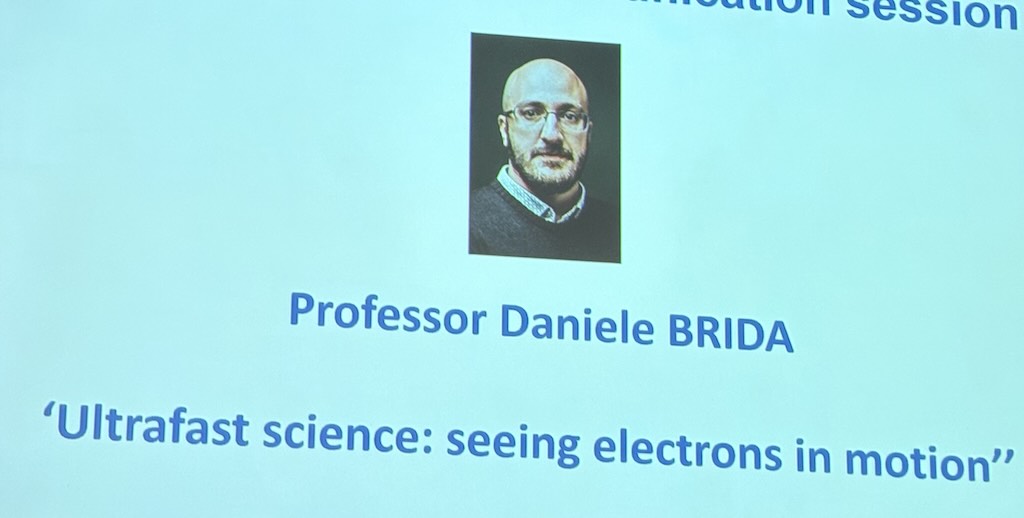
Well, on the 26 February 2026 I listened to an evening lecture on “Ultrafast science: seeing electrons in motion” by Prof. Daniele Brida.
He is a full professor in Experimental Condensed Matter Physics, and Head of DPHYMS (Department of Physics and Materials Science), in Luxembourg Universities‘ Faculty of Science, Technology and Medicine. He leads the research group Ultrafast Phenomena in Condensed Matter.
This group investigates the fundamental phenomena occurring in matter at ultrashort timescale. So they develop ultrafast systems and techniques designed to understand and control how light interacts with matter. The aim is to understand the microscopic origin of the properties of matter.
The evening lecture
It was the first time I’ve actually been to any part of Luxembourg University, and I just happened to track on the word “electron”, and came across this evening lecture.
It was interesting in multiple ways. Firstly, I arrived about 15 minutes early, just when Daniele Brida was putting on the lights in the lecture theatre. You could feel the tension in connecting the laptop to the theatre ceiling projector. Will it work first time? It did jump around a bit, but the blue-screen disappeared pretty quickly. It’s amazing that connecting a laptop to a projector is still tinged with tension.
I remember when I occasionally observed (sitting in the back) the emergence of MPEG-4 (think mid-late 90s), and saw all the techies still using overheads. At the time VGA standards varied, projectors were temperamental, and resolution mismatches were common. On top of that venues changed, and the mythical “conference technician” was permanently elsewhere. Yet in workshops in the Louvre, everyone just assumed that the technology worked, and they would connect their laptops and throw their presentations and videos onto the big screen.
As befitting a lecture focused on trying to measure femtoseconds (10−15 s) attoseconds (10−18 s), most people arrived just inside the last minute before it started. Someone once wrote that students drift into lectures like dust bunnies, an expression I now can’t unlearn. I do also wonder how many just drifted in, through the obligation to be seen, and didn’t care about the topic of the talk.
It was very satisfying to see numerous women in the lecture theatre, when I can remember over four years in the early 70s, only seeing one woman who studied physics. Also I could not help but notice that the dress sense of physicists has not changed over the last 50 years, very, very casual and a bit drab. It’s almost a uniform that minimises noise.
The talk
The theme of the talk was particularly topical, because the 2023 Nobel Prize in Physics (Pierre Agostini, Ferenc Krausz, Anne L’Huillier) was awarded for generating attosecond light pulses to study electron dynamics.
It’s a shame that this evenings talk is not available online. The university has a YouTube channel, but the Department of Physics and Materials Science is not very present. And I could not find any video tutorials on advance science topics.
Daniele Brida talked for just over one hour, and started with a very interesting and informative introduction to the history of the laser. He did a pretty good job moving into his specialist field of ultrafast measurements, but eventually I was reduced to trying to grab just the essentials.
This inspired me to pull together a collection of videos on lasers and ultrafast measurements.
Lasers and ultrafast measurements
The Science of Light and Lasers is a “Science at Home” from The Royal Institution from 2020 (thus a very basic introduction).
Below is a series from MIT dating back to 2008.
Laser Fundamentals I | MIT Understanding Lasers and Fiberoptics
Laser Fundamentals II | MIT Understanding Lasers and Fiberoptics
Laser Fundamentals III | MIT Understanding Lasers and Fiberoptics
Laser Fundamentals III (cont.) | MIT Understanding Lasers and Fiberoptics
Fiberoptics Fundamentals | MIT Understanding Lasers and Fiberoptics
Electron Microscopy: Looking into the Atomic World is from the Canadian Centre for Electron Microscopy, dating from 2021.
The Extreme World of Ultra Intense Lasers is from The Royal Institution (2015).
Webinar: Benefits of Laser Technology as an Advanced Manufacturing Process is a very recent video about the industrial use of lasers.