As part of my visit to Canada (26 September to 25 October 2026), I visited Whistler for two days (17-19 Oct. 2026).
Whistler, British Columbia, lies approximately 120 km north of Vancouver, in the Coast Mountains, at an elevation of about 675 metres above sea level. The municipality has a permanent population of approximately 14,000, but receives several million visitors annually. Unlike Banff or Jasper, which developed around railway tourism and national parks, Whistler is principally the product of a deliberate 20th-century effort to create a major skiing resort. Later it transformed into a year-round destination, and more recently a centre for art and culture..
Whistler Valley lies within the traditional territories of the Squamish Nation (Sḵwx̱wú7mesh Úxwumixw) and the Lil’wat Nation (Líl̓wat7úl). Indigenous communities used the mountain valleys for hunting, gathering, travel and trade long before European settlement. The modern municipality’s name derives from Whistler Mountain, previously known as London Mountain, which was renamed after the whistling calls of the hoary marmots inhabiting its slopes.
Permanent non-Indigenous settlement developed around Alta Lake during the early 20th century. An important event was the completion of the Pacific Great Eastern Railway through the valley in 1914, connecting the area more reliably with the coast. Before a proper road connection existed, the railway was the principal means of transporting people and supplies into the valley.
So Whistler was a summer holiday destination decades before it became a ski resort. There was no central Whistler Village, and the commercial activity was concentrated around Alta Lake and the railway.
The decisive change occurred in 1960, when a group of Vancouver businessmen began considering the mountains around Alta Lake as the possible site for the 1968 Winter Olympic Games. Although the Olympic bid did not succeed, the project continued commercially, and Whistler Mountain officially opened for skiing on 15 January 1966.
The project faced a major practical difficulty, namely road access. Improvements to Highway 99 during the 1960s and 1970s were essential to the resort’s growth.
A second ski area, Blackcomb Mountain, opened in December 1980, introducing direct competition between two neighbouring mountains. A particularly important date is 6 September 1975, when the Resort Municipality of Whistler was incorporated, with a permanent population of fewer than 1,000.
The American landscape architect Eldon Beck, who had worked on Vail in Colorado, designed the village around pedestrian streets, small squares and carefully arranged views towards the mountains. Vehicle traffic was largely excluded from the centre, with roads and parking placed around its perimeter.
The first phase of Whistler Village opened in December 1980, coinciding with the opening of Blackcomb Mountain. The village architecture was deliberately informal, intending to create the impression of an established alpine town, although nearly all the buildings were new.
The development of summer tourism was a deliberate economic strategy. The resort expanded golf, hiking, mountain biking, sightseeing and conference facilities. The most substantial lift investment was the PEAK 2 PEAK Gondola, opened in December 2008, connecting Whistler and Blackcomb mountains.
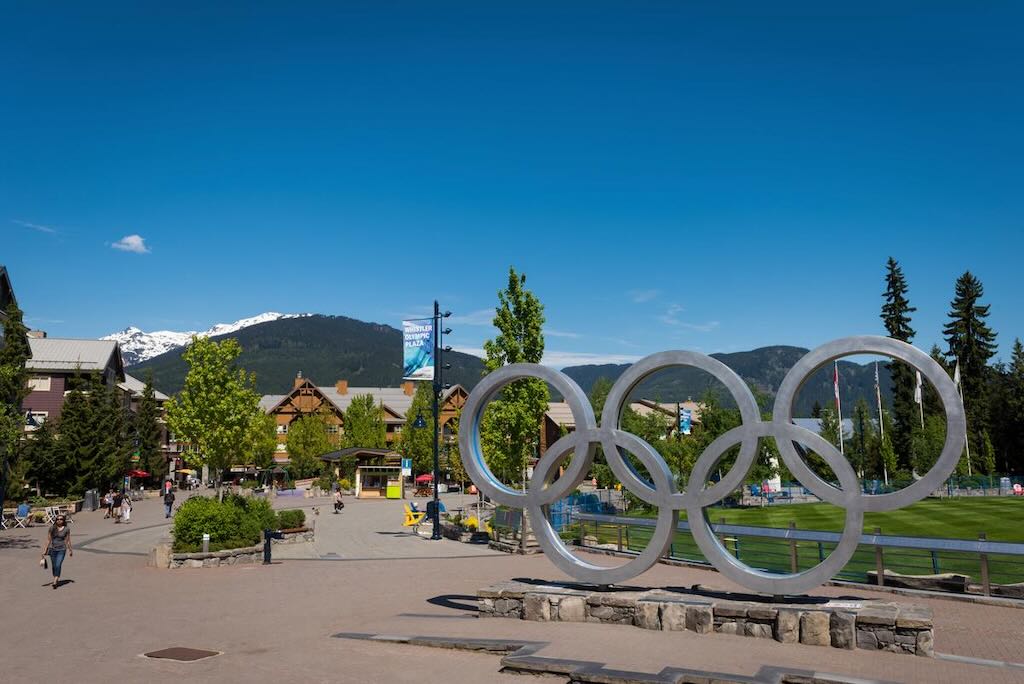
Whistler’s long-standing Olympic ambition was finally realised when Vancouver and Whistler were awarded the 2010 Olympic and Paralympic Winter Games by the International Olympic Committee on 2 July 2003. The Games were held from 12 to 28 February 2010, with the Paralympic Games following from 12 to 21 March.
Squamish Lil'wat Cultural Centre — 2008
This is perhaps the most interesting phase of Whistler’s recent history, particularly for someone visiting outside the skiing season (like me in October 2026).
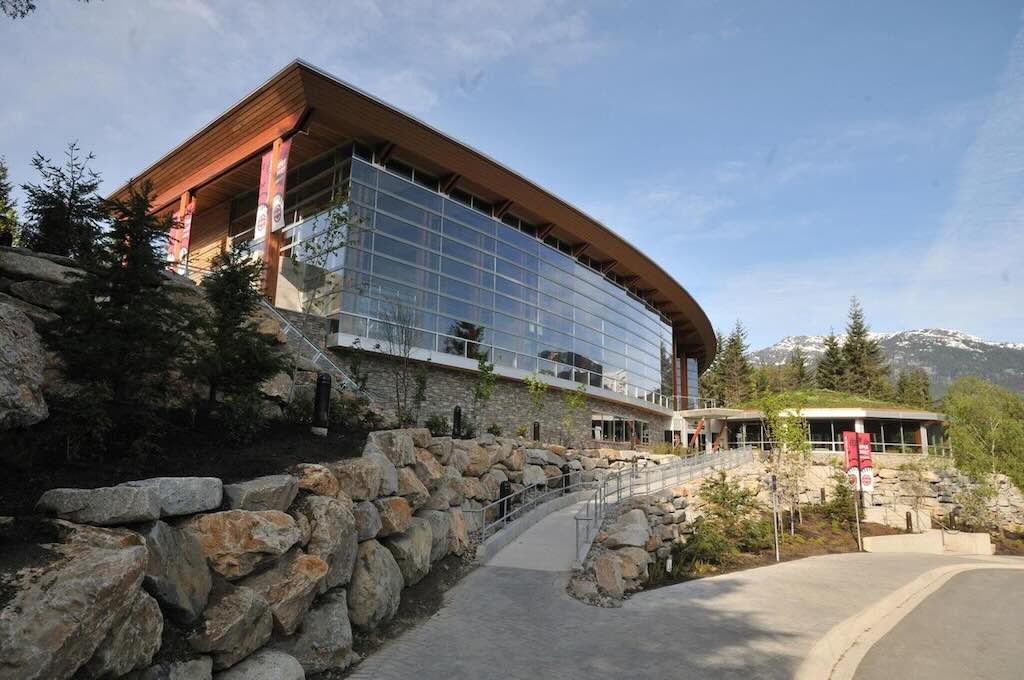
The Squamish Lil’wat Cultural Centre opened in July 2008, shortly before the Winter Olympics. It was created jointly by the Squamish and Lil’wat Nations to present their histories, artistic traditions and contemporary cultures.
Its origins can be traced to discussions beginning in 1997, followed by a formal cooperation agreement between the two Nations in 2001. The building combines architectural references to a traditional Squamish longhouse and a Lil’wat istken, a partly subterranean dwelling.
The centre includes exhibitions of carved objects, woven textiles, ceremonial regalia and other cultural material, as well as spaces for demonstrations and educational activities. It is not simply a museum about Indigenous history, but it is also an institution through which the two Nations represent their own continuing cultures.
So the first thing to understand is that the Squamish Nation and the Lil’wat Nation are two distinct Indigenous peoples whose traditional territories meet and overlap in the Whistler region of British Columbia. Both have histories extending thousands of years before European settlement, but they differ considerably in language, geographical origins, social organisation and traditional ways of life.
Both are recognised today as First Nations, a term that describes Indigenous peoples in Canada other than Inuit (traditionally inhabiting the Arctic and Subarctic regions) and Métis (whose historical homelands include Canada’s three Prairie Provinces). Importantly, neither nation acquired its identity when Canada introduced the term. Their existence as peoples predates Canada itself.
In Canadian terminology:-
- First Nations refers collectively to Indigenous peoples other than Inuit and Métis. It is also used for individual Indigenous nations and communities.
- Indian status is a specific legal status assigned to individuals registered under Canada’s Indian Act.
- An Indian Act band is a legally recognised community with a governing council and collective interests in reserve lands or other band assets.
- A reserve is land set apart for the use and benefit of a First Nation band. It is not equivalent to the Nation’s full traditional territory.
The term “band” comes from British colonial administration, which used band to describe groups of Indigenous people associated with a particular territory or community. It is a legal term, not simply a reference to a small group of people.
The Squamish (Sḵwx̱wú7mesh)
The Squamish Nation identifies a traditional territory of approximately 6,732 square km, extending from the Vancouver area north through Howe Sound (Canadian fjords) and the Squamish Valley into the mountains around Whistler. The Nation reports archaeological evidence of human occupation dating back approximately 8,600 years. Their culture developed around coastal waterways, salmon fisheries, cedar forests and maritime transport.
The most distinctive elements of traditional Squamish society were its relationship with the sea and its sophisticated use of western red cedar.
Cedar supplied the timber for large communal longhouses, canoes and ceremonial objects, while its bark and roots provided fibres for weaving. Large dugout canoes allowed travel along Howe Sound, Burrard Inlet and neighbouring waterways. Salmon fishing was fundamental, supplemented by shellfish gathering, hunting and other seasonal activities.
Squamish society was organised around extended families, hereditary leadership, community relationships and ceremonial obligations. Longhouses could accommodate several related families, and seasonal movement between settlements and resource-gathering locations was common.
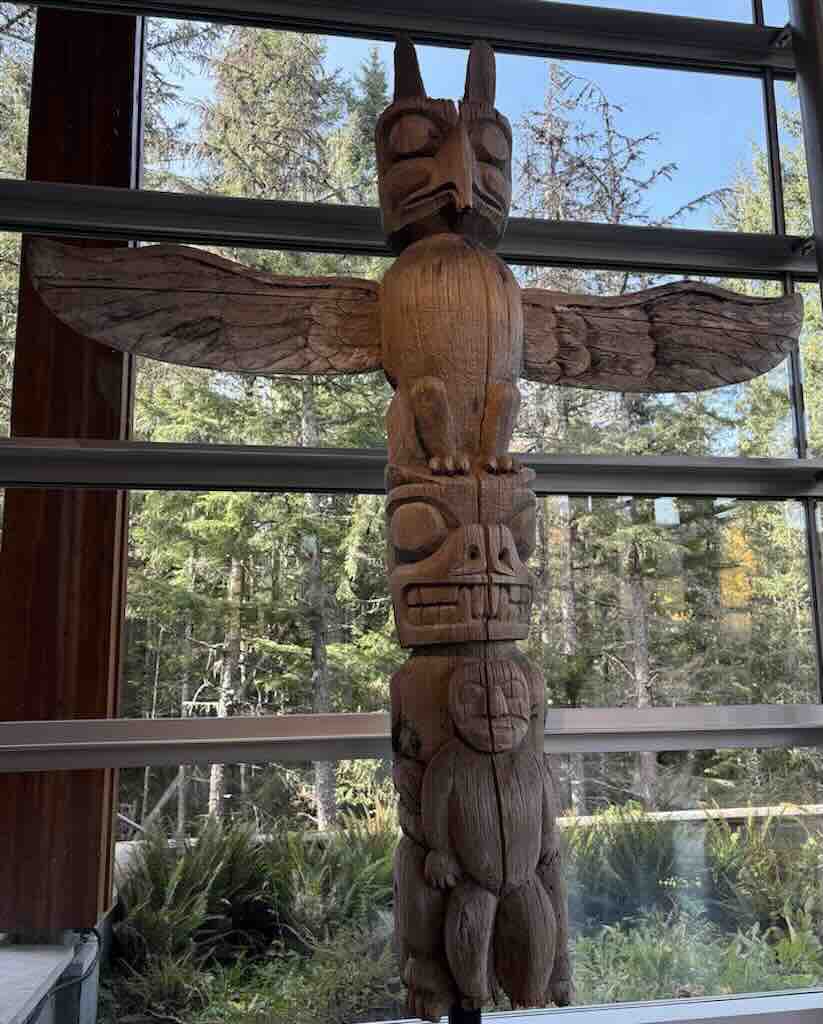
In the above photo, the top is a large bird with its wings spread horizontally. Below the bird is a broad face with exposed teeth, followed by a human-like figure with a rounded face and its arms and legs positioned vertically. The arrangement of animals and human figures is characteristic of Northwest Coast monumental carving traditions.
An important distinction is that such poles are not necessarily objects of worship. They can record family histories, ancestral relationships, inherited privileges, or particular stories. The meaning of the figures depends on the carver, the community and the purpose of each individual pole.
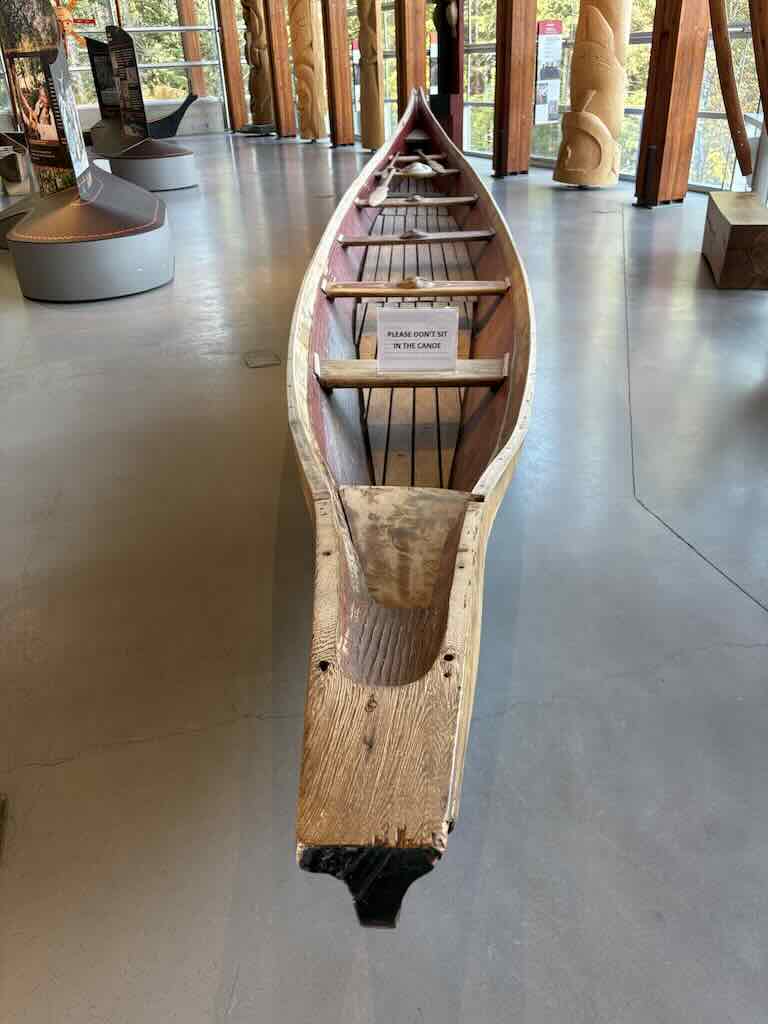
Above we have a narrow wooden canoe displayed in the Great Hall. It has a pointed, projecting bow, high sides, wooden crosspieces and a relatively narrow interior.
The important technological feature is that traditional canoes of this kind were carved from a single large cedar log rather than assembled from separate planks. The wood was hollowed using adzes and other tools, and the hull could be shaped and widened using controlled heat, moisture and bracing.
The Squamish developed vessels suitable for coastal waters, including larger hunting and transport canoes. The Lil’wat also developed river canoes adapted to narrower waterways.
This is a 12.2 m long Squamish hunting canoe called X̱aays Transformer Brothers, carved by master carver Ray Natraoro. What we see is the combination of woodworking and practical naval design. The relatively light, elongated hull provided an efficient means of transporting people and goods, and canoes were essential for fishing, trading and maintaining relationships between communities.
The Lil’wat (Líl̓wat)
An Interior Salish people, based principally around the Pemberton Valley and Mount Currie, north of Whistler. Their traditional economy combined river fishing with hunting, plant gathering and travel through mountainous interior valleys.
The Lil’wat Nation identifies a traditional territory of approximately 7,911 square km, extending from Rubble Creek south of Whistler north towards Gates Lake, east to the Upper Stein Valley and west towards Toba Inlet. Its principal community is Mount Currie, approximately 35 km north of Whistler.
Lil’wat archaeological finds have been dated to more than 5,400 years ago. The Nation also describes evidence extending much further back in its historical account.
Unlike the coastal Squamish communities, the Lil’wat traditionally occupied a transitional geographical region between the wet Pacific coast and the comparatively dry British Columbia interior.
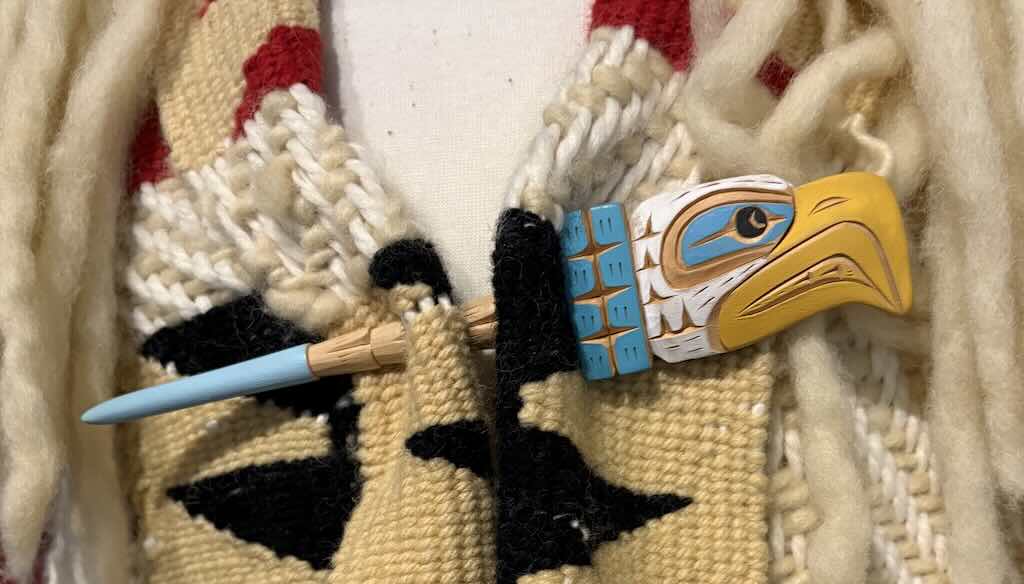
The museum explained that wool weaving was a major Coast Salish tradition. Historically, fibres included mountain-goat wool and the hair of specially maintained woolly dogs. Spinning and weaving produced blankets and other textiles with social, ceremonial and practical significance.
Some of the museum’s blankets draw on designs worn by Squamish chiefs who travelled to England in 1906 to raise land concerns with King Edward VII.
Audain Art Museum — 2016
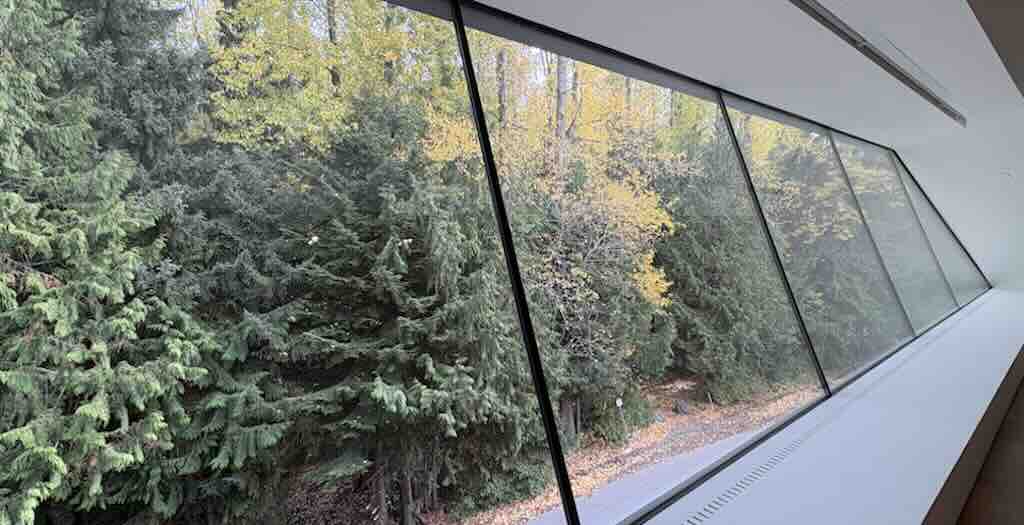
The Audain Art Museum, opened on 12 March 2016, and was founded by Vancouver property developer and art collector Michael Audain and his wife, Yoshiko Karasawa, to house a major collection of British Columbian art.
The building was designed by Patkau Architects of Vancouver and contains approximately 5,200 square m of floor space. It stands among trees close to Whistler Village, with dark metal cladding and a timber-lined interior. The architectural design responds to the substantial winter snowfall and the floodplain of Fitzsimmons Creek.
The permanent collection covers several centuries of artistic production in British Columbia, including historic Northwest Coast Indigenous art, paintings by Emily Carr and E.J. Hughes, and contemporary work by artists such as Jeff Wall and Stan Douglas.
The Permanent Collection
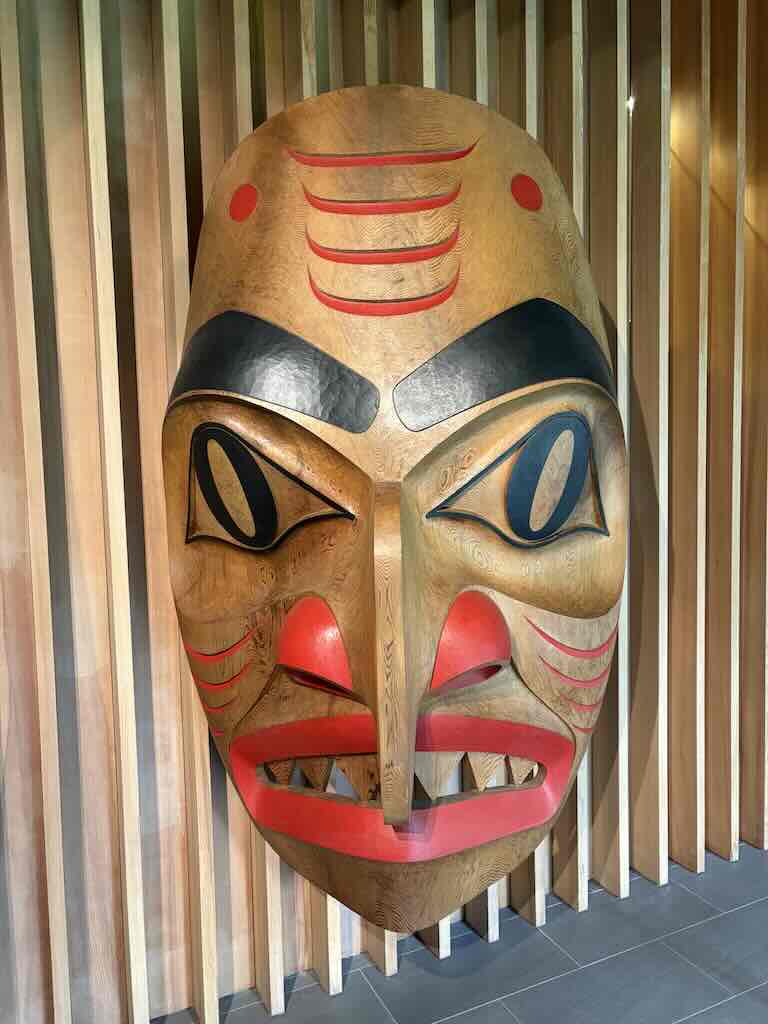
At the entrance to the permanent exhibition there is the “Dogfish Mask” (1999 – 2013), by Robert Davidson (1946 – ).
This very large mask is made from red cedar and pigment, and is positioned at the entrance to the permanent collection to highlight the artistic traditions of the Indigenous peoples of the Northwest Coast.
The dogfish is a small shark found in the coastal waters of British Columbia. In Haida art, Dogfish is a recognised crest figure, associated with particular family histories and inherited identities.
The mask is not intended to be a naturalistic representation of a shark. Davidson uses the formal language of Haida art, i.e. strongly defined eyes, curved shapes, carefully balanced positive and negative spaces, and the distinctive system of ovoids and U-forms characteristic of Northwest Coast formline design.
The result is a highly stylised animal image, whose anatomy is transformed into an organised pattern of interlocking shapes.
The large size is important. Traditional ceremonial masks were generally made to be worn or carried, whereas Davidson’s monumental work invites visitors to examine the design as sculpture. At this scale, the carved surfaces and relationships between individual forms become especially prominent.
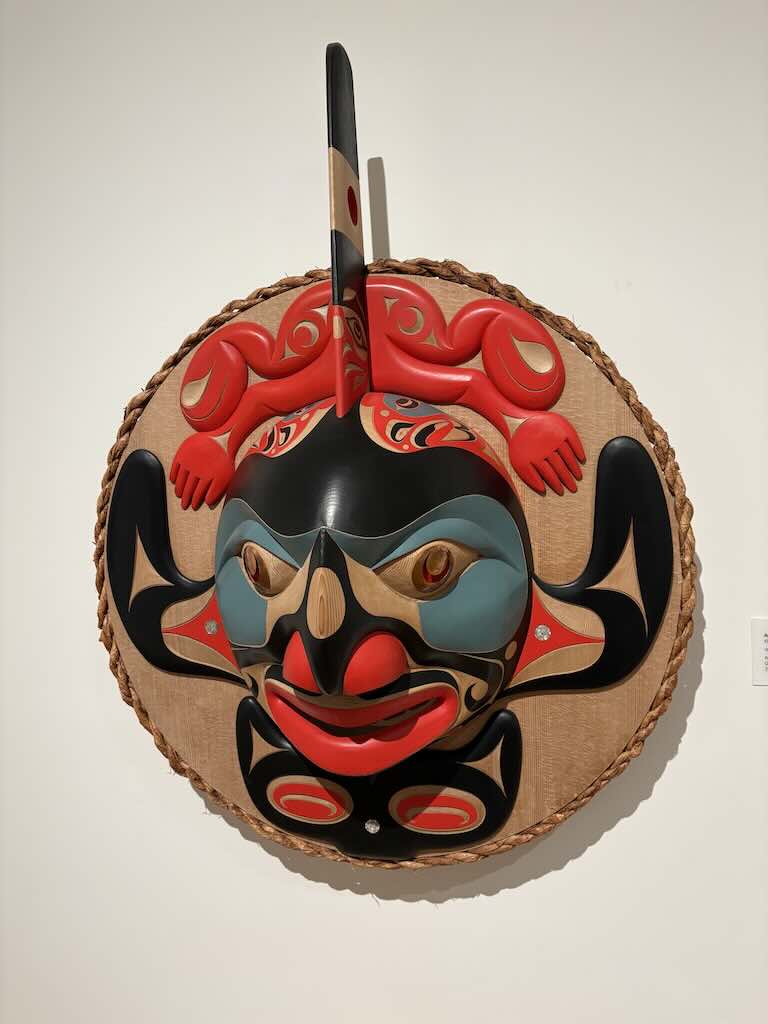
This is “Killer Whale Moon Mask” (c. 1997), by Art Thompson (1948–2003) of the Nuu-chah-nulth, Ditidaht First Nation. He became an important figure in the revival and development of Nuu-chah-nulth carving, particularly ceremonial masks, as well as printmaking.
His work draws on the artistic traditions of the Indigenous peoples of western Vancouver Island, rather than the Haida traditions of Haida Gwaii. This distinction matters because Northwest Coast Indigenous art encompasses several different artistic traditions.
This mask combines two subjects identified in its title, both the killer whale (orca) and the moon. The strong black, red and blue-green colour scheme is characteristic of Northwest Coast carving.
The killer whale has an important place in the cultural histories and artistic representations of several Northwest Coast peoples. However, its precise significance differs among communities and families. It is also important to distinguish this work from the historic masks displayed elsewhere in the Audain collection, some dating to the late 18th and 19th centuries. Thompson’s mask belongs to a period when Indigenous artists were actively reasserting and developing their own new artistic traditions.
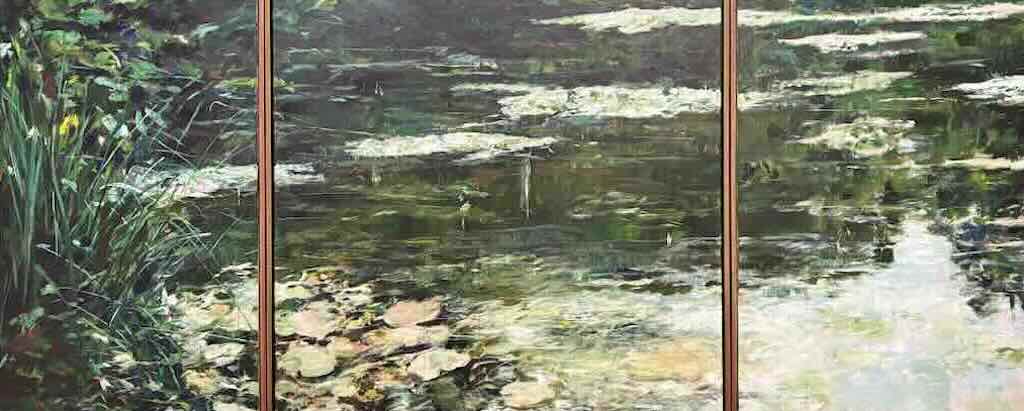
This is “Summer Pond” (2002) by Gordon A. Smith (1919–2020). He was born in England, but became an important figure in British Columbia’s modern painting movement.
In 1995, Gordon Smith visited Monet’s house and gardens at Giverny, France. Inspired by Monet’s water lilies in the pond paintings, he returned to Vancouver and began his own series of pond paintings. Smith subsequently moved towards greater abstraction because he felt audiences responded too readily to the recognisable imagery. This is consistent with Smith’s later approach to landscape painting, i.e. the natural subject remains identifiable, but the arrangement of colour, texture and brushwork becomes equally important.
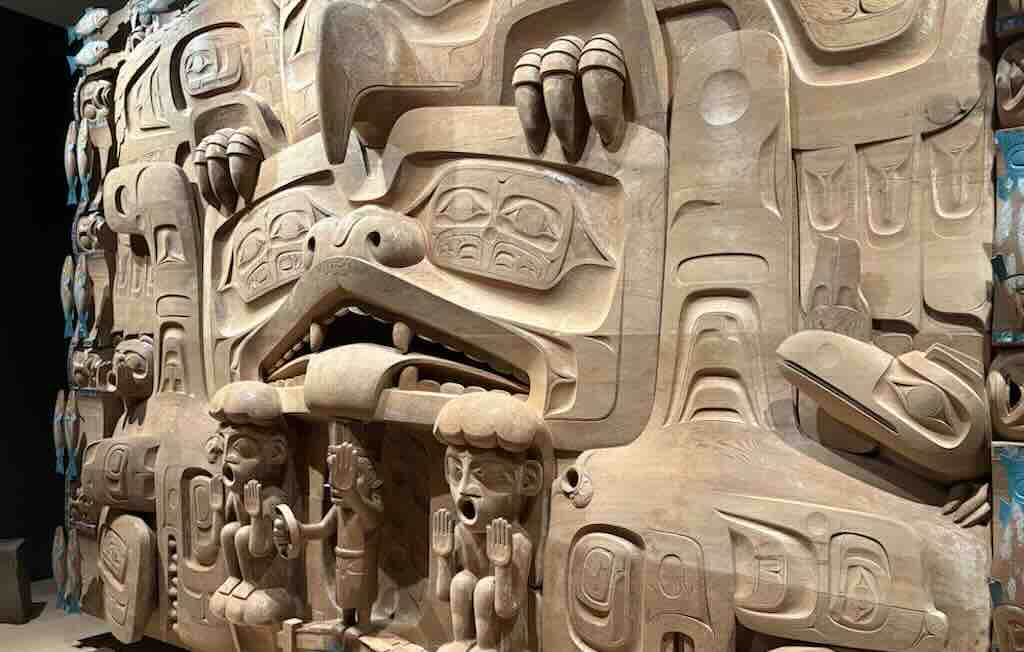
This is “The Dance Screen (The Scream Too)” by James Hart (1952-), hereditary Haida chief, also known as 7idansuu.
This is a substantial panel (4.8 m by 3.2 m) of red cedar, abalone, mica, acrylic, wire and yew. The central figure is Bear Mother, a character in Haida traditional narratives. Above her is an eagle, with frogs emerging from its ears. On either side of the complete screen are killer whales, together with representations of a beaver and raven. The entire screen is surrounded by salmon, linking the different creatures to the same ecological system.
The title deliberately refers to The Scream by Edvard Munch. The open mouths of the figures express alarm about the decline of Pacific salmon. Hart uses traditional Haida figures to communicate a contemporary environmental concern, because salmon sustain bears, eagles, killer whales, people and the wider coastal ecosystem.
A dance screen is a large carved structure associated with ceremonial performances in Northwest Coast Indigenous traditions. It can form the backdrop to dancers and even provide an entrance through which performers emerge.
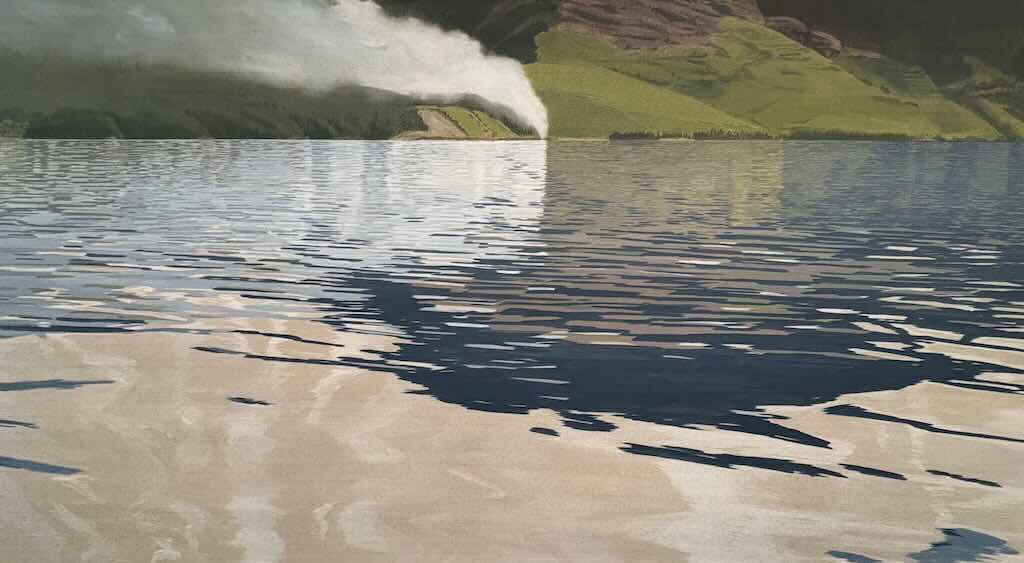
The exhibition, was both a retrospective and a celebration of his 100th birthday.
The title “The Johnstone Strait 1/92: Reflections” (1992), is a narrow marine passage between northeastern Vancouver Island and the mainland coast of British Columbia. It forms part of the Inside Passage shipping route.
The painting is particularly interesting because Tanabe makes the water, rather than the mountains, the principal subject, and in. particular the reflected light. He is representing the way an uneven water surface breaks reflected light into discontinuous horizontal patterns.
The title’s 1/92 is consistent with Tanabe’s practice of numbering works within a year.
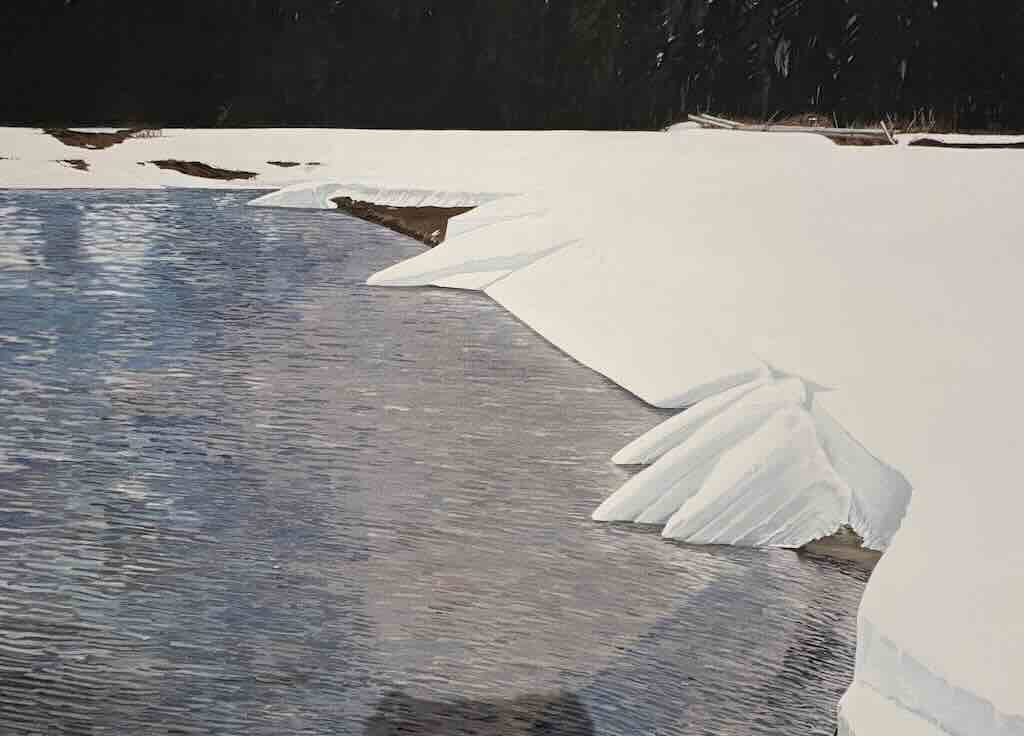
This is “Bow River, Spring Breakup 3/92” (1992). Here Tanabe uses the sharp boundary between white snow and moving water to organise the composition. The snowbank is reduced to large, nearly featureless shapes, while the river is represented through hundreds of small horizontal marks.
The dominant subject in both was reflected light, one depicting the transition from winter to spring in an inland river landscape, whilst the other examines reflections on a coastal waterway. The most striking feature here is the geometry of the melting ice. The projecting forms along the shoreline create strong diagonals that contrast with the horizontal movement of the river.
I tried to capture something about what the artist was saying, but remained unimpressed.
This was presented as a special exhibition because it brought together works around a particular theme, rather than simply displaying the museum’s permanent collection.
The title suggests two contrasting conditions, firstly storm, representing disturbance and change, and stillness, representing calm and reflection.
Solstice refers to the astronomical turning points of the year, when the Sun reaches its greatest northern or southern declination.
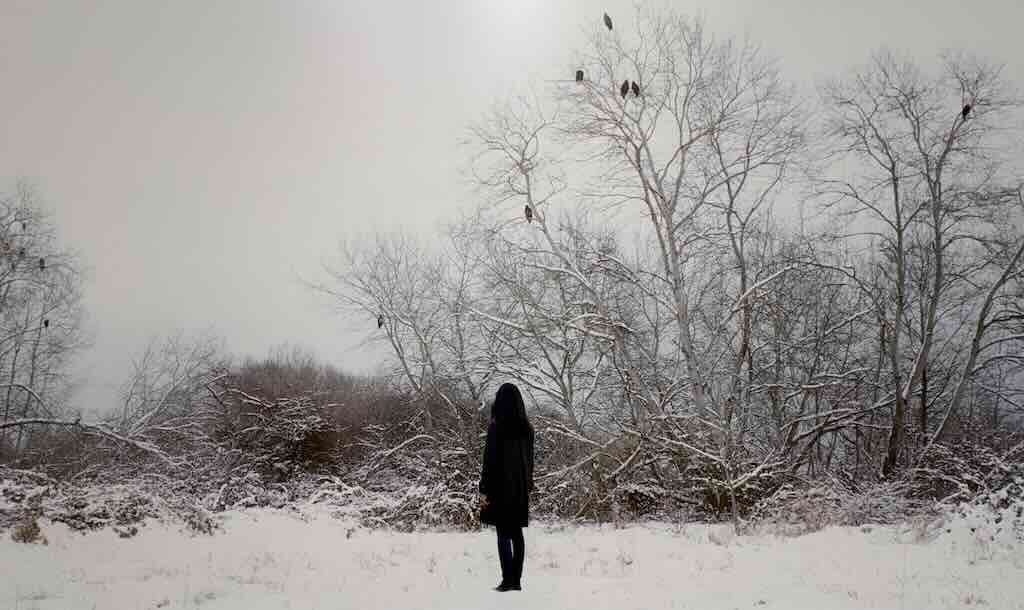
I only retained one, “Woman with Eagles” (2017), by Karin Bubaš (1976-). This is a colour photographic print of a solitary woman standing in a snow-covered clearing, facing away from the camera towards a group of leafless trees, with eagles.
The composition is deliberately restrained. There is no dramatic action, and the woman appears unaware of, or indifferent to, the viewer. The museum identifies this work as exploring the relationship between a carefully styled female subject and the natural environment.
The photograph illustrates the exhibition’s central contrast between winter as a physical condition and winter as a psychological experience. At least, that is what is mentioned in the museum’s description.