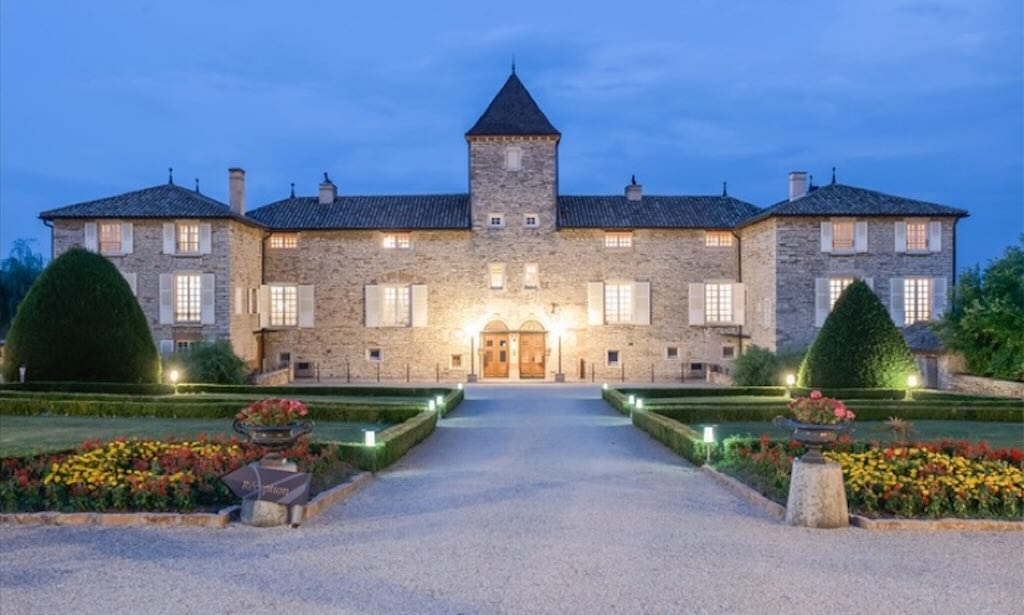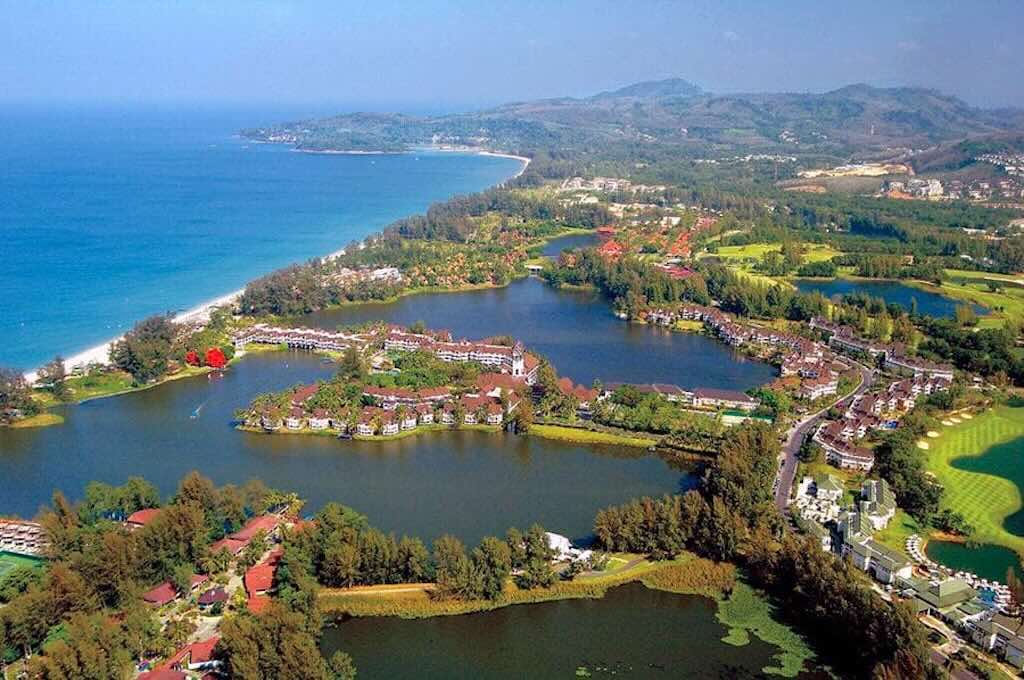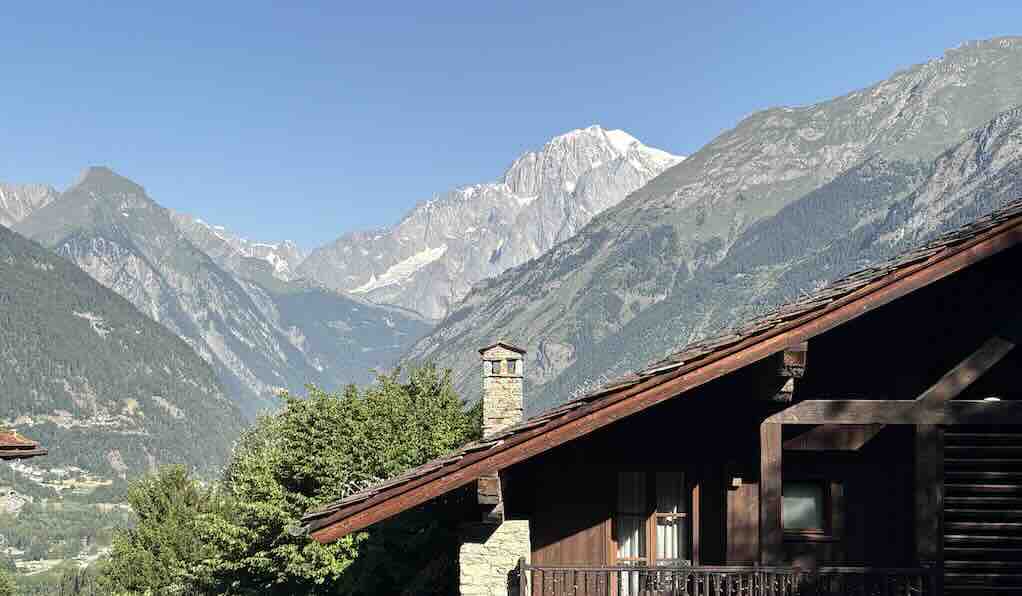
I stayed in the Mont Blanc Relais & Spa in La Salle in the Aosta Valley. It is presented as a 5-star hotel.
Booking gave it a 9.3 (Superb) based on 392 reviews. Most positive comments included the service, and the view of Monte Bianco.
Tripadvisor gave it 4.2 (Good) from 544 reviews. Most comments were very positive, but some visitors mentioned the old style of the hotel and that the standard rooms were small and simple.
I have known this hotel for many years, but have never stayed there. My wife and I would use the pool and spa facilities, and occasionally dine on the terrace with its spectacular view of Monte Bianco.
I stayed there in June 2026 and profited from a mid-week “3-nights for the price of 2”, and a free upgrade from a standard room to a junior suite.
Judging from the booking options, this hotel is quiet, except when fully booked Thursdays through Saturdays. In fact Sunday night I was almost alone for dinner, and for breakfast the next day. However through to Wednesday morning it was well frequented, and the breakfast buffet was back.
Arrival and Welcome
Very friendly welcome, and they have a large underground garage. They gave me a free upgrade from a standard room to a junior suite.
My room
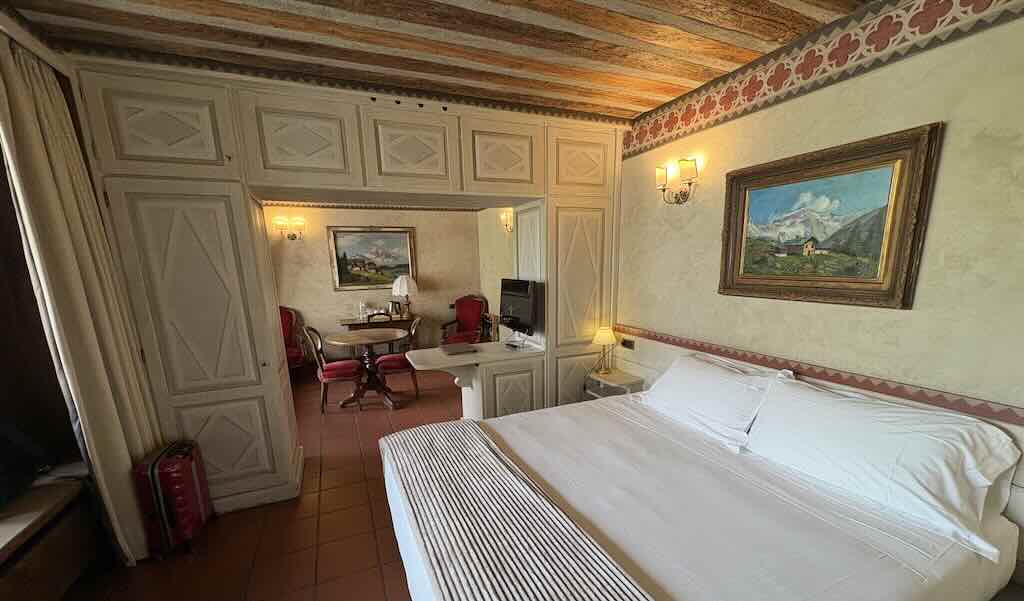
The suite was comfortable, but I would admit, it was a little old-fashioned. However, this is often the case in a mountain resort, where old-fashioned becomes traditional.
Positives were a good bed, and negatives were no Nespresso coffee machine and no wall-safe able to take a laptop, etc. Also I found the wi-fi in the bedroom flaky and phone reception poor (it was fine on the hotel terrace).
One inconvenience of the room was the two large windows that opened on to a small garden shared with a couple of other rooms. Although I didn’t see anyone, in-room privacy was limited.
Bathroom
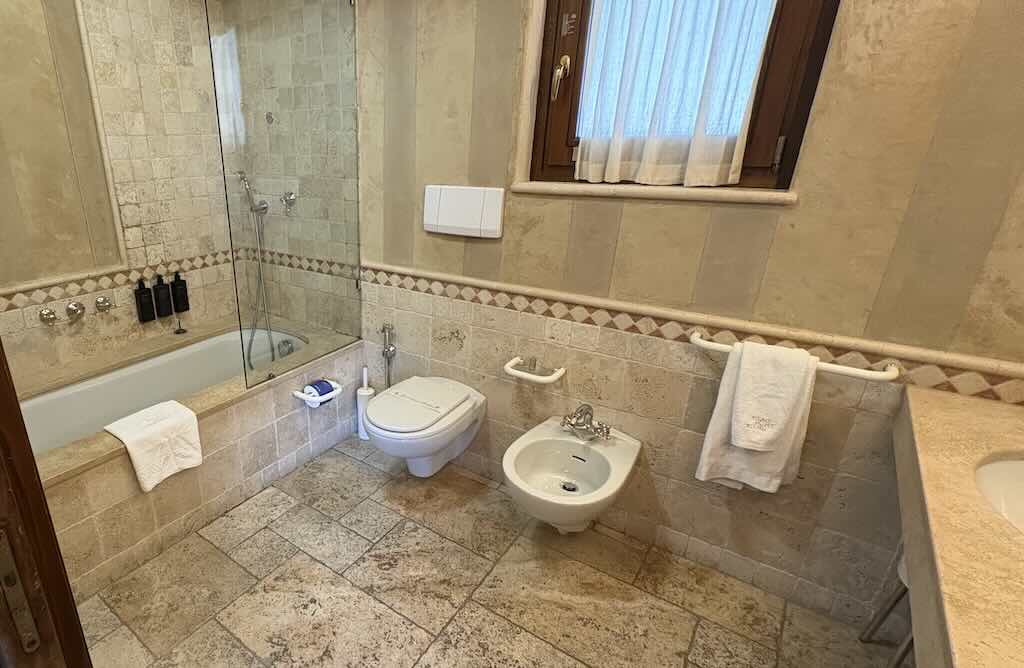
I prefer a more modern bathroom decor, but my only real complaint was no walk-in shower. I didn’t specify this because I thought it was standard for a 5-star hotel. Evidently not.
Breakfast
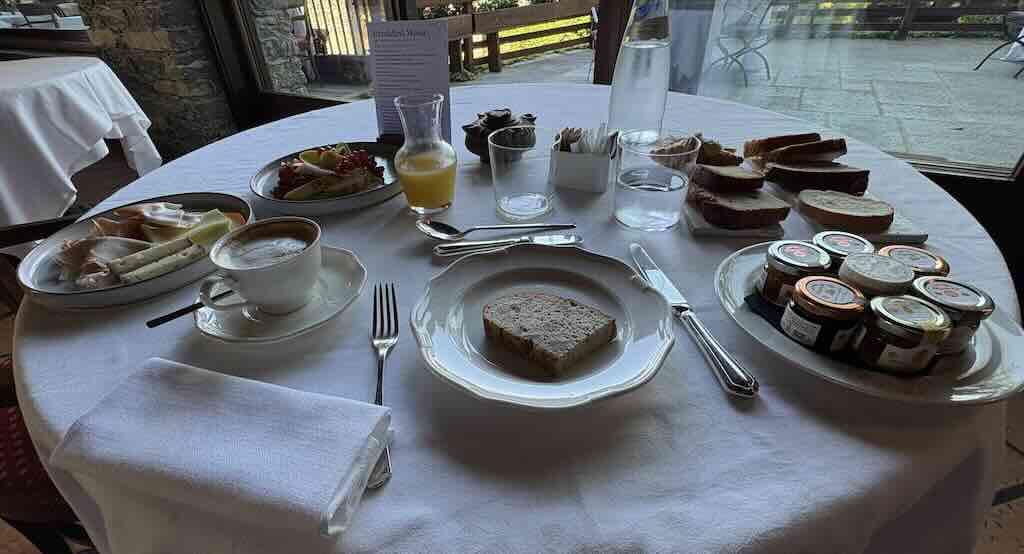
On my first morning it was waiter service, but perfectly well presented. As is often the case, coffee was served cup-by-cup, when I prefer an unlimited supply. The prepared fruit was excellent. There was also a full menu of prepared breakfast dishes.
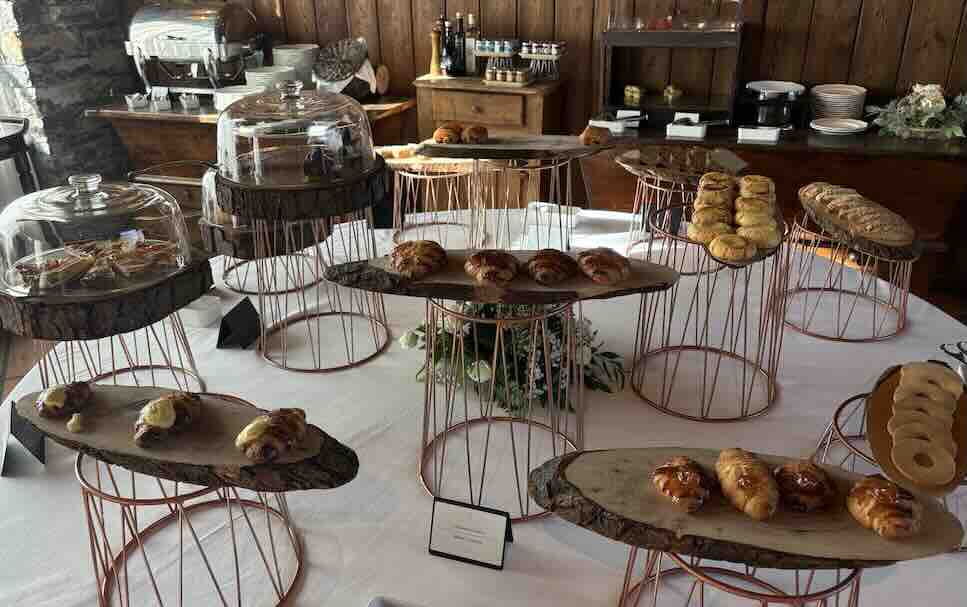
The other mornings it was a breakfast buffet, with the usual fruit, cooked options, etc., and coffee in small cups.
Lunch
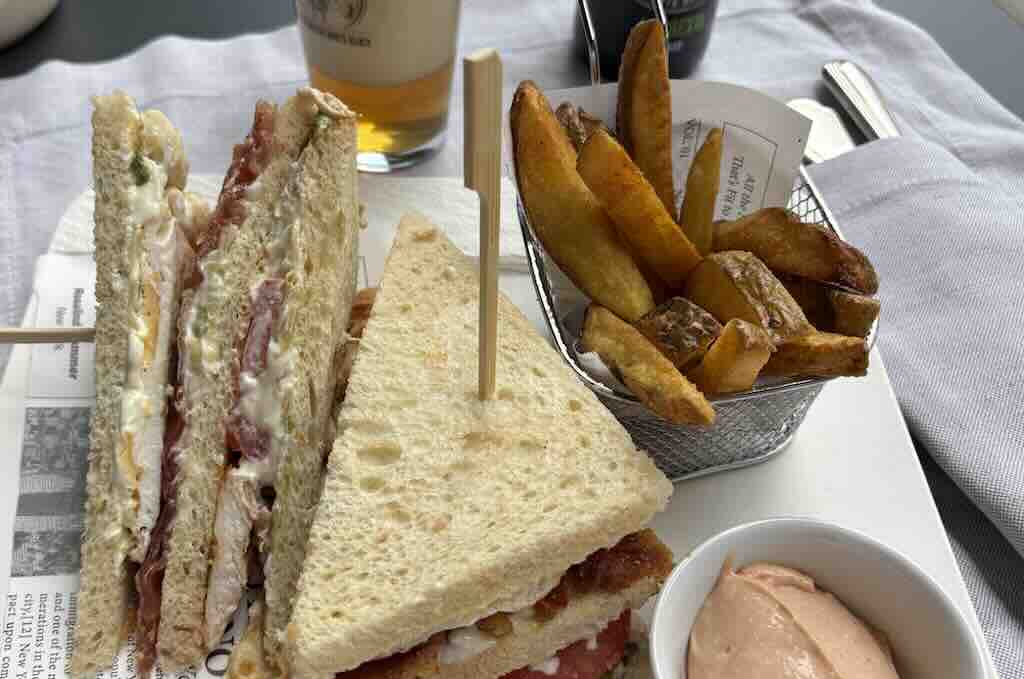
The day I arrived I took a club sandwich and beer on the terrace. It was very good, but it did affect my appetite for the evening.
Dinner
There was a good dinner menu, with several traditional options re-visited by the chef. On two of the days there was also a special three-course menu based on porcini mushrooms from the valley. Below I have described the different dishes I tasted during my stay.
My preferred drink through all my dinners was a Gosset Grand Millésime 2012.
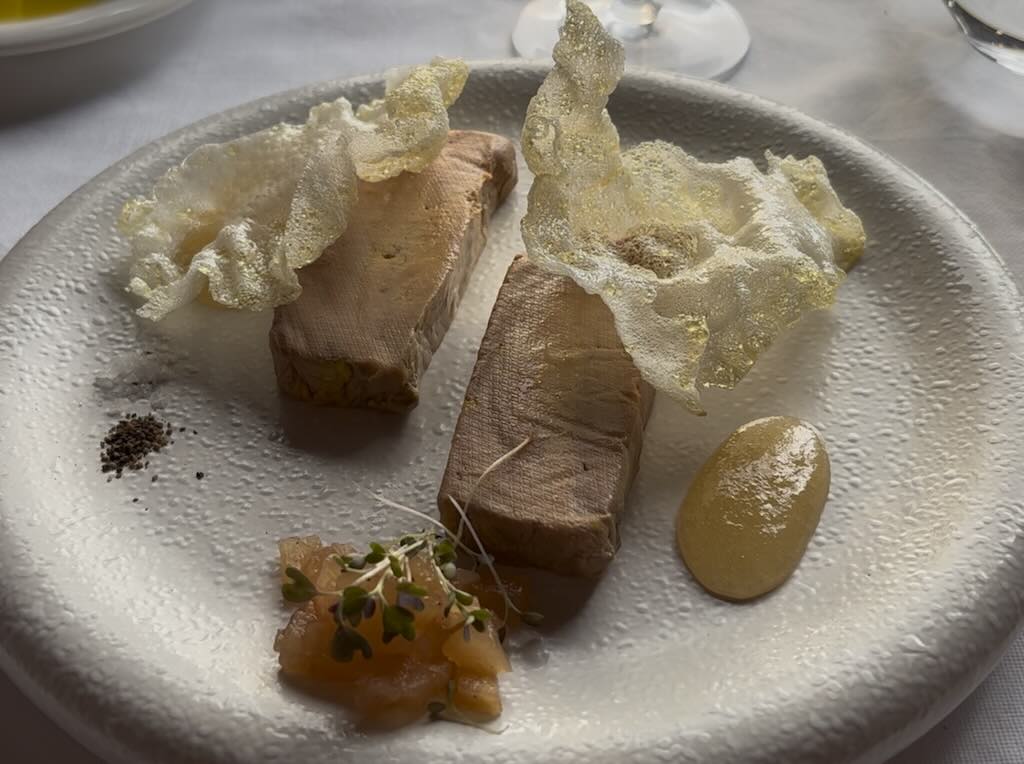
Above we have La Terrina di Foie-Gras – Marinata al liquore di pera “Martin Sec”, sfoglie croccanti e chutney alla frutta in accompagnamento.
I appreciate that the traditional accompaniment would be toasted brioche, pain d’épices, or possibly toasted country bread. I have always liked the brioche. And I know that today many chefs prefer crisp wafers because they influence less the taste of the foie gras. Here both the crisp wafers and the chutney were quite spicy (I think unusually so).
Frankly, I was not impressed.
What exactly means Marinated in “Martin Sec” pear liqueur? Firstly, I’m guessing that the foie gras was first marinated, before cooking and pressing.
“Martin Sec” is in fact an ancient variety of cooking pear that is particularly associated with the western Alps, especially the Aosta Valley and neighbouring Piedmont (specifically Cuneo). It was rediscovered in the 1990s.
According to Wikipedia it is small with a brownish or sun-reddish exterior, entirely covered with grey spots and largely carmine on the side facing the sun. It is very firm, slightly grainy, crunchy, relatively dry (hence Sec), and not particularly pleasant eaten raw (although it is sweet). It’s considered one of Italy’s finest pears for cooking. There is also a mention of this pear in red wine.
St. Roch Levi Ottoz is said to produce a Liquore al Martin Sec. I can’t find it on their website, but the colour (a clear golden amber, tending towards honey or light whisky) appears to come from the production process and the fruit infusion rather than from heavy caramel colouring. The producer simply describes it as a fruit liqueur made from Martin Sec pears, bottled at 35% alcohol.
So I can’t find a reason why this marinate foie gras was so dark in colour, and didn’t taste particularly good, in my opinion.
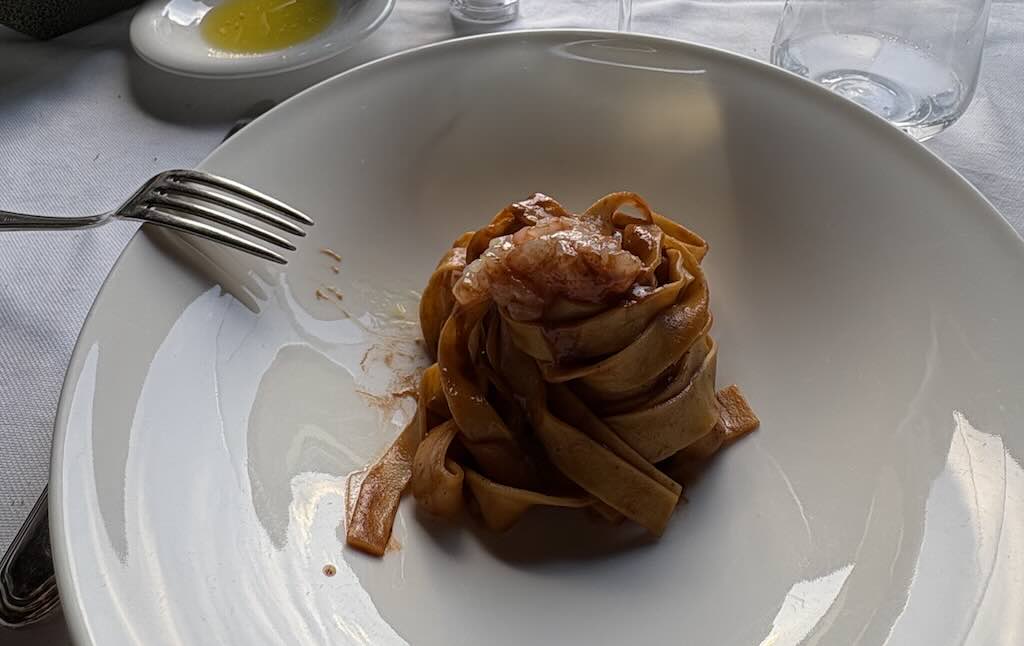
Fresh Pasta Fettuccine – Creamed with lime jam, purple shrimp, and vanilla.
Firstly, it’s not an especially attractive plate. It looked boring, lacking contrast in colour.
I expected something lighter, maybe a bit of glossy butter, perhaps tiny green flecks of lime zest. Instead the sauce is quite dark.
Where is the lime jam (marmellata di limetta)? I certainly could not taste the vanilla. The prawns were formless (probably diced), whereas “gambero viola” (purple prawn) is a type of premium Mediterranean prawn. Depending on the fish market and region, it usually refers to deep-water prawns with a violet or purple shell.
The fettuccine were hand-made, but for me they were slightly too thick (but the right width).
Again, unimpressed.
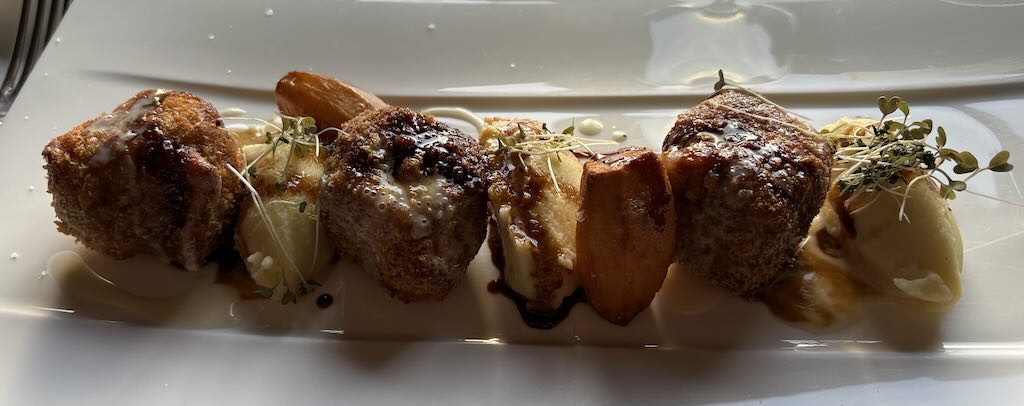
Above we have La “Valdostana” del Relais Mont Blanc – Cubi di vitellino da latte farciti alla Fontina DOP e prosciutto cotto dorati nel burro serviti con fonduta di fontina, patate mantecate e il suo fondo.
The “Valdostana” from Relais Mont Blanc – Cubes of suckling veal stuffed with Fontina DOP and cooked ham browned in butter, served with Fontina fondue, creamed potatoes and its stock.
I’m a fan of the “Valdostana” and in its simplest form, it’s a rustic mountain dish, designed to showcase the three great products of the Aosta Valley, namely veal, Fontina DOP and butter. Everything else is secondary.
The traditional meal is lightly flattened slices of milk-fed veal folded over one slice of Fontina and one slice of local prosciutto cotto. Then lightly dusted with flour, and browned gently in a generous quantity of foaming butter. Many traditional recipes add a splash of dry white wine, or simply a little stock. The pan is then covered to let the veal cooks gently for several minutes, and the Fontina melts. It’s usually finished with a little sauce from the butter, meat juices, and maybe a little reduced stock.
Here the chef used cubes, and instead of melted cheese inside, he added a kind of Fontina fondue. Instead of boiled potatoes, he served whipped potatoes (patate mantecate). As a fine-dining reinterpretation it looked very appetising.
The tastes were there, but the vitellino da latte (milk-fed veal) was not tender enough. When cooked properly, it should almost separate with gentle pressure from a fork. Also I didn’t really taste the Fontina inside the cubes, but it was present in the dish.
An almost perfect, and an “almost” is often a strong criticism.
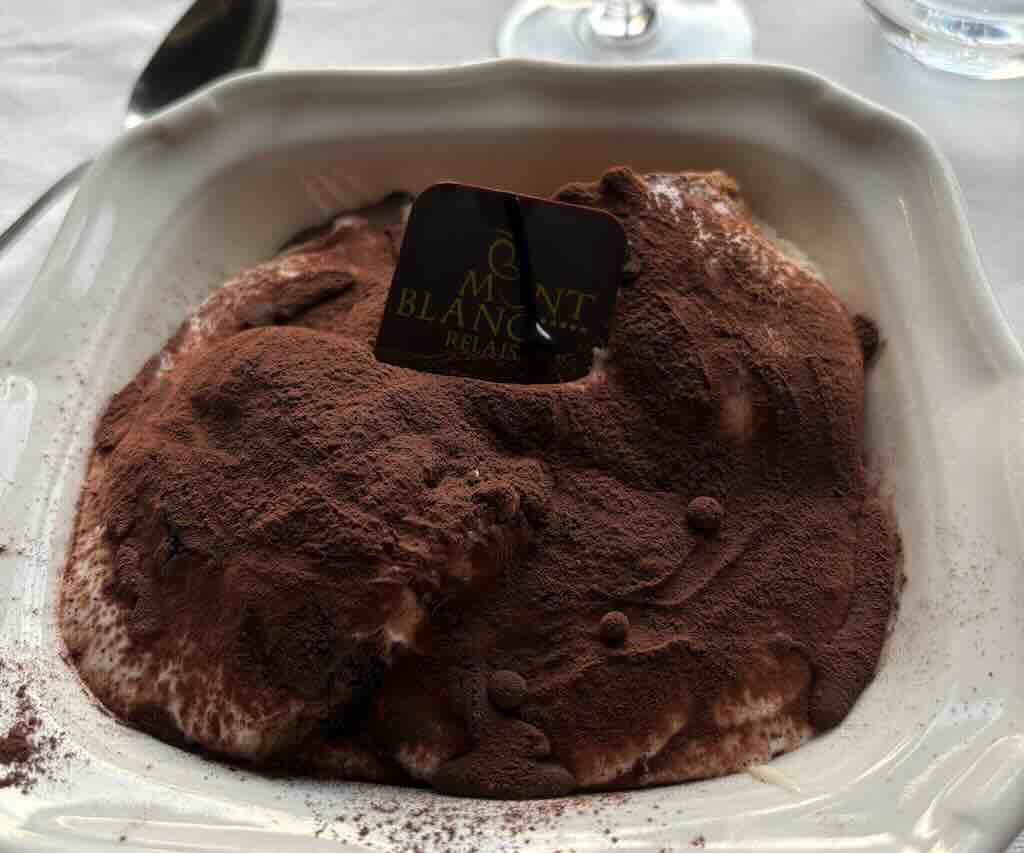
Below we have “Fentre-Misù” – Con Savoiardo fatto in casa.
“Fentre-Misù” – With homemade ladyfingers.
The name “Fentre-Misù” is a play on words, La Fenêtre (the restaurant name) and tiramisù.
Firstly the Savoiardo has its historic origins in the Duchy of Savoy, which included the Val d’Aosta. It is said that it was created to honour the visit of the French king, probably Charles VIII of France, although the exact historical details are debated. Ladyfingers is a name based only on the biscuits delicate appearance.
What is important is that it was homemade, and I could taste it. The texture was much better than a commercial variety, and they retained their form in the dessert.
Of equal importance was that the flavours were very well balanced between the bitter cocoa, the bitter espresso, the slightly sweet Savoiardi, and the rich mascarpone cream. Firstly, the cream didn’t taste like frosting or whipped cream. Secondly, it was soft rather than stiff. And thirdly, it wasn’t sweet, there was just enough to offset the bitterness of the expresso. Just enough, restrained sweetness, at the end of the taste.
A really excellent dessert.
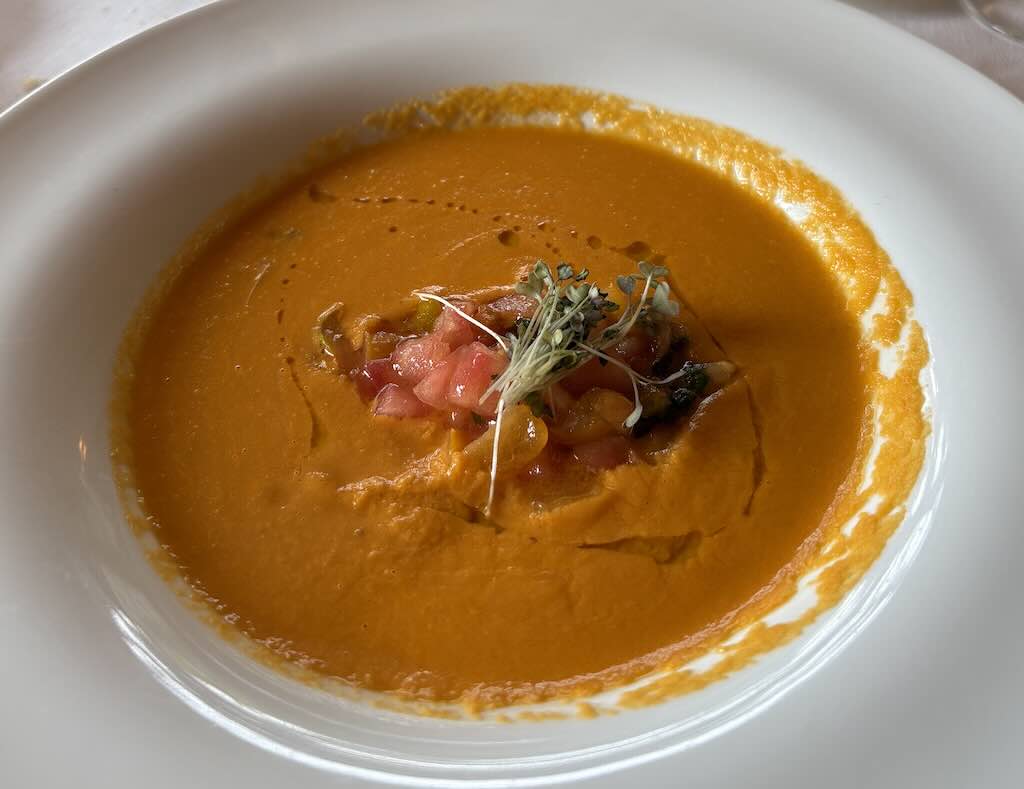
Above we have La Zuppa di Pomodoro – Servita con pane alla cipolla fatto in casa e colori di pomodoro.
Tomato Soup – Served with homemade onion bread and tomato sauce.
The waiter explained that there were five varieties of locally grown tomatoes. It arrived hot (as a zuppa would), but I expected it cold. And I must admit it looked as if it was cold.
It was very tasty, and it was accompanied by a very small bread tower rolled around some lightly cooked onion. No tomato sauce.
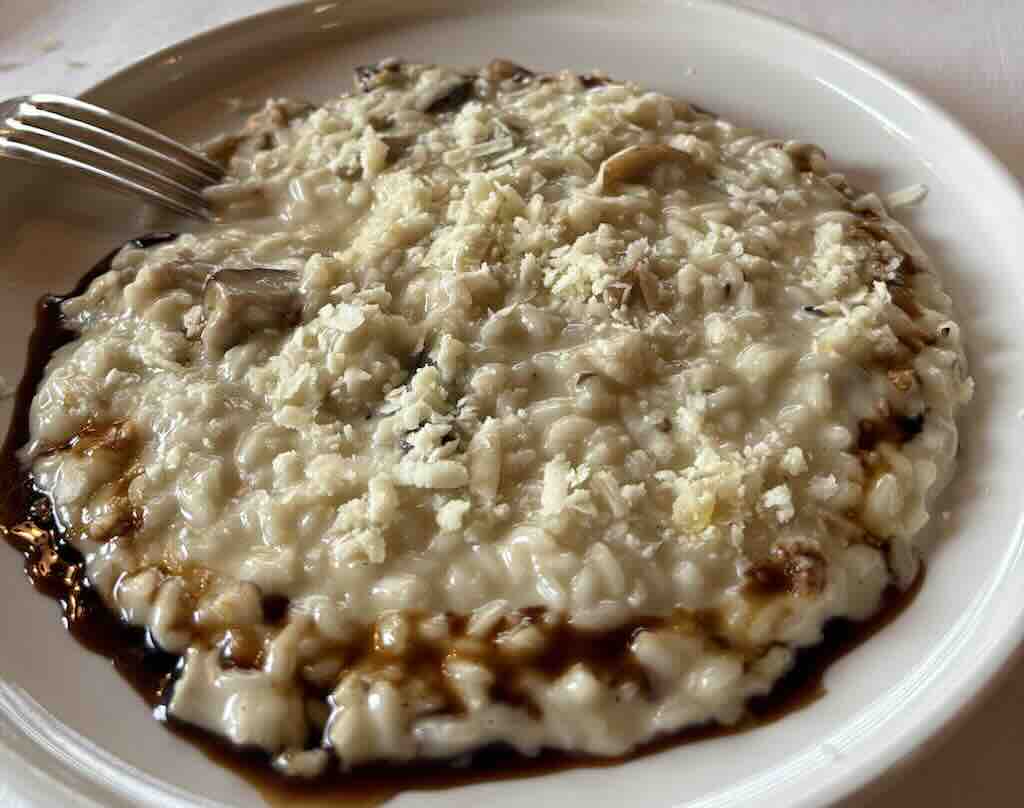
Below we have Porcini Mushroom Risotto with Castelmagno Cheese from the special menu.
This was exactly as I expected, and was outstanding. Simple, and totally dependent on taste.
Firstly, I could see the individual grains of rice, a proper risotto should never resemble porridge. I should have asked, was the rice Carnaroli, or the more usual Arborio?
Secondly, in Italy they describe this perfect presentation as “all’onda” (like a wave). It means that the risotto slowly spread out over the dish, in a wave.
Thirdly, the grated Castelmagno has been added by the chef, just before serving. Castelmagno is from neighbouring Piedmont, but is a natural Alpine pairing. It is one of Italy’s great cheeses, and is a DOP cheese made in only a few communes in the mountains of the Province of Cuneo. Young Castelmagno is usually quite creamy, buttery and slightly lactic. Older Castelmagno becomes crumbly, much more savoury, and its blue-veins and slight spiciness is a bit reminiscent of Stilton in complexity, but much less aggressive. With porcini it is a classic combination.
Fourth, you can see a slight dark sauce around the edge of the rice. My guess is that this was a little balsamic reduced with the Porcini jus.
Finally, the porcini themselves. Excellent fresh taste, sliced rather than diced, and lightly sautéed.
For my three evening meals I picked a Gosset Grand Millésime 2012.
Gosset was my wife’s preferred Champagne, and I always look to see if its on the wine list. In this case it was.
Gosset is the oldest wine house in Champagne (founded in 1584 in Aÿ), and I find their wines lighter and fresher than many. Although going back to 2012, the Champagne was a little calmer, and went really well with the risotto.
Here is the problem. If I had walked into this restaurant knowing nothing except the menu, what would I have chosen?
Probably the foie gras and the Veal Valdostana. And I would have been disappointed. I was the most annoyed about the Valdostana, because it promised so much, but failed because of the veal.
I would not have ordered the risotto and the tiramisù. But these were the dishes I appreciated the most.