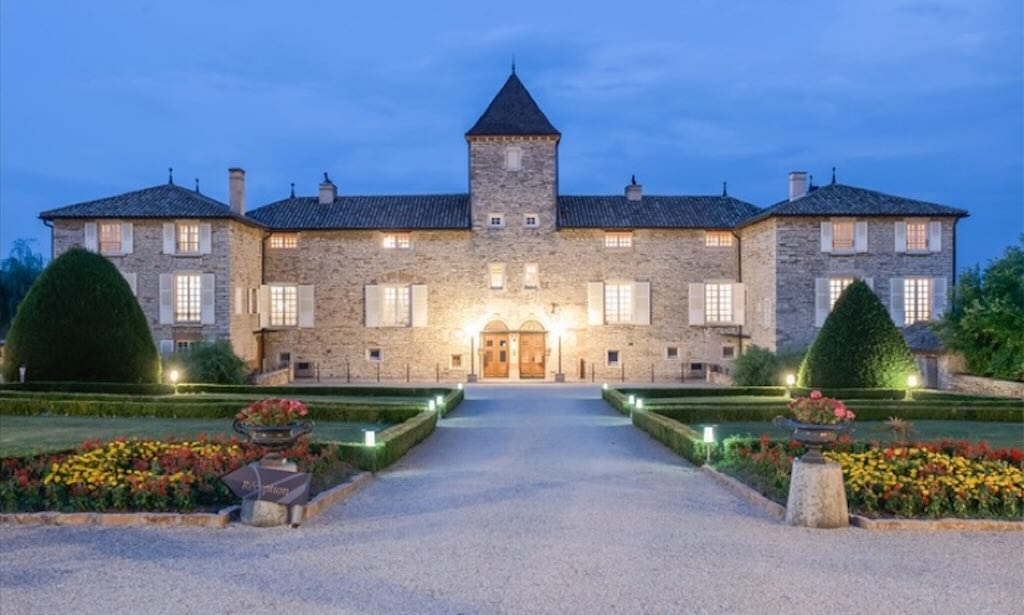
I picked my first overnight stop on my Road Trip March 2026 for the simple reason that it was a decent drive from my home in Luxembourg (about 725 km). And it left a decent drive (about 450 km) to my next overnight in the Parador Aiguablava.
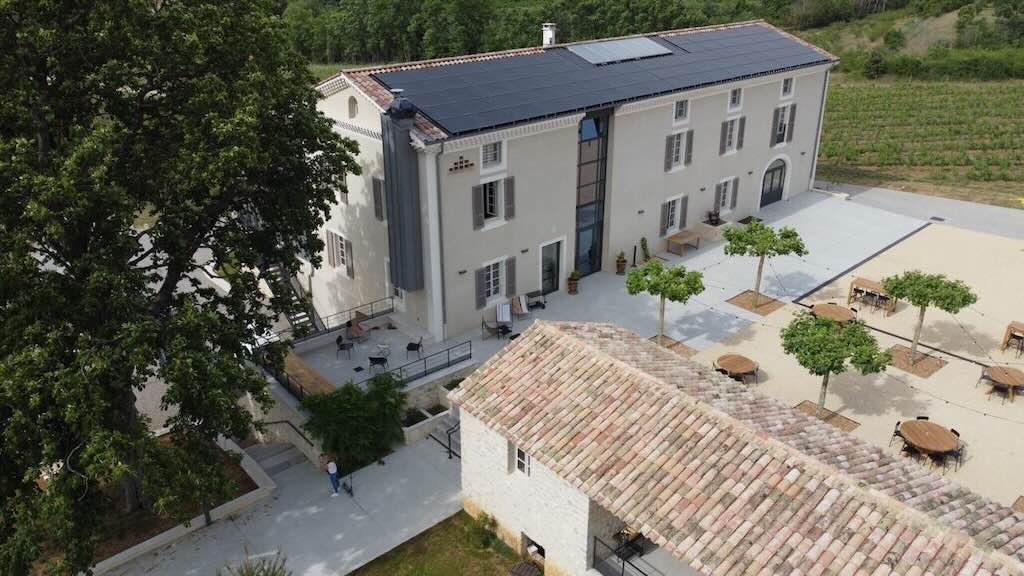
The hotel was the Garenne, a Hôtel Restaurant Domaine Viticole près de Valence. So it’s a large renovated family home in a small estate dedicated to viticulture (4 hectares of Chardonnay and Pinot Noir) and arboriculture (and once sericulture).
I will describe the vines I saw, but I did not collect any information on silk production or fruit tree crops. But it is worth noting that the wider Livron-sur-Drôme region was a significant silk-producing area from the 18th to 19th centuries (I don’t think the region is now a silk producer). I think I also saw peach (or nectarine) trees in flower.
Booking gave the hotel a 9.3 (Superb), based upon 338 reviews. I could not find a Tripadvisor review for the hotel, but Tripadvisor did give the Michelin gourmet restaurant a 4.4 (Very Good) based upon 75 reviews. The gourmet restaurant was not open on the night of my visit, but they also offer a bistro-style pizza (true Neapolitan style with the thick crust).
What's so special about Livron-sur-Drôme
Livron-sur-Drôme lies on the Rhône–Drôme alluvial plain, where deep alluvial gravel and silt soils deposited by the Rhône and Drôme rivers create well-drained but irrigation-dependent farmland. The climate is a Mediterranean-influenced Rhône valley regime, i.e. hot summers, limited rainfall, and frequent mistral winds that reduce fungal pressure in orchards and vineyards.
The surrounding lower Drôme valley is one of France’s principal stone-fruit zones, particularly for apricots, with the Drôme department producing roughly 25–30 % of the national crop from about 6,000–7,000 ha of orchards, concentrated between Valence and Montélimar. On slightly higher terraces and slopes above the floodplain, vineyards belonging mainly to the Côtes-du-Rhône zone and the small Brézème AOC cultivate varieties such as Grenache, Syrah and Mourvèdre, with Viognier, Marsanne and Roussanne for whites.
Finding the hotel
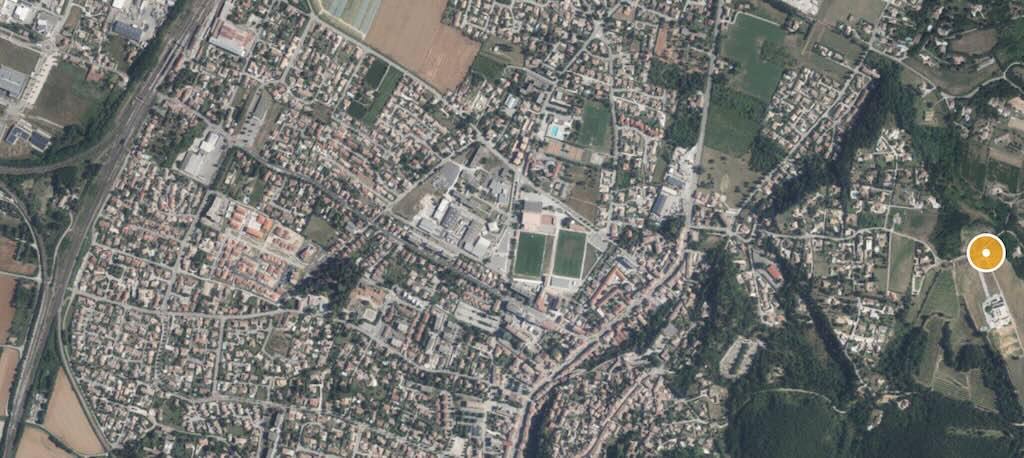
The navigation system on my new Mercedes was far superior to old one, and it was easy to find the hotel location. In the above map we can see that the hotel was the about 5 km from the autoroute, just the other side of Livron-sur-Drôme. In fact my navigator stopped about halfway along Rue Van Gogh, but it was obvious that I had to continue on a one-lane wide track. There were a couple of signposts for the hotel, and it was easy to find the hotel entrance. Later I was told that other navigator systems brought visitors right to the hotel front door.
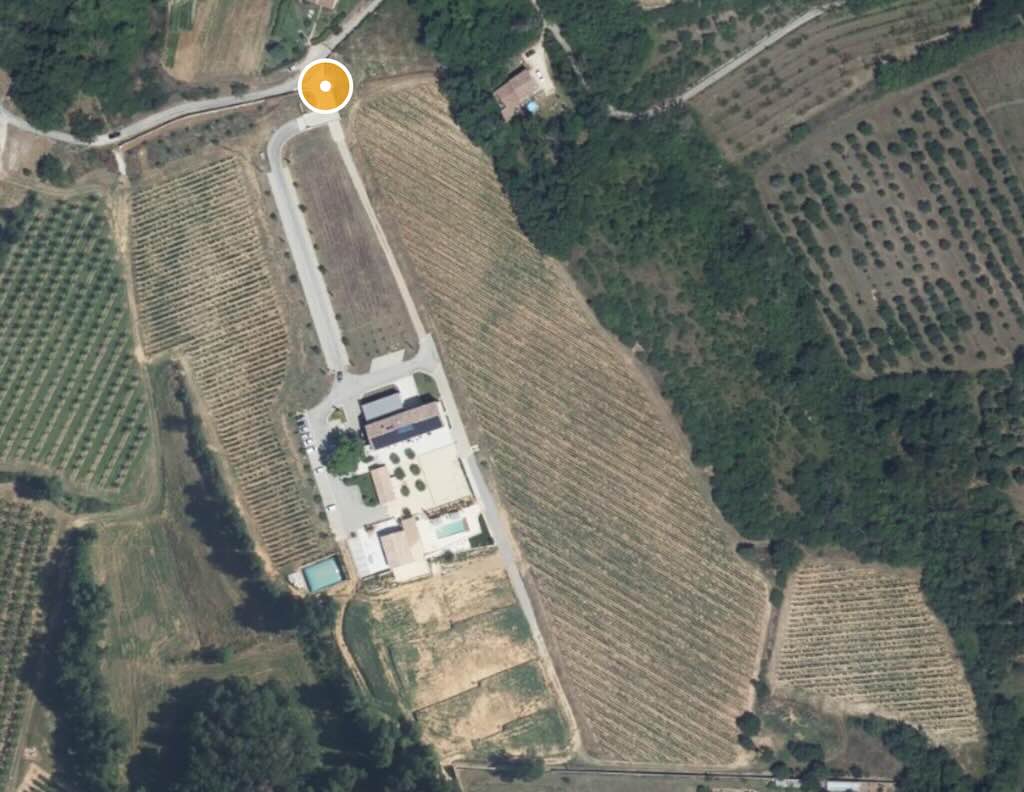
Above we can see the full extent the domaine. There was some building work ongoing, on one of the outbuildings, and I was the only guest that night. Above we can see the main building where the hotel rooms are, along with the two restaurants. We can also see a terracing which will be used for vegetables, herbs, etc. for the restaurants, and we can see the 4 hectares of vines. We can also see two blue rectangles, one the hotel pool, and the other a 180 cubic-metre water “réserve incendie” (a closed plastic (souple) container).
This réserve incendie is a dedicated water supply for firefighters, independent of the normal drinking-water network. It is part of the system called DECI (Défense Extérieure Contre l’Incendie). This can be natural (pond, river), or artificial (tank, basin, or flexible container). The reasoning is simple, in places like Livron-sur-Drôme (especially vineyards/farms/hotels outside town), the mains network often cannot deliver sufficient water flow or pressure. Therefore the authorities require a local stored volume instead of relying on pipes. The rule is that the fire services need a continuous water source of about 120 cubic-metres for ~2 hours of intervention. And typically it must be within ~200 metres of the risk.
The welcome
I have included a section on the welcome, because I found it one of the most important features of my visit. Upon arrival I was offered a coffee at the bar, shown my room, ate my pizza in the evening, breakfast in the morning, and checkout, all with a smile and a comfortable and extended chat. It was one of the things that made all the difference to my visit.
My room
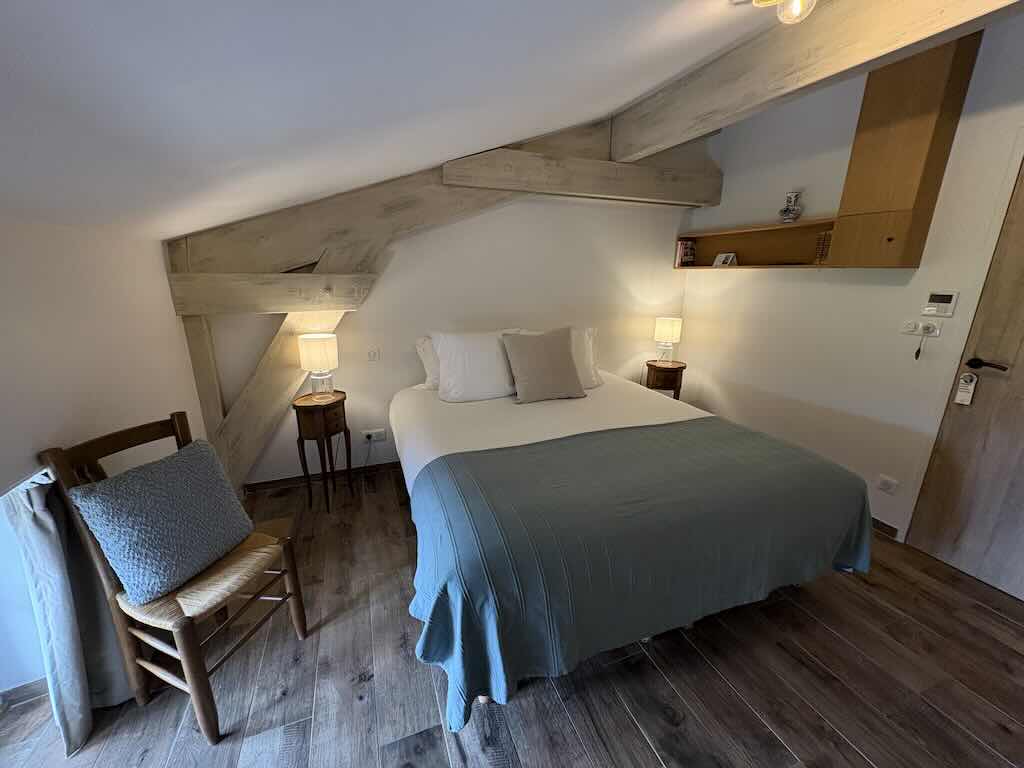
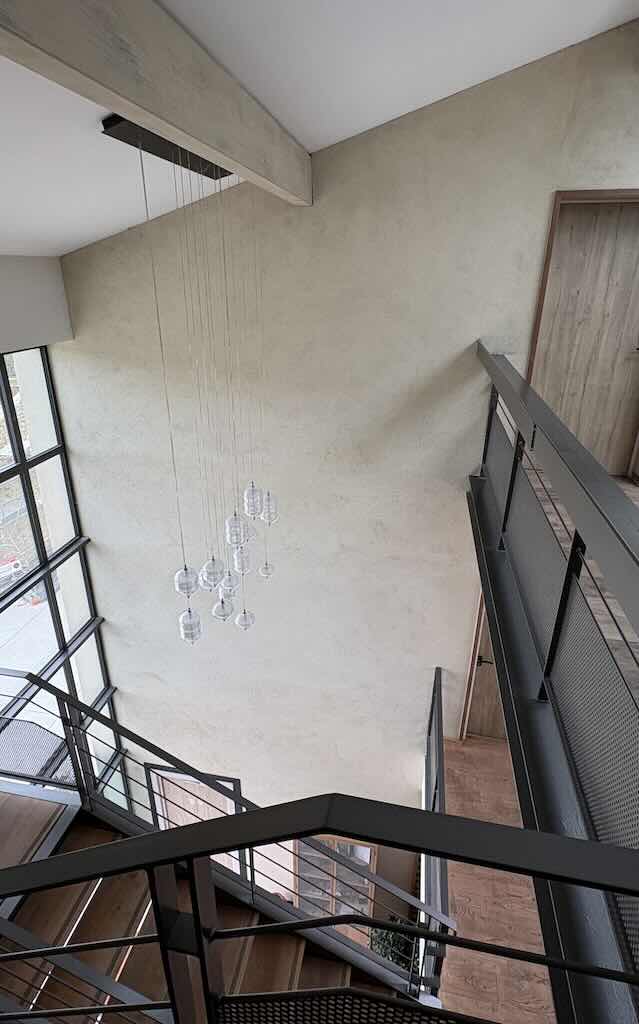
My room was in the attic, with a lift to the first floor, and stairs to the second floor. The room was comfortable, with a good bed. I can’t really judge how practical it might be for a longer stay, but I did notice the absence of a wall safe.
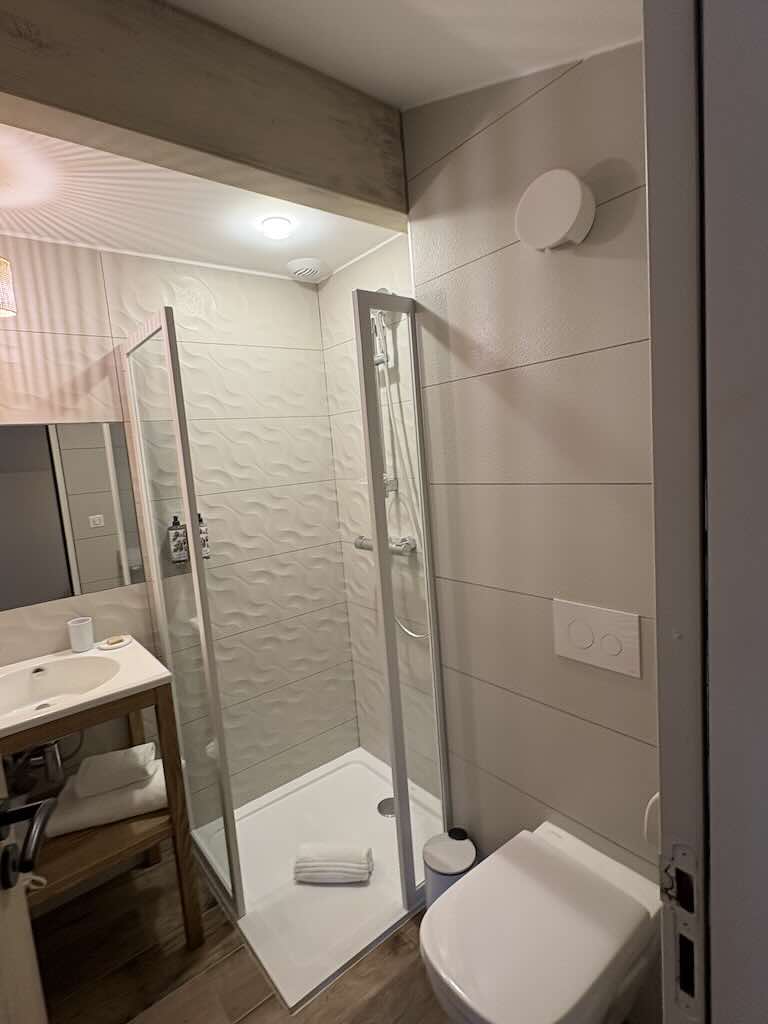
The shower room was fine, with a good shower, good towels, but no closed shower cubical.
The evening meal
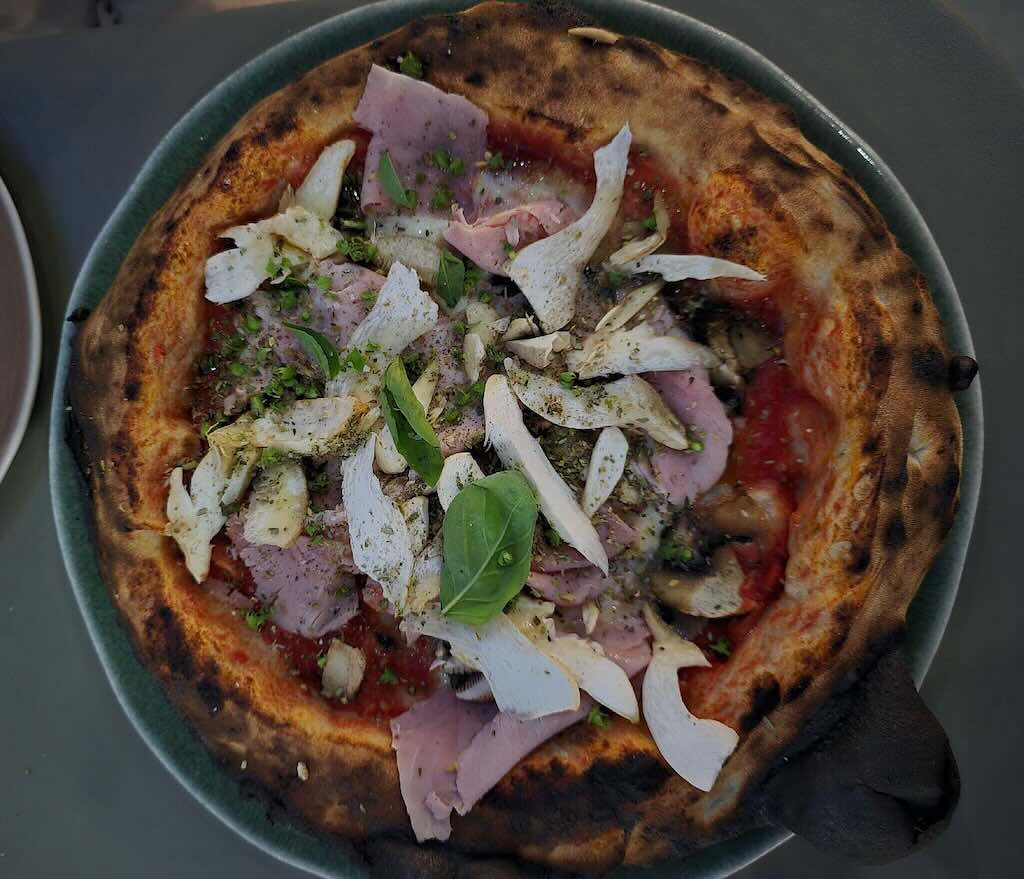
I knew that the gastronomic restaurant was closed, and there would be a pizza option for the evening. They offered a variety of pizzas, and I went for my usual ham and mushroom (prosciutto e funghi). They also clearly stated it was a Neapolitan pizza, with the characteristic airy, “leopard spots”, blistered crust (called the “cornicione”). I forgot to take a photo, but the image above, from the hotel, is a good example.
Having lived in North Italy for (on and off) 10 years, I am more used to the Roman-style pizza, and I had always learned to leave the crust of a Neapolitan pizza. Traditionally the rim served as a handle while folding the pizza (“pizza a portafoglio”). People often held the edge and ate toward it. There was a tradition, of debatable truth, that as a street food, people ate with dirty hands, and so they left the edge.
The dough (impasto) is a mixture of flour, water, yeast, and salt. Which should be left to ferment for at least 8–24 hours. During that time it’s divided into individual portions, called panetti (dough balls), and again left to rise (operetta). Many serious pizzaioli now extend fermentation to 24–48 hours (often partly in the fridge), and sometimes even longer (48–72 hours). Our pizzaioli said he left his dough for 5-6 days.
In the old days the edge might have also been a little difficult to digest, but with modern flour, and an extended fermentation period, the dough is lighter, fuller in flavour, and far more digestible.
I had the chance to visit the kitchen and chat with the pizzaioli. I can’t remember exactly the make of the pizza oven, but it looked like a free-standing Kuma Forni, with a revolving cooking platform and a smaller wood fire concentrated to one side.
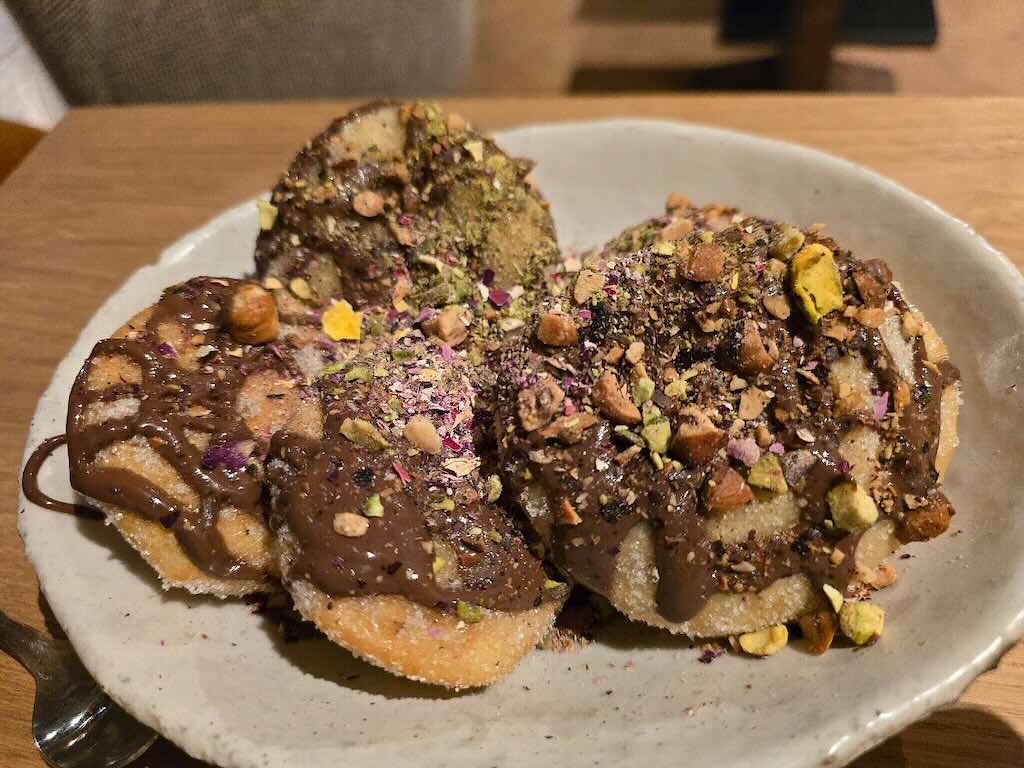
They managed to also convince me to try their beignet made with pizza dough rather than brioche-like dough. Again I found a photo that looks very much like what I had (with less chocolate and nuts). It was really freshly made and outstanding.
My meal was washed down with a couple of small bottles of a local beer, bière de blé (often also called bière blanche, or in English just a wheat beer) made by a local company called la Chouette in St Jean de Muzols.
Breakfast
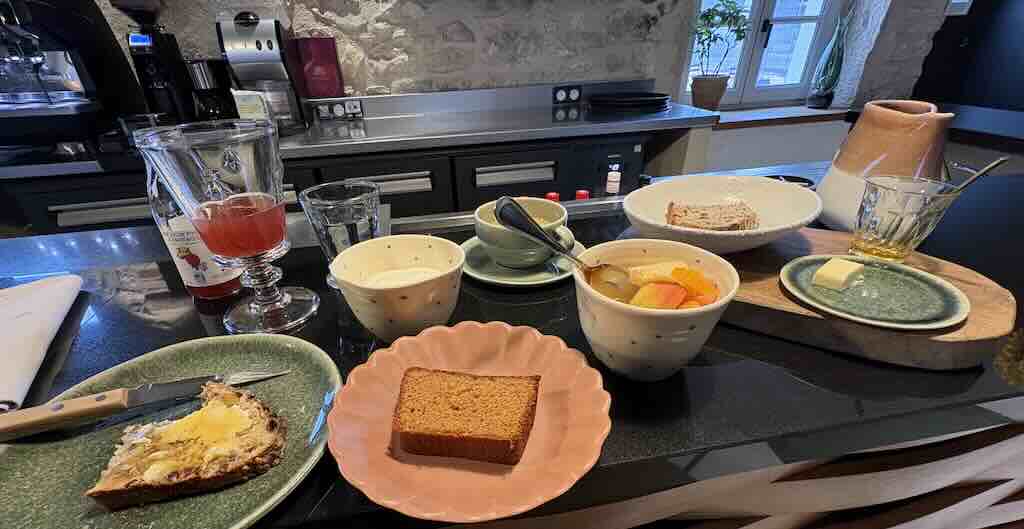
They offer a full breakfast with cooked options, etc., but I just went with a more or less conventional continental option. It was nice that the fruit was freshly prepared, and the bread home-made. They didn’t have an orange juice, but I tried a pure organic apple-raspberry juice, again from a local producer. The only down was the coffee, I like a pot of coffee and separate hot milk that I can mix myself.
The vineyard
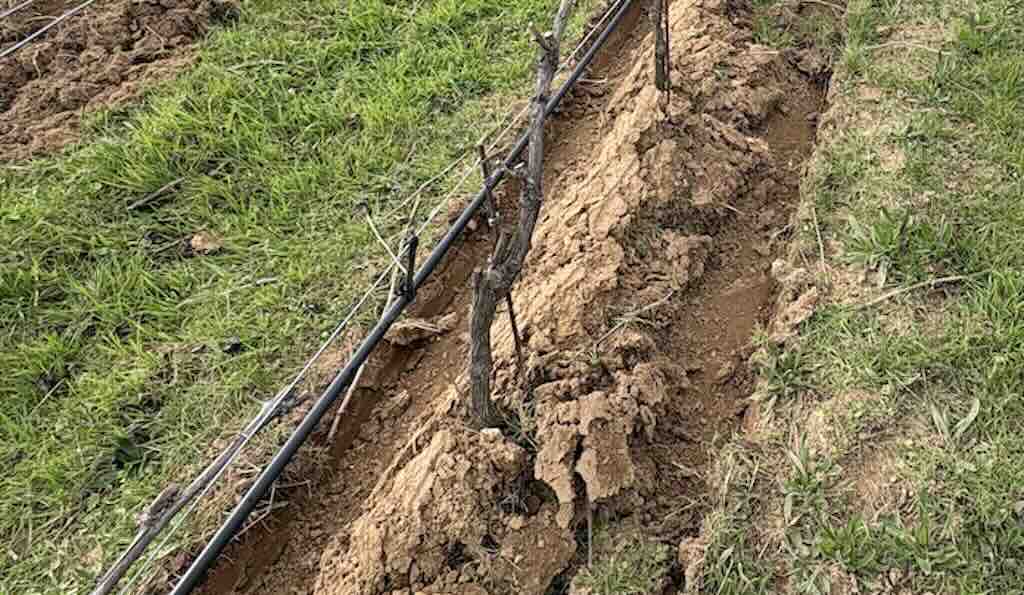
As I drove into the domain, I could see the vines on both sides of the track, but more surprising I could see horses ploughing along the vines.
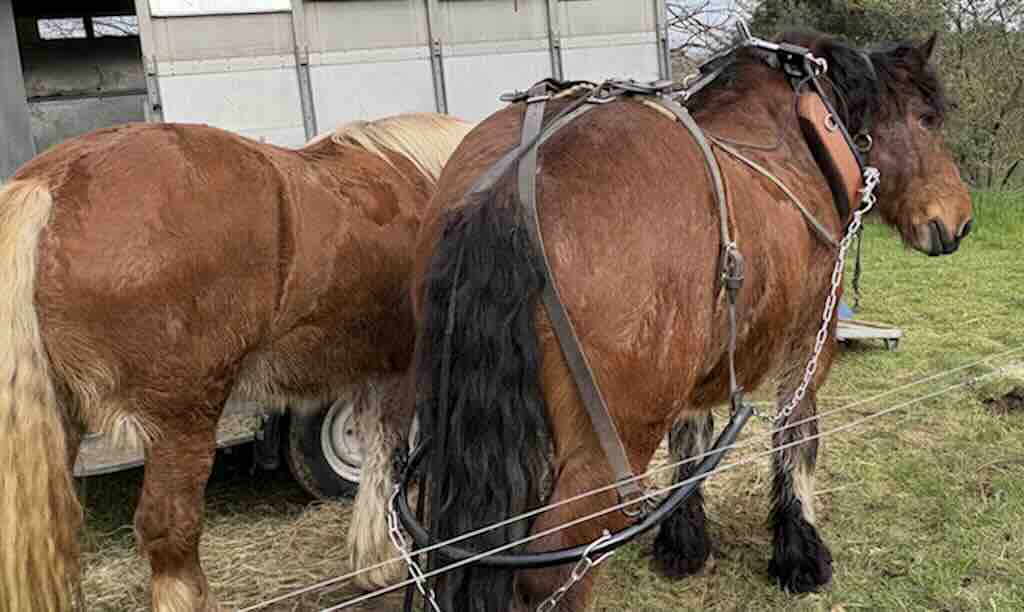
I had the opportunity to see the horses in action, to talk with their owners, and also to talk with the woman who was managing the vines.
What we see is a little of the standard cycle in traditional (often organic) vineyards. The soil is ploughed up toward the vine, forming a ridge (buttage), and creating a furrow (sillon). This protects the base of the vine, buries weeds, and improves drainage. I was told that the horse is slower, but more precise, than using a tractor.
Later, again using the horses, the soil is pulled away from the trunk (débuttage). This is even more delicate, and I think they use a “intercep hoe” (decavaillonneuse or inter-row rotary hoe). What this does is loosen the soil and improves oxygen availability in the root zone. Ridging helped drainage in winter, but now opening the soil helps water penetration in spring. It also physically disrupts weed growth and replaces herbicides. And finally it avoids compaction from tractors, and maintains microbial life (important in biodynamic farming).
Using horses is not a tourist attraction, but a serious small-scale, but labour-intensive, quality viticulture practice.
I think, here and there, it’s mentioned that the hotel is a 4-hectare biodynamic vineyard estate. I’m not convinced about the biodynamic aspect, but certainly you can see they focus on organic farming.
The reality is that the estate is very small, and I think the domain, as with many such properties in the Drôme, grow grapes, but sell them to a cooperative or nearby winemaker, rather than produce a commercial labelled wine themselves.
It is here that I’m a little confused (a good reason to return soon). Firstly, we are in the area of wine production called Brézème.
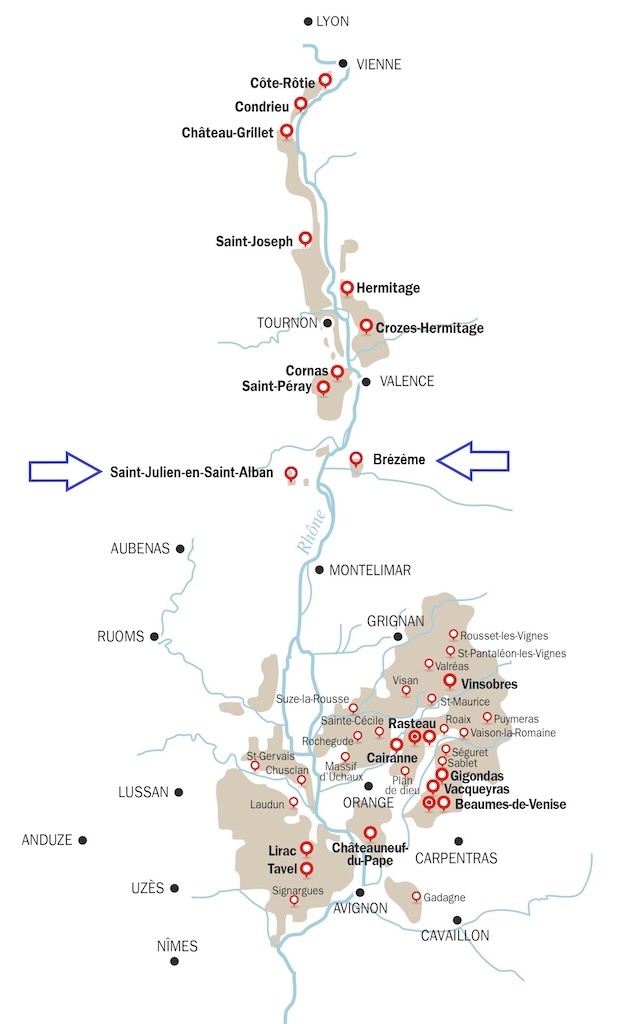
But it would appear that the terroir of Brézème is absolutely unique and would fully justify its own appellation, yet, it is not identified among the crus. This was probably due to the decline of the area at the time of the creation of the Northern Rhône’s crus appellations, which led to its neglect by the INAO authorities. The vineyard is in a grey zone, neither quite a regional appellation (Côtes du Rhône by default, even though the vineyard does not meet the official specifications) nor quite a cru. The mention “Brézème”, which has been present on bottles for a very long time, is a unique exception in France.
On the above map we see mention of Brézème on the map, but the vast majority of maps just indicate Côtes du Rhône without mentioning Brézème. The appellation Côtes du Rhône can be used throughout the region, also in those areas which are covered by other AOCs. In a limited part of the region, the Côtes-du-Rhône Villages AOC may also be used, in some cases together with the name of the commune.
Côtes du Rhône as the basic AOC wines of the Rhône region, is generally dominated by Grenache for reds and rosés, and Grenache blanc for whites. More generally in the northern sub-region of Rhône valley the red wines come from the Syrah grape, sometimes blended with up to 20% of white wine grapes, and white wines from the Marsanne, Roussanne and Viognier grapes. And it is these grapes that are usually associated with the Brézème wines.
But in hotels’ domain they have Chardonnay and Pinot Noir, which I understand would have to be bottled as IGP Collines Rhodaniennes or even just as Vin de France.
IGP Collines Rhodaniennes just means Protected Geographical Indication (Indication Géographique Protégée), a mid-tier classification, from the Rhône hills.
It’s true that these two grapes are very commonly planted together because they form the classic Burgundy pair, however I was told that several small estates in the region are experimenting with Chardonnay and Pinot Noir, especially for biodynamic or boutique production.
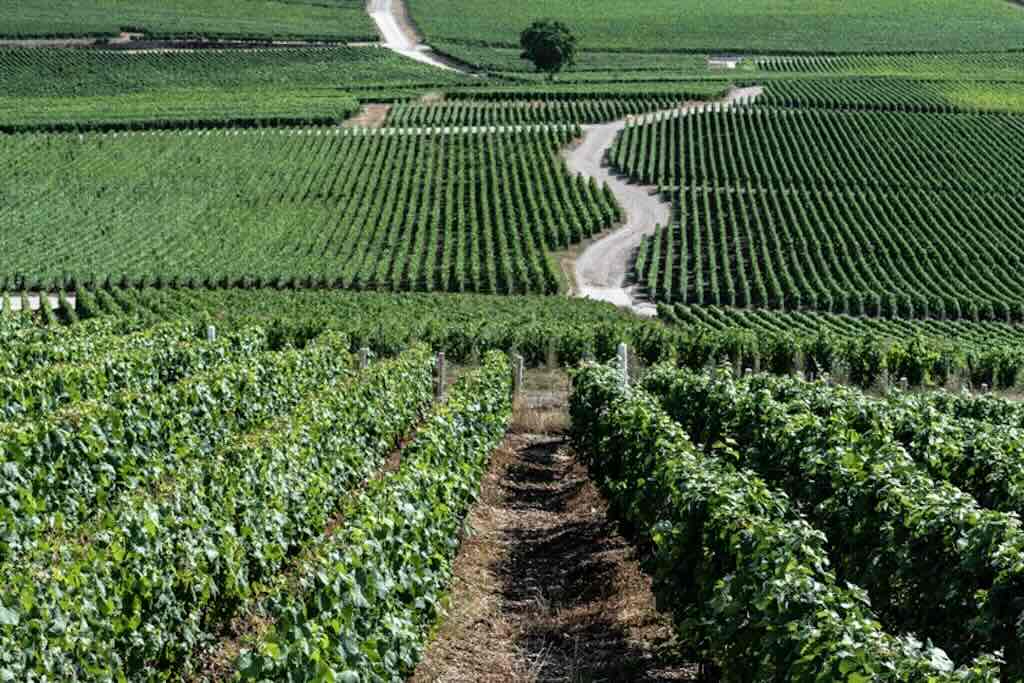
Looking at the photos, what we see is “Cordon de Royat” with VSP (Vertical Shoot Positioning), which describes the permanent vine structure and pruning method.
“Cordon de Royat” means short trunk (~40–60 cm), with one or two horizontal arms (cordons) fixed along a wire, and small spurs left each year on those arms (each spur will produce a new shoots every season).
Vertical Shoot Positioning (VSP) just means that the new shoots are trained straight upward, and are held between pairs of wires (“catch wires”), creating a vertical wall of vegetation.
This approach is often used to control (limit) the yield. The grapes get even sunlight, which improves ripening consistency. And the open structure reduces humidity, which lowers the risk of mildew and rot.
So what it looks like is using Burgundy grapes, but training them according to Rhône tradition.
Overall conclusion
I enjoyed my visit. The environment was interesting (with the horses and vines), the welcome was really positive, the parking was safe, and the room and food was fine for an overnight stay. I would certain go back if my travel plans allow it.