For the moment this post just logs my collection of books about China.
List of Books
Chine by Si Renzuo and Peng Wenlan (1994).
This is an illustrated general introduction to Chinese civilisation, so its geography, people, history, religion, philosophy, culture and contemporary life.
Chine by Zheng Shifeng, Chu Shaotang, et. al. (1989), published in France in conjunction with Éditions du Peuple de Shanghai.
This is an illustrated portrait of China as a country, rather than an art-history book. Originally from 1980, it is showing China around the beginning of the Deng Xiaoping reform era, before the enormous physical transformation of Chinese cities during the following 30–40 years.
L’Art chinois or Regard contemporain sur 6,000 ans d’histoire was published by Phaidon (2014).
This is a coffee-table book with academic substance. It deliberately rejects a straightforward dynasty-by-dynasty history. Instead, works are paired on facing pages because they have some visual, historical or conceptual relationship, even when separated by centuries.
5000 Ans d’Art Chinois by Guo Huaiyu, Liu Jing, Zhao Jing and others, with the French translation by Virginie de Bermond-Gettle (2018).
The book is organised around approximately 250 actual Chinese objects, selected by professors from China’s Central Academy of Fine Arts and curators from Chinese museums for their historical, artistic and cultural significance.
One of the books strengths is that it has a chronological range from prehistoric China through to the end of the Qing dynasty in 1912.
The publisher explicitly describes it as a “livre-objet à la reliure japonaise” (Japanese-bound book-object). This means that the pages are folded/doubled. Each sheet is printed and folded so that the fold forms the outer edge of the leaf, rather than being cut open as in an ordinary Western book. This is the traditional fukuro-toji or “pouch-binding” principle. The apparently doubled pages are therefore intentional, not uncut pages awaiting separation. In addition it is bound by a red cord that is the actual visible binding element. Rather than hiding the sewing inside a Western spine, the binding deliberately exposes the cord along the edge of the book.
The irony is that a book entirely about Chinese art, has adopted a binding convention generally described in Europe as Japanese binding (which originally was a Chinese binding method).
The Arts of China by Hugo Musterberg (1972).
This book explores the rich artistic heritage of China, spanning from prehistoric times to the Ch’ing dynasty. It presents a comprehensive overview of Chinese art traditions, showcasing ceramics, bronzes, sculpture, painting, and architecture. The narrative follows the evolution of these art forms through various dynasties, highlighting the unique characteristics and aesthetic principles that define Chinese art.
La Citta’ Proibita, Storia e Collezioni by Piero Corradini (1992).
Piero Corradini (1933–2006) was an Italian sinologist and historian of China, not simply an art-book writer. He describes the Forbidden City not as a container for beautiful objects but as simultaneously an architectural complex, the repository of the Ming and Qing imperial collections, and the physical evidence of the workings of the imperial court and state. It is essentially a study of one of the world’s great palace-museums in its historical context.
Imperial Peking – Seven Centuries of China, by Lin Yutang (1967), and edited by the Musée Cernuschi, an Asian art museum in Paris.
In a contemporary review entitled “Peking in the Past Tense” (Times Literary Supplement, 29 December 1961), the judgement was mixed. It praised the book as a “handsomely produced, excellently illustrated Chinese scrapbook”, and regarded Lin’s chapters on old Peking, its palaces, history and beliefs as an agreeable mixture of history and description. Its principal criticism was very specific. Lin was ostensibly writing about Peking in 1961, but was really describing the Peking he had known between the wars, often using the present tense. The reviewer thought this made parts of the book already outdated after thirteen years of Communist rule. More fundamentally, the reviewer felt that Lin’s China had become “something of a faded stereotype” (even now, I feel the knife going in).
Des Profondeurs de la Terre Chinoise, by Chen Heyi, Tsian Hao and Rou Souitchou (1987).
The book surveys the extraordinary archaeological discoveries made in China after the establishment of the People’s Republic in 1949. Its objects cover approximately 2,400 years, from the 14th century BC to the 10th century AD. So it’s more about what archaeology reveals about ancient China.
It looks at the Shang remains and the intact tomb of Fu Hao at Anyang, containing bronzes, jade, weapons and other objects. Then in the state of Zhongshan there are spectacular discoveries from a relatively little-known state of the Warring States period. There is also the tomb of Marquis Yi of Zeng, famous particularly for the enormous set of 65 bronze bells. There are the Han tombs at Mawangdui with preserved silk, manuscripts, lacquer, food, etc. and finally Qin archaeology, including the extraordinary terracotta infantry and cavalry associated with the First Emperor.
Chinese Cloisonné – The Pierre Uldry Collection by Helmut Brinker and Albert Lutz (1989). The catalog of an exhibition held at the Rietberg Museum, Zurich, in 1985.
The collection was historically housed at Museum Rietberg, but it was largely a private long-term loan, not a Rietberg-owned collection. At least some of it subsequently belonged to Pierre Uldry’s heirs. Its present status as a complete collection is unclear.
Celadons from Longquan Kilns by Zhu Boqian.
Celadon is a type of high-fired stoneware or porcelain whose glaze contains iron and is fired in a reducing atmosphere, i.e. one with restricted oxygen. Under those conditions the iron produces colours ranging from grey-green and olive to the particularly admired soft blue-green or jade-green.
Longquan in southwestern Zhejiang province. But “Longquan ware” refers to an enormous kiln complex/industry spread across the Longquan region. For example, at the important Dayao complex alone, archaeological work has identified 126 kiln sites, spread over about 512 hectares.
Production began around the Five Dynasties/Northern Song period (10th century), flourished during the Northern Song, and reached its greatest artistic and commercial importance during the Southern Song (1127–1279) and Yuan (1271–1368), continuing on a very large scale into the Ming.
UNESCO describes Longquan as having become at its height, the largest porcelain-production centre in China. Longquan celadon is one of the major traditions of Chinese ceramics, and in terms of historical importance it is one of China’s greatest ceramic-production centres and probably the most internationally distributed Chinese celadon tradition.
Chine de tous les jours by Pierre d’Ursel (1985).
The book grew out of d’Ursel’s filmed travel lectures rather than being conceived as an academic study of China. The period now gives it considerably more interest than it had as a current travel book. China had only recently begun the reform period under Deng Xiaoping. The urban redevelopment, industrialisation and huge increase in prosperity that transformed China over the following decades were still in the future. Consequently, photographs intended simply to show “everyday China” have become a visual record of a society during a very particular transition.
Tibet, le rire jaune by Gilbert Leroy (1988).
The book arose after Leroy had already spent considerable time in the Himalayas. He first encountered Tibetan culture in Nepal in 1974 and was among early foreign travellers into Ladakh and Zanskar. Then, in 1985, when Tibet had recently become more accessible to foreign visitors, he travelled there to make this book (and a film).
The Cultural Revolution had ended less than a decade earlier. Religious institutions had suffered enormous destruction, but during the 1980s monasteries were reopening and religious practice was reviving. At the same time China was beginning to open Tibet to foreign travellers. Leroy’s photographs therefore capture Tibetan society during that transitional period.
The title is deliberately double-edged. In French, “rire jaune” means a forced or uncomfortable laugh, smiling when there is little reason to smile. But jaune also obviously evokes the Western imagery traditionally associated with Asia.
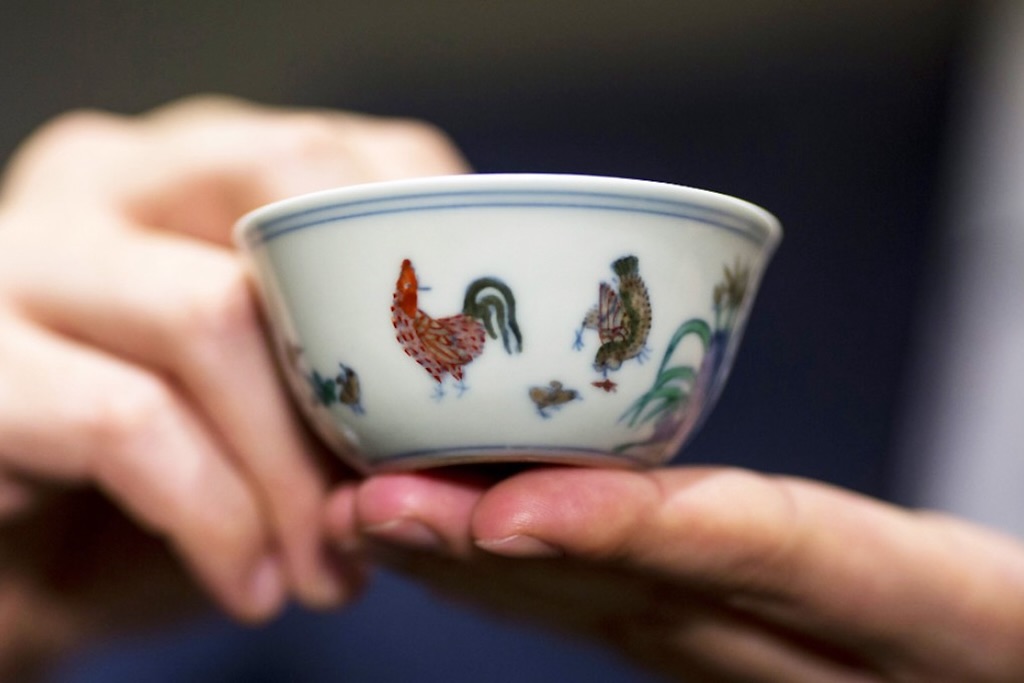
The Meiyintang 'Chicken Cup', documents the sale in Hong Kong, by Sotheby's, on 8 April 2014.
The Meiyintang Chicken Cup is a tiny imperial porcelain wine cup made during the reign of the Chenghua Emperor (1465–1487) of the Ming dynasty. It was produced at the imperial kilns at Jingdezhen. It is only about 4.1 cm high and 8.3 cm across the rim.
It is the feature image of this posting.
Its importance comes from several things. First, it is an original Chenghua-period Doucai, (“contrasting/contending colours”). This is a particularly sophisticated technique where parts of the design were outlined in underglaze cobalt blue, the vessel was glazed and fired, and coloured enamels were then added over the glaze and fired again at a lower temperature. On this cup the colours include yellow, green, olive and several iron reds.
The subject is a modest rooster, hen and chicks among rocks and flowering plants. Hence “Chicken Cup”. It isn’t called that because of its shape.
What makes it exceptional is the combination of extremely thin, finely potted translucent porcelain, the soft silky glaze, delicate colours and remarkably informal painting. Chenghua imperial porcelain has long been regarded as one of the technical and aesthetic high points of Chinese porcelain production.
There is also a six-character Chenghua reign mark in underglaze blue on the recessed base.
This particular cup became famous because it has excellent provenance. Sotheby’s records it with Mrs Leopold Dreyfus, subsequently reputedly Edward T. Chow, then the important Japanese dealer/collector Gorō Sakamoto. It was sold at Sotheby’s Hong Kong in 1999 for HK$29.17 million, itself then a world-record price for Chinese porcelain, before entering the Meiyintang Collection assembled by the Swiss Zuellig brothers.
Then came the extraordinary sale of Sotheby’s Hong Kong, 8 April 2014, with a hammer bid of HK$250 million. With premium, HK$281.24 million, approximately US$36.05 million. The buyer was a Chinese collector Liu Yiqian. It established a world auction record for Chinese porcelain at the time.
There is an amusing (and controversial) postscript. After buying it, Liu Yiqian famously drank tea from the 500-year-old cup, generating considerable publicity and criticism.
These cups were already prized within China centuries ago. Sotheby’s catalogue records that the Wanli Emperor admired Chenghua chicken cups, and their prices were celebrated during the Kangxi period. The Qianlong Emperor actually composed an ode praising them. Later imperial workshops repeatedly copied the Chenghua originals.
In 2014 Sotheby’s stated that only three other genuine Chenghua examples remained in private collections. The majority of surviving examples were already in museums, notably the National Palace Museum in Taipei.
Books on Formal Chinese Dress
Chinese Dress by Valery Garrett (2007).
Roughly the first half concentrates on Qing China (1644–1911) with the emperor and imperial family, mandarins, merchants, women and ordinary people. The later chapters then follow the radical transformation of dress through Republican China and the People’s Republic.
The book has been described as a serious, though concise, history, particularly praising Garrett for explaining why customs and forms of dress developed rather than merely identifying garments.
Imperial Chinese Robes edited by Ming Wilson (2010), accompanied a Victoria & Albert Museum exhibition in 2011, organised jointly with the Palace Museum, Beijing.
This book looks at the garments preserved in the former imperial palace itself.
Heavenly Splendour, or the Edrina Collection of Ming and Qing Imperial Costumes (2009).
It was published as part of “Timeless Legacy: The Mok Family Collections”, an exhibition by the Art Museum of the Chinese University of Hong Kong (CUHK) that ran 2008-2009.
The Edrina Collection is a private collection associated with the Mok family of Hong Kong. The CUHK exhibition was specifically devoted to a selection of its Chinese imperial textiles and costume.
The catalogue contains 52 pieces dating from the Ming (1368–1644) and Qing (1644–1911) dynasties. This is not just a collection of spectacular “dragon robes”, it illustrates the hierarchy and different functions of imperial clothing.
This includes chaofu (formal court robes), jifu (semi-formal or festive court robes), changfu and bianfu (less formal/casual dress), together with lengths of unmade textile, buzi rank badges and court necklaces. The garments were intended for different levels of the imperial system, from emperors, empresses, members of the imperial family, down to officials and nobles.
As far as I know the Edrina Collection was a private collection of the Mok family, but by 2024, some objects explicitly carrying Edrina provenance were appearing at auction. So it looks like at least some of its Chinese costume holdings have been released and sold.