For the moment this post just logs my small collection of books about Ancient Egypt (3150-30 BC).
1997 Andreu, Rutschowscaya & Ziegler – L’Égypte ancienne au Louvre
This is a book where the authors don’t attempt to write a general history of Egyptian art, instead they use 130 selected objects to explain Egyptian civilisation.
The book was published in connection with the reopening of the Louvre’s Department of Egyptian Antiquities in December 1997.
It was conceived both as an introduction to the reorganised collections and as an independent introduction to ancient Egyptian civilisation. The authors deliberately selected 130 objects, including internationally recognised masterpieces but also less familiar objects whose importance derives from their historical, scientific, epigraphic or documentary significance. This was not intended to be an exhaustive inventory of the museum’s collections.
The authors
Andreu-Lanoë (born 1948) is a French Egyptologist, archaeologist and museum curator, with a particular interest in Egyptian material civilisation.
Christiane Ziegler (born 1942) is an Egyptologist and former director of the Louvre’s Department of Egyptian Antiquities.
Marie-Hélène Rutschowscaya brought a further dimension to the publication, namely Coptic Egypt. The Louvre’s 2007 scientific research programme identified her as a member of the department’s specialist Coptic section.
The intellectual approach
The publisher’s description establishes that the objects were selected not simply for their aesthetic qualities but also for their usefulness as historical evidence.
Two of the objects explicitly identified in descriptions of the book are:-
Le Scribe accroupi – Beyond its artistic importance, the statue provides a starting point for discussing the social position of scribes, literacy, administration, writing materials, polychrome sculpture and the manufacture of inlaid eyes.
Le Buste d’Akhénaton – An opportunity to investigate changes in artistic conventions, religious authority, royal representation and the artistic transformations associated with the Amarna period (1348-1320).
The selection also includes more modest objects, chosen precisely because of their documentary significance.
I like the way the authors start with an actual historical object and using it to reconstruct the civilisation that produced and used it. The danger with conventional histories of art is that they often discuss artistic style without examining the practical function of the object, the technology available to its manufacturer or its place within society.
History of the Louvre’s Egyptian collections
I have also located a contemporary review published in 1998, accessible through Persée. The review places considerable emphasis on the formation of the museum’s Egyptian collections following Champollion’s appointment in 1826. These collections were particularly enriched by the acquisition of three major private collections, those of Edme-Antoine Durand (1768-1835), Henry Salt (1780-1827), and Bernardino Drovetti (1776-1852). These 19th-century acquisitions were instrumental in establishing the Louvre as a major centre of Egyptian studies. Read the contemporary 1998 review on Persée
Positive and negative aspects
The content is provided by three experts, but the book is nearly 30 years old. I like the idea of a object-based analysis, but it is limited to one collection. And it’s nice to see everyday objects, and their scientific and historical context.
The Louvre Collections database provides access to individual object records, which can include inventory numbers, dimensions, materials, provenance, dating, photographs and bibliographic references.
For individual objects, the database can offer more recent information than the 1997 publication. However, the intellectual value of the printed book lies in the authors’ selection and interpretation of the objects, bringing together evidence that would otherwise be dispersed across hundreds of separate database records.
I like the way this book answers simple but fundamental questions, namely what the object is, why it was made, who made it, how it was manufactured and what it tells us about Egyptian civilisation.
1989 Mekhitarian, Kunnen & Wulleman – Passage vers l’éternité
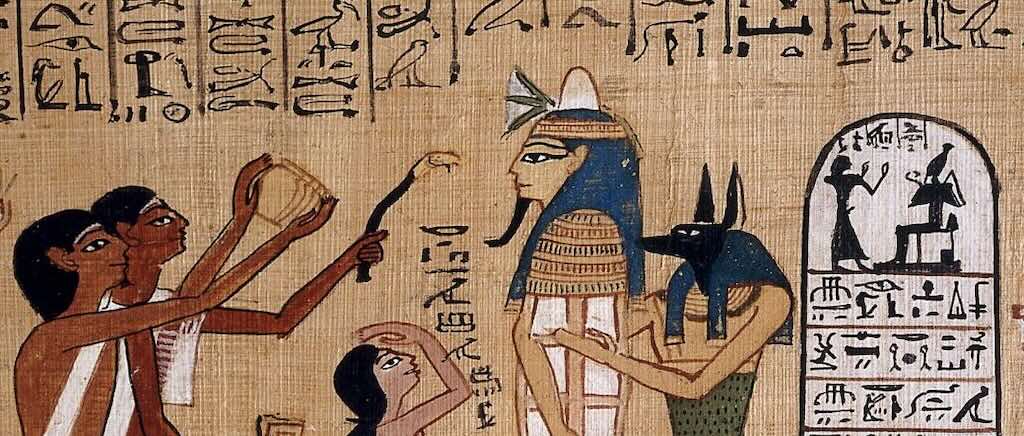
This book is specifically about the painted decoration of ancient Egyptian tombs in the Theban necropolis, principally on the western bank of the Nile opposite present-day Luxor.
It is not a general history of Egyptian art, nor simply a photographic survey of royal treasures. Its focus is funerary painting, its religious significance, artistic development and representation of Egyptian life.
The authors
Arpag Mekhitarian (1911–2004) had a substantial professional career in Egyptology. In 1929, he began working with Jean Capart, the influential Belgian Egyptologist and founder of the Fondation égyptologique Reine Élisabeth. He subsequently became a curator at the Musées royaux d’Art et d’Histoire in Brussels, specialising in Egyptian and Islamic antiquities.
Marc Kunnen and René Wulleman both collaborated with Mekhitarian on other Egyptological publications.
Musées royaux d’Art et d’Histoire – Inventory of the Arpag Mekhitarian archives (PDF)
Independent academic review (1990)
There is a particularly informative contemporary review by E. De Keyser, published in the Revue belge d’archéologie et d’histoire de l’art, volume 59, 1990, pp. 125–126. The reviewer mentioned that the text addresses the living and working conditions of the craftsmen of Deir el-Medina, including their professional practices, humour and the difficulties of living in a settlement without its own water source.
The review was very favourable concerning the photographic and editorial quality. Its principal criticism was that the individual photograph captions are sometimes difficult to understand without first reading the accompanying general text.
Negative aspects
Twenty tombs represent only a small proportion of the Theban necropolis. This is a selective photographic study rather than a comprehensive archaeological inventory.
Its focus is to explain religious representations, rather than reconstruct the technical processes by which the tombs were excavated and decorated.
I like this book because visitors Inside Egyptian tombs are often confronted with an overwhelming quantity of visual information, with limited time to examine individual scenes. Reading the book before travelling could help identify particular representations, understand their location and recognise their significance when confronted with the originals.
1986 Champollion – Panthéon égyptien (edition Perséa)
The 1986 Perséa edition is a modern reproduction of an historically important work. Its principal value is intellectual, documentary and iconographic. And the original is freely available online.
Contemporary review of this edition
Published in Le Monde on 11 December 1986, entitled Champollion retrouvé, the reviewer describes the Perséa edition as “une superbe reproduction par fac-similé et quadrichromie“.The review specifically praises the preservation of the original typography and the reproduction of Dubois’s 90 plates, including their carefully nuanced colours.
It also acknowledges that Champollion’s interpretations can surprise modern Egyptologists.
An important limitation
Champollion originally intended to publish approximately 200 plates, but only 90 were produced. His premature death prevented completion of the project. The Perséa edition reproduces this unfinished work, it does not attempt to complete it using modern Egyptological knowledge.
Consequently, its incompleteness is a characteristic of the original work, not a deficiency of the 1986 edition.
1982 Béatrice André-Leicknam & Christiane Ziegler – Naissance de l’écriture
The full title is “Naissance de l’écriture : cunéiformes et hiéroglyphes” and it was the official catalogue of the exhibition held at the Galeries nationales du Grand Palais in Paris, from 7 May to 9 August 1982.
The book examines one of the fundamental intellectual and technological developments in the history of human civilisation – the emergence of writing.
Editorial and historical context
The catalogue was directed by two specialists representing different areas of ancient civilisation:-
- Béatrice André-Leicknam (1949-2020), later known by her married name, Béatrice André-Salvini, was a specialist in the ancient Near East and Mesopotamian civilisation.
- Christiane Ziegler, a French Egyptologist who subsequently became director of the Department of Egyptian Antiquities at the Louvre, a position she held from 1993 to 2007.
The comparative approach is particularly important. Rather than treating Egyptian hieroglyphs as an isolated cultural achievement, the exhibition placed them alongside the development of cuneiform writing in Mesopotamia.
The subject therefore extends considerably beyond Egyptology into archaeology, linguistics, economic history, administrative systems and the development of complex societies.
The broader intellectual questions underlying the subject are particularly interesting:-
- Why did societies need writing?
- What was the relationship between writing, economic administration and political authority
- How did representations of physical objects develop into signs expressing language
- How did writing become associated with religious beliefs, royal legitimacy and the preservation of knowledge?
- Did Egyptian and Mesopotamian writing develop independently?
These are questions that make the book potentially much more rewarding than a conventional illustrated history of Egypt.
The French Egyptologist Pascal Vernus, writing approximately eleven years after the exhibition, described it as an “admirable exposition” and recognised the catalogue as providing a substantial presentation of the available evidence and a useful synthesis of Egyptian writing. Read the original article by Pascal Vernus (PDF)
Limitations and scientific ageing
The principal weakness is its publication date. The catalogue appeared in 1982, before several important archaeological discoveries and advances in the understanding of early writing.
Most notably, excavations of tomb U-j at Abydos in 1988 revealed inscribed ivory and bone labels dating from approximately 3300–3200 BC. These discoveries significantly changed discussions concerning the chronology, origins and administrative functions of Egyptian writing.
However, the relationship between the emergence of Egyptian and Mesopotamian writing also remains a subject of scholarly debate.
This is the kind of book that deserves preference over several large, general illustrated histories of ancient Egypt.
1979 Aldred et.al. – L’Empire des conquérants
L’Égypte au Nouvel Empire (1560–1070 avant J.-C.) is a considerably more substantial scholarly publication than the typical illustrated history books about Egypt. It concentrates on a specific period of Egyptian civilisation and brings together five internationally recognised Egyptologists.
The collection – L’Univers des formes
This prestigious Gallimard collection was initiated by André Malraux and André Parrot, with the objective of presenting the world’s artistic civilisations through scholarly texts and extensive visual documentation.
The Egyptian series consists of three complementary volumes, namely 1978 – Le Temps des pyramides (from prehistory to the Hyksos), this volume 1979 – L’Empire des conquérants (the New Kingdom, approximately 1560–1070 BC), and a third volume 1980 – L’Égypte du crépuscule (from Tanis to Meroë, approximately 1070 BC to the fourth century AD).
The three volumes together represent approximately 1,000 pages of scholarly documentation. This volume covers approximately five centuries, encompassing the 18th, 19th and 20th dynasties. A period that witnessed a considerable expansion of Egyptian political authority, military activity, international trade, monumental construction and artistic production.
Intellectual objectives
What interests me particularly is the relationship the authors establish between the expansion of Egyptian political power and changes in artistic production. It links military expansion, access to wealth, tribute and precious materials with the development of monumental architecture and increasingly elaborate decorative arts. Here are just some of the questions that book addresses:-
- How did conquest change access to materials and economic resources
- How were the resources of the state transformed into temples and royal tombs?
- How did access to gold and precious stones influence craftsmanship?
- Who determined the appearance and function of religious monuments?
- How could established artistic conventions change so rapidly?
- How was monumental art used to communicate royal authority?
An important intellectual reservation
The title L’Empire des conquérants and the publisher’s use of the term nationaliste reflect an older historiographical vocabulary.
Applying modern concepts of nationalism to Bronze Age Egypt is questionable. Egyptian kingship, territorial expansion, religious ideology and the extraction of tribute should be investigated within their own historical contexts.
This does not invalidate the book, but it is one example of why older scholarly publications need to be read critically.
On the other hand it is probably among the most directly relevant books for anyone preparing a visit to Upper Egypt. It looks at:-
Karnak – and the successive building programmes, architectural organisation, construction methods and the accumulation of religious and economic power.
Deir el-Bahari – with Hatshepsut’s mortuary temple, architectural integration with the landscape and the representation of trade expeditions.
Amarna – and religious transformation, urban planning and the departure from established artistic conventions.
Abu Simbel – with rock-cut architecture, colossal sculpture and the projection of Egyptian royal power into Nubia.
Medinet Habu – and temple planning, military representations, economic organisation and the final major building programmes of the New Kingdom.
Negative aspects
There are several limitations, namely the original archaeological information is now nearly fifty years old, and the publication remains primarily concerned with art and civilisation rather than engineering and technology. The concentration on royal monuments means less focus on ordinary Egyptian society.