I had decided to follow an Oxford University Summer School (2026) on the subject “130 Years of Discovery: Nuclear and Particle Physics from Becquerel to Gianotti”.
One of the recommended reading was “The Pope of Physics” – Enrico Fermi and the Birth of the Atomic Age, by Gino Segrè and Bettina Hoerlin (2016).
What the critics thought?
This is not a physics book, and most reviewers consider it a well written, highly readable and informative biography of one of the most important physicists of the 20th century. Many complimented Segre and Hoerlin for bringing Fermi to life in an easily readable fashion. The book reinforced Fermi position as one of the world’s great physicists, alongside Lawrence, Oppenheimer and Einstein.
For some reviewers it opened up a new perspective on Fermi’s role in the development of atomic weapons, whilst others focussed more on his almost unique ability to jump back and forth between theory and experimentation.
Some reviewers complained that they learnt little more than what they already knew, and called the book “a serviceable but unremarkable biography”. A few highlighted the fact that Fermi appeared “to treat the bomb blast as just another physics experiment”.
My opinion
Firstly, I found this book a very easy-to-read biography of one of the most important physicists of the 20th century. I have always admired those who could casually jump back and forth between theory and experiment, and for me Fermi sits on the top of that tree. In this sense I expected much from this book.
Despite dating from 2016, it must now be out-of-print, because I had to buy a second-hand copy through Amazon. I don’t know why, the book itself was in excellent condition, but it felt older. It had that boring grey binding and slightly off-white coloured pages, characteristic of older books.
The book is divided into five broad parts, starting with his life in Italy, then his work in the US leading to the world’s first atomic “pile”, and concluding with his period in Los Alamos, and his untimely death at the age of only 53.
The first two parts covers Fermi’s life in Italy, and I felt it tried to portray fairly well the life of an Italian researcher at that time. However, I would have like more facts about how research funding was organised, and, for example, how salaries compared to those in the public sphere. Also how did the life of an Italian researcher compare to that in France, Germany or Denmark.
I lived and worked in Italy in the 1970s, and I missed those little remarks that touched on the everyday life of a group of aspiring scientists. There was a lot of “went there, went here”, but little on the details that would have made the character of Fermi, and the others, more alive.
The next part concerned Fermi’s move to the US and the building of the world’s first “pile”. I felt that the text became tighter, almost aligned with the increasingly importance of the research in the war effort. I didn’t learn anything new, but I liked better the overall rhythm.
Part four, the Atomic City, was about Fermi’s stay in Los Alamos. I liked the interplay with what was happening in Italy at the time. Despite living in Italy for about 10 years, the war period was not one I had read-up on, so it was quite illuminating. It highlighted Fermi’s apolitical stance on war, and even on the moral questions about detonating atomic bombs on civilians.
The last part followed Fermi back to Chicago, and his death at the age of 53.
Conclusion
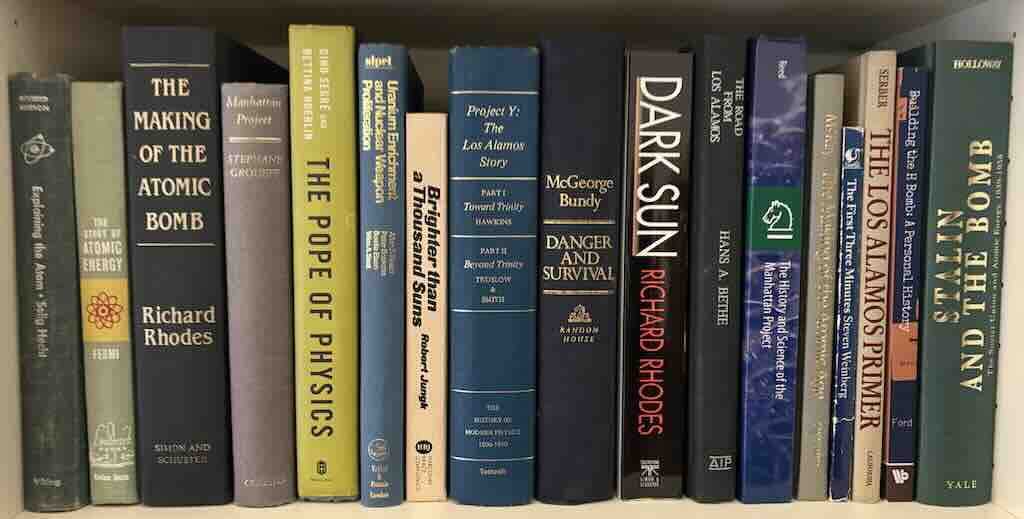
I had to read this book for my Summer School, and I did learn a little more about the life and personality of Fermi. For that I am grateful. I don’t think I learned anything new about his work, or the Manhattan Project, but I already had a decent library on the topic.
However, check out the videos:-
The World of Enrico Fermi pt1 (1970)
The World of Enrico Fermi pt2 (1970)
Enrico Fermi: Godfather of the Atomic Bomb (I don’t particularly like this video-bio, but it does highlight the paradox of Fermi’s character).
post script
Scribbled in the inside cover were some words, more or less clear
Dallas Metrocare (presumed officially “Dallas County Mental Health and Mental Retardation Center (Metrocare Services)”
-Skillman
-Samuel
These were, and still are, two of the major adult outpatient clinic sites.
Then followed Dr. Fenton and a Dr. Ma??toony (or similar).
It would appear that a Dr. Barry Fenton was a psychiatrist at the clinic, but is not currently listed. The second name could refer to Dr. Art Mirzatuny, also once list with the clinic, but is also no longer list.
To whomever might recognise this, rest assured, your book has found a new home and sits comfortably with new friends.