This is the part two of a review of the 4-volume “History of the Venetian Republic: Her Rise, Her Greatness, and Her Civilization“, by William Carew Hazlitt (1834–1913), published in 1860.
The first part of this reviewe is on Hazlitt’s Volume I, whereas this part covers Volumes II, III and IV.
As mentioned in part one, the 1900 and 1915 editions also provide substantial revisions and additions. In order to capture the fullest description I have added some elements from these later editions at the end of this review.
Volume II — The Fourth Crusade and the Creation of a Mediterranean Empire
Hazlitt’s second volume takes us into a different world, with a Venice capable of financing and organising large fleets, negotiating with European rulers and exercising considerable influence over Mediterranean commerce.
There is an important distinction between Venice’s war fleet, its armed merchant galleys and its privately owned merchant ships. They were not one permanent navy. The Republic could mobilise substantial naval forces, but their size varied enormously according to the war, the period and the money available.
Hazlitt’s second volume begins in the later medieval period (AD 1300-1500), when Venice had already developed a sophisticated maritime infrastructure. By the 15th century, its Arsenal could build and maintain warships, while the government could requisition merchant vessels and hire crews for major campaigns.
Some concrete figures make the scale clearer. In 1202 for the Fourth Crusade Venice contracted to transport 33,500 soldiers and 4,500 horses, and agreed to provide 50 armed galleys at its own expense. The contract was worth 85,000 silver marks. The number of crusaders who actually arrived was substantially smaller, but the naval mobilisation was extraordinary.
Also for the Battle of Zonchio in 1499 Venice provided 50 light war galleys. The Venetian fleet also included approximately 15 large merchant galleys and 20–30 carracks. These sailing ships were especially useful for transporting supplies and carrying heavy artillery. The battle against the Ottomans ended disastrously for Venice.
The Fourth Crusade (1202–1204) - How Venice Helped Conquer Constantinople
The central figure was Enrico Dandolo (1107-1205), Doge of Venice from 1192 to 1205. He was already an elderly man, probably in his eighties, and had extensive experience of Venetian commercial and diplomatic relations with Byzantium. Venice was not simply providing ships for the crusade. It was committing a substantial proportion of its maritime resources to an enormous undertaking whose financial and political consequences could be considerable.
The original agreement with Venice
In 1201, representatives of the crusading leaders negotiated with Dandolo for the transport of an army to the eastern Mediterranean. The original strategy was to attack Egypt, considered the key to recovering Jerusalem.
The contract required Venice to provide vessels capable of carrying 4,500 knights, 9,000 squires, 20,000 infantry and 4,500 horses, together with provisions for nine months. Venice also undertook to contribute 50 armed war galleys.
The agreed price was 85,000 marks of silver, representing roughly 20 tonnes of silver. At that time, this was an immense financial commitment. Venetian shipbuilders had to construct or prepare transports, horse carriers and warships, while the government organised supplies, crews and accommodation.
Hazlitt gives a fleet total of 280 vessels, comprising 50 galleys and 230 other ships of various types.
The difficulty arose when substantially fewer crusaders than expected assembled at Venice in the summer of 1202. Those who arrived could not meet the contractual payment. Hazlitt records that only 53,000 marks were forthcoming, leaving a shortfall of approximately 32,000 marks. Other reconstructions give a somewhat different figure.
Venice had prepared the ships and incurred the expense. The crusaders could neither pay in full nor readily abandon the expedition. Dandolo proposed a solution, the crusaders would help Venice recover Zara, and payment of the outstanding debt would be deferred.
Zara, November 1202, was the first diversion
Zara was an important Adriatic port whose allegiance had long been contested between Venice and the Hungarian-Croatian monarchy. It had rejected Venetian authority and was under the protection of King Emeric of Hungary (1174-1204), himself a Christian ruler who had taken the crusading vow.
The attack was therefore politically useful to Venice but difficult to reconcile with the crusade’s religious purpose. The combined fleet reached Zara on 10 November 1202. The city surrendered on 24 November, following a siege lasting approximately two weeks. It was subsequently plundered, and its fortifications suffered destruction.
Pope Innocent III (1161-1216) had expressly opposed an attack on a Christian city. He excommunicated those responsible, although the crusaders subsequently received absolution, but not the Venetians.
This was a critical turning point. The crusade had now undertaken military operations for Venetian territorial interests rather than against Muslim powers. Yet the attack on Zara did not automatically make Constantinople the next objective. That decision arose from another set of circumstances.
The Byzantine succession crisis was an offer the crusaders could scarcely afford to ignore
The Byzantine emperor Isaac II Angelos (1156-1204) had been deposed and blinded in 1195 by his brother, who became Alexios III (1153-1211). Isaac’s son, also named Alexios, escaped to Western Europe and sought military assistance to recover the throne.
The young prince’s cause was supported by Philip of Swabia (1177-1208), the German king, who was married to his sister Irene. It also attracted the attention of Boniface of Montferrat, leader of the crusade.
In return for restoring his father, Prince Alexios promised the crusaders 200,000 marks of silver, military assistance, supplies and the submission of the Greek Church to papal authority.
The promised payment was more than twice the original Venetian transport contract. For an army already in financial difficulty, it offered an apparent means of recovering its resources and continuing towards the Holy Land.
The proposal was controversial. Some crusaders refused to participate and departed. Others accepted it, believing that Byzantine assistance would ultimately make the expedition against Muslim powers possible.
The decision to sail to Constantinople was thus a political and financial bargain, not an inevitable consequence of the attack on Zara.
Constantinople, 1203 was a restoration that failed
The crusaders arrived outside Constantinople in June 1203. The city was one of the largest and wealthiest in the Christian world, protected by formidable land walls and the fortified harbour of the Golden Horn.
Venetian naval forces played a decisive role. After the crusaders captured the tower protecting the harbour chain, their ships entered the Golden Horn. During the July assault, Venetian vessels attacked the sea walls while the crusader army operated on land.
Alexios III fled on the night of 17–18 July. Isaac II was restored, and his son was crowned Alexios IV (1182-1204) on 1 August 1203.
But the new government could not fulfil its promises. The imperial treasury was insufficient, heavy taxation and the confiscation of church treasures caused resentment, and the presence of the Western army provoked increasing hostility among Constantinople’s inhabitants.
In January 1204, a palace revolution overthrew Alexios IV. He was subsequently killed, and Alexios V Doukas, known as Mourtzouphlos, became emperor. The crusaders now faced a hostile government, substantial unpaid promises and no straightforward way to continue their expedition. They decided to conquer the city.
April 1204 they sack Constantinople
A first major assault on 9 April failed. On 12 April 1204, a renewed attack succeeded when Venetian ships enabled attackers to reach and penetrate sections of the sea walls. Organised resistance collapsed, and the city fell.
The ensuing sack lasted approximately three days. Churches, palaces and private houses were plundered. Religious objects, precious metals, manuscripts and works of art were seized or destroyed. Contemporary accounts also describe killings and sexual violence.
The destruction was particularly shocking because Constantinople was a Christian city, and the expedition had been undertaken in the name of Christianity.
Venice received an important share of the spoils. Among the objects taken to Venice were the four bronze horses eventually installed on the façade of St Mark’s Basilica, although their precise earlier history and the details of their removal remain subjects of scholarly discussion.
The conquest also profoundly damaged Byzantine political and military power. Although a Byzantine emperor recovered Constantinople in 1261, the empire never regained its former position.
What did Venice actually gain?
The victors established a Latin Empire, with Baldwin of Flanders (1172-1205) elected emperor in May 1204. The conquered Byzantine territories were allocated through a partition agreement, but much of the territory being divided had not actually been occupied.
Venice was assigned a share conventionally described as three-eighths of the former Byzantine Empire, including substantial rights in Constantinople. This was a legal and political allocation, not proof that Venice immediately controlled three-eighths of Byzantine territory.
Its practical priorities were ports, islands, maritime routes and commercial privileges. Venice acquired a major position in Constantinople and extended its influence over strategic points in the Aegean and Ionian seas. It also obtained Crete, purchased from Boniface of Montferrat (1150-1207) in 1204, although establishing effective Venetian government there required further military effort and was followed by repeated revolts.
Other Aegean islands came under Venetian families, sometimes as private lordships rather than territories administered directly by the Republic. Marco Sanudo’s Duchy of the Archipelago, centred on Naxos, illustrates this distinction.
A Contemporary Account of the Spoils
Geoffrey of Villehardouin (1150-1213), who participated in the crusade, describes the distribution of the treasure seized in Constantinople.
According to his account, the booty was collected and divided equally between Venetians and the other crusaders. From their share, the crusaders then paid Venice 50,000 marks to settle outstanding obligations. He also records the distribution of at least 100,000 marks among the crusaders.
Villehardouin believed that the total value would have been considerably greater had so much property not been concealed or stolen before the official division.
The longer-term gains were arguably more important
The money was only one part of the result. Venice recovered Zara, obtained rights and property in Constantinople, and acquired a claim to Crete, which subsequently became a major Venetian possession. Venetian families also established themselves on islands throughout the Aegean.
Control of strategic ports and islands offered commercial advantages that could continue for generations. But these possessions also imposed costs such garrisons, ships, administration, fortifications and the suppression of rebellions.
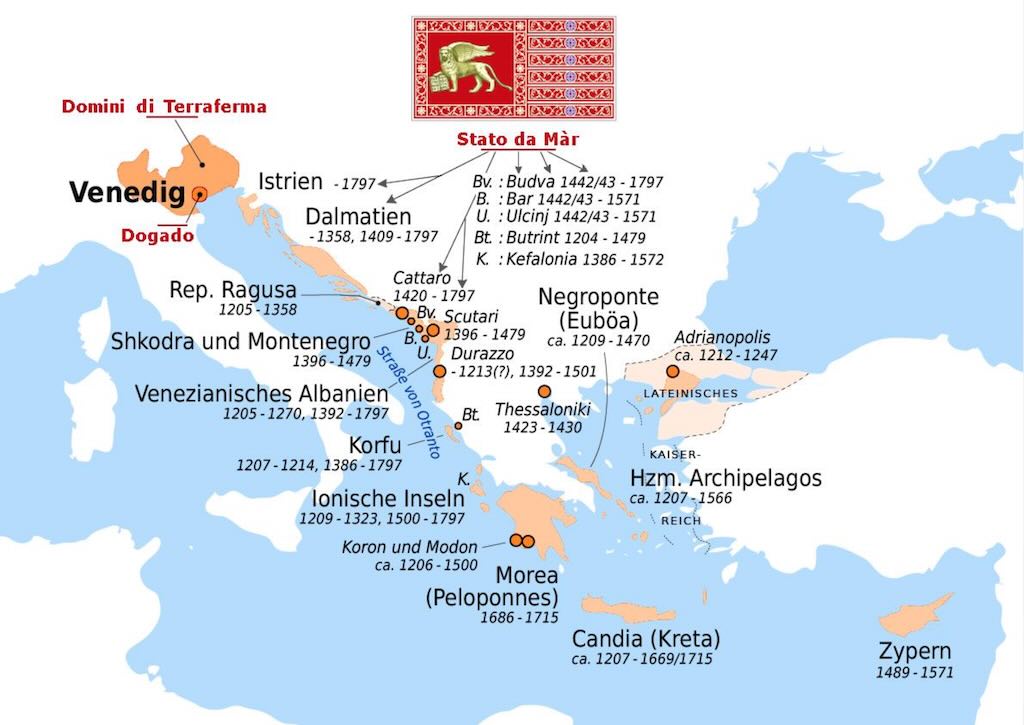
These acquisitions contributed to the development of the Venetian Stato da Màr, its overseas maritime dominion. It was not a continuous territorial empire like the Roman Empire. It was a network of islands, ports, fortified positions, commercial privileges and dependent territories designed principally to protect navigation, trade and strategic access.
How should Hazlitt’s description be judged?
Hazlitt presents the Fourth Crusade largely from the Venetian perspective. He recognised that Venice pursued its own political and commercial interests, and he also explicitly attributed Dandolo’s support for the Byzantine prince Alexios to the commercial advantages expected from restoring him to the throne. He also acknowledged that Venice used the crusading expedition to strengthen its position in the Adriatic, even before the attack on Zara.
Hazlitt is generally sympathetic to Dandolo and the Republic. He treats their actions as those of capable and determined statesmen exploiting opportunities, rather than as evidence of a deliberately planned betrayal of the crusade. His narrative praises Venetian military effectiveness while repeatedly emphasising Byzantine political weakness, corruption and internal divisions. Even the Pope’s condemnation of Venetian conduct is presented partly as a consequence of papal hostility towards the Republic.
This creates a significant imbalance. Hazlitt is willing to acknowledge Venetian self-interest, but is less willing to subject the Republic’s aggression and its participation in the destruction of Constantinople to the same moral scrutiny that he applies to Byzantine failures.
Modern scholarship offers a more complex explanation. There is insufficient evidence that Dandolo planned the conquest of Constantinople from the outset. The expedition was redirected through successive financial crises, political negotiations and military decisions. Yet Venice was not a passive participant. Dandolo helped shape those decisions, and the Republic emerged with substantial territorial and commercial advantages.
Hazlitt therefore sees the Fourth Crusade primarily as an extraordinary achievement of Venetian statesmanship and maritime power. A modern assessment must also recognise its cost in the conquest and devastation of a Christian capital, the fragmentation of Byzantine authority and the transformation of a religious expedition into an instrument of political and commercial expansion.
Venice: From Lagoon Refuge to Imperial Splendour

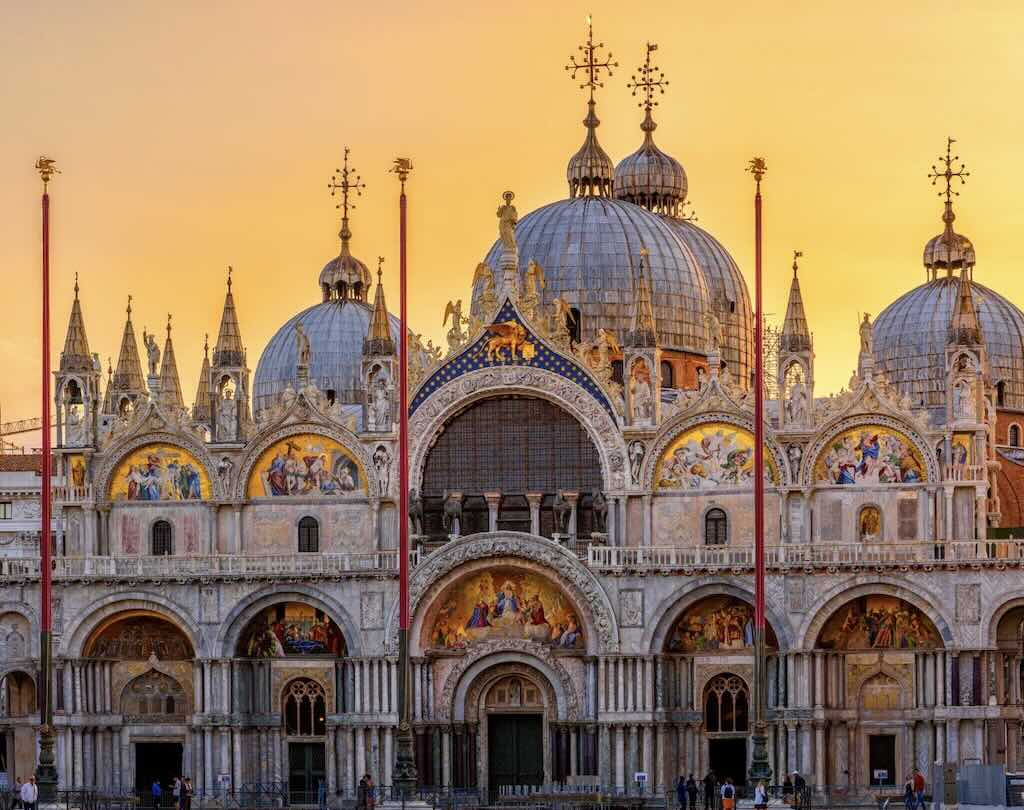
The Basilica of St Mark is an extraordinary material record of Venice’s relationship with Byzantium and the eastern Mediterranean.
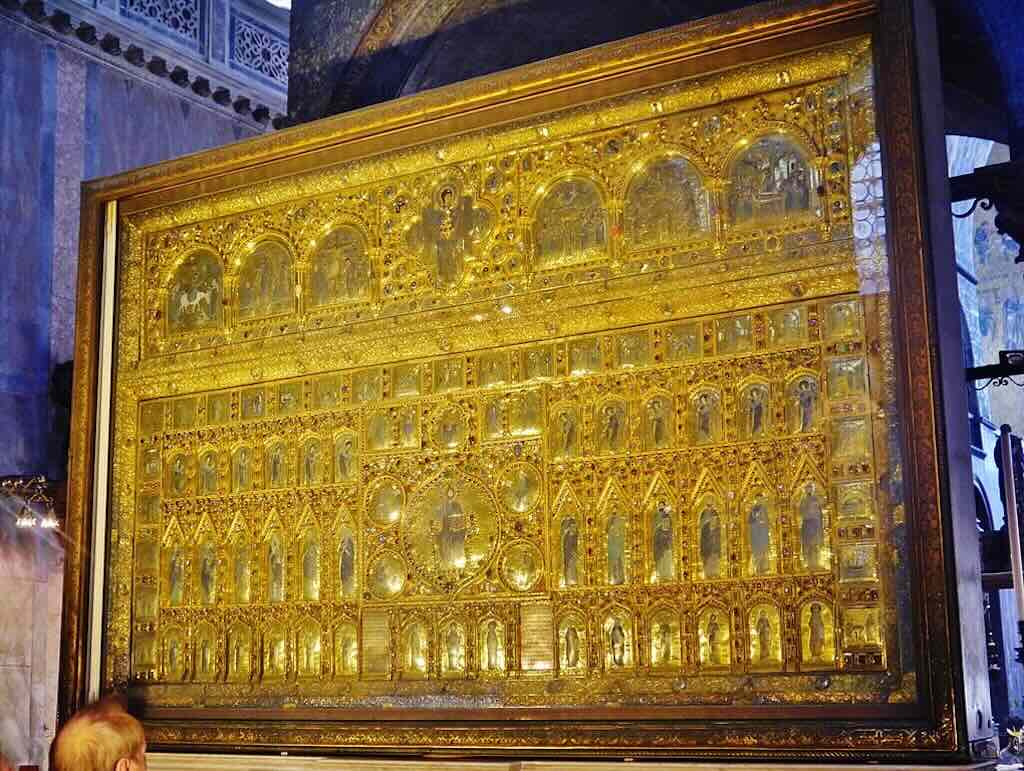
Its treasury contains objects of Byzantine origin, including material associated with the events of 1204 (e.g. The Pala d’Oro, a Byzantine altar screen of gold).
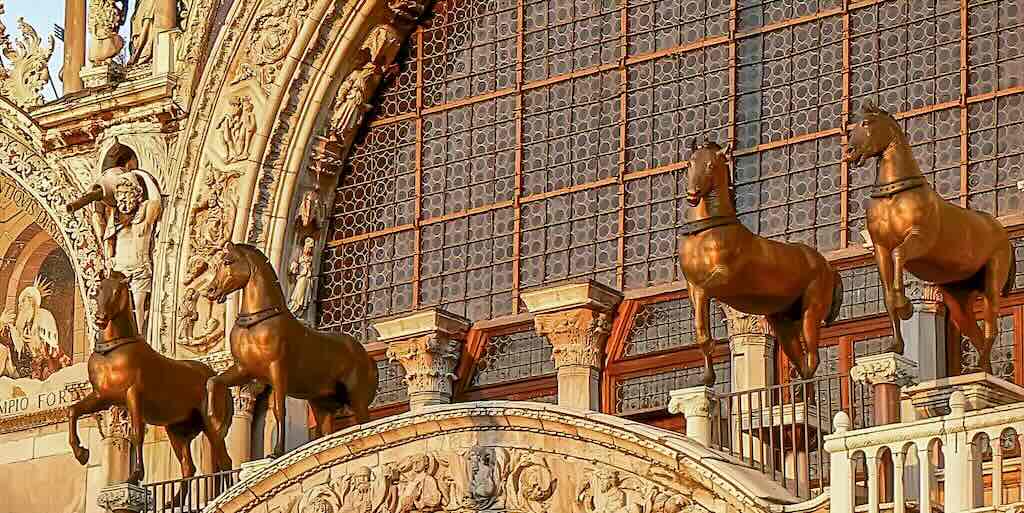
The Basilica is therefore not simply a church decorated in an eastern style. Its contents reflect centuries of diplomatic, religious, commercial and sometimes violent contact.
A modern criticism of Hazlitt must distinguish Venice’s legitimate commercial development from the violence and appropriation accompanying imperial expansion. Admiration for the Republic’s achievements should not obscure the experience of those subjected to its power.
The Four Horses of San Marco, Venice
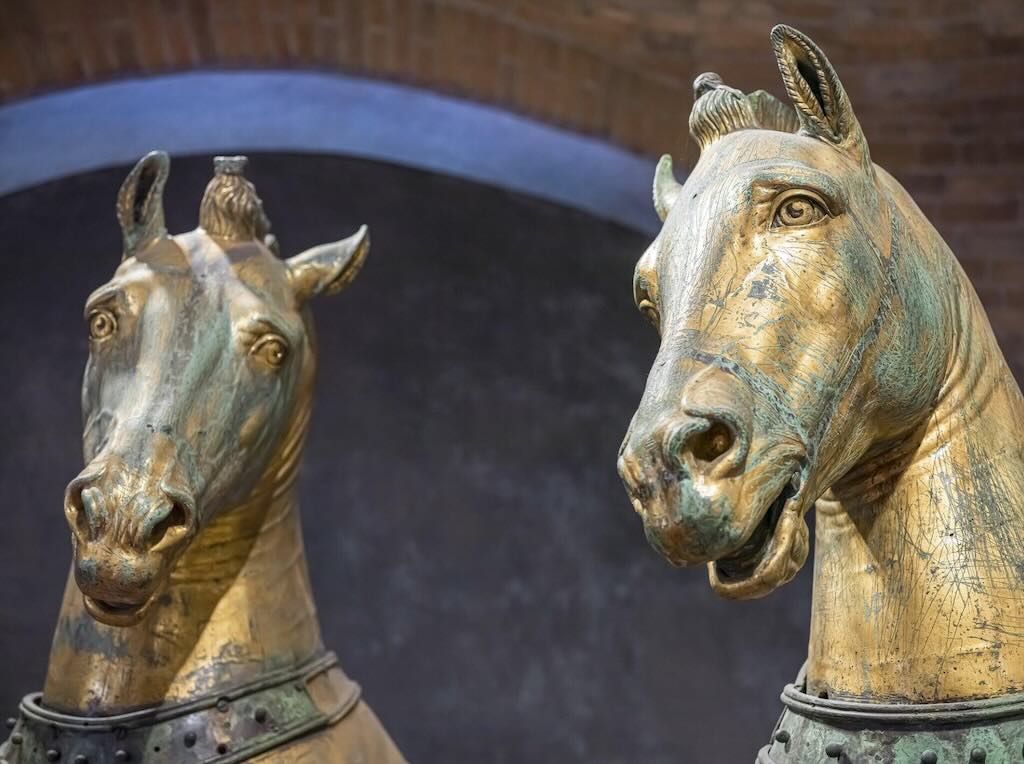
The four horses of the Basilica di San Marco are among the most important surviving examples of monumental metal sculpture from antiquity. They are also unusually problematic historical objects, since their original date, sculptor, intended location and even the circumstances of their arrival in Constantinople remain uncertain.
What makes them particularly interesting is the combination of three histories. First, their manufacture in antiquity, second, their appropriation by Venice in 1204, and third, their subsequent use as political trophies by Napoleon and the restored Venetian authorities.
This means understanding what they are, what contemporary documents actually record, and only then what later writers have reconstructed.
One preliminary correction is important. Although universally called the Bronze Horses of San Marco, they are not ordinary bronze sculptures. Their unusually high copper content, surviving gilding and construction techniques are central to understanding their manufacture.
What exactly are the four horses?
The group consists of four approximately life-sized, or slightly larger-than-life, cast-metal horses, conventionally identified as the surviving team of an ancient quadriga, a four-horse chariot.
Their principal characteristics are:
- Height: approximately 2.35–2.38 metres.
- Length: approximately 2.5 metres per horse.
- Material: a copper-rich alloy, approaching 98% copper in published technical analyses.
- Surface: originally gilded, with surviving gold and evidence of subsequent surface treatment.
- Manufacture: hollow casting using the lost-wax process.
- Original sculptor: unknown.
- Date: disputed, with published attributions extending from the Hellenistic period to the later Roman Empire.
- Original location: unknown.
- Earliest securely established historical setting: Constantinople, before the Venetian seizure of 1204.
The dimensions are recorded by Smarthistory and the Venetian heritage project Meraviglie di Venezia. The metallurgy is discussed by William A. Oddy and colleagues in the scientific literature (e.g. The gilding of bronze statues in the Greek and Roman world).
Why their metallurgy matters
Ordinary ancient bronze sculpture generally used a copper alloy containing appreciable tin, sometimes with lead. These additions improved casting characteristics and altered the properties of the finished metal.
The horses are different. Their exceptionally high copper content made casting more demanding, but the resulting surface was particularly suitable for mercury gilding.
In mercury gilding, gold was combined with mercury to form an amalgam, applied to the metal surface and heated to drive off the mercury, leaving a gold coating. The process was technically sophisticated and hazardous.
Scientific examination revealed evidence of mercury gilding and additional gold leaf. However, researchers could not establish whether all the observed gilding belonged to the original manufacture or included subsequent restoration.
This is important because the horses’ present appearance is not necessarily an exact representation of their appearance when first cast.
William A. Oddy, Licia Borelli Vlad and N. D. Meeks examined the gilding using X-ray diffraction and scanning electron microscopy. Their findings are published in W. A. Oddy, Licia Borrelli Vlad and N. D. Meeks, “The Gilding of Bronze Statues in the Greek and Roman World”, in Guido Perocco (ed.), The Horses of San Marco, Venice, Milan: Olivetti, 1979, pp. 182–187..
When were they made? The dating controversy
The traditional attribution to Lysippos, the Greek sculptor active in the 4th century BC, is not supported by a surviving ancient inscription or reliable documentary identification.
Lysippos was associated with Alexander the Great and was celebrated for his representations of horses. This made him an attractive candidate to Renaissance antiquarians seeking an illustrious origin for the Venetian sculptures.
But stylistic resemblance does not establish authorship.
There are three broad approaches in the literature.
The Hellenistic attribution: Some scholars have argued for a Greek original, potentially from the 2nd or 3rd century BC, based on anatomical modelling, sculptural style and particular interpretations of technical evidence.
The Roman Imperial attribution: Other researchers argue that the composition may preserve a Hellenistic sculptural tradition but that the actual metal objects were cast during the Roman Empire (AD 395 – 476/480).
The later Roman Imperial attribution: William Oddy specifically favoured a late Roman Imperial date (AD 395 – 476/480), partly on the basis of alloy composition and gilding technology.
There is a genuine conflict between published assessments. The Italian heritage database ArcheoVeneto reports an early second-century BC dating based on radiocarbon analysis, whereas the Venetian Meraviglie di Venezia project favours the second half of the second to the beginning of the third century AD.
These conclusions cannot simply be averaged. Nor can radiocarbon analysis directly date copper, because it would have to include associated organic material, whose relationship to the original casting must itself be established.
Conclusion is that the sculptures are ancient, but neither a precise date nor a named sculptor can presently be stated as established fact. A late Roman casting remains a serious scholarly position, not a certainty.
Constantinople: where were the horses before 1204?
The usual account places the horses above the starting gates of the Hippodrome of Constantinople, the enormous chariot-racing arena adjoining the imperial palace. This is plausible and has documentary support.
The crucial Byzantine eyewitness: Niketas Choniates
Niketas Choniates (c. 1155–1217) was a Byzantine historian and senior imperial official. His history is one of the most important sources for the events surrounding the Fourth Crusade.
In his description of the Hippodrome, he refers to four gilded metal horses above the starting gates, with their necks turned as though looking towards one another. This is unusually valuable evidence because Choniates was describing a monument in the city in which he lived, rather than attempting to reconstruct a distant ancient past.
Niketas Choniates, Historia, available in English as O City of Byzantium: Annals of Niketas Choniates, translated by Harry J. Magoulias, Wayne State University Press, 1984.
Were they brought from the island of Chios?
An earlier Byzantine source, the Parastaseis Syntomoi Chronikai, records several groups of sculpted horses in Constantinople. Its references include four gilded horses associated with the Hippodrome, said to have been brought from Chios during the reign of Theodosius II (408–450).
But the source also mentions other groups of horses elsewhere in the city. It is not sufficient to find a reference to four horses and assume that it describes the four now in Venice.
Averil Cameron and Judith Herrin examined these passages in Constantinople in the Early Eighth Century: The Parastaseis Syntomoi Chronikai (1984). Their work is essential for understanding how unreliable some seemingly precise identifications can become when several similar monuments existed.
The Fourth Crusade: how Venice acquired the horses
In April 1204, the armies of the Fourth Crusade captured and plundered Constantinople. Venice had provided the fleet that transported the crusaders, and Doge Enrico Dandolo played a central role in the expedition. The seizure of Constantinople led to the redistribution of Byzantine territory, commercial privileges and imperial property. Among the objects transferred to Venice were marble columns, sculptural reliefs, precious materials and the four horses.
The basilica’s own historical account explicitly connects its 13th-century marble decoration with the arrival of architectural materials taken from Constantinople.
The horses were particularly valuable as political objects because of their association with imperial triumph. They represented something beyond the value of their metal or craftsmanship: Venice had acquired a monument of the Roman imperial tradition from the capital of the Eastern Roman Empire.
What happened immediately after their arrival?
The horses are traditionally said to have been brought first to the Venetian Arsenal. They were subsequently installed on the principal façade of San Marco.
The surviving mosaic of the Translation of the Body of Saint Mark, in the lunette of the Porta di Sant’Alipio, dates to approximately 1265 and already depicts the horses in their elevated position.
Michael Jacoff has argued for an earlier installation, possibly in the 1230s or early 1240s, based on the development of the façade’s sculptural programme. That is a scholarly reconstruction rather than a securely documented installation date.
Why put pagan horses above a Christian basilica?
The conventional explanation is that the horses proclaimed Venetian victory over Constantinople. That explanation is convincing but may be incomplete.
Michael Jacoff proposed a more specific religious interpretation in his 1994 study, The Horses of San Marco and the Quadriga of the Lord. He argues that the four horses were incorporated into a medieval Christian symbolic system in which the four Evangelists were understood as the horses drawing the chariot of Christ.
This was not a symbolism invented by Jacoff. The association appears in early Christian and medieval writings, including those of Jerome, Augustine, Bede and other commentators.
Jacoff’s argument is that the Venetian installation combined two messages. Firstly, the political message of victory, imperial inheritance and Venetian authority. Secondly, the religious message of the four Evangelists, with particular prominence given to Saint Mark, Venice’s patron.
The sculptural arrangement changed substantially in later centuries, particularly during the 15th-century remodelling. Jacoff’s argument is therefore more sophisticated than simply declaring that four horses represent four Evangelists. It attempts to reconstruct the original architectural and iconographic programme intended by the Venetian authorities.
Bibliographic reference: Michael Jacoff, The Horses of San Marco and the Quadriga of the Lord, Princeton University Press, 1994, xvii + 164 pp., 64 illustrations, ISBN 0-691-03270-X. Especially chapters II, V and VI.
The horses as instruments of political humiliation
Once installed in Venice, the horses became so closely associated with the Republic that threatening them amounted to threatening Venetian sovereignty.
One remarkable example comes from the war between Venice and Genoa. During the War of Chioggia (1378–1381), the Genoese commander Pietro Doria reportedly threatened to put bridles on the horses of San Marco. Meaning that Genoa would subdue Venice and harness its most conspicuous symbols of power.
The episode is discussed by Raymond Chevallier in his study of the horses’ successive political meanings. It is an example of how a monument acquired through conquest could itself become the symbolic target of another conqueror.
Petrarch’s observations
Petrarch (1304–1374) provides an important 14th-century literary reference to the horses. Writing in connection with a tournament, he admired the sculptures as works of antiquity while acknowledging that the artist was unknown. The relevant material is in Petrarch’s Rerum senilium libri, discussed by Chevallier.
Napoleon: a second appropriation
After Napoleon’s defeat, the sculptures were recovered for Venice. The sculptor Antonio Canova was involved in the wider recovery of Italian artworks taken to France.
On 13 December 1815, the horses were restored to the façade of San Marco, in the presence of Emperor Francis I of Austria. At the time, the Republic of Venice no longer existed. So the horses were returned under Austrian sovereignty, not to an independent Venetian state.
The basilica’s official historical account documents the 1797 removal and the 1815 restoration.
The surviving originals and the question of restoration
The horses remained exposed to the Venetian environment for centuries, except during periods of removal, restoration and wartime protection.
By the 1960s, technical examinations had confirmed significant conservation problems. The combination of historic surface damage, gilding deterioration and continued outdoor exposure made permanent protection necessary. The originals were removed from the façade in 1977. Following restoration, they were installed in the Museo di San Marco in 1982 (in the present-day Piazza San Marco, in Florence).
The horses now visible above the central entrance are copies. This is not merely a matter of preventing further corrosion. The original sculptures preserve evidence of ancient casting, gilding, assembly and centuries of subsequent intervention. Losing that evidence would damage their historical value as much as their artistic value.
The Italian cultural heritage database ArcheoVeneto records the conservation chronology and the present museum arrangement.
I have a copy of Les Chevaux de Saint-Marc, Venise, published by Olivetti and Réunion des musées nationaux, 1981, as the catalogue for the exhibition in the Galeries nationales du Grand Palais, Paris, 10 April–10 August 1981. The scientific and technical sections are especially interesting because the exhibition occurred during the period when the horses were undergoing important conservation investigations.
My understanding is that the horses have collars across their chests, interpreted as equipment for pulling a chariot. Their surfaces preserve negative impressions of bridles and harness fittings that have disappeared, and their mouths were fashioned to accommodate bits and reins. in addition Roman numerals are engraved on parts of their hooves and harnesses. From what I remember I could not find any mention of evidence of saddles, stirrups, or mounting arrangements, suggesting that they had riders.
The essential bibliography
Giovanni Perocco and Renzo Zorzi (eds.), I cavalli di San Marco. Milan: Olivetti, 1981. A principal collective publication on the horses, incorporating historical, archaeological and technical research. Particularly important for the scientific examinations and conservation history.
Vittorio Galliazzo, I cavalli di San Marco. Treviso, 1981. A specialised study of the sculptures and their historical attribution.
Vittorio Galliazzo, “I cavalli di San Marco: una quadriga greca o romana?” Faventia, 6/2 (1984), pp. 99–126. Especially relevant to the disputed Greek or Roman attribution.
William A. Oddy, “Scientific Dating of the San Marco Horses.” MASCA Journal, vol. 2, no. 2, pp. 45–47. A focused examination of what the metallurgy and gilding technology can establish about their date.
William A. Oddy, Licia Borelli Vlad and N. D. Meeks, “The Gilding of Bronze Statues in the Greek and Roman World.” In The Horses of San Marco, Venice, Milan: Olivetti, pp. 182–187. Essential for the actual physical composition of the sculptures and the evidence for their surface treatment.
Michael Jacoff, The Horses of San Marco and the Quadriga of the Lord. Princeton: Princeton University Press, 1994. The major interpretative study of the horses’ Christian iconography, their relationship to the basilica’s sculptural programme and their political meaning.
Raymond Chevallier, “Les chevaux de Saint-Marc, ou la vie aventureuse de l’œuvre d’art”. Bulletin de la Société nationale des Antiquaires de France, 1978–1979 (published 1982), pp. 61–72. A useful scholarly overview of the sculptures’ changing historical identities, from antiquity through Venice and Napoleon. Read on Persée.
What remains unknown
Despite their fame, several basic historical questions remain unresolved. We do not know who commissioned the horses, who sculpted them, exactly when they were cast, where they were first displayed, or whether they originally formed part of a complete chariot group.
The reality is that the horses have survived not because their original meaning remained intact, but because successive regimes found them useful for expressing their claims to power.
Volume II (1202-1308) — A Twenty-First-Century Assessment
Hazlitt opens Volume II (of the 1860 edition) with the Fourth Crusade (1202–1204), the expedition that transformed Venice’s position in the eastern Mediterranean.
The agreement concluded in 1201 required Venice to transport and provision an exceptionally large crusading force. The contracted payment was 85,000 marks of silver, while Venice undertook to provide ships, supplies and fifty armed galleys. The agreement was an extraordinary demonstration of the Republic’s maritime and organisational capacity.
Yet the crusaders who assembled in Venice in 1202 were fewer than anticipated and could not meet their financial obligations. The resulting crisis was fundamental to the expedition’s subsequent history.
Hazlitt’s treatment reflects the 19th-century tendency to interpret the Doge Enrico Dandolo as an exceptionally capable statesman who planned all along to exploit circumstances to advance Venetian interests. His political judgement and determination are central to the narrative.
Modern scholarship asks a different question. What evidence establishes Dandolo’s intentions before the expedition departed?
The traditional accusation that Venice deliberately engineered the diversion to Constantinople has been substantially challenged, notably by Donald E. Queller and Thomas F. Madden. They demonstrate the importance of the original contractual arrangements, the crusaders’ financial difficulties and the successive decisions taken during the expedition.
The documentary evidence does not show that Venice planned the conquest of Constantinople in 1201. Nor does it support the opposite extreme, in which Dandolo and the Venetian government bear no responsibility for subsequent decisions.
The distinction between original intention and subsequent opportunity is essential. Venice committed major resources to the expedition. Once the crusaders failed to pay, Dandolo faced a serious financial and political problem. The eventual decisions were taken in circumstances that had changed considerably since the original agreement.
The most defensible modern interpretation is therefore neither a premeditated Venetian conspiracy nor an innocent commercial undertaking overtaken by events.
The diversion developed through successive political and financial decisions in which Venice exercised considerable influence.
Zara in 1202: an attack on a Christian city
The siege of Zara, which began in November 1202, was the first major consequence of the crusaders’ inability to meet their financial obligations.
Zara was a Christian city on the Dalmatian coast, contested between Venice and the Hungarian-Croatian crown. Its political allegiance had changed repeatedly, and it had resisted Venetian authority.
Dandolo proposed that the crusaders assist Venice in recovering the city as part of the arrangement for settling their debt. The attack created a fundamental contradiction. An expedition assembled to fight in the eastern Mediterranean was being used against a Christian city belonging to a Christian ruler who had himself taken the cross. Pope Innocent III opposed the attack. Nevertheless, Zara surrendered on 24 November 1202, after which the crusading army remained there during the winter.
Hazlitt prefers to places Zara within the history of Venice’s long struggle to maintain control of Dalmatia. That context is important, but it does not adequately explain the moral and political consequences of employing a crusading army against a Christian population.
Modern scholarship also distinguishes between the position of the crusading leadership and that of individual participants. Not all crusaders supported the attack. Some refused to participate or left the expedition. The episode demonstrates that the crusade was already politically divided before the proposal to intervene at Constantinople became decisive.
Principal references: Queller and Madden (1997); Villehardouin, La Conquête de Constantinople; Innocent III, correspondence concerning the Fourth Crusade.
Constantinople in 1204: conquest, destruction and responsibility
The conquest of Constantinople in April 1204 was the defining event of volume II.
The crusaders first intervened in Byzantine politics in 1203, supporting the restoration of Isaac II Angelos and the elevation of his son Alexios IV. The promised payments and assistance failed to materialise as expected. Political instability in Constantinople intensified, and relations between the crusaders and the Byzantine population deteriorated. In April 1204, the crusaders attacked and captured the city.
Hazlitt gives considerable attention to the military operations and to Dandolo’s role. The conquest is presented as an extraordinary achievement of Venetian naval power and political calculation, and the destruction and looting is given insufficient attention.
A modern assessment must distinguish the military achievement from the consequences. Constantinople was one of the largest and wealthiest cities of medieval Europe. Its capture was followed by extensive looting, destruction, violence and the dispersal of religious and artistic treasures.
The Byzantine historian Niketas Choniates (1155-1217) provides a particularly important account of the catastrophe from the perspective of those who experienced it. His narrative is not politically neutral, but it is indispensable because it reveals how differently the conquest appeared to the inhabitants of Constantinople and to the victorious crusaders. The destruction was not merely incidental to a successful military operation. It permanently altered the political and cultural history of the eastern Mediterranean.
The Byzantine Empire was fragmented, although Byzantine successor states survived and subsequently challenged Latin rule.
Modern historians therefore reject an interpretation of 1204 solely as the beginning of Venetian imperial greatness. It was simultaneously a major Venetian opportunity, a catastrophic defeat for Byzantium and a profound rupture between Latin and Greek Christianity.
Principal references: Niketas Choniates, Historia, especially the account of 1204; Michael Angold, The Fourth Crusade: Event and Context (2003); Jonathan Phillips, The Fourth Crusade and the Sack of Constantinople (2004); Queller and Madden (1997).
The partition of the Byzantine Empire: claims were not possessions
The settlement following the conquest gave Venice an extraordinary position within the former Byzantine Empire. Under the arrangements associated with the Partitio Romaniae, Venice was assigned three-eighths of the conquered imperial territories and rights.
The Doge subsequently adopted the title referring to his lordship over a quarter and half a quarter of the Roman Empire, corresponding to three-eighths. Hazlitt understandably regards these arrangements as a decisive enlargement of Venetian power.
The principal historical qualification is that the partition allocated claims to territories that the victors did not necessarily control. The former Byzantine Empire was not an empty political landscape. Local rulers, Byzantine successor states and established communities continued to exercise authority.
Venice also had to decide which territories were worth occupying, administering and defending. Its interests were particularly concentrated on strategic ports, islands, anchorages and routes connecting the Adriatic with Constantinople and the Levant.
Modern historians consequently distinguish between the nominal territorial division of 1204 and the actual construction of Venetian overseas power.
Ruthy Gertwagen‘s research on Venice’s policy towards the Ionian and Aegean islands shows the importance of geographical position, commercial security and the productive resources of individual islands.
Venice’s overseas empire was not simply the territorial result of a successful crusade. It developed through selective occupation, negotiation, private enterprise and prolonged military effort.
Crete: the difference between acquisition and conquest
Crete was among Venice’s most important acquisitions following 1204. Boniface of Montferrat transferred his claims to the island to Venice, but the Republic did not immediately establish uncontested authority.
The Genoese adventurer Enrico Pescatore (1205-1230) occupied parts of Crete, and Venice had to undertake military operations before consolidating its position.
Systematic Venetian colonisation began in the early 13th century, particularly from 1211. The island subsequently became one of the most important possessions of the Stato da Mar.
Hazlitt describes the acquisition and the military operations involved in securing Venetian control. Modern scholarship examines more closely the colonial institutions established after conquest.
Venice introduced settlers, organised landholding, imposed administrative structures and sought to control the island’s agricultural and commercial resources. The indigenous Greek population retained its religious and cultural traditions but occupied an unequal position within the colonial system.
Resistance was recurrent. The history of Venetian Crete includes repeated uprisings and negotiations involving local Greek elites, Venetian settlers and the colonial administration. The island was therefore not simply a profitable possession added to the Republic’s territories. It required a substantial and continuing commitment of military, administrative and financial resources.
The distinction is important because the acquisition of Crete demonstrates both the strengths and limitations of Venetian expansion. The Republic could establish an extensive colonial government, but effective authority had to be maintained over generations.
The Aegean islands: Venetian families and the limits of state control
The territorial settlement of 1204 also encouraged the acquisition of Aegean islands by individual Venetian nobles.
Marco Sanudo’s establishment of the Duchy of the Archipelago, centred on Naxos, is the best-known example. Yet these territories should not automatically be treated as possessions administered directly by Venice.
Sanudo and other Venetian adventurers established lordships whose political relationships with the Latin emperors, Venice and neighbouring powers could be complicated.
The distinction between Venetian nationality, private lordship and Venetian state sovereignty is essential.
Hazlitt’s emphasis on the expansion of Venetian influence risks obscuring these different legal and political arrangements.
Modern historians distinguish the Republic’s directly governed possessions from territories controlled by Venetian families under other forms of allegiance.
The result was a fragmented political landscape, not a single centrally administered empire. This also explains why maps showing the Venetian maritime empire at a particular date require careful interpretation. They can conceal substantial differences between sovereignty, commercial privileges, dynastic control and temporary military occupation.
The recovery of Constantinople in 1261
The restoration of Byzantine rule in Constantinople in 1261 fundamentally changed the political balance of the eastern Mediterranean.
Michael VIII Palaiologos (1224-1282) recovered the city from the Latin Empire, ending the regime established after the Fourth Crusade.
For Venice, this was a serious strategic reversal. The Republic lost the privileged position it had enjoyed under the Latin emperors, while Genoa emerged as an important beneficiary of Byzantine policy.
The Treaty of Nymphaeum, concluded between Michael VIII and Genoa in March 1261, promised the Genoese extensive commercial privileges in return for naval assistance.
The recovery of Constantinople occurred before the Genoese assistance envisaged in the treaty had become decisive, but the agreement nevertheless helped reshape commercial competition in the region.
Hazlitt describes the diplomatic and military consequences, particularly the developing rivalry with Genoa.
Modern scholarship emphasises that the restoration of Byzantine power demonstrates the limits of the territorial settlement of 1204.
The Latin Empire had proved politically fragile, and Venice’s commercial advantages depended partly on the survival of a regime it could not ultimately protect.
The Republic subsequently negotiated renewed relations with Byzantium, showing that commercial interests could survive major political reversals. The history of Venice after 1261 is therefore not simply a story of territorial loss. It also illustrates the adaptability of its merchants and diplomats.
Venice and Genoa: more than naval rivalry
The wars between Venice and Genoa occupy an important place in Hazlitt’s account of the second half of the 13th century.
Both republics possessed substantial merchant fleets, extensive trading networks and commercial establishments throughout the Mediterranean. Their rivalry concerned access to ports, trading privileges, shipping routes and political alliances.
The conflict was particularly intense in the eastern Mediterranean, where the two cities competed for advantages in Constantinople, the Black Sea and the Latin possessions.
Hazlitt concentrates on naval campaigns, commanders, diplomatic negotiations and the changing fortunes of the two republics.
Modern historians place these events within a wider commercial system. Venetian and Genoese merchants were competitors, but their activities also depended on many of the same markets and political authorities. The rivalry was consequently not a simple struggle for exclusive control of the Mediterranean. It involved the protection of commercial privileges, the security of shipping and the ability to negotiate favourable terms with regional rulers.
The battle of Settepozzi in 1263, in which a Venetian fleet defeated a Genoese-Byzantine force, demonstrated that Venice remained militarily formidable after the restoration of Byzantine rule.
Yet individual victories did not resolve the underlying commercial competition. The continuing conflicts reveal that maritime power depended on more than the capacity to win battles.
The battle of Curzola, 1298: a defeat that did not destroy Venice
The battle of Curzola, fought on 8 September 1298 near the island now known as Curzola (Korčula), was one of the most important Venetian naval defeats of the period.
The Genoese fleet under Lamba Doria (1245-1323) defeated the Venetians commanded by Andrea Dandolo. Venice suffered heavy losses in ships and personnel. Hazlitt describes the defeat within the wider history of Venetian–Genoese rivalry.
Modern historians emphasise that the result of a single naval battle should not be confused with the long-term balance of commercial power. Despite the defeat, Venice retained important trading networks and the institutional capacity to recover.
The peace of Milan in 1299 ended the immediate conflict without establishing permanent Genoese supremacy.
The battle of Curzola illustrates the vulnerability of even a major maritime republic to catastrophic military losses. It also demonstrates the limits of explaining economic and political history primarily through naval victories and defeats.
The Doge: increasingly restricted authority
Hazlitt gives considerable attention to the succession of Doges and the development of electoral procedures.
The 13th century witnessed important changes in the constitutional position of the Doge. The election of Lorenzo Tiepolo (?-1275) in 1268 was conducted under the elaborate electoral procedure involving forty-one final electors, following successive stages of selection by lot and election. This system was designed to reduce the influence of individual families and factions.
The Doge remained the Republic’s most visible political figure, but his freedom of action was increasingly restricted by councils, oaths and established procedures.
The promissione ducale, the oath sworn by a newly elected Doge, became an important instrument for defining his obligations and limiting his authority.
Modern constitutional historians distinguish between the symbolic dignity of the office and the practical distribution of power.
The elaborate election procedures did not represent popular democracy. They were mechanisms for managing competition within the political elite.
Hazlitt tends to interpret the development as evidence of constitutional sophistication. That judgement is reasonable, but incomplete. The same institutions that limited personal rule also strengthened the collective authority of the aristocracy.
The Serrata of 1297: did the Great Council suddenly close?
The constitutional changes associated with 1297 are among the most important developments in the volume.
The Serrata del Maggior Consiglio, traditionally described as the closing of the Great Council, is frequently presented as the moment when Venice became a hereditary aristocratic republic. The historical reality was more gradual. The legislation of 1297 altered the conditions for admission to the Great Council, favouring men with previous membership or established family connections. It did not immediately create a completely closed hereditary caste.
Further measures during the early 14th century progressively restricted access and regularised the hereditary character of membership.
Hazlitt’s treatment of the Serrata del Maggior Consiglio is more nuanced than the conventional description of a sudden closure of the Great Council in 1297. He identifies the initial legislation of 1297, its confirmation in 1298 and the further restrictions introduced in 1300, 1307 and 1317. He also recognises that the measures did not immediately exclude the wider population from every form of political influence.
His account therefore correctly presents the Serrata as a gradual constitutional transformation. Subsequent historical research extends the legislative chronology, notably to 1323, and provides a more detailed examination of the emergence of hereditary patrician membership.
The principal qualification concerns Hazlitt’s interpretation rather than his chronology. He presents the changes as a struggle between aristocratic ascendancy and popular political freedom, with Doge Pietro Gradenigo occupying a central role. This gives the constitutional developments a coherent political narrative, but risks attributing a more unified purpose to successive legislative measures than the evidence necessarily establishes.
Hazlitt’s reconstruction of the legislative sequence remains substantially valuable, however it is his interpretation of the political motives and consequences that requires closer scrutiny.
Modern historians, notably Frederic C. Lane (1900-1984) and Donald E. Queller, have examined the relationship between patrician identity, political eligibility and the institutional mechanisms governing membership. The essential distinction is between the emergence of a ruling elite and the formal closure of access to its principal political institution.
The Venetian aristocracy did not suddenly appear in 1297. Powerful families had dominated political life for generations. What changed was the legal organisation of political privilege. The Serrata helped transform an established pattern of elite dominance into an increasingly hereditary constitutional system.
The result was greater continuity within the ruling class, but also a progressive restriction of political participation.
After the Serrata, 1297–1308: aristocratic consolidation and conflict with the papacy
The final years of Volume II deserve attention because they demonstrate that the Serrata of 1297 was not the completion of Venice’s aristocratic constitution, but the beginning of a period of political consolidation and increasing tension.
The conspiracy of Marin Bocconio, traditionally dated to 1300, illustrates the resistance associated with the restriction of access to the Great Council. According to the later Venetian historical tradition, Bocconio attempted to force his way into the political establishment with the assistance of armed supporters. The plot was discovered and its leaders punished.
The episode has often been presented as an unsuccessful popular revolt against the new aristocratic order. Modern historians are more cautious. The surviving narrative does not establish a broad democratic movement. Opposition to the Serrata could also come from families and individuals who had previously enjoyed political influence but now found themselves excluded.
This distinction matters, because the political conflict was not necessarily between an established nobility and the population at large. It also concerned competition within Venice’s wider governing class.
The Serrata itself was followed by further legislation defining eligibility for the Great Council. The creation of a hereditary patriciate was a gradual legal and institutional process, not an accomplished fact in 1297.
Doge Pietro Gradenigo (1251-1311), elected in 1289, was a central figure in these developments. His government was associated both with the restriction of political participation and with increasingly assertive foreign policy.
The most important external dispute concerned Ferrara. Following the death of Azzo VIII d’Este in 1308, a succession crisis developed in Ferrara. Venice intervened to protect and extend its interests in the lower Po region, an area of considerable commercial and strategic importance.
The papacy also claimed authority over Ferrara, creating a direct confrontation between the Republic and Pope Clement V.
We will see in Volume III that the dispute was more than a quarrel over one city. Control of the lower Po affected inland trade, river navigation, access to Adriatic markets and the relationship between Venice and neighbouring Italian powers. The conflict subsequently produced a papal interdict and military operations against Venice in 1309. Those consequences belong principally to the following volume.
From a twenty-first-century perspective, the significance of these final years lies in the relationship between domestic constitutional change and external expansion.
Venice was developing a more restricted political system while continuing to pursue commercial and territorial interests that exposed it to serious diplomatic and military risks.
The Republic’s governing institutions were becoming more stable, but its political order was neither uncontested nor immune to internal opposition.
The events after 1297 also anticipate the Quirini–Tiepolo conspiracy of 1310 and the creation of the Council of Ten, both belonging to Volume III.
Hazlitt’s account of the closing years is therefore best understood not as the culmination of Venetian constitutional progress, but as evidence of the continuing struggle to define political membership, maintain internal authority and reconcile commercial ambition with the Republic’s diplomatic limitations.
Finally, his account gives insufficient attention to the social and economic foundations of Venetian power. The Republic’s prosperity depended on maritime labour, commerce, finance, shipbuilding and the management of overseas territories, not just on the decisions of its governing elite.
It was the period in which the Republic acquired a new combination of commercial opportunities, but along with territorial obligations, fragile political institutions and strategic vulnerabilities.
The conquest of Constantinople greatly enlarged Venetian ambitions but did not eliminate Byzantine power. The acquisition of overseas territories strengthened commercial networks but created expensive commitments. Naval victories demonstrated military capacity without securing permanent supremacy. Constitutional reforms increased stability while restricting political participation.
Hazlitt correctly identifies the 13th century as a decisive period in the development of Venetian power. A twenty-first-century assessment sees it as the period in which the Republic’s maritime empire and hereditary political system took shape, together with the contradictions that would influence its subsequent history.
The Venetian economy: what Hazlitt’s political narrative leaves out
Hazlitt’s second volume is dominated by political and military events. The Republic’s economic development receives attention, but largely through commercial treaties, overseas privileges and the actions of leading merchants.
Modern scholarship has demonstrated the importance of examining the institutions and labour underlying Venetian prosperity. The 13th century saw the continued development of maritime partnerships, credit arrangements, public borrowing and commercial administration. Venetian merchants operated across the Mediterranean, participating in the exchange of spices, textiles, metals, timber, grain, salt and other commodities.
The establishment of the Venetian gold ducat in 1284, during the Dogeship of Giovanni Dandolo, was a particularly important development. The ducat, weighing approximately 3.5 grams and struck in high-purity gold, became one of the most influential commercial coins of the later Middle Ages.
Its success depended on the credibility of Venetian monetary institutions and the Republic’s extensive trading networks. The gold ducat was not simply a symbol of prosperity. It was an instrument facilitating commercial exchange across political boundaries.
Venice’s economic success also depended on shipbuilders, sailors, craftsmen, transport workers and merchants who did not necessarily belong to the political elite. The development of the Arsenal and the organisation of maritime labour were fundamental to the Republic’s naval capacity.
Modern economic history therefore shifts attention away from the assumption that commercial prosperity resulted primarily from the political wisdom of the Doges and patricians. It was produced by a much broader economic system involving labour, capital, institutions and international networks.
The Stato da Mar: was Venice already an empire?
By the end of the 13th century, Venice possessed an extensive network of overseas territories, commercial privileges and strategic positions. Hazlitt’s narrative presents this development as a major achievement of the Republic’s political and maritime institutions.
Modern historians agree that Venice had become an imperial power, but they are more precise about the nature of that empire.
The Stato da Mar was not a continuous territory governed through a uniform administrative system. It included directly administered possessions, strategically important ports, islands, commercial establishments and territories with differing legal relationships to Venice. Some territories were acquired through conquest, others through treaties or dynastic arrangements.
Local communities retained varying degrees of autonomy, while Venetian officials exercised authority under different institutional arrangements. The empire was consequently both geographically dispersed and politically heterogeneous.
Its primary value lay in protecting maritime communications, facilitating commerce and securing resources. Yet maintaining it required military intervention, administrative expenditure and negotiation with local populations.
The history of Venetian expansion must therefore include the costs of empire as well as its commercial advantages.
Overall historical judgement
Hazlitt’s second volume is valuable because it provides a detailed narrative of one of the most important periods in Venetian history.
His treatment of the Fourth Crusade, the conquest of Constantinople, the succession of Doges, the rivalry with Genoa and the development of Venetian institutions preserves a substantial body of historical material.
He also recognises the extraordinary administrative and maritime capabilities that enabled Venice to undertake major military and commercial enterprises.
The principal weakness is the interpretation imposed upon that material.
First, Hazlitt tends to judge the Fourth Crusade through its consequences for Venice. Modern scholarship places greater emphasis on the financial crisis of 1202, the successive decisions leading to Constantinople and the devastating consequences of the conquest for Byzantine society.
Second, he gives insufficient weight to the difference between territorial claims and effective political control. The partition of the Byzantine Empire in 1204 did not immediately produce a coherent Venetian empire. The acquisition and administration of Crete and other possessions required prolonged military and political effort.
Third, his account of Venice’s rivalry with Genoa is heavily military and diplomatic. Modern historians emphasise the commercial networks, institutional arrangements and economic interests underlying the conflict.
Fourth, he interprets constitutional development primarily as progress towards political stability. The restriction of ducal power and the evolution of the Great Council were important achievements, but they also contributed to the concentration of political authority within a hereditary aristocracy.
Some Useful Home Reading
Frederic C. Lane, Venice: A Maritime Republic (Baltimore: Johns Hopkins University Press, 1973). The principal general reference for Venetian political, commercial and maritime history.
Donald E. Queller and Thomas F. Madden, The Fourth Crusade: The Conquest of Constantinople, 2nd ed. (Philadelphia: University of Pennsylvania Press, 1997). Essential for the Fourth Crusade and Venice’s involvement in the conquest of Constantinople in 1204.
Donald M. Nicol, Byzantium and Venice: A Study in Diplomatic and Cultural Relations (Cambridge: Cambridge University Press, 1988). Relations between Venice and Byzantium, including the consequences of 1204 and the Byzantine recovery in 1261. (The author has written other books on the topic)
Donald E. Queller, The Venetian Patriciate: Reality versus Myth (Urbana: University of Illinois Press, 1986). Venetian political institutions, patrician government and the development of the ruling oligarchy.
Sally McKee, Uncommon Dominion: Venetian Crete and the Myth of Ethnic Purity (Philadelphia: University of Pennsylvania Press, 2000). Colonial administration and society in Venetian Crete.
Dennis Romano, Venice: The Remarkable History of the Lagoon City (Oxford: Oxford University Press, 2024). A modern synthesis providing a twenty-first-century perspective on Hazlitt’s account.
Volume III (1309–1413): Political Conspiracy, Maritime Crisis and Territorial Expansion
The third volume of Hazlitt’s 1860 book covers one of the most turbulent periods in the Republic’s development, extending from the political conflicts of the early 14th century to Venice’s emergence as a major territorial power in northern Italy.
Its principal subjects are the consolidation of patrician government, the challenges to ducal authority, the prolonged rivalry with Genoa, the defence of Venice’s Adriatic interests and the acquisition of mainland territories.
These developments are interlinked. Venice’s ability to wage war, negotiate alliances and extend its dominions depended upon the political institutions and financial resources developed during the preceding centuries.
For Hazlitt, writing in the 19th-century tradition of political and narrative history, this period offered a succession of dramatic episodes, e.g. conspiracies, trials, assassinations, naval engagements, sieges and diplomatic settlements. Such events give his history considerable narrative interest. They also present a difficulty for the historian, the actions of prominent individuals can become more conspicuous than the institutional and economic circumstances in which those individuals operated.
The conspiracy of 1310 and the Council of Ten
The conspiracy led by Baiamonte Tiepolo in June 1310 provides an important opening to the period. It arose amid tensions within Venice’s ruling class following the gradual restriction of participation in the Great Council. The movement involved members of distinguished patrician families, including the Tiepolo and Marco Querini, and was directed against the government of Doge Pietro Gradenigo.
The attempted uprising failed. Its suppression was followed by the establishment of the Council of Ten on 12 July 1310, initially as an extraordinary body responsible for investigating threats to the state. The Council’s authority was subsequently renewed and, in 1335, made permanent.
The episode has two distinct historical dimensions. The conspiracy revealed serious divisions within the Venetian aristocracy, and the government’s response demonstrated its capacity to create new institutions in defence of the existing political order.
The Council of Ten became one of the Republic’s most important instruments of political security. Its powers extended to investigations of conspiracy, treason and other offences considered dangerous to the state. Its proceedings could be secret, and its authority was not confined to the ordinary administration of justice.
This is particularly fertile ground for a narrative historian. The conspiracy offers recognisable protagonists, a decisive confrontation and an institutional consequence of lasting importance. Yet the establishment of the Council should not be treated merely as the successful conclusion of a failed rebellion. It marked a significant change in the machinery of Venetian government.
Marino Faliero and the limitations of ducal authority
The conspiracy associated with Doge Marino Faliero (c. 1274–1355) is among the most extraordinary episodes in Venetian political history. Faliero was elected Doge in September 1354, but less than seven months later became implicated in a conspiracy against the Republic’s established government. The plot was discovered before it could be carried out, and Faliero was condemned and executed on 17 April 1355.
The conspiracy against Doge Marino Faliero was uncovered because the authorities received information in advance. Historical accounts do not all tell the story in exactly the same way. There are two accounts to distinguish, but they are not necessarily contradictory.
In the account given by Hazlitt, a certain furrier Beltramo warns his employer Nicolò Lioni to stay indoors, who then became suspicious. Also a Marco Nigro of Castello provided information to Giovanni and Giacomo Contarini, who passed it to the Council of Ten. The difference concerns who first alerted the authorities. Hazlitt explicitly states that the Contarini report slightly preceded the information supplied by Lioni and his companions. Thus, according to Hazlitt, the Marco Nigro report reached the Council first, even though Beltramo’s warning forms the more elaborate narrative.
The evidence does not establish that one account is correct and the other false. Hazlitt incorporates both into his narrative, and there is additional evidence within his account that both informants were recognised by the government. After the suppression of the conspiracy, Hazlitt report reported Beltramo received an annuity of 1,000 ducats and permission to carry weapons, and Marco Nigro received a pension of 100 gold ducats and the same privilege.
The significance of the episode lies partly in the position of the accused. The Doge was Venice’s most prominent public official, representing the Republic, presiding over its ceremonies and enjoying exceptional dignity. Yet he was not a hereditary sovereign. His authority was restricted by the promissione ducale, the ducal councillors and the Republic’s governing institutions. His execution demonstrated that even the highest office in Venice did not place its occupant beyond the authority of the political system.
The conspiracy also exposed tensions within Venetian society. The concentration of political authority in the patriciate had created divisions between the governing elite and those excluded from political power. Faliero’s alleged intention to overthrow the existing constitutional order therefore raises questions extending well beyond the personal ambitions of an individual Doge.
Michele Steno’s Insult to Doge Marino Faliero (1355)
Hazlitt’s account of Marino Faliero’s conspiracy of 1355 combines the traditional explanation of its origins with a detailed reconstruction of its preparation, discovery and suppression. He also gives prominence to the insult, addressed to Faliero by the young patrician Michele Steno (1331–1413), whose relatively lenient punishment is presented as a source of Faliero’s resentment. And he also describes the grievances of Stefano Gisello, an official of the Arsenal who had suffered an insult from another nobleman. These personal conflicts provide the starting point for a conspiracy directed against the political supremacy of the Venetian patriciate.
Hazlitt does not, however, reduce the conspiracy to personal revenge. He recognises its wider political implications, particularly the proposed overthrow of the existing constitutional order and the restoration of extensive authority to the Doge. He also provides a detailed account of how the conspiracy was uncovered on 14 April 1355.
The principal limitation of Hazlitt’s account lies in his treatment of the evidence rather than in his understanding of the conspiracy’s political significance. His reconstruction incorporates reported conversations, private deliberations and descriptions of Faliero’s emotional reactions, often without clearly distinguishing contemporary testimony from later historical tradition. The discovery of the conspiracy, the arrests and the executions are more securely established than the precise motives attributed to its participants or the conversations through which Hazlitt develops his narrative.
Hazlitt’s account is therefore valuable for its detailed chronology, identification of the principal participants and recognition of the constitutional implications of the conspiracy. Its weakness is the confidence with which it sometimes presents reconstructed motives and dramatic incidents as part of a continuous historical narrative. A modern reading must distinguish different potential interpretations from the documented sequence of events, without dismissing the substantial historical information that Hazlitt preserves.
The rivalry with Genoa and the struggle for maritime power
The rivalry between Venice and Genoa occupies a central position in Hazlitt’s account of the 14th century. He follows the successive naval campaigns, the conduct of commanders, the diplomatic negotiations and the changing alliances through which the two republics contested commercial and maritime influence in the Mediterranean and Black Sea.
The war of 1350–1355 illustrates both the strengths and limitations of his approach. Hazlitt describes the naval operations, the defeat of the Venetian fleet at Portolongo in November 1354, the punishment of its commanders and the armistice of January 1355. He subsequently records the peace concluded with Genoa in June 1355, including restrictions upon Venetian access to Black Sea ports.
His narrative is particularly effective in demonstrating that neither republic could readily convert individual naval victories into lasting supremacy. The conflict involved distant maritime theatres, competing commercial interests and diplomatic relationships extending well beyond Italy.
Nevertheless, Hazlitt’s treatment remains predominantly political and military. The movements of fleets, decisions of commanders and negotiations between governments receive more sustained attention than the financial organisation of maritime warfare or the commercial networks whose protection made these conflicts necessary.
Modern historians, notably Frederic C. Lane and Steven A. Epstein, place greater emphasis on the relationship between commerce, shipping, state finance and naval power. Their approaches suggest that the rivalry cannot be adequately understood through campaigns and treaties alone. The economic institutions sustaining the two republics were themselves essential components of the conflict.
Hazlitt’s account therefore retains considerable value as a detailed reconstruction of events, but requires supplementation by economic and institutional history to explain the underlying competition.
Hazlitt: Vol. I, Chapters XXII–XXIV, particularly Chapter XXIII (1354–1355) and Chapter XXIV (1355–1365). Comparative reference: Frederic C. Lane, Venice: A Maritime Republic (1973); Steven A. Epstein, Genoa and the Genoese, 958–1528 (1996).
Dalmatia and the Treaty of Zadar, 1358
Hazlitt treats Venice’s struggle with Louis I of Hungary as an important confrontation over the Republic’s position in the eastern Adriatic. His account follows the military pressure upon Venetian possessions, the siege of Treviso, the divisions within the Venetian government over continuing the war and the negotiations that produced the settlement of February 1358.
He records the essential terms of the agreement, namely that Venice retained the Trevisan territory but relinquished Dalmatia. This was not simply an isolated territorial defeat. Hazlitt’s narrative shows that the Venetian government faced competing strategic priorities and had to decide which possessions could be defended and which could be sacrificed.
An important strength of his account is its attention to the political deliberations preceding the settlement. He presents the decision as the outcome of disagreement within the Republic, rather than as an automatic consequence of military defeat.
Nevertheless, the broader implications of the treaty extend beyond the immediate political and military circumstances. Dalmatian ports and islands formed part of a maritime network involving navigation, commerce, supplies and communications. The loss of sovereignty did not necessarily imply the disappearance of Venetian commercial interests.
One problem is that Hazlitt’s establishes the political importance of the settlement, but does not provide a systematic analysis of how Venetian trade and maritime activity adapted to the changed political circumstances. The treaty also complicated any straightforward description of Venetian expansion. The Republic’s territorial history included contraction, compromise and selective withdrawal as well as conquest.
Hazlitt: Vol. I, Chapter XXIV (1355–1365), especially the discussion of the Hungarian war, the debates over peace and the treaty of 18 February 1358. Comparative reference: Frederic C. Lane, Venice: A Maritime Republic (1973).
The War of Chioggia, 1378–1381
Hazlitt’s account of the War of Chioggia is among the clearest examples of his strengths as a 19th-century narrative historian. He reconstructs the successive military operations, the defeat and imprisonment of Vettor Pisani, the Genoese occupation of Chioggia in August 1379, the emergency measures adopted by Venice and the eventual recovery of the position in June 1380.
His narrative gives particular prominence to the contrasting fortunes of Vettor Pisani and Carlo Zeno. Pisani’s imprisonment and subsequent restoration to command provide a dramatic sequence, while Zeno’s return in January 1380 contributes to Hazlitt’s explanation of the Venetian recovery.
Hazlitt explicitly attributes exceptional importance to these commanders. In his account of the victory, he argues that Venice might not have survived without Pisani and Zeno. This is characteristic of his tendency to interpret major historical events through the decisions, abilities and personal qualities of prominent individuals.
The strength of this approach is its close attention to the chronology of the campaign. Hazlitt describes the geography of the lagoon, the difficulties of maintaining military operations, the shortage of provisions and the measures required to isolate the Genoese forces. His narrative consequently conveys the exceptional danger facing Venice and the practical difficulties of its defence.
Yet the prominence accorded to individual commanders can obscure the collective organisation upon which the recovery depended. The financing of the war, the mobilisation of ships and crews, the supply of food and the participation of different sections of Venetian society were not merely background circumstances. They were indispensable to the outcome.
Hazlitt also provides a detailed account of the Peace of Turin in August 1381. He records the concessions and obligations imposed by the settlement, including arrangements concerning Hungary, Padua, Tenedos, Trieste and Dalmatia. His own evidence therefore demonstrates that the military recovery at Chioggia did not amount to an unqualified diplomatic victory.
This distinction is essential. Venice survived an immediate threat to its independence, but the subsequent settlement required significant concessions and did not resolve every source of conflict.
A modern assessment can therefore recognise the considerable value of Hazlitt’s military narrative while questioning the extent to which the outcome should be explained through individual heroism. His detailed description of the peace negotiations provides an important corrective to the more dramatic elements of his account.
Hazlitt: Vol. I, Chapters XXV–XXVI, especially Chapter XXVI (1378–1383), covering the occupation and recovery of Chioggia and the Peace of Turin. Comparative reference: Frederic C. Lane, Venice: A Maritime Republic (1973).
Political institutions and the conduct of government
Hazlitt’s history repeatedly demonstrates the importance of Venice’s political institutions, although his treatment of them is distributed across accounts of particular events rather than developed as a continuous constitutional analysis.
The conspiracy of Bajamonte Tiepolo in 1310, the establishment and subsequent continuation of the Council of Ten, and the conspiracy of Marino Faliero in 1355 provide important examples. Hazlitt records how the Republic responded to perceived threats through councils, judicial proceedings and extraordinary measures of internal security.
His account of Faliero’s conspiracy is particularly revealing. The discovery of the plot was followed by the mobilisation of magistrates and military forces, the arrest of suspects and proceedings against the Doge himself. Hazlitt interprets the suppression of the conspiracy as an important demonstration of the authority of the oligarchy and the Council of Ten.
He therefore recognises that the constitutional position of the Doge was fundamentally different from that of an unrestricted sovereign. The execution of Faliero demonstrated that the office did not place its holder beyond the authority of the Republic’s governing institutions.
Nevertheless, Hazlitt frequently presents institutional development through the actions of particular doges, councillors and political factions. This gives his account narrative coherence, but can make the constitutional system appear more dependent upon individual initiatives than upon established procedures and successive legislative changes.
Modern constitutional history places greater emphasis on the distribution of authority between the Great Council, Senate, ducal councillors, Council of Ten and other magistracies. It also examines how their responsibilities evolved through legislation, administrative practice and political precedent.
Hazlitt’s history provides substantial material for such an analysis, but does not always draw these elements together into a systematic explanation of Venetian government. His interpretation is particularly shaped by the opposition between aristocratic authority and popular political freedom, a framework that requires careful examination rather than automatic acceptance.
The limitation is therefore not an absence of constitutional information. It is that the institutional evidence contained in Hazlitt’s narrative sometimes receives less analytical attention than the political confrontations through which he presents it.
Hazlitt: Vol. I, Chapters XIX–XX and XXIII–XXIV, especially the constitutional changes associated with the Serrata, the conspiracy of 1310 and the proceedings against Marino Faliero. Comparative references: Frederic C. Lane, Venice: A Maritime Republic (1973); Edward Muir, Civic Ritual in Renaissance Venice (1981).
Venice and the Italian mainland
Hazlitt’s account of the late 14th and early 15th centuries records the gradual transformation of Venice into a state possessing substantial territories on the Italian mainland.
He describes the changing relationships between Venice, Padua, Verona, Milan and other northern Italian powers, including the complicated alliances and conflicts involving the Carrara family and the Visconti. These developments culminated in the Venetian acquisitions of Vicenza, Verona and Padua in 1404–1405.
Hazlitt gives particular attention to the campaign against Francesco Novello da Carrara, the siege and fall of Padua in November 1405, and the subsequent imprisonment and execution of Francesco Novello and his sons in January 1406. He also follows the formal submission of the conquered cities and the arrangements made for their incorporation into Venetian territory.
This is an important strength of his account. The expansion of the Republic is not presented as an uninterrupted series of successful annexations. Hazlitt describes shifting alliances, negotiations, military operations and political decisions through which Venice gradually established its mainland position.
Nevertheless, the acquisition of territory raises questions that extend beyond the immediate circumstances of conquest. The Republic now governed agricultural districts, inland towns and populations with their own legal traditions, institutions and economic interests.
Modern historians examine the development of the Venetian Stato da Terra in terms of administration, fiscal arrangements, relations with local elites and the balance between central authority and municipal privileges. These questions help explain how mainland possessions became part of the Republic’s political and economic structure.
Hazlitt records the events through which the territories were acquired, but his narrative does not consistently investigate the longer-term institutional consequences with the same detail that he devotes to military and diplomatic developments.
The transition is particularly significant because it complicates the traditional image of Venice as exclusively a maritime republic. The acquisitions of the early 15th century added a substantial territorial dimension to Venetian power without eliminating the commercial and naval foundations of the state.
Hazlitt’s account provides a detailed political chronology of this transformation. A twenty-first-century assessment must extend that chronology to examine the administrative, economic and social consequences of governing a mainland state.
Hazlitt: Vol. I, Chapters XXVII–XXVIII, particularly the conflicts with the Carrara and Visconti, the acquisitions of 1404–1405 and the settlement following the fall of Padua. Comparative references: Frederic C. Lane, Venice: A Maritime Republic (1973); Michael Knapton, studies of Venetian mainland government and the Stato da Terra.
Assessment of Hazlitt’s historical narrative
The principal attraction of this part of Hazlitt’s history is the concentration of consequential events within a relatively short period. The Tiepolo conspiracy, the creation of the Council of Ten, Faliero’s execution, the wars with Genoa, the loss of Dalmatia, the siege of Chioggia and the expansion into northern Italy together provide a compelling account of political survival and territorial change.
They also expose several difficulties inherent in the kind of history Hazlitt was writing.
First, political and military episodes can encourage an emphasis on exceptional personalities. Doges, admirals and conspirators are essential to the narrative, but their actions need to be understood within the Republic’s institutions.
Second, the use of later Venetian chronicles requires care, particularly where dramatic personal motives or patriotic traditions are involved. A detailed account is not necessarily a contemporary or independently corroborated one.
Third, the outcome of an event can influence the way its earlier stages are presented. Venice’s eventual recovery from the War of Chioggia, for example, must not obscure the seriousness of the danger or the costs of survival.
Finally, the acquisition of mainland territories should be recognised as a change in the nature of Venetian government, rather than simply another addition to the Republic’s possessions.
These are questions about historical narrative, evidence and explanation, not yet a comparison with twenty-first-century scholarship.
Volume III is therefore especially valuable as a study of how the Republic responded to repeated threats while extending the geographical reach of its government. Its combination of political conspiracy, naval warfare, diplomacy and territorial expansion makes it one of the most eventful sections of Hazlitt’s history.
The separate modern assessment can examine how subsequent historical research has changed our understanding of those developments.
Principal bibliography
William Carew Hazlitt, History of the Venetian Republic: Her Rise, Her Greatness, and Her Civilization, Vol. III (London: Smith, Elder & Co., 1860).
Frederic C. Lane, Venice: A Maritime Republic (Baltimore: Johns Hopkins University Press, 1973).
Donald E. Queller, The Venetian Patriciate: Reality versus Myth (Urbana: University of Illinois Press, 1986).
Edward Muir, Civic Ritual in Renaissance Venice (Princeton: Princeton University Press, 1981).
Michael E. Mallett and J. R. Hale, The Military Organization of a Renaissance State: Venice c. 1400 to 1617(Cambridge: Cambridge University Press, 1984).
Dennis Romano, Venice: The Remarkable History of the Lagoon City (Oxford: Oxford University Press, 2024).
John Julius Norwich, A History of Venice (London: Allen Lane, 1982), useful as a narrative comparison rather than a substitute for specialist scholarship.
Volume III (1308-1413) — A Twenty-First-Century Assessment
The third volume is one of the most substantial of Hazlitt’s history, both in the importance of its subject matter and in the opportunities it provides for examining his historical method. His detailed chronological narrative, extensive references to Venetian chronicles and earlier historians, and interest in the personalities involved remain valuable. Yet the development of Venetian historical scholarship since 1860 has significantly altered how many of these events are understood.
The central question is not whether Hazlitt’s history has simply been superseded. It is how far his reconstruction of events remains reliable, which interpretations require qualification, and what modern historical research reveals about the institutions, economic structures and social relationships that sustained the Republic.
The consolidation of aristocratic government and the Council of Ten
The volume opens in the aftermath of the constitutional changes traditionally associated with the Serrata del Maggior Consiglio, initiated in 1297. These reforms progressively restricted access to the Great Council and established the hereditary character of Venetian political membership.
Hazlitt does not treat the Serrata as a single legislative event. His earlier account recognises successive measures between 1297 and 1317, an important distinction because the political transformation was neither instantaneous nor administratively simple. The hereditary principle was further consolidated by legislation in 1319 and 1323.
The consequences of these developments form part of the political background to Volume III. The conspiracy of Bajamonte Tiepolo in June 1310 brought opposition to the governing patriciate into open confrontation with the Republic. The attempt failed, its participants were suppressed or driven into exile, and the authorities established the Council of Ten as an extraordinary body concerned with the security of the state.
Hazlitt follows the conspiracy, its suppression and the subsequent development of the Council. He also records the continuation of the institution beyond its original temporary purpose, culminating in its establishment on a permanent basis in 1335.
His account is valuable because it places the Council’s emergence within a sequence of political crises rather than presenting it as an institution created without historical circumstances. He recognises the connection between constitutional change, aristocratic authority and the government’s increasingly elaborate mechanisms for defending itself.
Nevertheless, modern scholarship approaches the Serrata with greater attention to the composition of the ruling class and the mechanisms through which families obtained, retained or lost political status.
Research into Great Council membership demonstrates that the process was not simply the exclusion of all newcomers by an already unified hereditary aristocracy. Some families were incorporated during the transition, while the rules governing eligibility continued to evolve. The distinction between established patrician families, recently admitted families and other wealthy Venetian citizens is consequently important.
The Council of Ten also requires examination as an institution whose powers, membership and procedures developed over time. Its history cannot be explained entirely through the political crises that occasioned its creation.
Hazlitt provides a detailed account of the events, but modern institutional history allows a more precise examination of the relationship between political membership, aristocratic consolidation and the machinery of government.
Marino Faliero and the limits of political biography
The conspiracy of Doge Marino Faliero in 1355 provides one of the clearest examples of both the strengths and limitations of Hazlitt’s historical narrative.
Faliero became Doge in September 1354, during a period of serious military difficulty. The Venetian fleet suffered a major defeat at Portolongo in November, and the Republic subsequently negotiated an armistice with Genoa.
Hazlitt gives considerable prominence to the traditional account of an insult inflicted upon Faliero by the young patrician Michele Steno, whose punishment was considered insufficient by the Doge. He also describes the grievances of Stefano Gisello, associated with the Arsenal, and connects the conspiracy to resentment against the privileges and conduct of members of the ruling aristocracy.
Hazlitt therefore does not interpret the conspiracy simply as an act of personal revenge. He recognises that its political objective involved a fundamental challenge to the existing government and the position of the patriciate.
His reconstruction of the conspiracy’s discovery is particularly detailed. On 14 April 1355, Beltramo, a furrier implicated in the preparations, warned Nicolò Lioni against leaving his house the following day. Lioni’s suspicions led to further questioning and the disclosure of the plot. Hazlitt also records a separate channel of information through Marco Nigro and the Contarini brothers. The authorities intervened before the intended uprising, and Faliero was executed on 17 April.
These details demonstrate Hazlitt’s willingness to investigate the sequence of events rather than merely reproduce the familiar story of the Doge’s downfall.
The principal difficulty concerns the distinction between documented proceedings and the motives attributed to the conspirators. Reported conversations, personal grievances and descriptions of Faliero’s emotional reactions are incorporated into a continuous narrative, although their evidentiary foundations are not always equally secure.
A modern assessment must distinguish the established conspiracy and its suppression from the traditional explanations of why Faliero undertook such an extraordinary political gamble.
The episode also raises wider constitutional questions. Faliero was not an independent monarch attempting to overthrow a separate governing body. He was the head of a republic in which the ducal office had long been subject to substantial restrictions. His conspiracy must therefore be understood within the tensions of a political system that combined a prestigious lifetime magistracy with collective aristocratic government.
Hazlitt recognises this constitutional dimension, but his emphasis on the personalities and dramatic circumstances of the affair sometimes gives the traditional explanation of individual resentment greater prominence than the surviving evidence can securely justify.
The rivalry with Genoa and the struggle for maritime power
The long rivalry between Venice and Genoa is central to Hazlitt’s account of the 14th century. Both republics maintained extensive commercial interests in the Mediterranean and Black Sea, and their conflicts involved trading privileges, maritime routes, naval strength and relationships with regional powers.
Hazlitt follows the war of 1350–1355 through its successive campaigns, the actions of commanders and the diplomatic negotiations that accompanied the fighting.
The Venetian defeat at Portolongo in November 1354 provides a particularly revealing example. Hazlitt describes the destruction of Venetian naval strength, the punishment of the commanders and the determination of the government to continue defending its interests despite the setback.
His account of the peace concluded in June 1355 also demonstrates that the outcome of the conflict cannot be measured simply by victories and defeats at sea. The settlement imposed restrictions upon Venetian access to Black Sea ports, including an exception for Caffa.
Hazlitt is effective in conveying the geographical scale of the struggle and the difficulties both republics encountered in securing decisive and lasting advantages. Nevertheless, the commercial and financial foundations of maritime warfare receive less systematic attention than the campaigns themselves.
Naval operations depended upon the mobilisation of merchant shipping, the recruitment and payment of crews, the financing of fleets and the maintenance of commercial networks. The availability of credit, the organisation of maritime transport and the capacity of governments to sustain repeated expenditure were fundamental to the competition.
Modern historians such as Frederic C. Lane and Steven A. Epstein place these economic structures closer to the centre of their interpretations of Venice and Genoa.
This does not make Hazlitt’s military narrative obsolete. Rather, it demonstrates that the struggle for maritime supremacy cannot be fully explained without examining the commercial institutions that made naval power possible.
Dalmatia and the Treaty of Zadar, 1358
Venice’s struggle with Louis I of Hungary reveals another important dimension of the Republic’s vulnerability.
Hazlitt follows the Hungarian challenge to Venetian authority along the eastern Adriatic, the military pressure upon Venetian possessions and the political disagreements within the Republic over whether the war should continue.
The resulting Treaty of Zadar, concluded in February 1358, required Venice to relinquish its Dalmatian possessions and claims while retaining the Trevisan territory.
Hazlitt’s account is particularly valuable for its treatment of the internal deliberations preceding the settlement. He shows that Venetian policy involved a difficult choice between possessions whose strategic importance differed.
Treviso was close to the lagoon and formed part of the Republic’s immediate defensive environment. Dalmatia, by contrast, consisted of maritime territories separated from Venice by the Adriatic, although they remained important for navigation, communications and commercial influence.
The decision therefore illustrates the relationship between geography, military capability and political priorities.
Modern historical analysis adds an important qualification. The loss of territorial sovereignty did not necessarily entail the disappearance of Venetian commercial activity in Dalmatian ports. Political control, commercial access and maritime influence were related but distinct matters.
Hazlitt records the political and military significance of the treaty, but a fuller understanding requires investigation of the economic consequences of the settlement and the continuing relationships between Venetian merchants and the eastern Adriatic.
The episode also provides a corrective to any interpretation of Venetian history as an uninterrupted process of territorial expansion. The Republic repeatedly adjusted its ambitions to changing military and diplomatic circumstances.
The War of Chioggia, 1378–1381
The War of Chioggia is arguably the most dramatic episode in Volume III and one of the strongest demonstrations of Hazlitt’s ability as a narrative historian.
The conflict developed from renewed rivalry with Genoa and disputes over maritime influence, particularly in the eastern Mediterranean. By 1379, however, it had become a direct threat to Venice itself.
Following the Venetian defeat at Pola in May 1379, Vettor Pisani was prosecuted and imprisoned. Genoese forces subsequently advanced into the lagoon and occupied Chioggia in August.
Hazlitt reconstructs the campaign in considerable detail, describing the geography of the lagoon, the approaches to Venice, the defensive preparations and the difficulties encountered by the Republic.
He follows the release of Pisani, his restoration to command, and the extraordinary efforts made to contain the Genoese position. The Venetian counteroffensive began in December 1379, while Carlo Zeno returned with additional forces at the beginning of January 1380.
Through blockade and sustained military pressure, the Venetians eventually compelled the Genoese garrison at Chioggia to surrender in June 1380.
Hazlitt gives exceptional prominence to Pisani and Zeno. He goes so far as to suggest that without these commanders Venice might not have survived. This interpretation reflects a characteristic feature of 19th-century historical writing: the explanation of major events through the courage, judgement and abilities of outstanding individuals.
Yet Hazlitt’s own narrative contains the evidence for a broader interpretation. The defence of Venice depended upon collective mobilisation, the organisation of shipping, the availability of provisions, financial contributions, political coordination and the capacity of the government to sustain a prolonged emergency.
Modern historical scholarship places greater emphasis upon these structural conditions.
The Peace of Turin in August 1381 further complicates the interpretation of the war. Hazlitt records its detailed provisions, including arrangements concerning Hungary, Padua, Tenedos, Trieste and Dalmatia.
Venice had survived a military crisis that threatened its independence, but the diplomatic settlement involved important concessions.
The distinction between military survival and diplomatic victory is therefore essential. The recovery of Chioggia was an exceptional achievement, but it did not represent an unconditional Venetian triumph over all its adversaries.
Hazlitt’s account remains valuable for its chronology, geographical detail and reconstruction of the military campaign. Its principal limitation lies in the prominence accorded to individual commanders and the dramatic interpretation of the Republic’s recovery.
Political institutions, government and collective authority
The events of 1310, 1355 and 1379–1380 reveal an important characteristic of Venetian political history: the capacity of the Republic’s institutions to continue functioning during severe crises.
Hazlitt repeatedly describes the actions of the Doge, Senate, Great Council, ducal councillors and Council of Ten. His narrative records political deliberations, judicial proceedings, diplomatic decisions and extraordinary measures of internal security.
These details demonstrate that Venetian government was neither a simple monarchy nor an undifferentiated aristocratic assembly.
The Doge possessed considerable prestige, but his authority was restricted by law and by the powers of other institutions. The Senate played an increasingly important role in foreign policy and military affairs, while the Great Council remained fundamental to the political structure of the Republic.
The Council of Ten developed particular responsibilities for state security, although its functions and powers changed over time. Hazlitt recognises these distinctions and provides substantial information about their operation. Nevertheless, the institutional material is frequently subordinated to the chronological narrative. Councils and magistracies appear principally when their decisions affect a conspiracy, war or diplomatic negotiation.
Modern constitutional history asks different questions. How were officials selected? How were responsibilities distributed? What procedures governed political deliberation? How did magistracies supervise one another? How did institutional arrangements change in response to the growth of Venetian territory?
Such questions are essential because the durability of the Republic cannot be explained solely through the abilities of particular doges or commanders. Hazlitt supplies much of the material from which these questions can be developed, but he does not consistently organise his interpretation around the functioning of government as a system.
His account is therefore most useful when read alongside modern studies of Venetian constitutional development rather than as a complete explanation of the Republic’s institutions.
Venice and the expansion onto the Italian mainland
The closing decades of Volume III record a transformation in the geographical character of Venetian power.
Venice had acquired Treviso in 1339, although its control of the territory subsequently changed. During the later 14th century, the Republic became increasingly involved in the political struggles of northern Italy, particularly those involving the Carrara rulers of Padua, the Scaliger family of Verona and the Visconti of Milan.
Hazlitt follows the shifting alliances, military interventions and diplomatic negotiations through which Venice gradually strengthened its mainland position.
The death of Gian Galeazzo Visconti in September 1402 altered the balance of power in northern Italy. Venice subsequently intervened against Francesco Novello da Carrara and acquired Vicenza, Verona and Padua during 1404–1405.
Hazlitt gives considerable attention to the military operations, the fall of Padua in November 1405 and the subsequent fate of the Carrara family. Francesco Novello and two of his sons were executed in January 1406.
The narrative demonstrates that Venetian mainland expansion was neither inevitable nor accomplished through a single coherent programme. It emerged from changing alliances, military opportunities, concerns about neighbouring powers and the perceived requirements of security.
Nevertheless, territorial conquest was only the beginning of a more substantial political transformation. The Republic now governed inland towns, agricultural districts, roads and populations whose economic and institutional circumstances differed from those of the lagoon and overseas possessions.
Modern historians examine the development of the Stato da Terra through the administration of subject cities, fiscal arrangements, local privileges, relationships with municipal elites and the distribution of authority between Venice and its territories.
Hazlitt describes the political events that brought these territories under Venetian control, but gives less sustained attention to the long-term processes through which they were incorporated into the Republic.
The significance of the expansion was not simply that Venice possessed more land. It was that the state acquired new resources, obligations and political relationships that would increasingly influence its development during the 15th century.
Hazlitt’s documentary sources and historical method
An important reason for retaining Hazlitt’s history is the extent of his engagement with earlier historical writing and documentary material.
Throughout Volume III, his notes refer to Venetian chroniclers and historians, including Andrea Dandolo, Lorenzo de Monacis, Daniele Chinazzo, Pietro Giustinian, Marino Sanudo and Samuele Romanin, together with other Italian narrative sources.
These references demonstrate that Hazlitt was not simply retelling a conventional popular history. He made a substantial effort to reconstruct events from the historical literature and documentary materials available to him.
Nevertheless, these sources are not all of equal evidentiary value.
Contemporary testimony, later chronicles, retrospective historical compilations and 19th-century interpretations require different treatment. A chronicler writing close to an event may preserve valuable information, but may also reflect political loyalties, incomplete knowledge or a particular institutional perspective. A later historian may reproduce earlier material while introducing interpretations of his own.
Hazlitt frequently identifies his sources, but his narrative does not always make these distinctions sufficiently explicit. This is particularly important when he reconstructs private conversations, political motives or the emotional reactions of historical figures. Such passages may derive from historical traditions whose origins and reliability require independent examination.
Modern historical methods place greater emphasis on establishing the date, authorship, transmission and purpose of individual sources, as well as comparing narrative testimony with surviving administrative and legal records.
The development of Venetian archival scholarship has also made it possible to investigate subjects that Hazlitt could address only imperfectly, including the composition of governing institutions, fiscal administration, commercial activity and the relationships between Venice and its subject territories.
Hazlitt’s references remain useful as guides to the historical traditions on which his account was constructed. They should not, however, be treated as guarantees that every incident or interpretation is equally well documented.
Overall assessment
Volume III is among the most historically substantial parts of Hazlitt’s History of the Venetian Republic. It covers a century during which Venice’s political system became more firmly aristocratic, its maritime power was repeatedly challenged and its territorial ambitions underwent a significant transformation.
Its principal strength is the detailed reconstruction of political and military events. Hazlitt provides extensive chronological information, identifies numerous participants, follows diplomatic negotiations and incorporates references to earlier chronicles and historical studies.
His treatment of the Tiepolo and Faliero conspiracies, the war with Genoa, the loss of Dalmatia, the War of Chioggia and the acquisition of mainland territories makes the volume a useful guide to the principal developments of the period.
His weaknesses are primarily interpretative.
He sometimes gives excessive explanatory importance to individual personalities, personal grievances and dramatic political confrontations. Although he records institutional and economic circumstances, these are not always integrated into a systematic explanation of how Venetian power operated.
His treatment of historical evidence also requires caution. Reported conversations, traditional anecdotes and reconstructions of personal motives are sometimes presented with greater confidence than their documentary foundations justify.
At the same time, it would be unfair to dismiss Hazlitt as merely a romantic 19th-century historian. His attention to constitutional changes, the complexity of diplomatic settlements and the detailed terms of treaties demonstrates a more substantial historical approach.
His account of the gradual development of the Serrata, his reconstruction of the discovery of Faliero’s conspiracy and his description of the concessions imposed by the Peace of Turin are examples of historical detail that complicate any simplistic criticism of his methods.
The most productive twenty-first-century reading therefore treats Hazlitt as a serious 19th-century historian whose work preserves a substantial body of historical information, but whose interpretations must be examined against subsequent research.
Volume III remains worth reading not simply for its dramatic accounts of conspiracies and wars, but because it records the political transformation through which Venice became both a consolidated aristocratic republic and an expanding territorial state. Its enduring value lies in the historical detail it preserves; its limitations lie in the explanations Hazlitt sometimes constructs from that detail.
Volume IV (1414–1457): Territorial Power, Political Justice and Venetian Civilization
Hazlitt’s fourth and final volume (1860 edition) brings his chronological narrative to the death of Doge Francesco Foscari in 1457. It examines a Republic whose ambitions had extended far beyond its original maritime interests and whose involvement in the political and military affairs of northern Italy was becoming increasingly important.
The volume is concerned not simply with territorial expansion, but with the problems created by that expansion. The employment of professional armies, the control of military commanders, the administration of conquered territories and the tensions between individual officeholders and the institutions of the Republic.
Its concluding sections also broaden the scope of the work beyond political narrative. Hazlitt turns to Venetian government, law, commerce and social organisation, attempting to explain the institutional and material foundations of the Republic’s power.
Francesco Foscari and the expansion of Venetian power
Francesco Foscari (1373–1457) was elected Doge in April 1423 and remained in office for more than thirty-four years, one of the longest Dogeships in Venetian history. His election came at a time when Venice had already established a substantial territorial presence on the Italian mainland. During the preceding two decades, the Republic had acquired important centres including Vicenza, Verona and Padua, transforming its relationship with neighbouring Italian states.
Under Foscari, this policy continued, particularly in Lombardy, where Venice confronted the territorial ambitions of the Duchy of Milan (1395-1796). The principal Milanese ruler during the earlier part of the conflict was Filippo Maria Visconti (1392–1447). Following the extinction of the Visconti ducal line in 1447, the struggle for Milanese power eventually brought Francesco Sforza (1401–1466) to the duchy in 1450.
Venice’s territorial gains included Brescia, which passed under Venetian control in 1426, and Bergamo, acquired in 1428. Both cities were important strategic and economic additions to the mainland state.
Brescia strengthened Venetian influence in western Lombardy, while Bergamo extended its territorial position towards Milan. Their surrounding territories offered agricultural production, revenues, communications routes and military positions.
But these acquisitions also imposed new responsibilities. Venice had to administer cities with their own legal traditions, privileges and established governing elites. Its mainland territories required fortifications, garrisons, judicial officers, fiscal arrangements and the maintenance of relations with local communities.
The resulting state was not simply an extension of the lagoon city. It was a composite territorial system in which Venetian-appointed officials governed alongside existing municipal institutions.
Hazlitt’s narrative places the military and diplomatic struggles of these decades within the larger history of Venetian expansion. The significance of the period lies in the transformation of a maritime republic into a power deeply engaged in the affairs of the Italian peninsula.
Francesco Carmagnola: military command and political suspicion
One of the most important episodes of the period concerns Francesco Bussone, Count of Carmagnola (c. 1382–1432), a professional military commander whose career illustrates the difficulties faced by Italian states employing mercenary armies.
Carmagnola had risen to prominence in the service of Filippo Maria Visconti of Milan (1392-1447) before entering Venetian employment in 1425. His military experience made him an important acquisition for the Republic, which depended upon professional commanders for major land campaigns. Unlike Venice’s naval forces, its mainland armies were substantially reliant upon hired soldiers and their commanders, generally known as condottieri.
Carmagnola commanded Venetian forces during the wars against Milan and was associated with the victory at Maclodio on 12 October 1427. The battle was an important success for the Venetian coalition, but Carmagnola’s subsequent conduct became a source of dissatisfaction and suspicion.
Venetian authorities questioned his military decisions, particularly his apparent reluctance to exploit opportunities against Milan. His previous association with the Visconti court and his continuing connections with Milanese interests further complicated his position.
In 1432, he was summoned to Venice, arrested, interrogated and condemned. He was executed on 5 May 1432.
The episode raises a question that cannot be answered simply by accepting the accusations brought against him: Was Carmagnola guilty of deliberate betrayal? Or had military failure, political suspicion and the government’s distrust of an exceptionally powerful commander become sufficient grounds for his execution?
The surviving record establishes the action taken by the Venetian government, but the precise extent of Carmagnola’s disloyalty remains a separate historical question.
Hazlitt’s treatment of the affair belongs to a broader narrative in which military success and political authority were inseparable. The Republic required capable commanders but was unwilling to allow military reputation or professional independence to escape civilian control.
Carmagnola’s execution illustrates the severity with which Venice could act when its governing authorities concluded that a commander had become a danger to the state.
Jacopo Foscari and the limits of ducal authority
The difficulties surrounding the family of Doge Francesco Foscari form another important episode in the volume.
His son, Jacopo Foscari, became involved in successive investigations and judicial proceedings, including accusations of corruption and the unauthorised communication of politically sensitive information. The proceedings led to imprisonment, exile and repeated intervention by Venetian judicial and political authorities.
Jacopo’s position was particularly sensitive because his father occupied the highest public office in the Republic. Yet the Doge could not simply suspend proceedings against his son or override the decisions of the institutions responsible for investigating and punishing offences against the state.
The affair consequently exposed the limits of ducal authority in a particularly personal form. Francesco Foscari possessed the dignity and ceremonial precedence of the Dogeship, but he did not possess the independent judicial authority of a monarch.
The successive proceedings against Jacopo also illustrate the importance of the Council of Ten, whose responsibilities included matters affecting state security and political offences.
Jacopo died in exile on Crete in 1457. The tragedy of the Foscari family subsequently became a subject of European literature and opera. Lord Byron published The Two Foscari in 1821, while Giuseppe Verdi’s I due Foscari, with a libretto by Francesco Maria Piave, was first performed in Rome in 1844.
These works helped establish the familiar image of Venice as a state in which political institutions could prevail over family affection and individual suffering.
For Hazlitt, the episode provides material for a particularly dramatic historical narrative. Its importance, however, extends beyond the personal misfortunes of the Foscari family to the constitutional relationship between the Doge, the patriciate and the bodies exercising judicial authority.
The deposition and death of Francesco Foscari
The final years of Francesco Foscari’s Dogeship were marked by personal tragedy, political exhaustion and growing pressure for his retirement. In October 1457, after more than thirty-four years in office, Foscari was compelled to relinquish the Dogeship. He died on 1 November, shortly after his removal.
His deposition was an exceptional event, but it was consistent with the fundamental principle that the Doge was an elected magistrate rather than an independent sovereign. The promissione ducale, sworn upon accession, imposed obligations and restrictions upon the officeholder. The ducal councillors, the Senate, the Great Council and other institutions collectively limited the scope of his authority.
The circumstances of Foscari’s removal nevertheless raise an important distinction between the constitutional limitations of an office and the political means employed to enforce them. The fact that the Doge could be removed did not, by itself, establish that the procedure was free from political pressure or institutional coercion.
Hazlitt brings his chronological account to a close with an episode that encapsulates one of the recurring themes of Venetian history, namely the tension between the exceptional public dignity of the Doge and the collective authority exercised by the Republic’s governing patriciate.
Venetian government, law and commerce
The concluding portion of Volume IV is important because Hazlitt’s interests extend beyond the succession of Doges, diplomatic negotiations and military campaigns.
His wider purpose, reflected in the subtitle Her Rise, Her Greatness, and Her Civilization, is to explain the institutions and activities through which Venice developed and sustained its power.
The Republic’s government rested upon an elaborate distribution of authority among councils, magistracies and elected officeholders. The Great Council formed the principal political assembly of the patriciate. The Senate played a major role in foreign affairs, finance and commercial policy, while the Council of Ten exercised important responsibilities in matters of political security. The Doge presided over the Republic’s public life but operated within a system designed to restrict the concentration of personal power.
The administration of justice, the regulation of public offices and the maintenance of written records were integral to this system. But Venetian commercial prosperity also depended upon institutions extending well beyond the central councils.
The Arsenal supported the construction and maintenance of ships. Maritime legislation regulated aspects of navigation and commercial activity. Public authorities supervised important markets, customs revenues, weights and measures, and elements of the Republic’s commercial infrastructure.
The state also maintained diplomatic and commercial relationships across the Mediterranean, supported by resident communities, consular arrangements and privileges negotiated with foreign rulers. These activities required a substantial administrative apparatus and a continuing interaction between public authority and private enterprise.
Hazlitt’s decision to examine these subjects is an important feature of his work. It recognises that Venice’s historical significance cannot be understood solely through military victories or territorial acquisitions. The Republic’s political continuity and commercial influence were also products of institutions, administrative practices and economic organisation.
Historical documents and supporting material
An additional feature of the work is Hazlitt’s use of historical documents and references to earlier chronicles, legal texts and administrative records. These materials form part of his attempt to establish a documentary foundation for the history of the Republic.
Ducal oaths and constitutional provisions help explain the formal limitations placed upon public officeholders. Treaties and commercial privileges reveal the legal arrangements through which Venice negotiated its position with neighbouring states and overseas powers. Administrative and judicial records provide evidence of the procedures through which the Republic exercised authority.
The distinction between these different forms of evidence is important. A constitutional provision establishes a formal rule, a judicial proceeding records an institutional action, or a chronicle provides a narrative whose reliability must be examined in relation to its author, date and sources.
Hazlitt’s documentary interests deserve recognition as part of his historical undertaking, even where the relationship between the surviving evidence and his narrative reconstruction requires further examination.
Why the history ends in 1457
The decision to conclude the four-volume history with the death of Francesco Foscari gives the work a particular chronological character.
By 1457, Venice had established a substantial mainland state alongside its long-standing maritime possessions and commercial networks. Its political institutions had acquired considerable continuity, and its influence extended across northern Italy and the eastern Mediterranean.
Yet the Republic’s subsequent history would be shaped by developments already underway.
The Ottoman conquest of Constantinople in 1453 had transformed the political situation in the eastern Mediterranean. The Ottoman–Venetian War beginning in 1463, the Portuguese development of the maritime route around Africa, the League of Cambrai in 1508 and the conflicts of the 16th century would present further challenges to Venetian interests.
The result is a history ending at a moment when Venice had achieved considerable territorial and institutional power, but before the longer-term consequences of that expansion and the changing international environment had fully emerged.
Hazlitt subsequently returned to the subject in The Venetian Republic: Its Rise, Its Growth, and Its Fall, 421–1797 (1900), a substantially revised two-volume work extending the narrative to the Republic’s dissolution in 1797.
The later publication must be distinguished from the four-volume edition of 1860 reviewed here. It represents a revision and enlargement of Hazlitt’s historical undertaking, rather than an additional volume continuing the original work.
Volume IV (1414–1457) — A Twenty-First-Century Assessment
The fourth volume of William Carew Hazlitt’s History of the Venetian Republic presents a particularly interesting opportunity to examine the strengths and limitations of 19th-century historical writing. It concludes the chronological history with the death of the Doge Francesco Foscari in 1457, after describing a period in which Venice had become a major territorial power in northern Italy while retaining its extensive maritime and commercial interests.
The value of Hazlitt’s work lies not simply in the historical events he records, but in his attempt to explain the development of Venetian power through political decisions, military campaigns, constitutional arrangements and the actions of prominent individuals.
A twenty-first-century assessment must therefore ask how convincingly Hazlitt explains these developments, how effectively he uses his sources and whether his conclusions remain consistent with the evidence and subsequent historical research.
Hazlitt and the expansion of Venetian power
One of the central subjects of Volume IV is Venice’s expansion on the Italian mainland, particularly during the Dogeship of Francesco Foscari.
Hazlitt describes the conflicts with Milan, the activities of Venetian military commanders and the acquisition of territories that extended the Republic’s influence across northern Italy. These events fit naturally into the larger structure of his four-volume history, which traces the Republic’s rise from its early lagoon settlements to its position as a major European power.
The question for a modern assessment is whether this emphasis on the development of Venetian power adequately explains the consequences of territorial expansion.
The acquisition of Brescia, Bergamo and other mainland territories was not simply an addition to the Republic’s possessions. It created administrative, financial and military obligations that differed from those associated with its maritime interests. Venice had governed overseas territories for centuries, but its mainland expansion brought it into sustained military competition with neighbouring Italian states and required increasingly extensive land forces.
Michael Mallett and John Hale’s The Military Organization of a Renaissance State (1984) provides an important basis for evaluating this aspect of Hazlitt’s account. Their examination of military organisation, recruitment, finance and administration allows the campaigns described by Hazlitt to be considered within the wider operation of the Venetian state.
This does not mean that territorial expansion should be interpreted simply as a mistake or as the beginning of Venetian decline. Mainland possessions supplied agricultural resources, revenues, strategic positions and access to important commercial routes. They could strengthen the Republic while simultaneously increasing its expenditure and political commitments.
The issue is whether Hazlitt’s account gives sufficient weight to these competing consequences. His narrative provides the political and military chronology, but a fuller explanation requires the relationship between conquest, expenditure, administration and economic benefit to be examined systematically.
The distinction is important because territorial acquisition is one thing, establishing whether it strengthened the state is a separate historical judgment.
Hazlitt’s treatment of Carmagnola
The execution of Francesco Carmagnola in 1432 provides a particularly useful test of Hazlitt’s historical method. Carmagnola had previously served the Duke of Milan before becoming a commander in Venetian employment. His military successes, subsequent disagreements with the Venetian government and eventual execution form a narrative involving military command, political suspicion and accusations of treason.
The principal historical difficulty concerns the distinction between the Venetian government’s judgment and Carmagnola’s actual conduct. That he was arrested, condemned and executed is established. Whether his military decisions amounted to deliberate betrayal is a different question.
A historian examining the case must distinguish the accusations made against Carmagnola from independently established evidence of disloyalty. Military hesitation, failure to pursue an enemy or disagreement over strategy could result from incompetence, caution, operational necessity or deliberate obstruction. The same conduct does not necessarily establish the same motive.
This is where Hazlitt’s account requires particularly careful examination. Does his narrative establish Carmagnola’s guilt through evidence, or does it adopt the interpretation advanced by the Venetian authorities? Does he consider alternative explanations for the commander’s conduct? And how far does his presentation depend upon chronicles written after the events?
Mallett’s Mercenaries and Their Masters (1974) supplies the broader context of Italian mercenary warfare, while Mallett and Hale’s later study examines the particular organisation of Venetian military forces.
Together, these works offer a basis for evaluating Carmagnola’s position within the military system, rather than treating his fate exclusively as a story of personal loyalty or treachery. The value of Hazlitt’s narrative is that it brings the episode into the political history of the Republic. Its reliability must be judged by how securely the evidence supports his explanation of why Carmagnola was condemned.
Hazlitt and the tragedy of the Foscari family
The proceedings against Jacopo Foscari and the removal of his father, Doge Francesco Foscari, present a different problem.
These events have long occupied a prominent place in accounts of Venetian political justice. They also acquired an extensive literary afterlife, particularly through Byron’s The Two Foscari (1821) and Verdi’s I due Foscari (1844).
For a 19th-century historian, the episode offered exceptionally dramatic material, with a father occupying the highest office of the Republic, a son subjected to successive prosecutions and exile, and an elderly Doge eventually compelled to surrender his position.
Yet the dramatic qualities of the story create difficulties for historical interpretation. The judicial proceedings against Jacopo, the decisions of the Council of Ten and the circumstances surrounding Francesco’s deposition must be distinguished from later literary representations of the family’s suffering.
The fact that the Doge could not protect his son demonstrates the limitations of ducal authority. It does not, by itself, establish that the proceedings were either impartial or unjust.
Similarly, Francesco Foscari’s removal demonstrates the ability of Venetian institutions to act against the highest magistrate. It does not automatically establish that those institutions exercised their authority legitimately in this particular case.
A critical reading of Hazlitt should therefore concentrate on the relationship between his documentary evidence and his interpretation of the proceedings. Does he explain the specific accusations against Jacopo and the evidence supporting them? Does he identify the legal and constitutional authority under which the Council of Ten acted? Does he distinguish established judicial procedures from exceptional political measures?
Above all, does the emotional force of the narrative influence the conclusions he draws about Venetian justice?
The significance of these questions extends beyond the Foscari family. They concern the distinction between a government possessing constitutional restraints upon personal authority and a government exercising its collective authority fairly.
The two characteristics are not necessarily identical.
Hazlitt’s interpretation of Venetian government
The institutional material associated with the conclusion of Hazlitt’s history is important because it reflects his ambition to explain more than the succession of Doges and the Republic’s military achievements.
Venice possessed an unusually elaborate political structure. Authority was distributed among the Doge, the Great Council, the Senate, the Council of Ten and numerous magistracies.
The durability of this system is one of the most striking facts of Venetian history. But explaining its constitutional structure is not the same as explaining how political power operated within it.
A description of the formal powers of the Great Council establishes the legal position of that institution. It does not necessarily establish who exercised the greatest practical influence over its decisions.
Similarly, the existence of elaborate electoral procedures does not demonstrate that political appointments were free from family influence, personal alliances or informal arrangements.
This distinction provides an important basis for assessing Hazlitt. His account should be examined not merely for the accuracy with which he describes Venetian institutions, but for the extent to which he distinguishes constitutional provisions from political practice.
Donald Queller’s The Venetian Patriciate: Reality versus Myth (1986) is particularly relevant here. Its importance lies in challenging idealised descriptions of Venetian government and directing attention towards the actual behaviour of the governing class.
The same critical standard must, however, be applied to Queller and other modern historians. The existence of informal political influence does not mean that formal institutions were irrelevant. Nor does evidence of patrician self-interest establish that every decision was motivated by private advantage.
The historical problem is to determine how formal procedures, personal relationships and collective political interests interacted. Hazlitt’s institutional descriptions provide a starting point for this inquiry, but the constitutional system must also be examined through evidence of its operation.
The problem of political representation
A related question concerns the population over which Venice exercised authority.
The Republic’s central political institutions were controlled by the hereditary patriciate. This restriction was a fundamental feature of Venetian government by the 15th century.
Yet the relationship between the governing class and the wider population cannot be explained simply by describing Venice as an oligarchy. The Republic contained merchants, artisans, professional groups, religious confraternities, resident foreigners and numerous communities possessing different forms of citizenship and legal status.
Its mainland territories also retained municipal institutions, statutes and local elites whose relationships with Venetian authority varied considerably. The question is how far Hazlitt’s account incorporates these groups into his explanation of Venetian power.
A history organised principally around Doges, councils, diplomacy and warfare risks presenting the governing patriciate as though it were synonymous with Venetian society. This is not necessarily a factual error. The decisions of the governing institutions were central to the events Hazlitt describes. It is, however, a limitation if the political history is presented as a sufficiently complete explanation of the Republic’s development.
Later scholarship offers opportunities to investigate the participation of non-patrician groups in economic and social life, the relationship between central authority and local institutions, and the different experiences of Venetian government among subject populations.
Dennis Romano’s Venice: The Remarkable History of the Lagoon City (2024) provides a recent synthesis in which political developments can be considered alongside broader changes in Venetian society.
The resulting assessment should not condemn Hazlitt for failing to write the particular social history preferred by modern historians. Rather, it should identify which aspects of Venetian life his chosen approach explains effectively and which remain outside its principal field of attention.
Hazlitt’s use of historical evidence
Perhaps the most important question concerns Hazlitt’s treatment of his sources.
His work draws upon chronicles, earlier historians, constitutional material and historical documents. This documentary foundation is an important feature of the four-volume history and should not be overlooked merely because the work belongs to the 19th century.
The difficulty lies in determining how far the evidence supports the explanations constructed from it. A contemporary chronicle may establish that an event was reported in a particular way. It does not necessarily establish that the chronicler possessed reliable knowledge of every circumstance. An official judicial record may establish the accusations brought against an individual and the sentence imposed. It does not necessarily establish the truth of the accusations. A constitutional oath may define the formal powers of an office. It does not establish that those powers were always exercised in accordance with the written provisions.
These distinctions are particularly important in the episodes of Carmagnola and the Foscari family, where the interpretation of motives and political intentions forms a substantial part of the historical problem.
Hazlitt’s narrative style can make complex events appear coherent and comprehensible. That is a genuine literary and explanatory strength. But coherence is not itself evidence of historical accuracy. A convincing reconstruction must identify the evidence on which it depends, acknowledge significant contradictions and distinguish documented circumstances from interpretations of motives.
This is the appropriate basis for comparing Hazlitt with later historians.
Modern scholarship benefits from additional archival work, improved documentary editions and more extensive comparative research. These developments may provide stronger explanations than those available to Hazlitt.
They do not, however, eliminate the need for inference, nor do they justify confidence where the evidence remains insufficient. The superiority of a modern interpretation must be demonstrated through its handling of the evidence, not assumed from its date of publication.
Hazlitt’s decision to end in 1457
The chronological conclusion of Hazlitt’s four-volume history also deserves consideration.
By ending with the death of Francesco Foscari, Hazlitt brings his narrative to a point at which Venice had achieved substantial territorial power while retaining its maritime interests and established political institutions.
Yet the Ottoman conquest of Constantinople had occurred in 1453, and the Republic’s subsequent history would involve prolonged military and commercial challenges. The endpoint therefore excludes the later consequences of developments that Hazlitt had already described.
It would nevertheless be mistaken to regard 1457 as the beginning of an inevitable Venetian decline. The Republic survived until 1797 and continued to experience periods of economic strength, territorial security, cultural achievement and political adaptation.
The significance of Hazlitt’s endpoint lies principally in the limits it places upon his historical explanation. The reader can examine the processes through which Venice acquired power, but cannot follow within the same work how those institutions and territorial commitments responded to the changing circumstances of the following centuries.
Hazlitt later addressed this chronological limitation in The Venetian Republic: Its Rise, Its Growth, and Its Fall, 421–1797 (1900), a substantially revised two-volume history. That later publication should be treated as a separate stage in Hazlitt’s historical work, rather than as a continuation of the original four-volume edition.
Overall assessment
Hazlitt’s fourth volume is valuable for the breadth of its historical undertaking and for the connections it establishes between military expansion, political authority and the institutional development of the Venetian Republic.
Its treatment of mainland warfare and the Carmagnola affair provides an opportunity to examine the relationship between military command and civilian government. The Foscari episodes expose the limitations of ducal authority and the potentially severe exercise of collective political power. The institutional material directs attention towards the constitutional and administrative structures that sustained the Republic.
The principal question is not whether Hazlitt admired Venice too much or criticised it too little. It is whether his explanations consistently distinguish what the historical sources establish from what he, or the chroniclers upon whom he relies, infer.
His work should be credited where its factual reconstruction and use of documentary evidence remain convincing. It should be questioned where dramatic narrative, traditional explanations or assumptions about political motives exceed what can securely be established.
Subsequent scholarship provides important additional evidence and different methods of examining Venetian government, warfare and society. Its value lies in improving the correspondence between historical explanation and surviving evidence, not in possessing an automatic authority over earlier historians.
Hazlitt’s Volume IV should therefore be read neither as an authoritative final account nor merely as an outdated 19th-century interpretation. It is a substantial historical reconstruction whose conclusions deserve to be examined individually, tested against their sources and reconsidered in light of subsequent research.
Principal bibliography
-
William Carew Hazlitt, History of the Venetian Republic: Her Rise, Her Greatness, and Her Civilization, Vol. IV (London: Smith, Elder & Co., 1860).
-
Frederic C. Lane, Venice: A Maritime Republic (Baltimore: Johns Hopkins University Press, 1973).
-
Michael E. Mallett, Mercenaries and Their Masters: Warfare in Renaissance Italy (London: Bodley Head, 1974).
-
Michael E. Mallett and J. R. Hale, The Military Organization of a Renaissance State: Venice c. 1400 to 1617(Cambridge: Cambridge University Press, 1984).
-
Donald E. Queller, The Venetian Patriciate: Reality versus Myth (Urbana: University of Illinois Press, 1986).
-
Edward Muir, Civic Ritual in Renaissance Venice (Princeton: Princeton University Press, 1981).
-
Dennis Romano, Venice: The Remarkable History of the Lagoon City (Oxford: Oxford University Press, 2024).
-
William Carew Hazlitt, The Venetian Republic: Its Rise, Its Growth, and Its Fall, 421–1797, 2 vols. (London: A. & C. Black, 1900).
The Decline and Fall of the Venetian Republic, 1457–1797
Hazlitt’s later edition is not simply a compressed reprint of the 1860 work. Hazlitt describes a substantial rewriting, the incorporation of new evidence and the extension of the narrative to the Republic’s fall.
One particularly important change was the availability of new historical sources.
In his preface, Hazlitt identifies Samuel Romanin‘s Storia documentata di Venezia, the Calendar of State Papers Relating to English Affairs in the Archives of Venice, the diaries of Marin Sanudo and Pompeo Molmenti‘s studies of Venetian private life.
He also mentions the photographic documentation of Venetian canals and streets published by Ferdinando Ongania between 1890 and 1896. So the 1900 Hazlitt could draw on a much richer documentary and visual record than the young historian of 1858.
The value and danger of Venetian archives
Hazlitt was particularly impressed by the richness of the Republic’s surviving records. He believed that the documentary evidence permitted a much more accurate reconstruction of Venetian history than had previously been possible.
But his claim that the Republic effectively wrote its own autobiography is revealing. The records of the Senate, Council of Ten and diplomatic service are extraordinarily valuable. They document decisions, correspondence, commercial arrangements, intelligence and administration.
However, they were produced principally by the institutions of government, and they do not automatically tell us how ordinary inhabitants experienced Venetian rule. Modern historians therefore read official records alongside notarial documents, wills, household inventories, parish records, court proceedings, material remains and archaeological evidence.
A Senate decree regulating wages is evidence of what the government wanted to impose. It does not necessarily establish what workers were actually paid. A law forbidding a practice may demonstrate that the practice existed, but not how widespread it was. This is a fundamental difference between the archival confidence of Hazlitt’s mature work and the questions asked by modern social historians.
Venice’s early population: the people behind the institutions
The city was never simply a community of patrician merchants. It included sailors, shipbuilders, fishermen, artisans, domestic servants, clergy, traders, migrants and enslaved people. The composition of these groups changed over time.
The maritime economy depended on skills and labour as much as on political direction. The Arsenal could not build fleets without craftsmen, timber, rope, sailcloth, ironwork and extensive logistical organisation.
Hazlitt’s mature edition pays attention to these practical subjects, but his governing narrative remains centred on the Republic’s institutions and leading families. A modern history must also ask who performed the work, who benefited, who bore the costs and whose experience has been neglected in the surviving record.
A Factual Continuation based on William Carew Hazlitt's 1915 edition
The original four-volume History of the Venetian Republic (1860) concludes with the death of Doge Francesco Foscari in 1457. Hazlitt’s later, revised history extends the narrative to the dissolution of the Republic in 1797.
The second volume of the 1915 edition records the intervening 340 years, including Venice’s wars with the Ottoman Empire, the formation of European coalitions against the Republic, the loss of overseas territories, changes in its commercial position and its eventual surrender to revolutionary France.
The following account selects the principal events and developments described by Hazlitt, preserving his chronology and factual presentation without attempting a modern reassessment.
1457–1501 — Ottoman expansion and the changing position of Venice
The Ottoman conquest of Constantinople in 1453 had placed a powerful empire across the principal routes connecting Venice with its eastern Mediterranean possessions and trading interests.
Hazlitt describes the increasing Ottoman threat during the second half of the 15th century and the prolonged military struggle that followed. Venetian forces operated in the eastern Mediterranean and the Morea, while the government sought alliances and negotiated with other European rulers.
The Ottoman–Venetian War of 1463–1479 ended with substantial Venetian losses. The Republic also faced financial pressure arising from its military commitments.
During the same period, Venice became involved in conflicts on the Italian mainland. Its dispute with Pope Sixtus IV over Ferrara resulted in ecclesiastical sanctions, while the peace settlement of 1484 ended another costly Italian conflict.
The Republic nevertheless continued to acquire territories. Cyprus came under direct Venetian rule in 1489 following the abdication of Caterina Cornaro, widow of King James II of Cyprus.
Hazlitt also records the significance of geographical discoveries and the emergence of new maritime routes. The Portuguese voyage around the Cape of Good Hope and the opening of a sea route towards India introduced a new consideration into the future of Venetian eastern commerce.
In 1499, Venice suffered a naval defeat at the Battle of Sapienza during renewed hostilities with the Ottoman Empire.
Hazlitt reference: Vol. II, Chapter XXXII, pp. 1–37. Subjects include the Ottoman wars, Ferrara, Cyprus, geographical discoveries and the Battle of Sapienza.
1508–1517 — The League of Cambrai and the defence of the mainland state
The formation of the League of Cambrai in 1508 brought together several major European powers against Venice.
Its principal participants included Pope Julius II, King Louis XII of France, Emperor Maximilian I and Ferdinand II of Aragon.
On 14 May 1509, the Venetian army suffered a major defeat against French forces at the Battle of Agnadello.
The defeat was followed by the loss or threatened loss of extensive mainland possessions. The Republic mobilised its remaining resources, undertook diplomatic negotiations and attempted to divide the coalition.
Venetian forces recovered Padua on 17 July 1509 and subsequently resisted an imperial attempt to retake the city.
Hazlitt describes the Republic’s financial efforts, the contribution of private wealth and the changing diplomatic alliances that enabled Venice to continue the struggle.
In 1515, Venetian forces supported Francis I of France during the campaign culminating in the Battle of Marignano.
The conflict eventually ended through a succession of agreements, with Venice recovering much of its mainland position.
Hazlitt reference: Vol. II, Chapters XXXIII–XXXIV, pp. 38–93, particularly Chapter XXXIV, beginning on p. 50.
1570–1573 — The loss of Cyprus and the Battle of Lepanto
During the 16th century, Ottoman power continued to threaten Venetian possessions in the eastern Mediterranean.
In 1570, Ottoman forces invaded Cyprus. The defence of Famagusta continued into 1571, when the fortress surrendered and the island passed under Ottoman control.
Venice participated in the Holy League assembled with Spain and the Papacy.
On 7 October 1571, the allied Christian fleet defeated the Ottoman fleet at the Battle of Lepanto.
Hazlitt describes the Venetian participation in the battle and the celebrations that followed the news of victory.
The naval success did not restore Cyprus.
On 7 March 1573, the Venetian representative Antonio Barbaro concluded peace with the Ottoman government. Hazlitt records the payment of 300,000 ducats over three years, together with an annual payment of 1,000 ducats relating to Zante. The previous annual payment associated with Cyprus ceased.
The Republic accepted the loss of Cyprus while preserving its remaining possessions under the settlement.
Hazlitt reference: Vol. II, Chapter XXXV, pp. 94–126; the loss of Cyprus and Lepanto are treated particularly on pp. 118–125.
1605–1623 — Conflicts over sovereignty and internal security
In 1605–1607, Venice became involved in a major dispute with Pope Paul V over the jurisdiction of the Republic and the authority of the Church.
The Venetian government appointed Paolo Sarpi as an adviser in the controversy.
The Pope imposed an interdict, which the Republic resisted. The dispute was eventually settled in 1607.
Hazlitt subsequently describes the alleged Spanish conspiracy of 1618, including arrests, executions and the involvement attributed to foreign agents.
He also records the case of Antonio Foscarini, executed in 1622 following accusations of treason. The authorities subsequently recognised that the proceedings had resulted in a grave miscarriage of justice.
These events form part of Hazlitt’s account of the Republic’s relations with foreign powers and the operation of its institutions of political security.
Hazlitt reference: Vol. II, Chapters XXXVI–XXXVII, pp. 127–200. The papal dispute begins in Chapter XXXVI; the Spanish conspiracy and Foscarini affair are treated in Chapter XXXVII.
1645–1669 — The long war for Crete
The Ottoman invasion of Crete in 1645 began one of the longest and most expensive wars in Venetian history.
Hazlitt records that an Ottoman fleet of approximately 400 vessels, carrying an estimated 50,000 fighting men, departed from the Dardanelles in April 1645, ostensibly bound for Malta.
The principal objective was Crete, where the Ottoman forces landed in June.
Canea fell to the invaders, but Venetian resistance continued elsewhere on the island.
The struggle became concentrated upon Candia, the principal Venetian stronghold, which endured a prolonged siege.
Venice committed naval forces, soldiers, fortifications, money and supplies to the defence. It also sought assistance from other European powers.
Francesco Morosini eventually negotiated the surrender of Candia in 1669, bringing the long war to an end.
The settlement transferred the principal Venetian possession on Crete to the Ottoman Empire, although Venice retained certain fortified positions.
Hazlitt reference: Vol. II, Chapter XXXVIII, pp. 201–239, particularly the account of the Ottoman invasion from p. 227 and the conclusion of the war in the closing pages of the chapter.
1684–1699 — Francesco Morosini and the recovery of the Morea
The Republic returned to offensive operations against the Ottoman Empire during the later 17th century.
Under Francesco Morosini, Venetian forces conducted campaigns in the Morea, the Peloponnese.
The campaigns produced substantial territorial gains, and Morosini received public honours for his victories.
He was elected Doge in 1688 while continuing to hold military command.
Venice established authority over the conquered territories and undertook arrangements for their administration.
Morosini returned to the eastern Mediterranean but died at Nauplia in 1694.
The Peace of Karlowitz in 1699 confirmed Venetian possession of the Morea and brought a major phase of the Ottoman conflict to an end.
Hazlitt reference: Vol. II, Chapter XXXIX, pp. 240–262, covering Morosini’s campaigns, his election, the administration of the Morea and the settlement of 1699.
1714–1718 — The loss of the Morea
Venetian control of the Morea proved short-lived.
The Ottoman Empire renewed hostilities in 1714 and recovered the peninsula during the following campaign.
In 1716, Ottoman forces also threatened Corfu, but the siege was abandoned.
The wider war included Austrian victories against the Ottoman Empire, notably Prince Eugene’s success at Peterwardein in 1716.
The peace negotiations culminated in the Treaty of Passarowitz, concluded on 21 July 1718.
Hazlitt records that the Venetian representative Carlo Ruzzini sought the restoration of lost territories or compensating acquisitions.
The negotiations did not secure the return of the Morea. Venice retained certain positions in Dalmatia and neighbouring regions, but accepted the loss of the peninsula.
Hazlitt’s account of the treaty includes a summary of the territories lost by Venice during the preceding centuries, among them Cyprus, Crete, Negroponte and the Morea.
Hazlitt reference: Vol. II, Chapter XL, pp. 263–283, particularly pp. 276–278 for the peace negotiations and territorial settlement.
1718–1762 — Neutrality, diplomacy and commercial adjustment
Following the Treaty of Passarowitz, Venice increasingly pursued a policy of neutrality in European conflicts.
Hazlitt describes the Republic’s continuing diplomatic relations with major European powers and its attempts to preserve commercial activity.
The government also introduced adjustments to commercial regulations, including a relaxation of customs duties in 1736.
Although its territorial possessions and military resources had diminished, Venice continued to maintain diplomatic representation, commercial institutions and an independent government.
Hazlitt describes changes in the Republic’s financial resources and the economic circumstances of its population, together with measures intended to sustain trade.
Hazlitt reference: Vol. II, Chapter XL, pp. 263–283.
1762–1797 — The final Doges and the dissolution of the Republic
Hazlitt’s final chronological chapter follows Venice from the election of Marco Foscarini in 1762 to the end of the Republic in 1797.
He records the Dogeships of Foscarini, Luigi Mocenigo IV, Paolo Renier and Ludovico Manin, together with constitutional disputes and diplomatic developments during the later 18th century.
The Republic continued to maintain naval forces. Hazlitt gives particular attention to Angelo Emo, whose operations against the North African states took place during the 1780s and early 1790s.
The decisive crisis followed the entry of French revolutionary armies into northern Italy under Napoleon Bonaparte.
Venetian mainland territories became involved in the military and political conflict, while the Republic attempted to negotiate with the French authorities.
Hazlitt records that the Venetian Treasury possessed substantial reserves and that the revenue accounts for 1788–1792 had shown surpluses. The collapse of the Republic was therefore not presented simply as the consequence of an empty treasury.
The government nevertheless proved unable to preserve its independence in the face of French military and diplomatic pressure.
On 12 May 1797, the Great Council met in the presence of Doge Ludovico Manin. Hazlitt records the attendance of 537 members, in addition to the Doge and the Signory. The Council voted to accept the provisional government demanded by Bonaparte.
French forces occupied the Venetian forts on 15 May, followed by the occupation of the city. The Dogeship and the constitutional government of the Republic came to an end.
Hazlitt reference: Vol. II, Chapter XLI, pp. 284–306, particularly pp. 302–306 for the final crisis and the decisions of May 1797.
Bibliographic note
William Carew Hazlitt, The Venetian Republic: Its Rise, Its Growth, and Its Fall, A.D. 409–1797, fourth edition, Vol. II, 1457–1797 (London: Adam and Charles Black, 1915).
The historical continuation occupies Chapters XXXII–XLI. Chapters XLII onward contain Hazlitt’s thematic treatment of Venetian history, including the city, the Church, the Dogeship, constitutional institutions, law, commerce, finance, arts and social life.
This later edition is distinct from Hazlitt’s original four-volume History of the Venetian Republic: Her Rise, Her Greatness, and Her Civilization (1860), which ends in 1457.
Chapter XLII — The Early Venetian Lagoon and the Foundations of the City
Hazlitt’s analysis is especially interesting because it moves away from political history to examine the physical formation of Venice. He discusses early settlements, the changing shape of islands and shorelines, the construction of embankments and the gradual consolidation of habitable land.
He also considers the early walled city and the Abbey of San Zaccaria, emphasising how different the medieval city was from the Venice familiar to later generations.
The chapter’s historical value lies in its recognition that the surviving city cannot simply be projected backwards into antiquity. Its principal limitation is the treatment of early evidence, e.g. Hazlitt dates the Cassiodorus letters to 520–523, whereas the frequently cited letter to the maritime tribunes is generally dated to 537–538. His topographical reconstructions also need to be distinguished from securely documented archaeological findings.
This is a useful opening chapter because Hazlitt recognises Venice as a city physically constructed and repeatedly transformed by its inhabitants, rather than merely founded at a legendary moment. Its strongest material concerns the early economic activities and environmental adaptations, but its more speculative reconstructions of the original city require greater caution.
Chapter XLIII — Streets, Bridges, Open Spaces and Animals
One of the most intriguing chapter summaries concerns the early streets and bridges of Venice.
Hazlitt describes wooden bridges, bridge tolls, open spaces and the gradual transformation of the central city. He also includes the striking detail of horses and pigs moving through the early capital.
The important historical point is that Venice was not always the pedestrian city of paved calli and stone bridges familiar today. Its streets, open spaces and waterways evolved over centuries. Many early bridges were wooden. Stone bridges became increasingly common, but their construction dates varied. The familiar stone Rialto Bridge was built between 1588 and 1591, long after the medieval period discussed in the earlier volumes. Earlier crossings occupied the same strategic location, but looked very different.
A Venetian campo is not simply an urban square. Such spaces could have religious, social, commercial and practical functions, including water collection. The survival of the word campo, meaning field, is itself a reminder that many open spaces had different earlier uses.
Chapter XLIV — Venice as a Fortified City
Hazlitt discusses the early defensive character of Venice and the evolution of its palaces. This challenges the familiar idea that Venice never needed fortifications because it was protected by water. The lagoon certainly provided substantial defensive advantages, but access channels, islands, ports and mainland approaches still required protection.
The Arsenal, the Lido entrances and other strategic locations were central to Venetian defence.
The city’s palaces also changed from relatively austere medieval residences into increasingly elaborate Gothic and Renaissance buildings.
Modern Venice contains buildings from many periods, often incorporating earlier structures beneath later façades. A palace described as 15th-century may contain foundations or masonry from much earlier phases. Its current appearance may also reflect 19th- or 20th-century restoration.
Chapters XLV–XLVII — Religion, the Doge and Ceremony
Hazlitt examines the relationship between religious authority and Venetian political power.
St Mark’s Basilica was originally the Doge’s chapel, not the cathedral of Venice. The episcopal seat was at San Pietro di Castello until the 19th century. The transfer of the patriarchal seat to St Mark’s in 1807 was therefore a major institutional change after the fall of the Republic. This comparatively little-visited church was the cathedral of Venice before St Mark’s acquired that function. Its position away from Piazza San Marco is an excellent reminder that religious and political geography did not always coincide.
The Doge’s ceremonial role was equally distinctive. The Republic surrounded its head of state with elaborate rituals while restricting his political independence. The ducal promissione, an oath of office, became increasingly detailed as the government sought to prevent the Doge from acquiring excessive personal power.
This is one of the strongest examples of the tension between magnificence and restraint in Venetian political culture. The Doge appeared as the embodiment of the Republic, but was not its absolute ruler.
Chapters XLVIII–LI — Government, the Arsenal and the law
Here Hazlitt’s mature work becomes especially interesting as institutional history.
In Volume II he describes the Republic’s elaborate governmental machinery. He identifies the Doge, Great Council, Senate, Council of Ten, State Inquisitors, Procurators of St Mark, judicial courts and numerous specialised magistracies. He also acknowledges that the Republic employed severe penal laws and extensive surveillance.
He argues that the city’s limited geographical area, mixed population and external enemies help explain the severity of its security arrangements. This is not a neutral explanation. It is an attempt to justify coercive institutions by reference to political necessity.
The modern historian must distinguish the administrative effectiveness of the Venetian state from the legitimacy of its methods. Venice was remarkably successful at developing specialised institutions, but that does not mean those institutions operated without abuse, political favouritism or social inequality.
For example, the Arsenale di Venezia was one of the most important industrial and naval complexes of medieval and early modern Europe. Its organisation required the coordination of skilled labour, raw materials, storage, ship construction, maintenance and naval supply.
Hazlitt recognised the importance of the Arsenal to Venetian power. Modern economic and labour history, however, allows us to investigate the workers themselves, their conditions, their organisation and their relationship with the state.
The surviving entrance, walls and industrial spaces are among the most important physical remains of Venice’s maritime economy.
The Central Comparison: Venice Then and Venice Now
The greatest value of reading Hazlitt alongside modern scholarship is the opportunity to see Venice as a succession of different cities occupying broadly the same location. A network of lagoon settlements, with shifting political and religious centres, modest buildings, fishing, salt production and connections to Byzantine Italy. Modern Torcello provides some of the most useful surviving evidence.
We see Venice as a increasingly powerful maritime city with trading houses, churches, shipyards, markets and elaborate political institutions. And the Grand Canal becoming the principal commercial and ceremonial artery.
18th-century Venice
Venice during Hazlitt’s lifetime, 1834–1913
A former capital under Austrian and then Italian government, increasingly connected to the mainland, developing modern transport and attracting international tourism. The railway bridge of 1846 and the growth of steam navigation transformed access to the city.
Venice today
A historic city preserving much of its street and canal network, but with radically altered economic functions, population patterns, transport and environmental management. The MOSE flood barriers represent another stage in the centuries-long engineering of the lagoon.
The survival of Venice’s buildings can conceal the extent of its transformation. The same palace might have served as a merchant family’s residence, an administrative office, a foreign consulate, a hotel or a museum at different moments.
That is why the physical city deserved an integral place in this review of Hazlitt, not a few illustrations added to a political history.
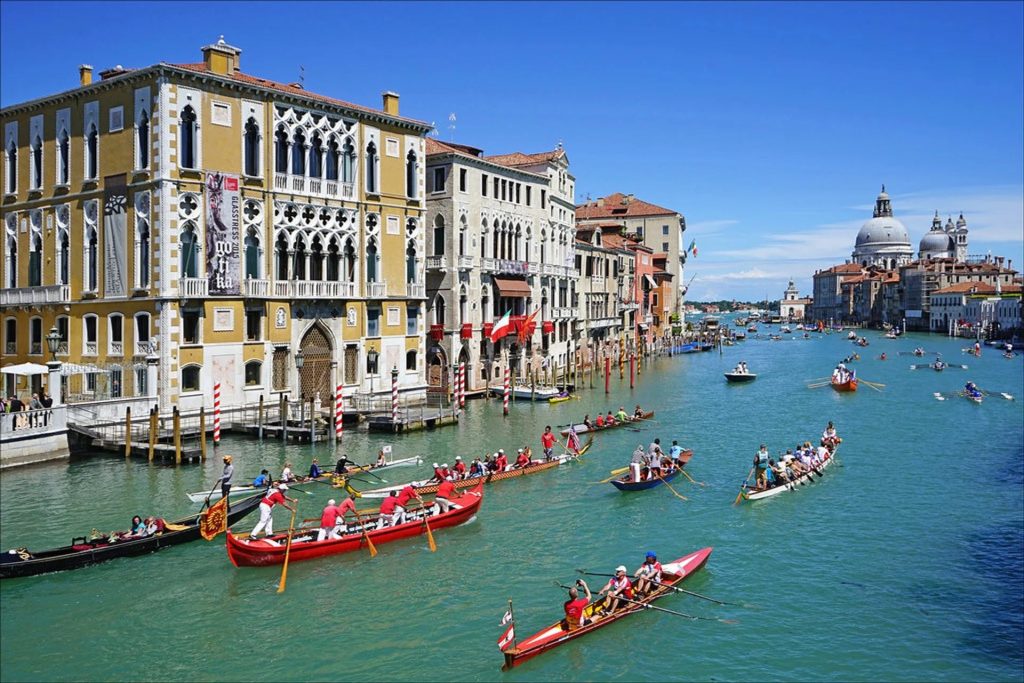


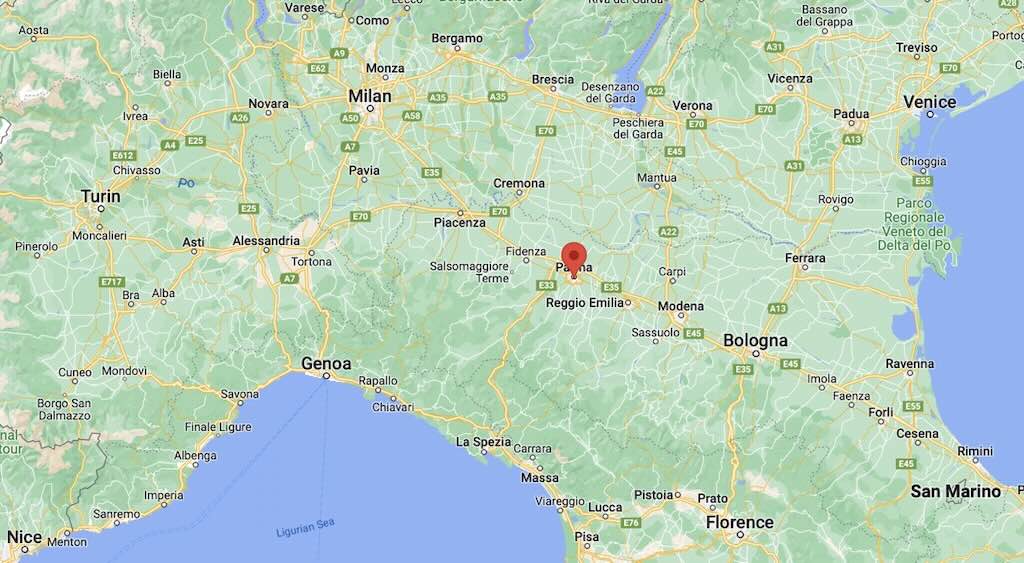

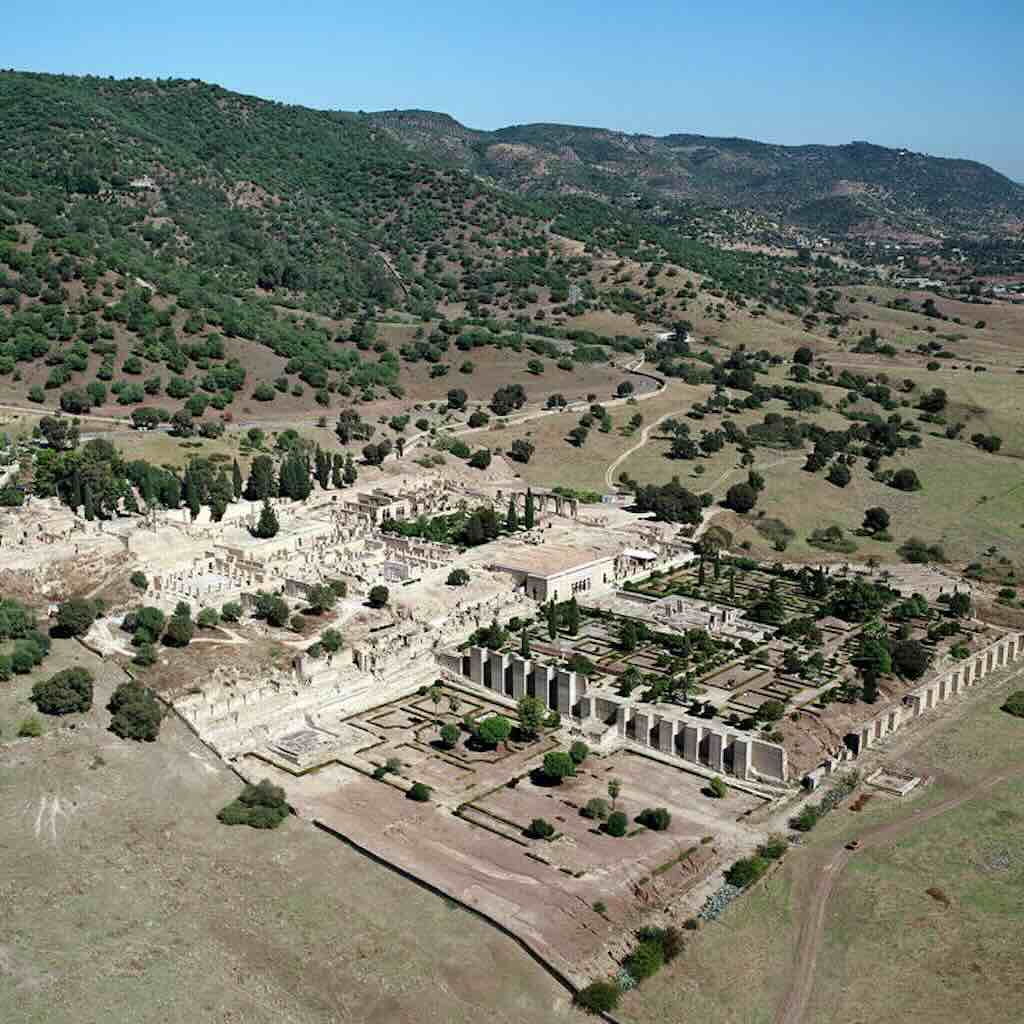
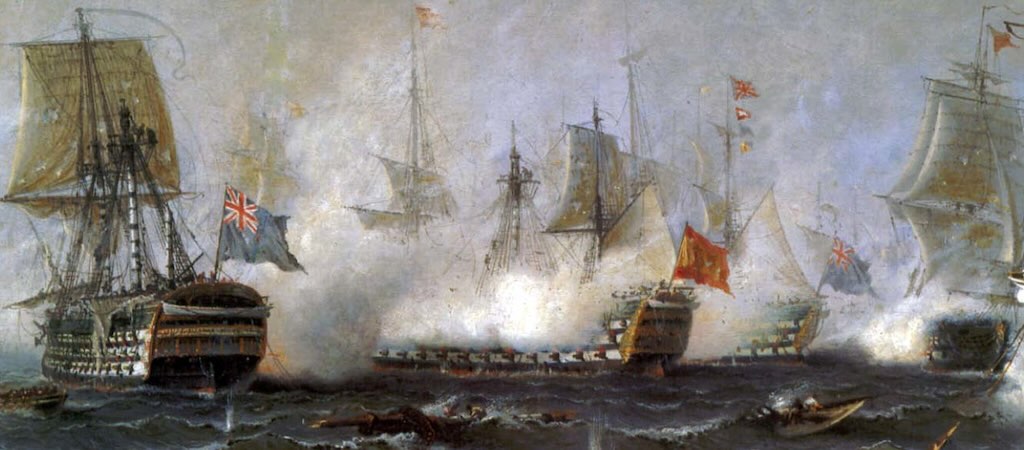


Pingback: Book Review – History of the Venetian Republic: Her Rise, Her Greatness, and Her Civilization – Part One – Geoff's Blog