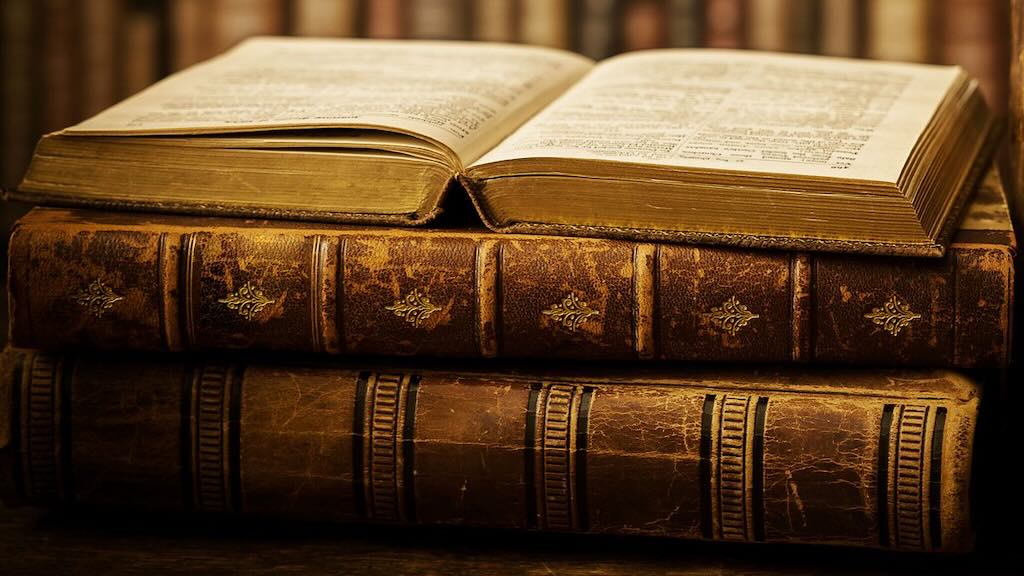
I own a copy of “A History of Physics” by Florian Cajori, which was published in 1916 (6th reprint from 1899) by The Macmillan Company (London). It looks like it was actually printed in the US by Norwood Press.
It is subtitled “in Its Elementary Branches”, and includes the “Evolution of Physical Laboratories”.
Florian Cajori (1859-1930) was a Swiss-American historian of mathematics. His 1928–1929 History of Mathematical Notations has been described even today as “unsurpassed”. The Cajori crater on the Moon was named in his honour.
This is one of the early printings of what became one of the standard English-language histories of physics before the First World War. It was later reissued again by Dover in the 20th century.
It was written at the very end of classical nineteenth-century physics, and as such describes what educated physicists believed in 1899, rather than what later historians concluded.
Th last chapter is devoted entirely to the history of physical laboratories. Today this may seem unusual, but around 1900 laboratory teaching was becoming central to university physics. Cajori explains how laboratories developed, how practical physics became part of education, the emergence of precision instruments, and why experimental work became as important as lectures.
Very few histories of physics written today devote an entire chapter to this subject.
That description is actually quite typical of a working academic book from the early twentieth century.
It has not been treated with care, but could be considered “good”. It has its original publisher’s cloth binding, which is still solid and the original sewing appears intact. It is a complete copy, and some pages remain unopened, showing that parts of the book were never read. There is some wear and damage to the spine, some staining around the binding, a few torn pages, and general evidence of use.
Cajori’s A History of Physics is a book that was printed in fairly large numbers and reprinted several times. It is sought after by historians of science, but it is not rare.
The publisher was The Macmillan Company (London), traditionally considered to be one of the “Big Five” English language publishers (along with Penguin Random House, Hachette, HarperCollins and Simon & Schuster).
Why are some pages unopened?
When books were printed around 1900, the printer produced large sheets containing several pages. These sheets were then folded into sections (called signatures) and sewn together. The outer edges were often left untrimmed, so adjacent pages remained joined along their top or fore edge.
The owner had to separate them with a paper knife before reading.
So, if some pages are still unopened, it means that those pages have never been read since the book left the printer over a century ago.
Evolution of Physical Laboratories
My plan is to read through this book, but when? I will start with the last chapter on the “Evolution of Physical Laboratories”.