I came across a little group of webpages on art appreciation. Lots to think about!
ThoughtCo. has a lot of webpages on the visual arts, art & artists, art history, and including the topic I like the most, architecture.
But what is “art appreciation”?
Wikipedia tells us that art has no generally agreed definition, but is a collection of human activities that involve a creative or imaginative talent which produces something that integrates (in differing degrees) technical proficiency, beauty, emotional power, conceptual ideas, and more…
And what about appreciation?
In the context of art it must have something to do with (subjective or) personal preferences associated with aesthetics, form (how the elements in an art work are presented or organised in contrast to its actual content), design, colours, (possibly) functionality, or even the past/present social and cultural context surrounding an “work of art”. I tend to put all this into a series of words, such as dislike, ignore (walk past without stopping and looking), like (nice feeling), impact (stop and think), etc. And there must be a series of more general thoughts, such as “this is worth keeping and curating”, “what the hell is this stupid thing doing here”, “boring”, “appreciate the technical skill involved”, “how did that survive the ravages of time”, “cool”, “elegant”, “why did the artist make that?”, “would I have in my home?”,…
I guess that to appreciate (or not) something it might start with a descriptive aspect. I suspect already this could prove quite challenging. Does the description focus on technical aspects (composition, colour theory, etc.), the subjective component (emotion, beauty, like/dislike, etc.), or the context in terms of the artists life and output? Perhaps the description should be based upon an established aesthetic theory, or maybe it’s important to known what the sociocultural context was at the time the artist was active? Does the “work of art” have a precise role, did it promote a narrative or does it “tell a story”, or is it (just) an act of self-expression?,…
Is “appreciation” just an ad-hoc mix of all the above?
Whilst Wikipedia does not provide a page on “art appreciation” there are a number of more or less tightly overlapping definitions “out there”. Below is just one example…
Art appreciation is the study and understanding of the visual arts, including painting, sculpture, architecture, and other forms of expression. It involves learning about the elements and principles of art, as well as the historical and cultural context in which works of art were created.
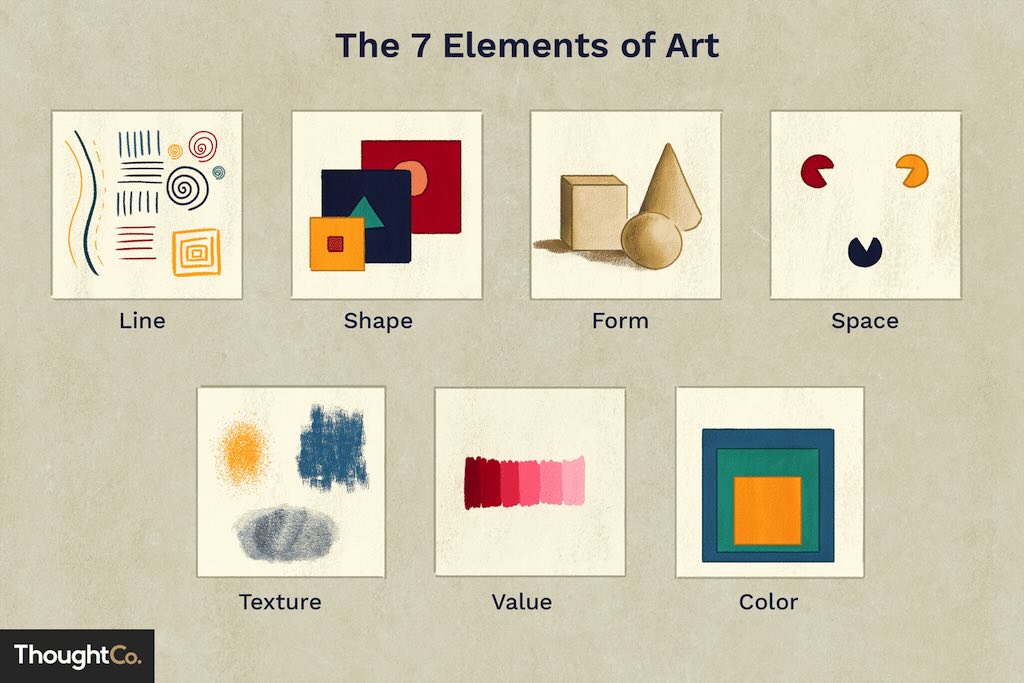
The seven Elements of Art are the building blocks, i.e. Line, Shape, Form, Space, Texture, Value and Colour.
Not quite the same thing, but this article lists 10 elements of painting. And they are:-
- Colour theory
- Tone
- Line
- Shape
- Space
- Texture
- Composition
- Direction (perspective)
- Size
- Time and Movement
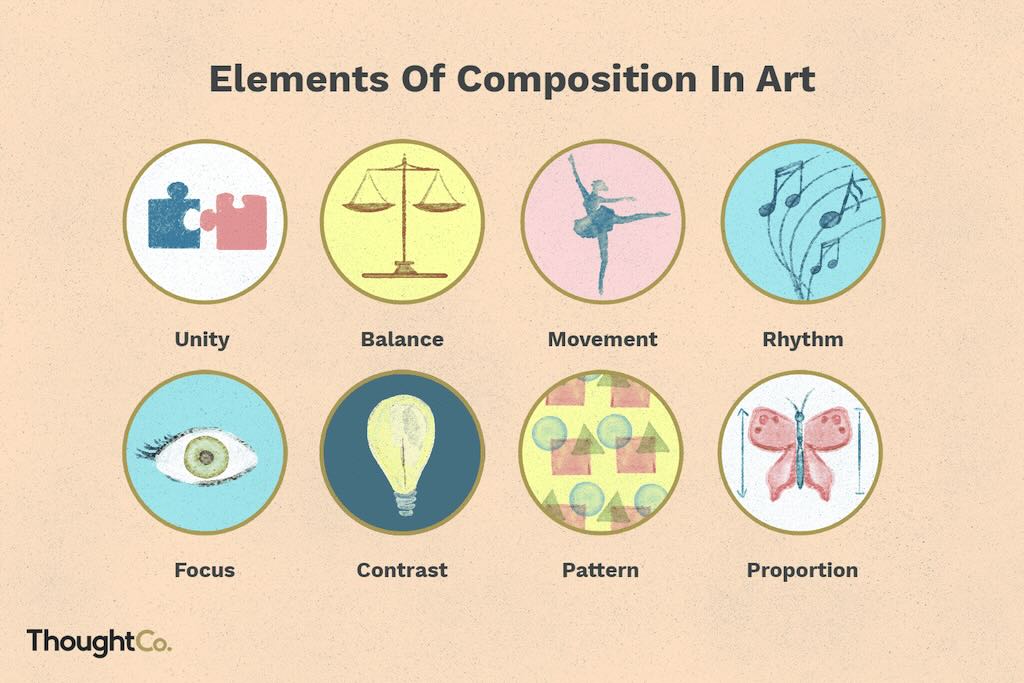
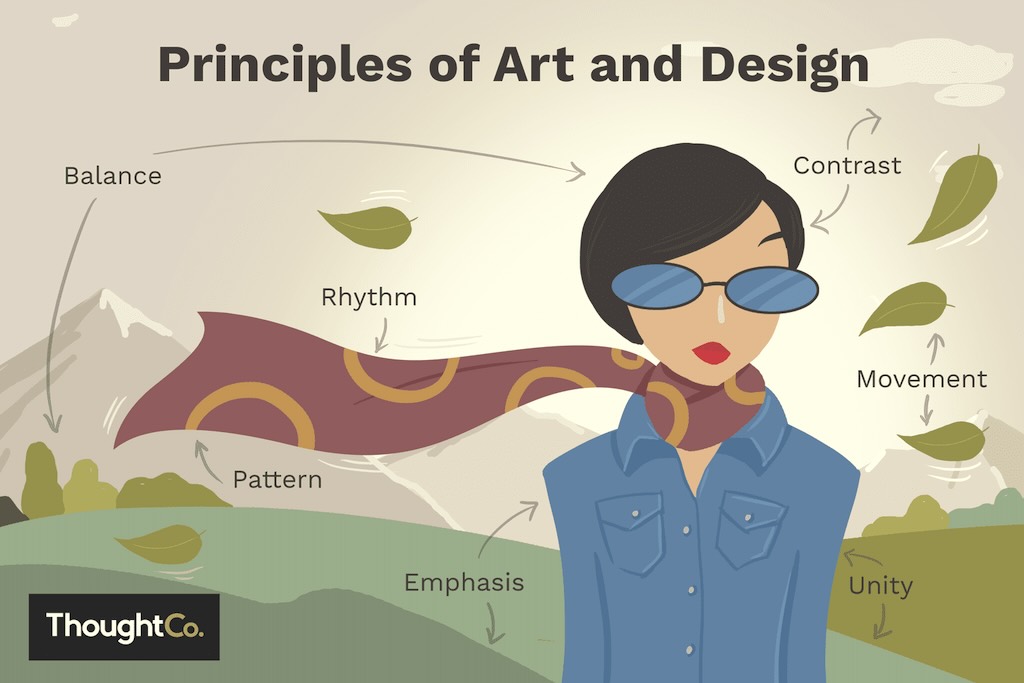
The eight Elements of Composition, are:-
- Unity: Do all the parts of the composition feel as if they belong together, or does something feel stuck on, awkwardly out of place?
- Balance: Balance is the sense that the painting “feels right” and not heavier on one side. Having a symmetrical arrangement adds a sense of calm, whereas an asymmetrical arrangement creates a more dynamic feeling. A painting that is not balanced creates a sense of unease.
- Movement: There are many ways to give a sense of movement in a painting, such as the arrangement of objects, the position of figures, the flow of a river. You can use leading lines (a photography term applicable to painting) to direct the viewer’s eye into and around the painting. Leading lines can be actual lines, such as the lines of a fence or railroad, or they can be implied lines, such as a row of trees or curve of stones or circles.
- Rhythm: In much the same way music does, a piece of art can have a rhythm or underlying beat that leads your eye to view the artwork at a certain pace. Look for the large underlying shapes (squares, triangles, etc.) and repeated colours.
- Focus (or Emphasis): The viewer’s eye ultimately wants to rest on the “most important” thing or focal point in the painting, otherwise the eye feels lost, wandering around in space.
- Contrast: Paintings with high contrast (i.e. strong differences between light and dark), have a different feel than paintings with minimal contrast in light and dark (e.g. such as in Whistler Nocturne series). In addition to light and dark, contrast can be created by differences in shape, colour, size, texture, type of line, etc.
- Pattern: A regular repetition of lines, shapes, colours, or values in a composition.
- Proportion: How things fit together and relate to each other in terms of size and scale; whether big or small, nearby or distant.