For the moment this post just logs my collection of books about the history, development and interpretation of artistic creation and material culture, from antiquity to the present, irrespective of geographical origin.
That means it covers painting, sculpture, architecture, decorative arts, furniture, ceramics, textiles, jewellery, artistic craftsmanship, historical design, manuscripts, book illustration, bookbinding and the history of artistic movements. It includes studies of individual artists, artistic schools and periods such as the Renaissance, Baroque and Impressionism.
So this includes the historical development, creation, techniques and interpretation of works of art and material objects, and the studies of artists, artistic movements, styles, workshops and the historical evolution of design.
What is excluded are political, economic and social history, geographical histories of countries and regions, everyday living conditions, customs and social practices not principally concerned with artistic production, practical manuals on crafts, decoration or restoration, and histories of science and technology not primarily concerned with art or design.
Also excluded are books principally concerned with the ownership, use, enjoyment or social significance of objects in everyday life, rather than their artistic creation and historical development.
1874 Paul Lacroix – Les Arts au Moyen Âge et à l'époque de la Renaissance
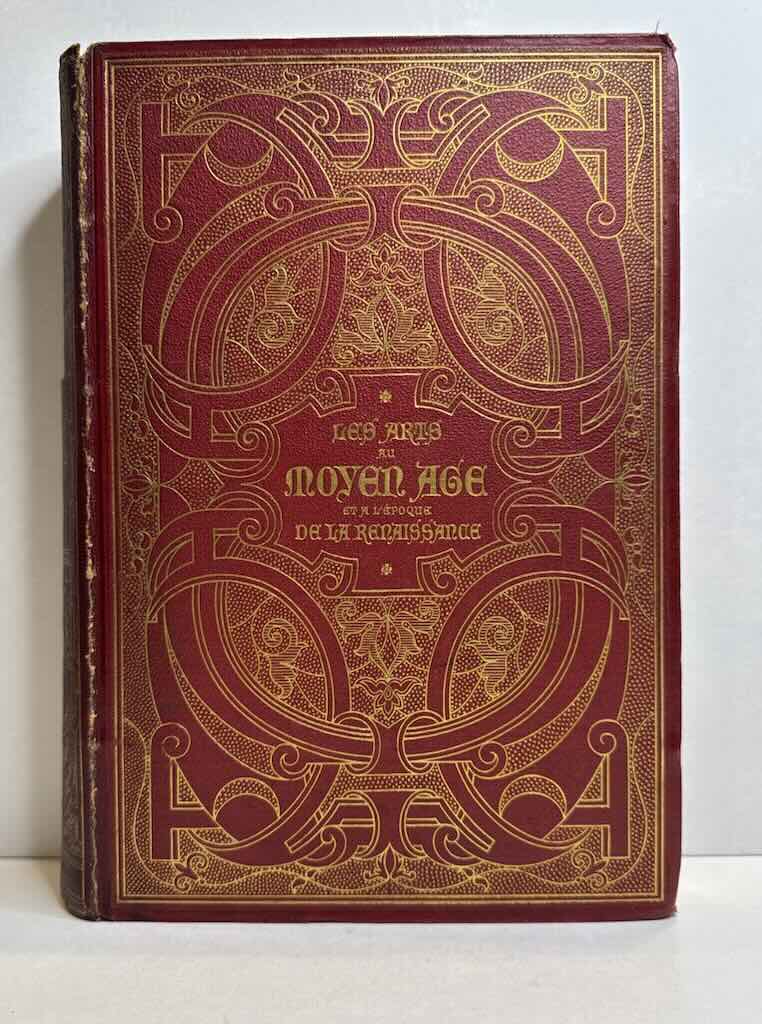
Les Arts au Moyen Âge et à l’époque de la Renaissance is one of the major illustrated historical works of Paul Lacroix, better known by his literary pseudonym Bibliophile Jacob. Published by the Parisian house of Firmin Didot, it belongs to a larger series devoted to the institutions, customs, arts and intellectual achievements of European civilisation from the Middle Ages to the 19th century.
The work is especially interesting because its conception of art is considerably broader than the modern division between fine art and applied art. Lacroix examines not only architecture, sculpture and painting, but also furniture, tapestries, ceramics, metalwork, armour, clocks, musical instruments, manuscripts, bookbinding and printing.
His subject is therefore the history of artistic production in its widest material sense, i.e. how objects were conceived, manufactured, decorated and used, and how artistic techniques developed over several centuries.
The volume deserves examination on three levels, firstly, as a study of medieval and Renaissance art, secondly, as a product of 19th-century historical scholarship, and thirdly, as a substantial achievement of illustrated book production.
Paul Lacroix and the historical culture of 19th-century France
Paul Lacroix was born in Paris on 27 February 1806 and died there in October 1884. He was a historian, novelist, bibliographer and librarian, whose exceptionally prolific career extended across literary history, the history of customs, bibliography and the study of earlier European civilisation.
His pseudonym, Bibliophile Jacob, originated in his early literary career. In 1829 he published Les Soirées de Walter Scott à Paris, introducing the fictional persona of an elderly, supposedly exceptionally learned bibliophile. The pseudonym subsequently became inseparable from his identity as a scholar and author.
Lacroix’s early historical interests were closely connected with the Romantic movement’s fascination with the Middle Ages. He frequented the literary gatherings of Charles Nodier at the Bibliothèque de l’Arsenal, where writers including Victor Hugo and Alexandre Dumas participated in the Parisian Romantic milieu.
His early career was primarily literary, with historical novels and plays. Over time, however, his activities increasingly concentrated on historical research, bibliography and the study of documents.
A decisive event occurred in 1855, when he was appointed conservator at the Bibliothèque de l’Arsenal in Paris, replacing Adam Mickiewicz. The position provided institutional stability and access to a major historical library.
The Bibliothèque nationale de France preserves a substantial Paul Lacroix archive, including manuscripts, correspondence and bibliographical material. Its institutional biography is an especially valuable source for reconstructing his career.
However, Lacroix was not an art historian in precisely the modern academic sense. His work combined documentary research, literary narrative, antiquarian scholarship and historical illustration. This combination is fundamental to understanding Les Arts au Moyen Âge.
He was interested in objects not simply as aesthetic achievements but as evidence of the civilisation that produced them. An illuminated manuscript could demonstrate the development of painting, but also the history of writing, religious practice, patronage and the manufacture of books.
Similarly, a suit of armour belonged simultaneously to the history of warfare, metalworking, decorative design and aristocratic society.
The result was a historical method in which objects and images helped explain the larger development of civilisation.
The intellectual background: the 19th-century rediscovery of the Middle Ages
To understand why Lacroix’s book was published, it is necessary to consider the changing reputation of medieval art in Europe.
During much of the 18th century, the Middle Ages were frequently contrasted unfavourably with classical antiquity and the Italian Renaissance. Gothic architecture, medieval ornament and manuscript painting did not always enjoy the artistic standing later assigned to them.
This began to change substantially in the late 18th and 19th centuries.
The Romantic movement encouraged interest in medieval literature, architecture, national traditions and historical monuments. In France, the publication of Victor Hugo’s Notre-Dame de Paris in 1831 helped bring Gothic architecture and the preservation of medieval monuments into wider public discussion.
At the institutional level, the French government established the position of Inspector General of Historical Monuments in 1830, followed by the Commission des monuments historiques in 1837.
The restoration of medieval monuments became an important cultural undertaking, associated particularly with Eugène Viollet-le-Duc (1814–1879).
Lacroix’s work developed within this environment of renewed historical interest. But his approach differed from a study devoted exclusively to Gothic architecture or monument restoration. He attempted to describe the entire artistic and material world of medieval and Renaissance Europe.
This wider perspective is one of the book’s most important characteristics.
The importance of decorative arts
The 19th century also witnessed increasing attention to the relationship between artistic design and industrial manufacture.
International exhibitions, notably London’s Great Exhibition of 1851 and the Paris exhibitions of 1855 and 1867, stimulated discussion about the quality of manufactured objects, the teaching of design and the relationship between craftsmanship and industry.
Historical examples of metalwork, ceramics, textiles, furniture and ornament became important sources for artists, manufacturers and designers.
Lacroix’s book participated in this larger cultural movement by making a wide range of historical objects accessible through illustrations and descriptive text. But it was not a technical manufacturing manual. Its purpose was historical and educational, but its subject matter overlapped considerably with contemporary interests in the decorative arts.
The organisation of Les Arts au Moyen Âge is revealing because Lacroix does not arrange the work simply as a succession of famous artists or artistic schools.
Instead, he examines major categories of objects, materials and artistic activity.
Architecture and monumental decoration
Architecture provides one of the most visible expressions of medieval and Renaissance artistic development.
The historical period covered by Lacroix encompasses Romanesque building, the development of Gothic architecture, the great cathedral-building programmes of medieval Europe and the later adoption of Renaissance architectural forms.
Churches, monasteries, palaces, castles and civic buildings required the collaboration of many crafts, e.g. masonry, sculpture, carpentry, glazing, metalworking and decorative painting.
This relationship between architecture and the other arts is essential. Medieval monumental construction was not simply the work of an architect in the modern sense. It involved networks of patrons, builders, craftsmen and workshops.
Lacroix’s broad treatment of the arts makes it possible to understand architecture as part of a larger material and artistic system.
Sculpture, painting and engraving
The chapters on sculpture and painting address the development of figurative art and decoration across the medieval and Renaissance periods.
Religious imagery occupies an important place because churches, monasteries and devotional manuscripts were major centres of artistic patronage.
Sculpture was frequently integrated into architecture, particularly through portals, capitals, tombs and monumental decoration.
Painting appeared in many different forms, e.g. wall paintings, panel paintings, manuscript miniatures and decorative objects.
The Renaissance introduced important changes in artistic theory, representation, perspective and the social standing of artists, although these developments differed substantially between regions.
The inclusion of engraving is particularly relevant to the history of artistic reproduction and the wider circulation of images.
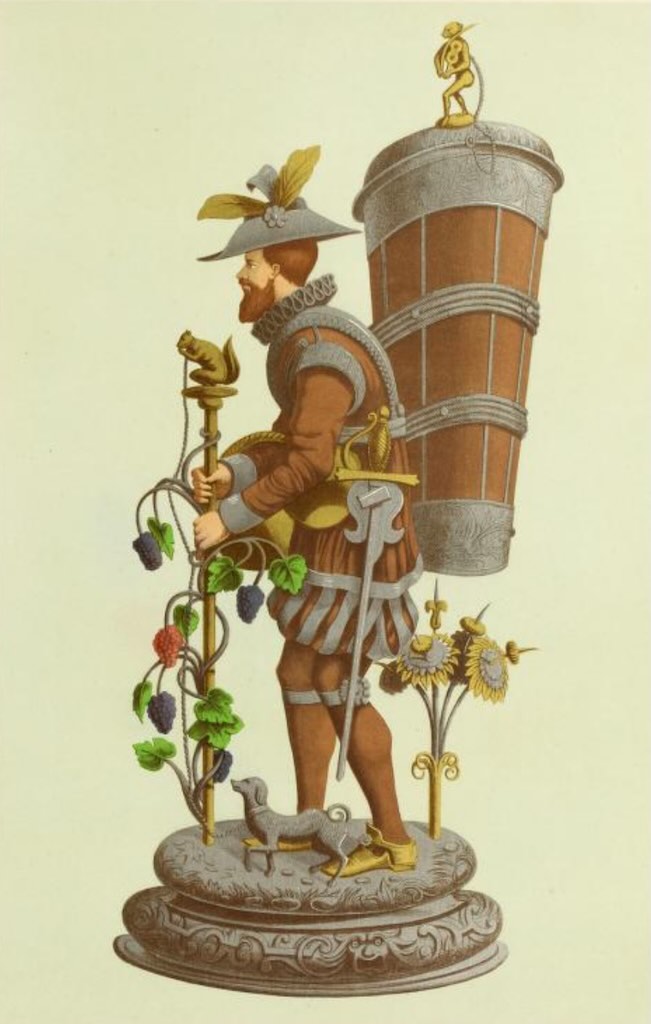
Above we have a Servant de Drageoir, which was a servant who carried a basket-like container called a drageoir. In French dining history, a drageoir was a specialised luxury vessel or box used to serve dragées (sugared almonds) and other fine table sweets at the end of a feast.
Furniture and domestic objects
Lacroix includes furniture intended for both religious and secular settings.
This subject is important because furniture provides evidence about how interiors were organised and used.
Chests, cupboards, tables, chairs, beds and ecclesiastical furnishings could serve practical purposes while also displaying elaborate carving, metal fittings and decorative painting.
Their design reflected available materials, manufacturing techniques, wealth, social status and changing habits of domestic life.
For medieval furniture, however, the surviving evidence is uneven. Objects made for wealthy institutions and individuals are disproportionately represented, while ordinary household furniture has survived much less frequently.
That limitation affects any historical reconstruction based primarily on surviving museum objects.
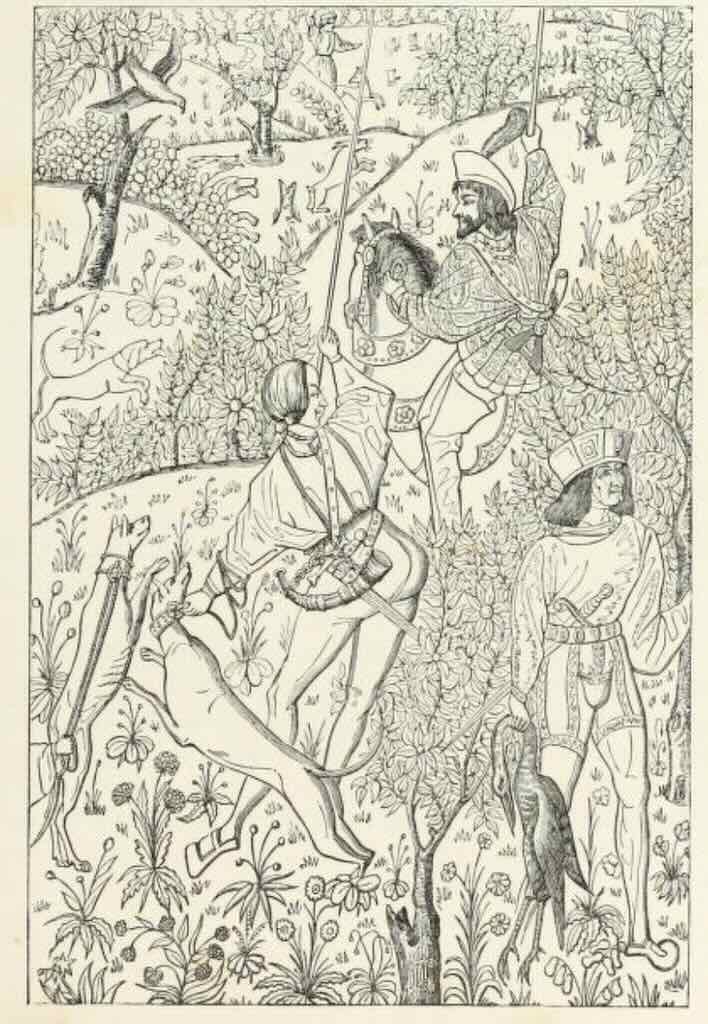
Textile production also involved extensive commercial networks, connecting raw materials, dyeing, weaving and trade.
The study of textiles therefore links artistic design with economic history and the organisation of labour.
Ceramics, glass and stained glass
Ceramics and glass demonstrate the close relationship between technological development and decorative art.
Pottery production required control of clay preparation, firing, glazing and decoration. Renaissance ceramics, particularly Italian maiolica, developed highly elaborate painted surfaces.
Stained glass was especially important in medieval religious architecture. Its production required specialised knowledge of coloured glass, cutting, leading and painted detail.
The large stained-glass programmes of Gothic churches combined architectural function, religious imagery and decorative colour.
Lacroix’s inclusion of these crafts reflects the 19th-century recognition that the history of art could not be restricted to painting on canvas or sculpture in stone.
Goldsmithing, jewellery and metalwork
Goldsmithing occupied an important position in medieval and Renaissance artistic production.
Precious-metal objects could serve religious, ceremonial, domestic and personal functions.
Reliquaries, chalices, crosses, jewellery, vessels and decorative fittings often combined several techniques, including casting, engraving, enamelling and stone setting.
Such objects were frequently commissioned by wealthy patrons or religious institutions and could embody both artistic craftsmanship and considerable intrinsic material value.
Their survival is particularly selective, since precious metals were often melted down and reused.
Armour, weapons and military equipment
The inclusion of armour may initially seem surprising in a history of art.
It is nevertheless entirely consistent with Lacroix’s conception of craftsmanship.
Armour-making required sophisticated metalworking, shaping, joining and finishing. Ceremonial and aristocratic armour could also carry elaborate etched, engraved or embossed decoration.
Weapons and military equipment therefore belonged both to the practical history of warfare and to the decorative arts.
This subject connects directly with your other Lacroix volume, Vie militaire et religieuse au Moyen Âge et à l’époque de la Renaissance.
The difference is one of emphasis. where the military volume concerns the institutions and practices of warfare, while Les Arts considers the artistic and technical production of the objects themselves.
Clocks, musical instruments and other specialised crafts
The treatment of clocks and musical instruments further extends the book beyond conventional art history.
Clockmaking combined mechanical design, metalworking and decorative craftsmanship. Medieval and Renaissance clocks were also associated with developments in the measurement and public representation of time.
Musical instruments similarly involved specialised woodworking, metalworking and decorative techniques.
These objects demonstrate how the history of technology and the history of art overlap.
Lacroix’s inclusion of playing cards is particularly revealing. Even comparatively modest printed or decorated objects could be treated as evidence of artistic techniques and historical customs.
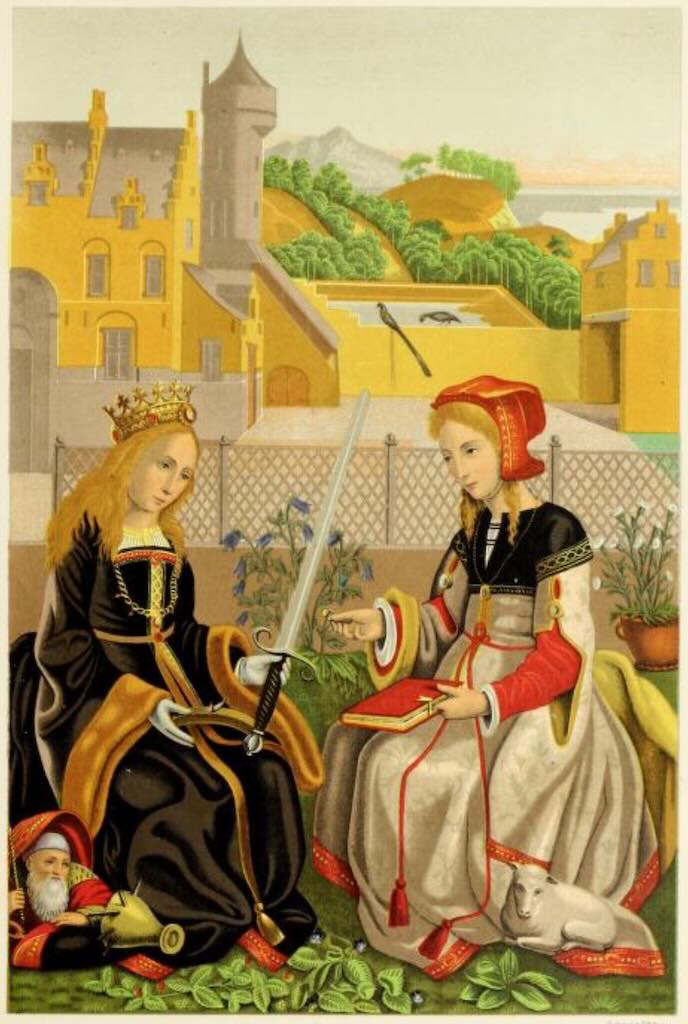
Above we have Saint Catherine of Alexandria (left) and Saint Agnes of Rome (right), two of the most celebrated female saints of medieval Christianity. They are shown together not because they knew one another, but because they shared a particular religious identity, they were both young women who, according to Christian tradition, refused to renounce their faith or their commitment to virginity, and both suffered martyrdom. The sword between them is particularly important. It is primarily the identifying attribute of Saint Catherine, who was traditionally said to have been executed by beheading.
Manuscripts, illumination, bookbinding and printing
This is perhaps the most interesting part of the work from a bibliographical perspective.
Lacroix gives considerable attention to the history of writing materials, manuscript production, illumination, binding and printing.
These subjects are closely connected but represent different stages in the history of the book.
Parchment, paper and manuscript production
Before the widespread adoption of printing in Europe, books were reproduced by hand.
Parchment, prepared from animal skin, was an important writing material throughout the medieval period. Paper gradually became increasingly significant, especially in the later Middle Ages.
Manuscript production required the preparation of writing supports, ruling, copying, decoration and binding.
The work could involve several specialists, particularly for elaborate illuminated manuscripts.
Monasteries were important centres of manuscript production, although commercial and urban workshops also became increasingly significant.
Manuscript illumination
Illumination combined writing with painted decoration, initials, borders and miniature illustrations.
The most elaborate manuscripts could be extraordinarily expensive objects, commissioned by rulers, aristocrats, wealthy merchants and religious institutions.
Books of hours became especially important examples of private devotional manuscripts during the later Middle Ages.
Their illustrations provide valuable evidence for religious imagery, costume, architecture, ornament and artistic technique.
Bookbinding
Bookbinding was both a practical craft and a decorative art.
Bindings protected manuscripts and printed books, but could also communicate wealth, institutional ownership and personal taste.
Medieval bindings included wooden boards covered with leather, while particularly luxurious examples might incorporate precious metals, enamel, ivory or other decorative materials.
During the Renaissance, leather bindings decorated with gold tooling became increasingly prominent in elite European collections.
For a modern collector of historical books, Lacroix’s discussion is especially interesting because it places binding within the longer history of artistic craftsmanship.
Printing
The introduction of European printing with movable metal type in the mid-15th century transformed book production.
Printing did not immediately eliminate manuscript production, nor did printed books instantly abandon manuscript conventions.
Early printed books often retained features familiar from manuscripts, including decorated initials, rubrication and layouts derived from scribal practice.
Woodcuts and, subsequently, other reproductive techniques enabled illustrations to circulate in much larger numbers.
Lacroix’s discussion of printing is therefore part of a broader account of how artistic production moved between manuscript craftsmanship and increasingly reproducible forms.
Kellerhoven and the production of the plates
The title page credits the chromolithographic plates to Franz Kellerhoven (1814–1872), who was a German-born illustrator and lithographer associated with Parisian illustrated publishing.
Firmin-Didot and the importance of the book as a publishing achievement
The books were designed to offer extensive historical texts together with hundreds of engravings and carefully printed colour plates. Their large quarto format provided sufficient space for substantial illustrations without requiring the exceptionally large dimensions of an atlas or folio.
The relationship between text and image
One of the notable characteristics of the series is the extensive use of wood engravings within the text.
Wood engraving was particularly suitable for illustrated books because the engraved blocks could be printed together with letterpress type.
The chromolithographs, by contrast, were produced separately and inserted into the bound volume.
This explains why the presence and completeness of the colour plates are important when assessing a surviving copy.
It also explains the book’s distinctive appearance, e.g. monochrome illustrations integrated into the historical narrative, supplemented by larger coloured reproductions.
Historical reliability and the limitations of Lacroix’s scholarship
The historical importance of Les Arts au Moyen Âge should not be confused with the reliability of every individual attribution or interpretation.
Lacroix wrote during a period when medieval and Renaissance art history was developing rapidly.
Many objects had not yet been systematically catalogued, archaeological methods were still evolving, and the dating and attribution of manuscripts, sculpture and decorative objects were often uncertain.
His book consequently requires critical reading, and three limitations are especially relevant.
First, the surviving objects available for illustration were disproportionately associated with wealthy patrons, religious institutions and important collections. Ordinary objects used by poorer members of society were less likely to survive or to attract 19th-century scholarly attention.
Second, the illustrations sometimes reproduce objects through earlier drawings or interpretations rather than direct modern photographic documentation.
Third, the book reflects 19th-century concepts of artistic progress, historical periods and national artistic traditions.
These limitations do not diminish its importance as a historical publication. They help define the appropriate way to use it.
Today the work has two complementary functions. Firstly, it provides a broad illustrated introduction to medieval and Renaissance material culture, and secondly, it documents how 19th-century scholars and collectors understood that material.
It’s useful to see this volume alongside Lacroix’s other volumes. For example, Mœurs, usages et costumes au Moyen Âge examines the organisation of social life, customs, clothing and material practices. Vie militaire et religieuse au Moyen Âge concentrates on two major institutions of medieval society, namely military organisation and religion. Les Arts au Moyen Âge examines the objects, artistic practices and craftsmanship associated with the same broad historical period.
The 18th-century volumes extend this historical approach into a later period, examining institutions, customs, literature, science and the arts.
Lacroix was not producing a continuous chronological history in the conventional sense. He was dividing the history of civilisation into complementary fields, each capable of receiving a substantial illustrated treatment.
The value of possessing several volumes is that they can be read together. A subject such as medieval armour, for example, can be approached through its manufacture and decoration in Les Arts, and through its military function in Vie militaire et religieuse.
Similarly, illuminated manuscripts can be studied as artistic objects in Les Arts, while the wider development of learning and written culture belongs to the companion Sciences et lettres.
This makes the group considerably more coherent than a miscellaneous collection of 19th-century historical books.
1925 Lacour-Bréval and Gaston Édinger – Dictionnaire pratique de céramique ancienne
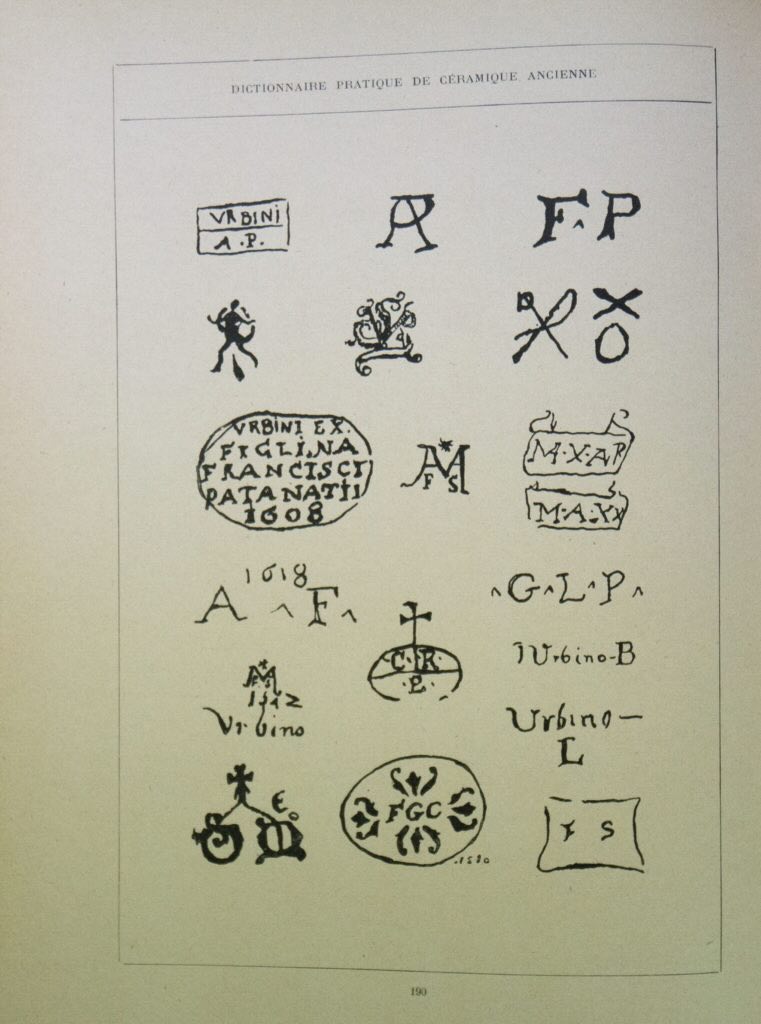
The Dictionnaire pratique de céramique ancienne of Lacour-Bréval and Gaston Édinger, was published as one volume, large quarto, by Albin Michel (Paris), a first edition in 1925. It contains numerous illustrations, principally reproductions of manufacturers’ marks, signatures and monograms.
The title page identifies Lacour-Bréval as editor-in-chief of the journal La Céramique ancienne, and Gaston Édinger as an art critic and expert. The book was intended for collectors, antiquarians, dealers and connoisseurs rather than a general history of pottery or a technical manual for ceramic manufacture.
The subject: ceramics as an historical and artistic discipline
The word céramique encompasses several distinct materials and manufacturing traditions. These include earthenware, tin-glazed faience, stoneware and porcelain, each distinguished by the composition of its ceramic body, firing conditions, porosity, surface treatment and decoration.
Their histories are closely interconnected. Techniques developed in one region were adopted, modified or imitated elsewhere, while workshops and manufactories competed in the production of objects intended for domestic use, architectural decoration, display and luxury consumption.
In Europe, particularly from the Renaissance (14th century) onwards, ceramics acquired an increasingly important position among the decorative arts. Italian maiolica, French faience, Dutch Delftware, German stoneware and European porcelain all developed distinctive artistic and technical traditions.
The distinction between ordinary utilitarian production and ceramics intended as luxury objects was never absolute. Plates, dishes, vases, jugs and drinking vessels could be practical household articles while simultaneously displaying considerable artistic refinement.
By the 19th century, historical ceramics had become a substantial field of collecting. Collectors were interested not only in the appearance of an object but also in its place of manufacture, date, attribution, rarity, provenance and market value.
This development created a need for reliable reference works capable of identifying the often complicated marks used by individual workshops, factories, decorators and craftsmen.
The Dictionnaire pratique de céramique ancienne belongs to that tradition.
The authors and the intellectual context of the publication
The collaboration between Lacour-Bréval (editor-in-chief of La Céramique ancienne) and Gaston Édinger (a critique d’art), is characteristic of a period when the boundaries between art-historical scholarship, museum expertise, antiquarian dealing and private collecting were relatively permeable.
The practical purpose of the dictionary is therefore significant. The authors attempted to organise existing knowledge in a form useful to people handling, studying or purchasing actual ceramic objects.
Purpose and methodology
The authors explain in their introduction that they did not intend to produce an exhaustive archaeological or technical treatise. Their principal objective was to identify the characteristics of individual ceramic manufactories and reproduce the marks associated with them.
The work is organised alphabetically by manufacturing centre or factory. Entries generally include geographical identification, a broad indication of the period of production, characteristic forms and decoration, and reproductions of relevant marks.
This arrangement has considerable practical advantages. A collector examining a marked plate, vase or porcelain figure can consult the relevant entry without first having to study the complete history of the region or manufacturing tradition concerned.
However, the arrangement also has limitations. The history of a major manufacturing centre may be compressed into a few lines, while questions of artistic development, ownership, technology and trade receive little attention.
Geographical coverage and the principal ceramic traditions
The dictionary covers French, Italian, German, Dutch and British production, together with manufacturing centres in Spain, Portugal, Belgium, Switzerland, Denmark, Poland, Russia and elsewhere in Europe.
French faience occupies an important place in the history of European decorative ceramics, particularly during the 17th and 18th centuries.
The dictionary includes such manufacturing centres as Rouen, Nevers, Moustiers, Strasbourg and Samadet.
Their production varied considerably in technique and decoration. Rouen developed characteristic forms of painted tin-glazed earthenware; Moustiers became particularly associated with finely painted faience; Strasbourg was important for its polychrome decoration; and Nevers developed a substantial production of decorative and utilitarian wares. Moustiers faience, associated with refined painted decoration.
The Italian entries are particularly relevant to the history of Renaissance decorative art.
Faenza, Urbino, Gubbio and Savona were important centres of production. The artistic development of Italian maiolica from the fifteenth century onwards was closely connected with Renaissance painting, the circulation of printed designs and the patronage of wealthy households and princely courts.
The term maiolica is especially associated with tin-glazed earthenware, often decorated with elaborate painted scenes. Some 16th-century Italian workshops produced istoriato wares, on which narrative compositions covered much of the ceramic surface. Gubbio lustreware, illustrating metallic lustre decoration.
Delft receives particularly extensive treatment. This is noteworthy because Dutch Delftware was extensively collected and because the identification of its marks could present considerable difficulties.
German stoneware and porcelain are also represented. The dictionary includes centres such as Grenzhausen, whose stoneware production was associated with the Westerwald region.
The contrast between the space devoted to Delft and the comparatively limited selection of marks for Sèvres and Sceaux is an indication of the dictionary’s uneven coverage. Its treatment of particular centres should not be mistaken for a reliable measure of their historical or artistic importance.
Marks, signatures and monograms: the central value of the dictionary
Furthermore, a mark does not necessarily establish authenticity. Historical marks were imitated, reused and sometimes added to objects after manufacture.
Consequently, the identification of ceramics requires comparison between the mark and the object itself: the body, glaze, firing characteristics, shape, decorative technique and stylistic period.
The dictionary provides an accessible visual record of marks as understood in 1925. Its value today lies partly in this historical documentation.
It is less satisfactory as a definitive modern attribution manual. Subsequent scholarship has corrected many traditional identifications and refined the chronology of particular factories.
The book therefore remains useful as a reference to historical attribution practices, but individual identifications should be checked against more recent specialist literature.
The unusual inclusion of monetary valuations
One of the dictionary’s most interesting features is its inclusion of approximate market prices. The authors understood that collectors were interested not only in identifying an object but also in determining its commercial value.
Examples reproduced in a specialist examination of the work include a German stoneware beer mug from Grenzhausen valued at 250 francs, a Nyon porcelain cup and saucer at 600 francs, and a fine Samadet plate at 350 francs.
The authors expressly recognised that two objects of similar shape and decoration might have very different values because of differences in glaze, colour or execution.
For the modern historian, such prices are valuable evidence of the French collecting market in the mid-1920s. Today the market for antique ceramics has changed independently of ordinary consumer prices, and the purchasing power of the French franc underwent substantial changes during the 1920s.
Position within the history of ceramic reference literature
The dictionary was published more than half a century after several major 19th-century reference works, and Lacour-Bréval and Édinger were not pioneers in the systematic reproduction of ceramic marks. Their work appeared within an already established tradition of reference literature.
Its distinctive contribution was to provide a relatively compact, accessible compilation of European manufacturing centres, their characteristics, identifying marks and approximate market values. It should therefore be regarded as a practical synthesis rather than a foundational scholarly work.
Scholarly importance and limitations
The dictionary is a record of ceramic scholarship in 1925, it documents the manufacturing centres, marks and traditional attributions familiar to French specialists of the period. It records the types of ceramics considered sufficiently important to merit inclusion, together with examples of their estimated market values. And it is a convenient alphabetical introduction to numerous European ceramic traditions.
However, the work also has substantial limitations. Its geographical coverage is deliberately restricted. Its descriptions are concise, often omitting the artistic and technological development of particular factories. Its treatment of different centres is uneven, and it lacks the depth required for detailed questions of provenance, attribution or authenticity.
A specialist review published by Le Dicopathe explicitly compares it unfavourably with the earlier dictionaries, particularly in the comprehensiveness of its documentation of marks.
Physical characteristics, edition and binding
The illustrations are primarily functional rather than decorative. This is not an illustrated art book in the tradition of large colour-plate publications devoted to porcelain or faience.
The Dictionnaire pratique de céramique ancienne is not generally treated as a major rarity in the antiquarian market.