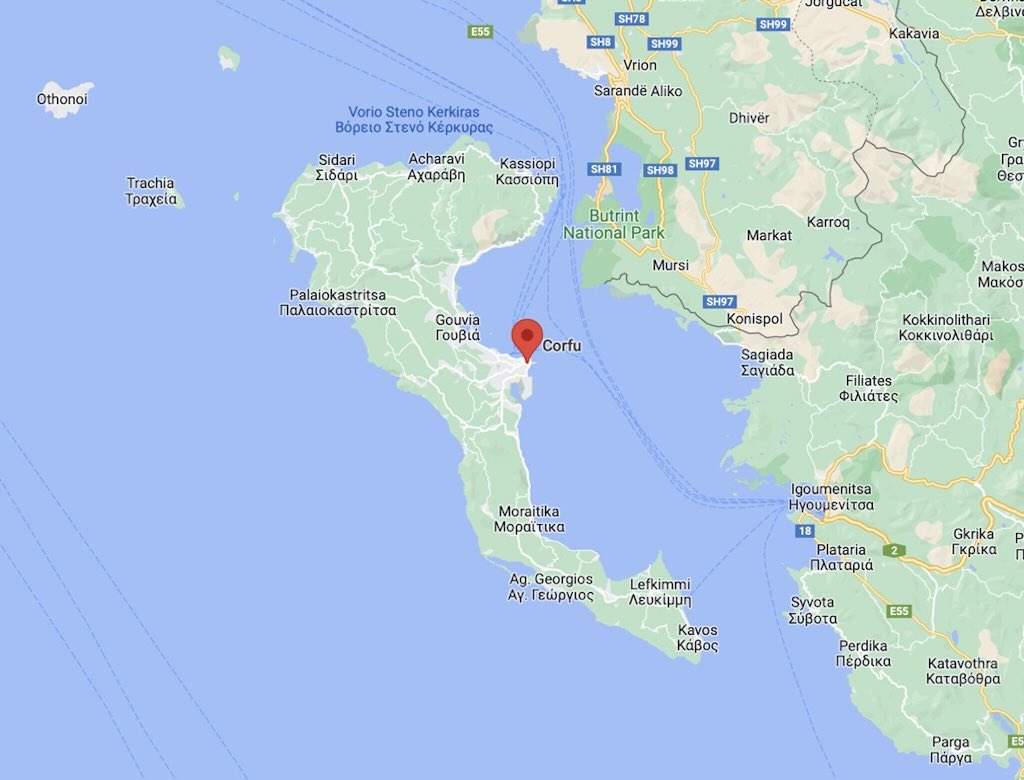
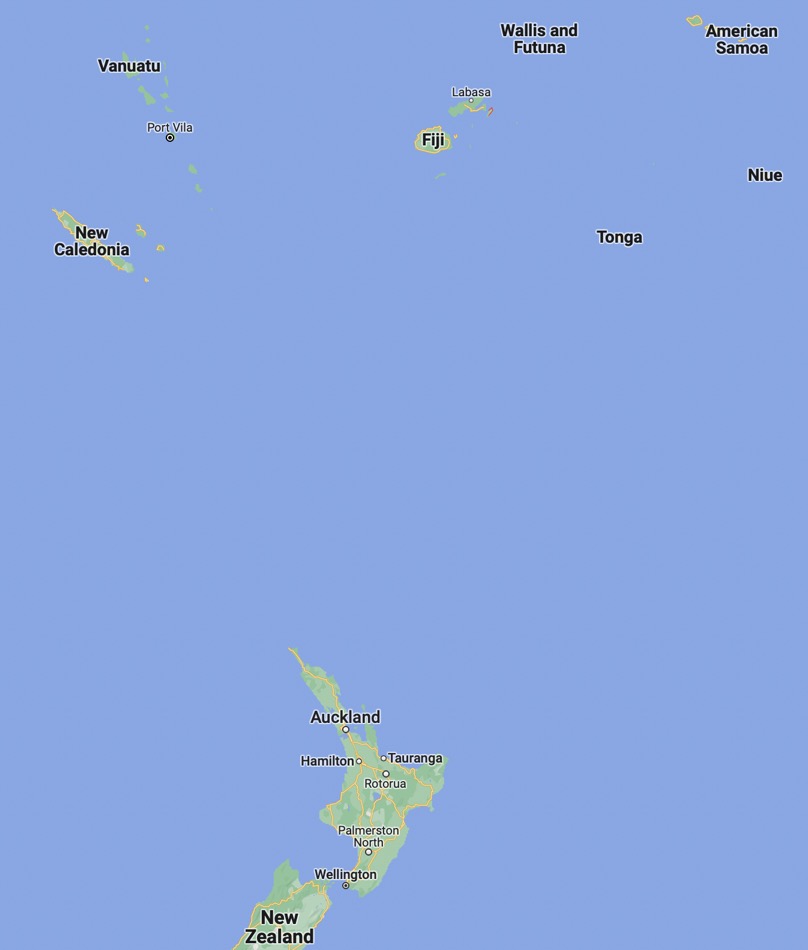
I flew into Vancouver on the 26th September 2026 from Luxembourg, via Frankfurt. I was meeting a friend and we had booked The Canadian for the 28 September 2026.
We stayed downtown for two nights at the Rosedale on Robson Suite Hotel, at 838 Hamilton Street, on the corner with Robson Street (see my hotel review).
However, we did have time to visit two famous museums…
Arrival in Vancouver
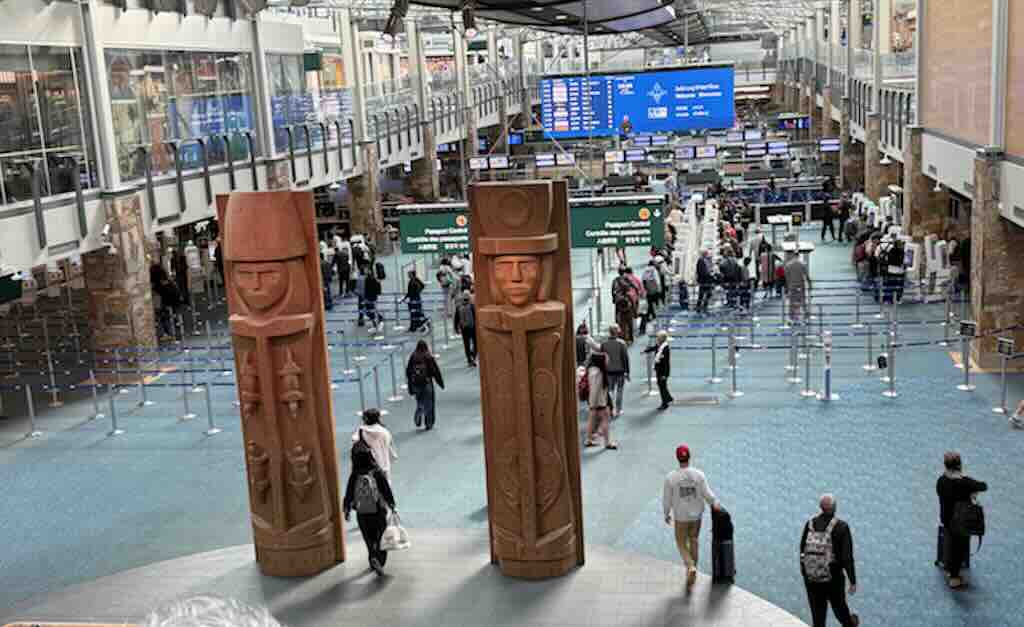
Arrival was easier enough, although a long walk to baggage claims. I then took the easy option to get to my hotel, namely a yellow cab, which has a fixed tariff for downtown of C$46 plus tip and taxes.
But first I had to get through passport control and customs…
As a Luxembourg passport holder I had already obtained a eTA or travel authorisation (cost C$7 or ≈€4.36). In applied one evening at 20:25 and I received conformation of my application, and a tracking number. At 20:28 I received confirmation that my application was complete, and no further action from me was required. At 20:30 I received approval.
The Canadian eTA is not a visa, but it authorised me, as a visa-exempt traveller, to board a flight to Canada.
My approved eTA is electronically linked to the passport I used when applying.
So the airline scans the passport and its system confirms the eTA.
It is valid for up to 5 years, or until that passport expires, whichever happens first.
I can travel to Canada repeatedly while the eTA remains valid, and it normally permits a visit (or stay) of up to 6 months on each entry, although the Canadian border officer determines the actual period of validity.
Replacing or renewing a passport invalidates eTA, which is matched to the old passport.
The eTA doesn’t technically give a right of entry. It gives permission to travel to Canada by air. The border officer still decides, and may ask the purpose and length of the visit and potentially about bookings and funds.
An eTA is required when flying into Canada, not when entering Canada by land or sea, although they still need the appropriate passport and must satisfy the normal entry requirements.
The eTA is needed to board an aircraft flying to Cananda, whereas the CBSA declaration is part of the process by which Canada decides what happens when a person actually arrives.
Arriving at Vancouver International Airport (YVR), there were two choices.
One option is to complete an Advance CBSA Declaration electronically through ArriveCAN, beginning up to 72 hours before your arrival in Canada.
Importantly, ArriveCAN is an advance declaration, not quite the final legal declaration. When arriving at Vancouver, I scanned my passport at a Primary Inspection Kiosk. The system retrieved the declaration linked to my passport. I reviewed my entries (can make changes), and then certify and submit the final declaration at the kiosk.
Had I not used ArriveCAN beforehand, I could have simply made the declaration at the airport kiosk after landing. Vancouver is one of the Canadian airports equipped with these kiosks.
The Inspection Kiosk gave me the go-ahead with a small paper receipt with a number on it. I then progressed to waiting lines, which I guess were controls and customs. There were lines for Canadian citizens, and a separate line for US and foreign passport holders. I took this second line which was empty and there was a person who simply looked at my receipt number and waved me to the baggage claim area.
It took about 15 minutes for the baggage to start arriving.
It’s important to keep the receipt from the Inspection Kiosk, although this was not mentioned, and could easily have been thrown away.
However, the receipt had to be collected when leaving the baggage claims area.
It was not difficult to find a Yellow Cab.
That evening we ate at Moltaqa Moroccan Restaurant, 1002 Mainland St, Vancouver. It was not bad, and it was crowded.
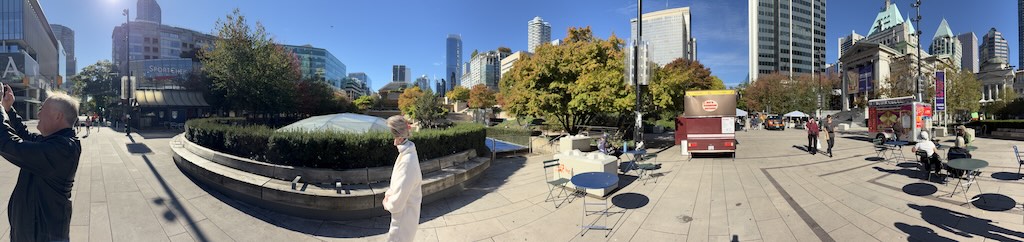
Above we have Robson Square, and we can see the Vancouver Art Gallery on the right. The low curved glass structure in the centre-left is part of the roof over the sunken Robson Square Ice Rink. The area was renovated by Arthur Erickson (1924-2009), with the landscaping by Cornelia Hahn Oberlander. Rather than putting a monumental government tower here, Erickson spread the complex horizontally over three blocks and made its roofs into a public landscape. His biographer records his idea as essentially turning the proposed government monument on its side and allowing people to walk over it.
And the large classical stone building at the right, with its columned façade and green copper roof, is the Vancouver Art Gallery.
Founded in 1931, the Vancouver Art Gallery occupies Vancouver’s former provincial courthouse, an imposing neoclassical building in the heart of downtown.
The original courthouse was designed by Francis Rattenbury (1867-1935), who also designed Victoria’s Parliament Buildings. It was again Vancouver architect Arthur Erickson who converted it into the Gallery, which opened there in October 1983.
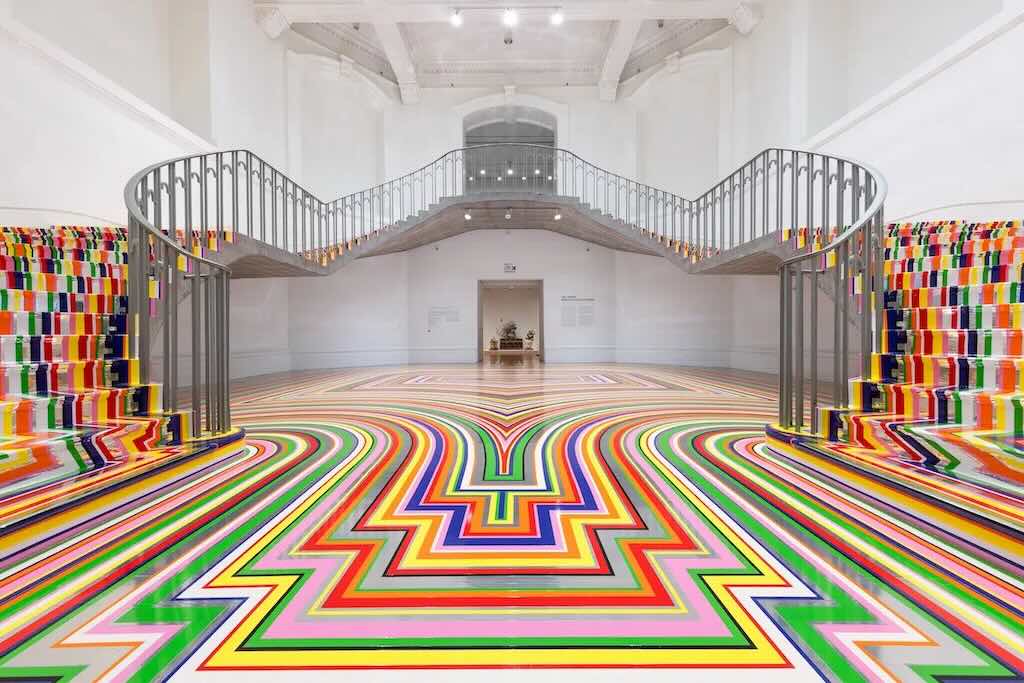
Jim Lambie: Zobop (Colour-Chrome)
It is said that Jim Lambie “transforms everyday architectural spaces into immersive, energetic experiences through his vibrant vinyl tape installations”. This site-specific stair work is an extension of his acclaimed Zobop series and uses brightly coloured strips of industrial vinyl tape to contour the shape of a staircase, wrapping its form in “optical rhythm and vivid saturation”.
Lambie is a Glasgow–based artist, DJ and musician. His practice draws from pop culture, music and Minimalism, and he often uses inexpensive, ready-made materials. In the Zobop works, which date back to the late 1990s, he meticulously applies tape in concentric patterns that respond to and amplify the geometry of the space.
Installed directly onto the stairs and floor of the Gallery’s Rotunda, Zobop (Colour-Chrome) “blurs the boundaries between sculpture, installation and drawing”, and “turns the mundane journey up or down a stairwell into a psychedelic, performative experience”.
Future Geographies: Art in the Century of Climate Change
We saw this exhibition firstly with a guided visit, before exploring ourselves the entire gallery. This also included That Green Ideal: Emily Carr and the Idea of Nature, with her views of British Columbia’s forests and landscapes.
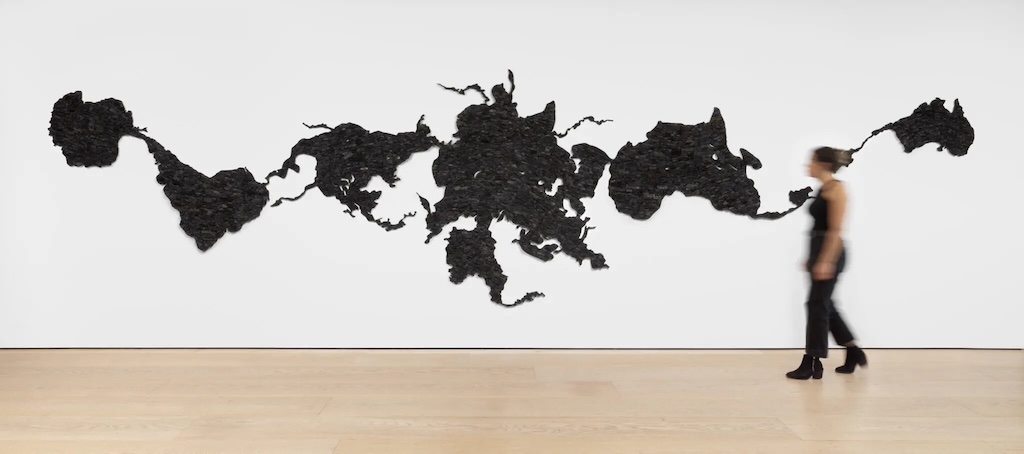
This is Island Universe 2 by Teresita Fernández (2023). This 7.70 m long set of solid charcoal pieces is a rearrangement of our continents in to a single landmass, inspired by Pangaea, when most of Earth’s continental land was assembled into one supercontinent.
She wants to stress that there is no conventional north-up/south-down hierarchy, no geography based upon power and dominance, no national frontiers. An additional hidden message is that this work is made from charcoal, once a living organic material.
Physical systems don’t respect socio-political divisions, and when everything is gone, what will be left is burnt matter.
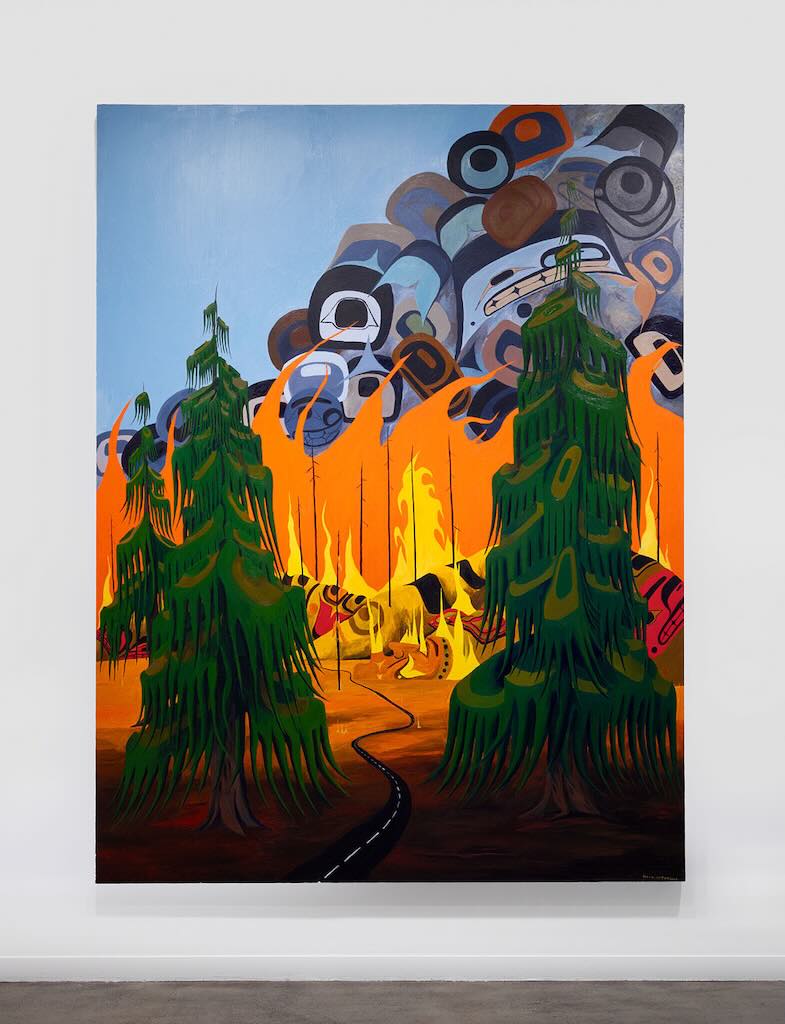
This is The Impending Fire Storms, by Lawrence Paul Yuxweluptun Lets’lo:tseltun (2024).
The artists name gives us an insight into Indigenous names. Lawrence Paul Yuxweluptun Lets’lo:tseltun was born Lawrence Paul in 1957. He is of Cowichan (Hul’q’umi’num Coast Salish) and Okanagan (Syilx) descent.
Yuxweluptun is a Coast Salish name usually translated as “man of many masks”. It was given to him when he was initiated into the Sxwaixwe Society as a teenager. So it isn’t an adopted artistic pseudonym in the ordinary Western sense, it comes from his participation in Coast Salish cultural life.
Lets’lo:tseltun is a second Indigenous name, given to him in 2018 by Stó:lō artist Laura Wee Láy Láq. It means “man of many colours”.
The painting concerns the climate crisis and the disproportionate effects of wildfires on Indigenous communities in British Columbia.
The artist uses something he calls “Ovoidism”, a rounded, swelling form derived from Northwest Coast visual traditions. The idea is that the hills, trees and sky as being animated through these forms, presenting the land itself as a living presence.
The artist uses the term history painting meaning that the destruction of the land is in itself an historic event, i.e. the landscape is one of the victims.
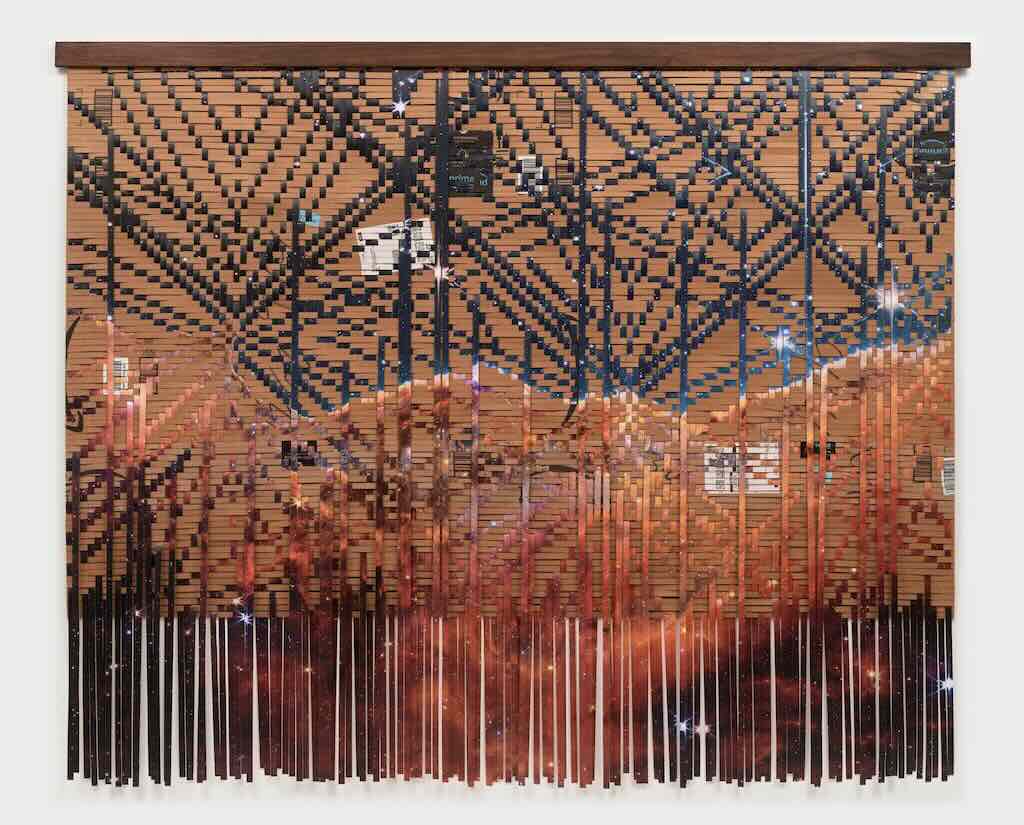
This is Cosmic Cliffs, by Clarissa Tossin (2023). This is made of Amazon delivery boxes, which symbolise excessive consumption and production, and is, in some way, a play on Amazon the forest and Amazon the e-retail store. If you look carerfully it is a weaving of cut strands from delivery boxes, still with the labels.
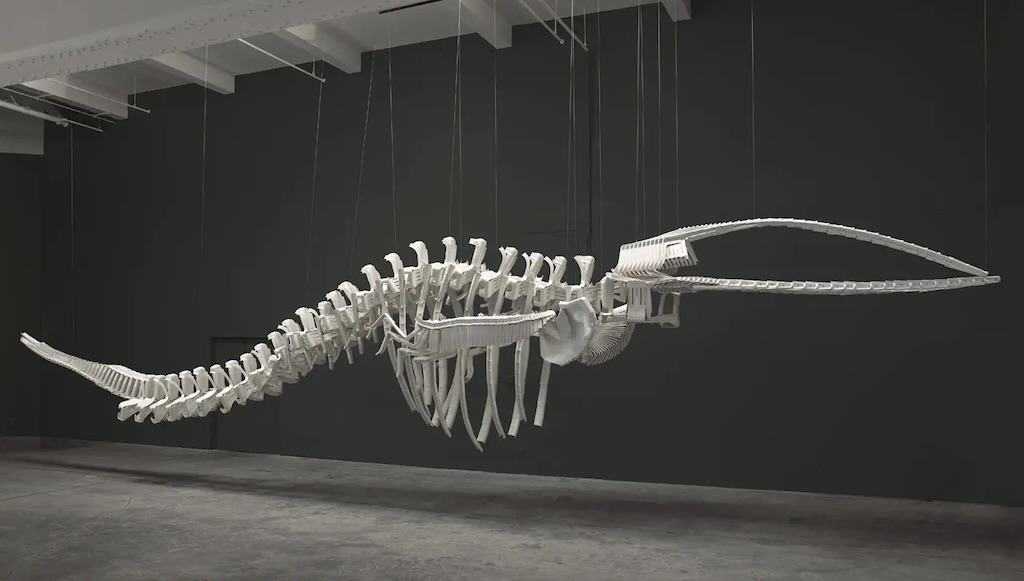
This is Cetology by Brian Jungen (2002), and is made from plastic chairs. Remember Herman Melville called Chapter 32 of Moby-Dick “Cetology”. Jungen is of Dane-zaa and Swiss ancestry, and much of his work examines the relationship between Indigenous culture and the modern consumer world.
Beyond the more obvious messages, I think it is possible that Jungen is commenting on the way a museum can make cheap plastic chairs look like an important natural or cultural specimen simply by reconstructing and displaying them. And this is what museums also do the Indigenous and natural objects, that should perhaps be left in their natural environment.
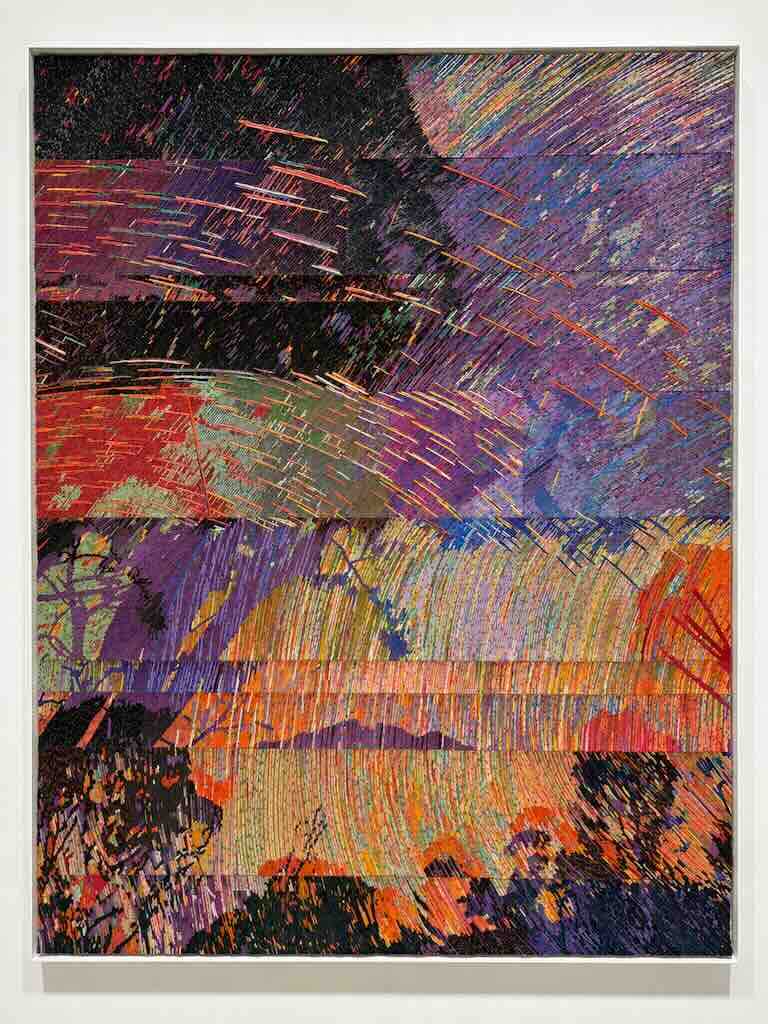
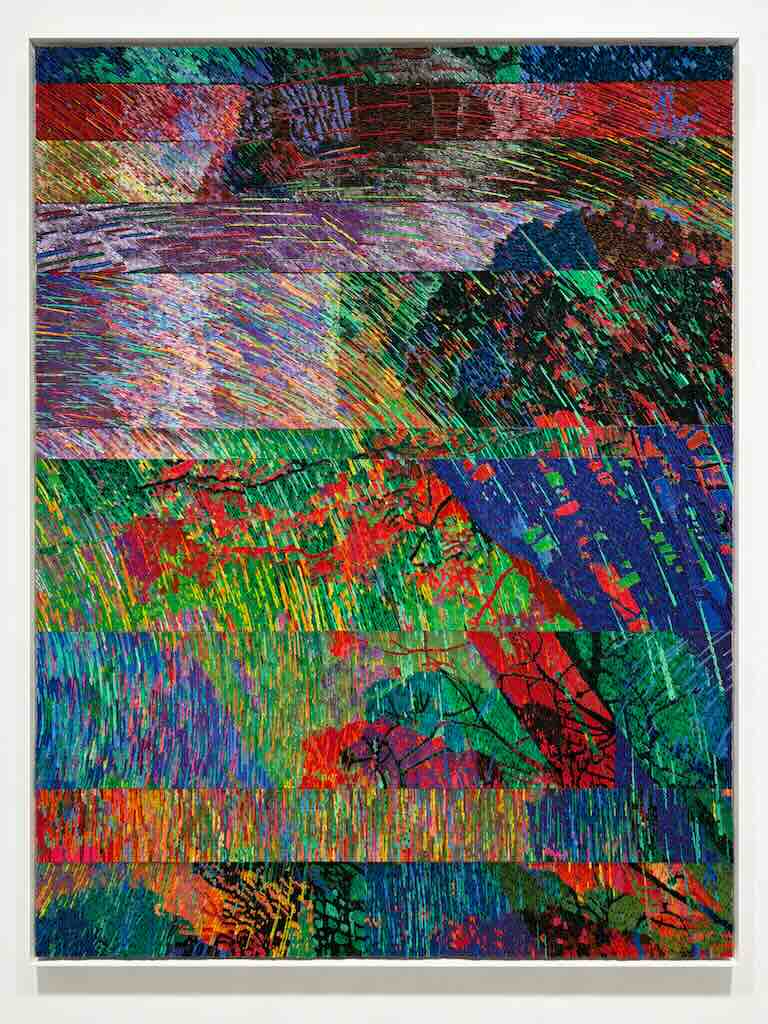
The exhibition highlighted Emily Hermant weavings, which are laboriously crafted from the wires and data cables of the technologies that envelop us. They invite viewers to move from the frenetic virtual experiences that increasingly characterise our daily lives to an unhurried and surprisingly aesthetically satisfying consideration of the material basis of that simulated world.
Above we have Illumination, 2023-24, collected and stripped telecommunications wires on canvas.
And below we have Farther From, 2026, also collected and stripped telecommunications wires on canvas.
The Museum of Anthropology at University of British Columbia (MOA) is much more than an art museum. It is a university research, teaching and conservation institution concerned with material culture. Its main aim is to study what physical objects can tell us about human societies, technologies, environments, beliefs and histories. That distinction is useful scientifically. Anthropology attempts to understand humans through evidence, and at MOA much of that evidence consists of objects, e.g. how they were made, what materials were selected, how they were used, exchanged and preserved, and what information about a society survives in them.
MOA holds nearly 50,000 ethnographic and artistic works, while UBC’s Laboratory of Archaeology houses another approximately 535,000 archaeological objects in the same building. The collections are worldwide, although MOA is particularly important for the cultures of the Northwest Coast of North America. Nearly half of MOA’s own collection comes from Asia and Oceania, and it also has substantial Arctic, Latin American and European holdings.
It’s also important to stress that contemporary anthropology is cautious about treating objects merely as specimens. MOA explicitly works with the communities whose ancestors made them, including on how objects are identified, classified, displayed and interpreted. Its Multiversity Galleries contain thousands of objects, with Indigenous and other source communities contributing their own systems of classification and knowledge rather than having everything interpreted solely through an external Western taxonomy.
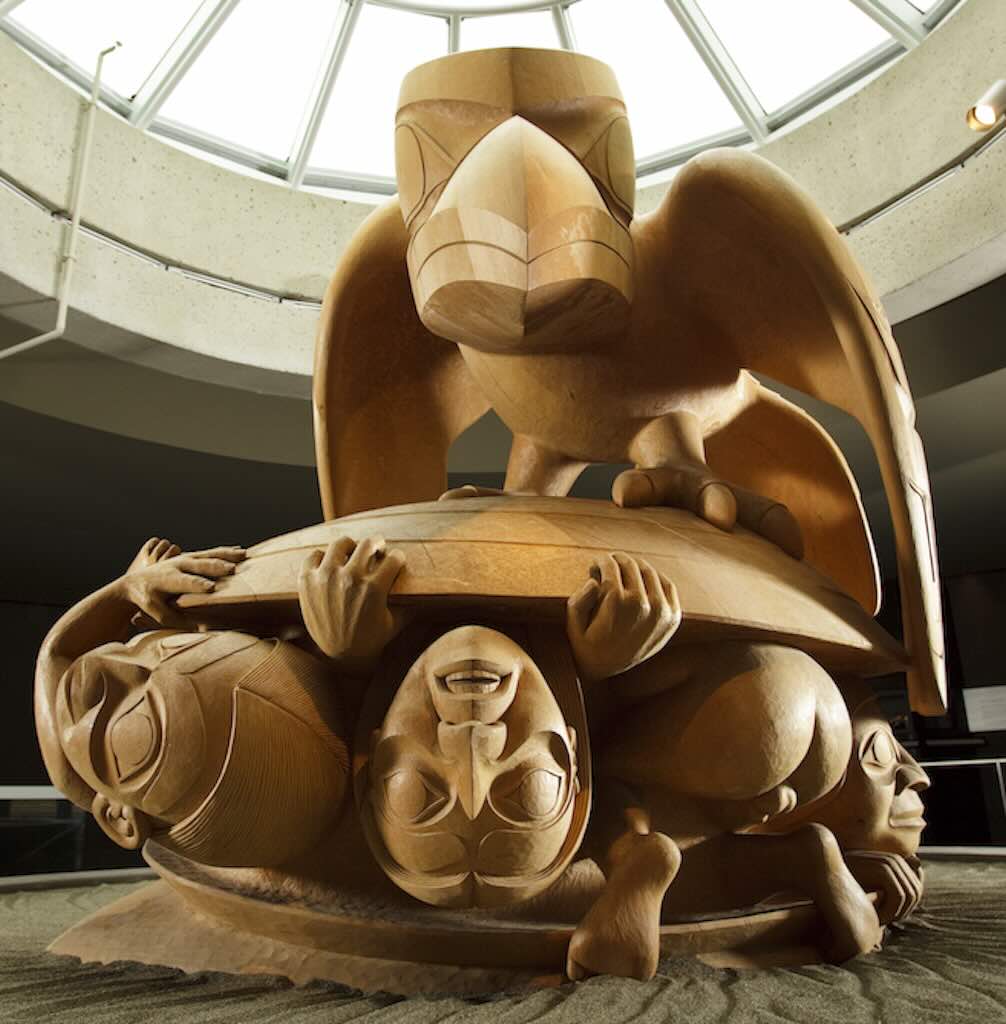
MOA is not primarily a museum of extinct or frozen cultures. So I am starting with something modern. The Raven and the First Men, by Bill Reid, is not an ancient Haida carving brought into a museum. Bill Reid completed it in 1980. Yet it provides an unusually good introduction to what MOA is. We have an ancient Haida narrative expressed through a living artistic tradition, interpreted by a modern artist and produced using both traditional carving and modern engineering. Starting here tells us not to treat Indigenous culture as something confined to the past.
This is Reid’s interpretation of a Haida origin narrative. Raven is alone on Rose Spit, Haida Gwaii, when he discovers an extraordinary clamshell. Small creatures are visible inside it. Raven coaxes them out. Initially they are hesitant, but curiosity eventually overcomes their fear. They emerge into the world and become the first Haida people.
This apparently monolithic wooden sculpture isn’t a single tree trunk, but an engineered block of 106 pieces of yellow cedar.
Totem Poles
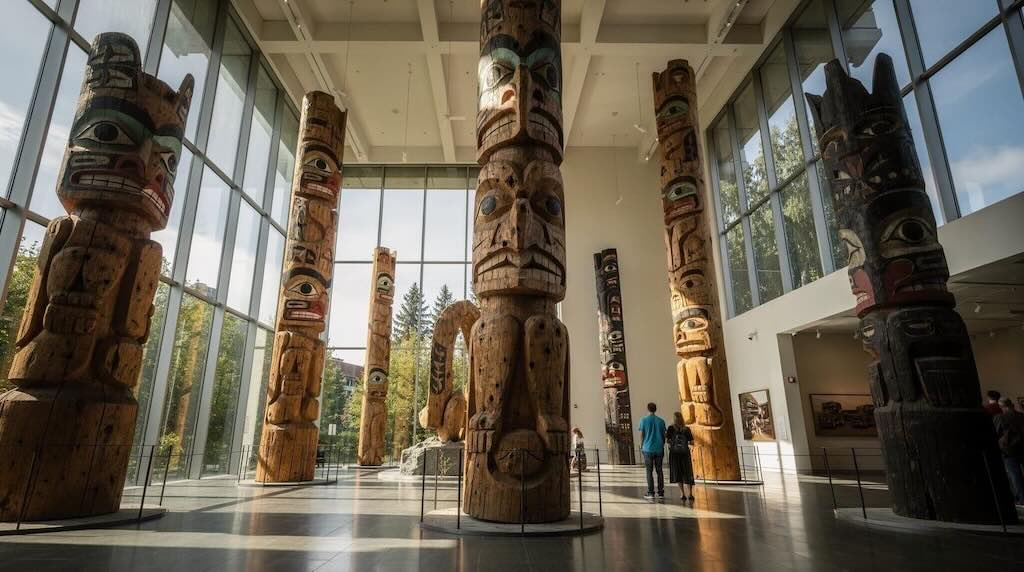
“Totem pole” is a convenient European umbrella term, not the name of one single type of Indigenous object. The monumental carved poles of the Canadian Northwest Coast had different functions. Some were house posts, which actually supported roof beams, others house-front poles, associated with the façade and sometimes incorporating the entrance. Yet others were memorial poles, commemorating people or events, or even mortuary poles, associated with the dead. MOA also distinguishes large carved welcome figures placed where visitors arriving by canoe would encounter them.
Nor should we imagine that a pole is simply an illustrated story which anyone can “read” from bottom to top. MOA stresses that the figures frequently represent crests and ancestral histories belonging to particular families. Animals such as Raven, Eagle, Bear, Beaver and supernatural beings can identify relationships, privileges and histories.
And some poles function almost as public declarations of identity and inherited rights. MOA describes poles erected by families as declarations of their ancestral heritage; house-front poles, for example, display crests belonging to the owners and thereby communicate the family’s status and affiliations.
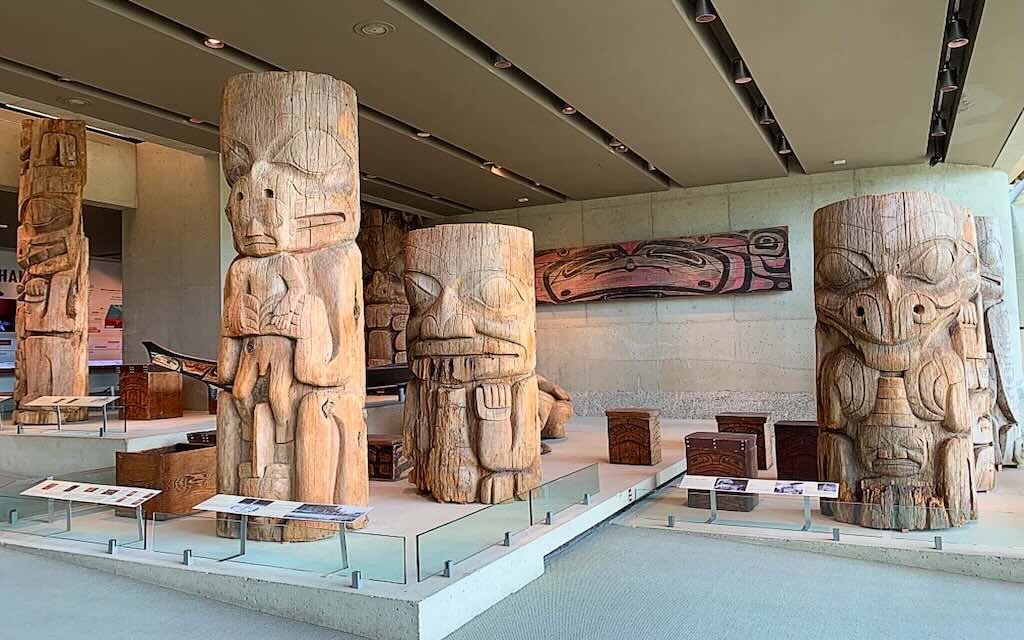
There is also a very simple reason why this extraordinary art developed on the Northwest Coast. The forests provided western red cedar, capable of producing huge, relatively straight trunks. It is comparatively light for its size, workable with carving tools, resistant to decay and can survive outdoors for generations. Poles were traditionally worked with adzes of different forms and sizes rather than being treated as pieces of joinery assembled from many small components.
I think the huge figure to the front just left of centre, with the enormous head, broad nose and small human-like body below, probably belong to one of MOA’s groups of Kwakwaka’wakw interior house posts. This was a house post, stood vertically inside a large dwelling and supported a major horizontal roof beam. The carved beings proclaimed histories and privileges which the family occupying the house had the right to display.
The shorter massive post immediately to its right is another architectural carving. The huge head, projecting eyes and nose, compressed body are deliberate. Northwest Coast monumental carving had to remain visually intelligible when incorporated into a building and seen from some distance.
At the far right, the monumental post represents a supernatural being rather than portraits of individual humans (e.g. a face does not always mean a chief or ancestor.
Thunderbird and Monumental Carved Figures
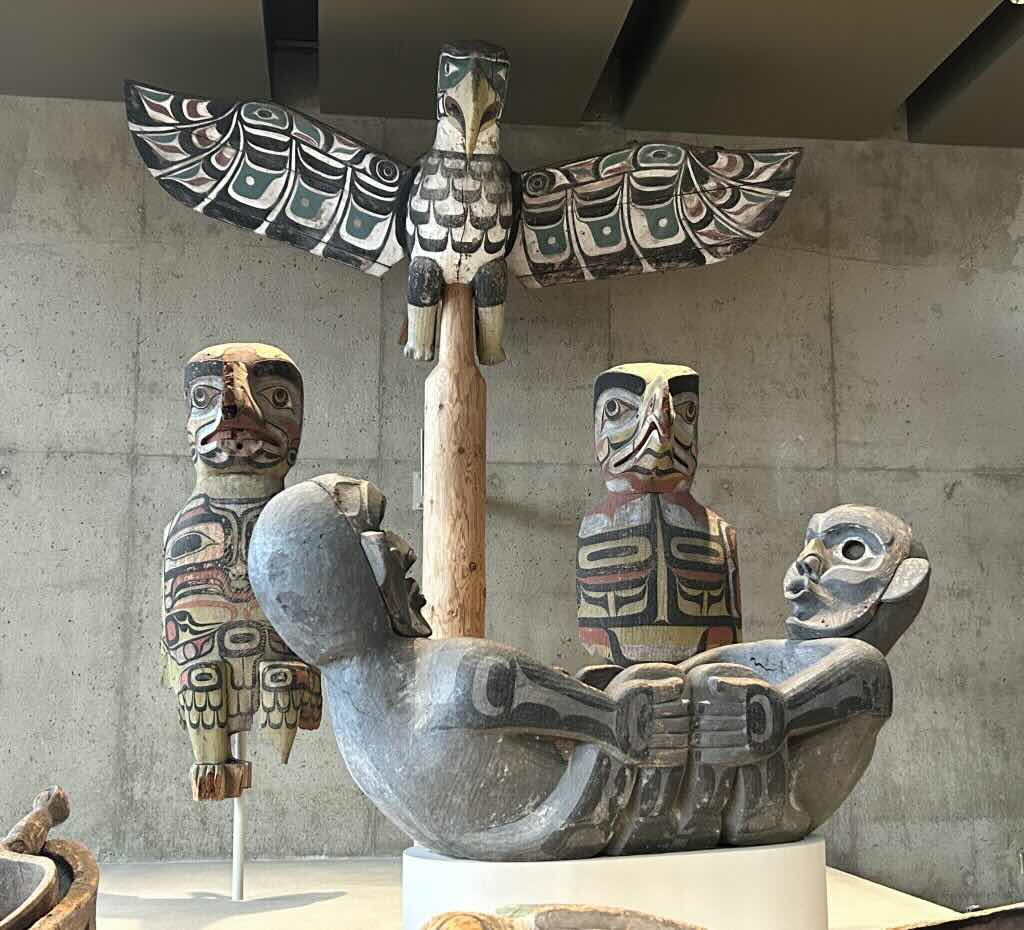
MOA identifies this type of supernatural bird as Thunderbird, recognisable in Northwest Coast carving by characteristic features including the powerful recurved beak and, in many representations, horn- or ear-like projections on the head. Thunderbird is a supernatural being rather than a representation of an ordinary eagle or other natural bird.
The Sea-Lion House Frame
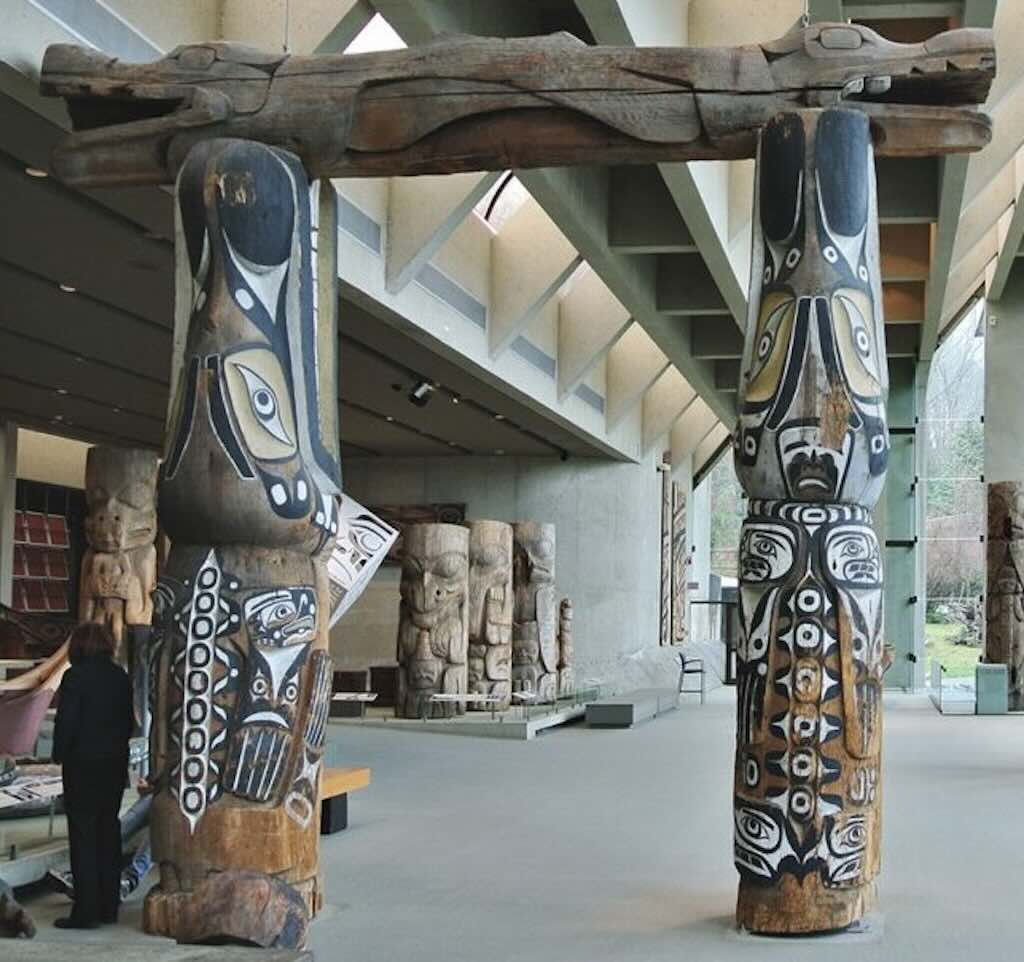
This is part of the monumental interior framework of Klix’ken Gukwdzi, or the Sea-Lion House, a Kwakwaka’wakw house at Xwatis (Quatsino), northern Vancouver Island. It was commissioned by Tza’kyius around 1906. MOA describes it as the last old-style dwelling erected at Xwatis for an extended family or lineage, and probably one of the last of its kind constructed on the Northwest Coast.
The two enormous vertical carvings and the horizontal member above them formed an actual structural house frame. The two upright figures are supernatural sea lions. Within the front flippers of each sea lion is an eagle shown in profile. The horizontal carving across the top represents a “supernatural double-headed sea lion”. MOA explains that supernatural beings represented on house frames were beings that the family occupying the house possessed the right, through its history and origins, to represent. In other words, the imagery proclaimed identity, history and inherited privileges.
Chiefly House Post and Slave-Supported Seat
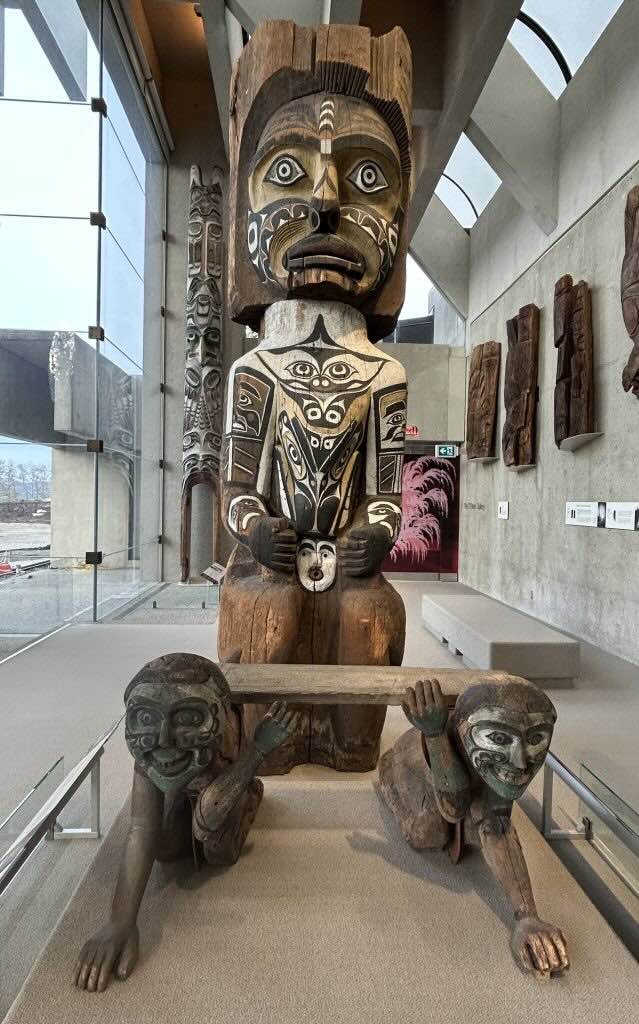
This cedar group was carved by George Nelson, a Kwakwaka’wakw artist, also for Klix’ken Gukwdzi, the Sea-Lion House at Xwatis (Quatsino). It therefore belongs to exactly the same original house as the two sea-lion posts and five-metre double-headed sea-lion crossbeam in the previous photograph.
The central figure is a seated human figure, carved in high relief from cedar. Its disproportionately large head has projecting eyes, nose and mouth and is extensively painted in black, white and yellow Northwest Coast designs.
The large symmetrical design on the chest is identified as a killer whale. On each arm are representations of broken coppers. A copper was a shaped sheet of copper possessing exceptional value and status in Northwest Coast societies. Breaking a valuable copper could itself constitute a conspicuous demonstration of wealth and rank. MOA consequently lists both killer whale and people among the subjects represented on this object.
The two crouching human figures are supporting a wooden platform or seat on their backs. MOA identifies them explicitly as representations of slaves. Each is down on one knee and one hand; the other arm is turned backwards to help support the seat. Their exaggerated grimacing faces and exposed teeth are deliberately carved, and traces of green, black and white paint survive.
Slavery really existed among Northwest Coast societies. MOA describes slaves in its catalogue as captured members of other Northwest Coast groups. Their representation beneath the seat therefore formed part of the visual language of status and power embodied by the house.