The last time I visited Villa Vauban was in 2023, and now (Feb. 2026) it’s time to see what has changed.
Not much had changed, despite the temporary exhibition “Art luxembourgeois du 20e siècle” and a mini-showing of a few painting on “Les plaisirs de la glace“, Paysages néerlandais, 17e-19e siècles.
And on a rainy Thursday morning, I saw three other visitors during about 1 hour.
Daphnis and Chloe - Allegory of Hunting and Fishing
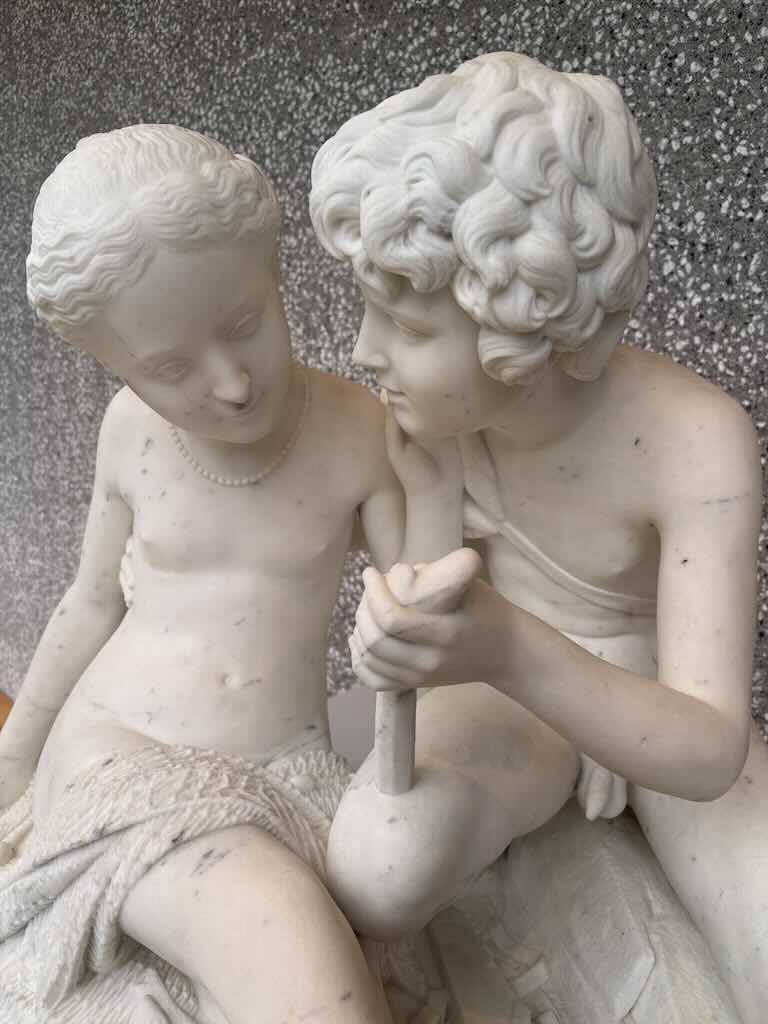
The first thing I spotted in the permanent collection was a smallish marble statue of Daphnis and Chloe, subtitled “Allegory of Hunting and Fishing”. What was nice about it was (despite the rain and grey sky) the bright natural light on fresh white marble, that really made a pleasant start to the visit.
This is by the Swiss sculptor Jean-Élie Chaponnière (1801-1835), who I would place as a Romanticists.
Apparently Daphnis and Chloe is a Greek pastoral novel written during the Roman Empire, the only known work of second-century Hellenistic romance writer Longus.
The whole novel is a kind coming-of-age through innocence. It’s set in an idealised countryside world (lots of flutes, caves, springs, well-washed shepherds, etc.), with city life hovering in the background as something more complicated and corrupt.
The story goes …
Daphnis and Chloe two infants, each abandoned at birth but left with identifying tokens that will later reveal their true origins. Daphnis is discovered by a goatherd named Lamon, while Chloe is found by a shepherd, Dryas. Both men choose to raise the children as their own.
Growing up together in the countryside, Daphnis and Chloe spend their days tending flocks and living within the simplicity of pastoral life. As they reach adolescence, they fall in love, though their innocence leaves them unable to understand the nature of their feelings. A wise old cowherd, Philetas, explains to them that what they are experiencing is love, and suggests that kissing is the only remedy. They follow his advice, though this provides only partial relief.
Later, Daphnis is initiated more fully into sexual knowledge by Lycaenion, a worldly woman from the city. Yet he refuses to act on this experience with Chloe, warned that Chloe’s innocence would make the act frightening and painful for her. Throughout the narrative, Chloe is pursued by suitors, and more than once becomes the target of abduction. She is even carried off by raiders from a nearby city, only to be rescued through the intervention of the god Pan.
Meanwhile, Daphnis himself suffers a series of dangers and humiliations: he is beaten, abducted by pirates, and narrowly escapes sexual violence. These trials form a sharp contrast to the novel’s idyllic rural setting.
In the end, both lovers are recognised by their birth parents through the tokens left with them as infants. Their true identities restored, Daphnis and Chloe are able to marry, and they choose to remain in the countryside, living out their lives within the pastoral world that shaped them.
Le Canal Grande vu du Campo San Vio by Le Canaletto
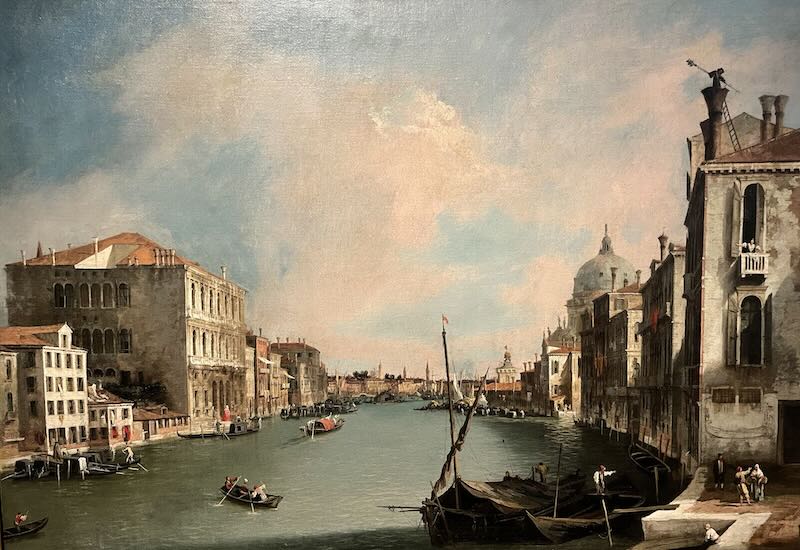
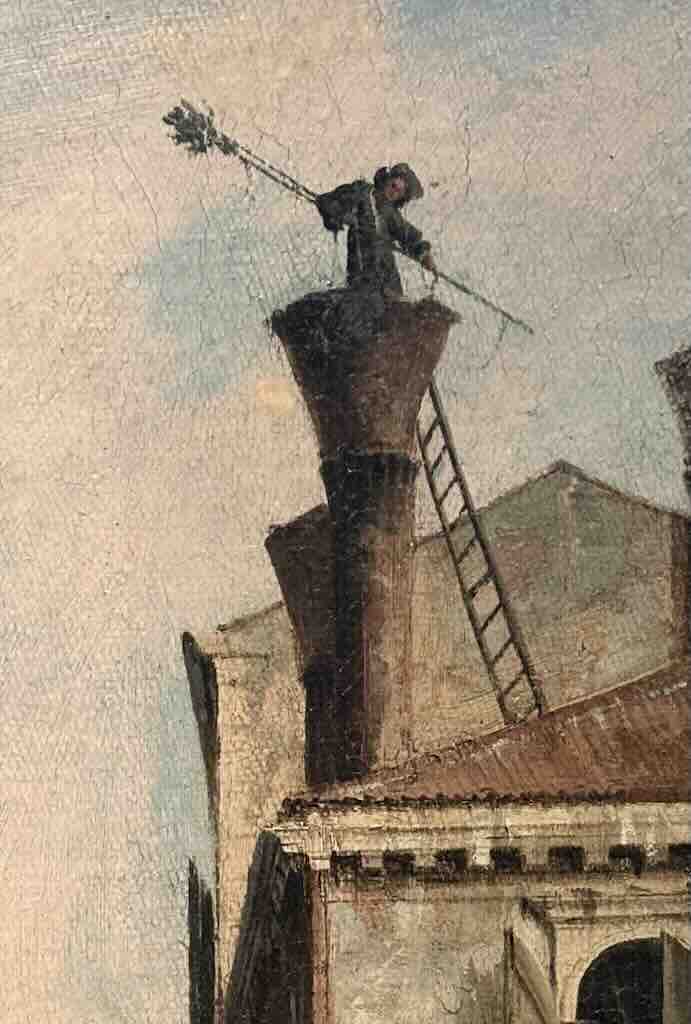
In my last visit I mentioned Canaletto, and “Le Canal Grande vu du Campo San Vio“.
This time I focussed on one small part of the painting, the chimney pots, and the chimney sweep (scoacamini in the local dialect). You can see that the pots are a very particular shape. The truncated cone was historically popular, as it allowed any sparks from wood burning fires, to fall back into the chimney breast. Fires were a major threat in Venice, especially when buildings were made of timber. You can just see that this was also ventilated. The hot air from the fire moved up into the terminal pot, and it pulled in cooler outside air from the ventilation holes (normally situated at the base or in the lower side walls). Any sparks would be rapidly cooled and extinguished.
In fact, medieval building tradition had developed the spectacular inverted bell-shaped chimney. They were very tall, often well above the ridge of the roofs, and functioned very well, thanks to the bell-shaped screen for extinguishing the sparks and for dispersing the smoke. It would appear that chimneys above the roofs were a “custom of Italy”, and some chimneys were called exceptional and spectacular, or even “scary”.
What happened when people from Rome started to take up residence in Venice, they removed chimneys from the front façade and placed them on side walls. Hiding the chimney inside a thicker wall became know as the “Roman style”, and half-protruding was “mezo Padiglione“. Those built outside of the walls were called Padiglione and French.
It’s my understanding that even as early as the late-1500s some of these chimney stacks on the front façade were replaced by very visible stone obelisk-like chimney structures, some as high as 7-8 metres (e.g. a painting by Veronese shows very distinct obelisks, dated to 1571). There are numerous 18th century paintings that also show roof-façade obelisks, although they were also called pinnacles, sometimes spires, or just cuspidi (and some texts just called them ornamental features). They were quite distinct constructions composed of a pedestal, four spheres on which the pyramidal body rested, and a sphere at the top. However they were also very functional. The “hollow inside” was lighter and served as a space for extinguishing the sparks, while the smoke escaped between the pedestal and the obelisk, through the space left open between the four spheres.
Despite this success, by the early 18th century, with the possible exception of a few villas on the mainland, obelisk-shaped chimneys were no longer being built in Venice. It’s not that they had gone out of fashion, or that they didn’t work well. The problem was that on the taller buildings in Venice obelisks topped with a sphere and metal spike, inevitably attracted lightning much more than any other roof structure. Only following Benjamin Franklin’s studies on atmospheric electric discharges in the mid-18th century, the obelisks still standing became valid support for lightning rods.
Between the last decades of the 19th century and the first decades of the 20th century, fireplaces were generally replaced by modern radiator heating systems. And fireplaces were reduced to niches to house radiators, and consequently the flues were closed. Some obelisks were rebuilt, but without the smoke vents.
Over time, the memory of the obelisks’ true function was also lost, and symbolic interpretations began to emerge. One widespread belief was that the obelisks were the distinctive sign of naval captains. There was even the belief that only families who had one or more members awarded the title of sea captain could display obelisks. This may be linked to the fact in the second half of the 17th century, obelisk’s appeared on funerary monument, copying an older tradition from the 1500s that obelisks were placed on the graves of naval captains. It’s said that the obelisk on roofs was a tradition from the 1500s, and represented the ancient tradition of corner pillars (even if chimneys are not in corners).
All this led, during any architectural renovation/restoration, to the removal of the flue and fireplace, so many houses were just left with their obelisks.
According to one report there were 80 chimney sweeps in Venice in 1661, coming from the Brembana Valley, Savoy, and Val Camonica. They lived in Calle “dei Scoacamini“, near St. Mark’s. They were generally small, black with soot, and carried their work tools on their shoulders (a ladder, a black rope,
a bundle of “pungitopo” and a weight.
Pungitopo is the Italian name for the plant butcher’s broom (Ruscus aculeatus). It literal meaning “mouse-pricker”, or a prickly shrub whose stiff leaves/spines were thought to keep mice away (remember rodents in roofs were a real Venetian problem).
I wonder what life must have been like as a chimney sweep. Even in the early 20th century chimney sweeps weren’t paid. They could have the soot to sell as fertiliser (soot from the factories was worth very little because it was too burnt).
Série de scènes érotiques

There was a temporary exhibition of 20th century Luxembourg artists. The above “mixed technique on paper” by Wil Lofy (1937-2021) was one of a series entitled “Série de scènes érotiques“.
I don’t know much about Wil Lofy, but I have seen one of his bronzes, which I found well executed.
I was unimpressed by the exhibition, but the crown in this particular work reminded me of an Englishman “formally known as a Prince”.