With English I I looked at the English alphabet and vocabulary, before moving on to abbreviations and synonyms. And we started with the question “What is language?”.
In this post I will try to discover why we write the way we do.
Who Invented Writing First?
Based on the current archaeological consensus, the first surviving evidence points to:-
- Sumer (southern Mesopotamia, modern Iraq) – the earliest widely accepted evidence for true writing is proto-cuneiform, emerging around late 4th millennium BC. We have clay tablets recording goods, quantities, and administration, that date from ca 3200 BC. This is the earliest civilisation for which there is firm, dated proof of writing.
- Egypt – early Egyptian hieroglyphs also appeared in the late 4th millennium BC, and scholars still debate details of timing and influence, but both are among the first clear writing traditions.
- Earlier writing could have existed on perishable materials (wood, leather, textiles) and left no trace.
Did Cuneiform Look Like A Modern-Day Language?
The simple answer is No, but it did have:-
- Fixed signs with agreed meanings
- Repetition and standardisation
- Ability to record information over time
- A link to spoken language (partial, indirect).
It didn’t have (initially):-
- Grammar (no verb tenses, syntax, or sentence structure)
- Phonetic spelling (signs mostly represented things or quantities, not sounds)
- Abstraction (very limited expression of ideas, emotions, or narratives)
- Full sentences.
What Was The First Written Language That Looked Like What We Have Today?
There is no single “first language” that looked like what we have today.
Mature Sumerian cuneiform (c. 2600 BC) became a full language, but was visually alien and structurally opaque. Egyptian hieroglyphs was a kind of full language, but was a mixed logographic/phonetic system. Phoenician (c. 1050 BC) was alphabetic, but had no vowels, so was efficient but not expressive.
So what written language had phonetic writing (symbols represent sounds), an explicit written grammar (verbs, syntax, sentences), abstract expression (not just lists or accounts), and continuous text (not ledgers or labels)?
The earliest system that clearly meets this threshold was Ancient Greek (ca 8th century BC). It had a full alphabet with both consonants (speech sound) and vowels. It could be written as a spoken sentence, had a syntax (e.g. tense, subordination, etc.), and produced texts recognisable as narratives, arguments, poetry, etc.
When Did The Written "Word" Appear?
Firstly, a “word” is a linguistic concept, not a visual one. It is a discrete unit of meaning that can be reused, combined, and distinguished from others. So a word need not necessarily be separated by spaces.
The earliest evidence of a word-based system is Sumerian (c. 3200–3000 BC). Individual cuneiform signs already correspond to stable lexical items (e.g. “sheep”, “barley”, “king”), and these signs could be recombined, inflected, and extended. Later Sumerian texts clearly distinguish roots, affixes, and compound forms.
Despite the fact that there were no spaces, scribes clearly knew they were handling linguistic units.
Spoken languages everywhere had words, but we don’t know if people actually thought about what the concept of a “word” meant. Humans recognised and theorised about words as units only around 2,400 years ago, first in Classical Greek thought.
This means not just using words (all spoken languages do that), but treating words as objects of thought, so naming, counting, defining, and analysing words. Which could then permit a discussion about whether a word was correct, true, or well formed.
Ancient Greek thinkers and grammarians could explicitly state, “Speech is composed of discrete units called words, which behave in systematic ways”. Plato (4th century BC) distinguished between ónoma (noun) and rhêma (verb), whereas Aristotle analysed words as meaningful units within propositions. Later Greek grammarians formalised word classes, inflection and syntax.
Why Writing Did Not Automatically Produce Words?
The simple answer is that writing was invented to record things, not to represent language. Early writing systems were used for accounting, control, administration, etc. They were semantic not linguistic (recording meaning, not form), and only used by specialists who already spoke the language fluently. Early systems (Sumerian, Egyptian) wrote things (“sheep”, “barley”, “king”), not sounds or spoken sequences. So one sign did not represent one spoken word.
Early texts had no spaces, no punctuation, and no consistent line structure. So there was nothing to suggest the question “what is a word?”. Writing was a learned craft, largely based upon copying, and certainly not an intellectual inquiry.
What changed was that alphabets encoded sounds, not things. This made speech visible as a structure, and Greek philosophers started to ask “What is the smallest unit that carries meaning?”, and the word became an object of thought. So emerged phonetic writing and a culture that valued abstraction.
Why Spaces Between Words?
The Wikipedia article on word dividers provides a useful background, and we learn its a glyph whose sole purpose is to separate words.
Classical Greek and Latin were written in scriptio continua (no spaces), so sticking in some spaces must have appeared quite revolutionary. Consistent word spacing only appeared during the 7th–9th centuries, especially in Irish and Anglo-Saxon monastic scriptoria.
These scribes were often writing Latin as a second language, and it is thought that the spaces might have been added to help non-native readers. For example, Irish monks spoke Celtic languages, and read Latin visually, not instinctively. Spaces were just a reading aid. This allowed silent reading, whereas before they would have had to read a text aloud or subvocal. For them the text had to be performed to be understood, with spacing the text became a private, internal thinking process.
Now individual words became visually real objects. You could count words, you could move them around, could compare them, and could give a definition to each. Some basic organised vocabulary lists did exist, but an encyclopaedia with a lexicographic purpose (explaining words, origins, and categories), only appeared in ca, 620. And the first English-only dictionary (~2,500 “hard” English words) aimed at explaining words for native speakers, dates from 1604.
With spaces scholars could argue about “this word means…”, lawyer finally had legal precision, and later came printing, proofreading, contracts, and science.
None of this depends on writing itself, it just depended on segmenting up existing writing. It’s odd that humans had spoken words for tens of thousands of years, and they had wrote their language for ~3,000 years, without seeing words. But they saw words only after they put spaces between them. Word awareness is a visual invention, not a linguistic one.
But those spaces changed how people thought. Before spaces, reading was slow, usually aloud, and often a performance. After spaces, reading became faster, could be silent, and words became manipulable objects. Without spacing the meaning of something depended upon how it was said, so thinking was tethered to rhythm and memory. With spaces meaning emerged depending upon the way words were seen, and thinking becomes internal, abstract, private, supporting silent reasoning and complex planning.
Initially scribes wrote in scriptio continua, without word boundaries. Around the 5th century BC, the Greeks began using punctuation consisting of vertically arranged dots usually a dicolon or tricolon, as an aid in the oral delivery of texts.
So punctuation are symbols in writing that help indicate pauses, structure, and meaning, especially in silent reading. They weren’t part of early alphabetic systems, which were originally just recorded speech.
But punctuation developed to help reading aloud, e.g. marks where an orator should pause and how long. When word spacing enabled silent reading, punctuation helped readers parse sentences without hearing them.
The dots were first used for pause lengths, then came the single low dot for sentence end (the standard full stop/period in medieval manuscripts and printing).
Comma “,” and the colon “:” developed to mark shorter and longer pauses.
Semicolon “;” came later as an intermediate pause.
Other marks (question mark, exclamation mark, etc.) came later as writing evolved to capture intonation and emphasis.
Letter case is the distinction between the letters that are in larger uppercase or capitals (more formally majuscule) and smaller lowercase (more formally minuscule).
Capital letters (majuscule) originally come from ancient inscriptions in stone (e.g. Roman square capitals). These forms existed before lowercase letters.
Capitals helped distinguish beginnings of texts and important elements when reading. In medieval times minuscule scripts (lowercase) developed for faster handwriting. It was only with printing, that the use of capitals at the start of sentences/paragraphs and for names became standardised to improve readability.
Other Punctuation Marks
We have a variety of other punctuation marks that became established as writing evolved, namely:-
Question Mark (?) – End a question – standardised by Renaissance
Exclamation Mark (!) – Emphasis or strong emotion – Renaissance (1300s modern form), emerging from Latin expressions like io
Parentheses ( ) – Insert additional information – 1500s with Renaissance printing
Brackets [ ] – Editorial insertion – Renaissance
Quotation Marks ” “ – Direct speech or quote – Ancient marginal diple and in 1500s the double commas, was standardised from 1700s
Dash ” – ” – Breaks in thought, stronger than comma – Late Renaissance/early modern typography
Apostrophe “ ‘ ” – Shows omission/contraction – Import from Continental usage in 1500s and standard in English during 1700s
Hyphen “–” – Join compound/break words – Medieval usage, and typographically refined by Renaissance
Ampersand “&” – Means “and” – Comes from “e+t” from Latin et, then used in medieval scripts, and finally name “ampersand” in 1900s
Slash “/” – Divides alternatives – Medieval
Ellipsis (…) – Omission or unfinished thought – standardised during 1700s
Did Word Order Evolve?
Word order is not fixed by writing, but by grammar, how languages arrange subjects, verbs, objects, etc.
Languages have evolved, grammar changed, and this changed word order over time.
Many modern languages shifted basic word order (e.g., Germanic languages like English moving toward subject-verb-object from earlier patterns).
It’s suggested that the earlier proto-human language was based on subject-object-verb.
The changes were probably to make communication easier, and reduce ambiguity and “processing overhead”. It’s probable that linguistic patterns might have fitted with, or even derived from, gesturing. Other changes occurred through bilingualism, conquest, etc. “Punctuation-like order” are just conventions used for clarity and communicative efficiency.
Chinese Writing System (Modern Standard Written Chinese)
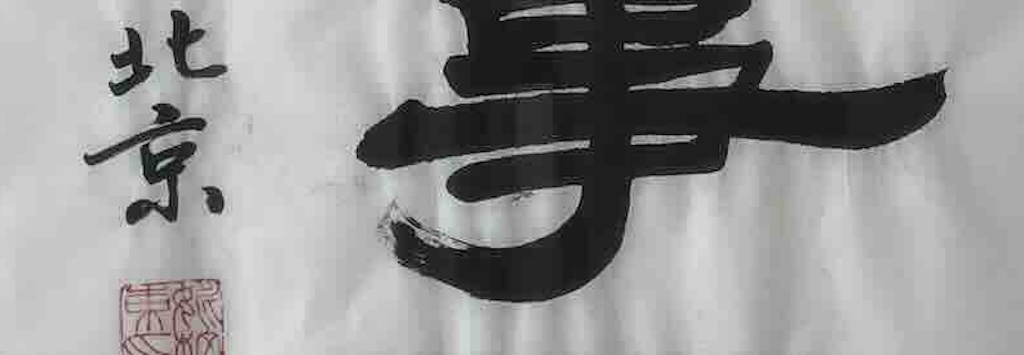
Written Chinese uses logographic characters called hanzi, where each character represents a morpheme (a unit of meaning) rather than a phoneme or letter.
Characters are written in a grid, each occupies the same square area regardless of visual complexity.
Chinese grammar has nouns, verbs, adjectives, particles, etc., just like Indo-European languages, but verbs do not inflect for tense or person. There are no plural forms for nouns and no gender agreement.
Word order is generally Subject-Verb-Object (SVO), similar to English. Some constructions allow alternate orders (e.g., the bǎ construction), but these are special patterns.
Traditionally there are no spaces between characters. Readers segment “words” mentally, based on vocabulary knowledge. Modern reform and digital usage sometimes add spaces for learning or clarity, but it’s not the native standard.
No capital letters exist in Chinese writing.
Spaces are not required because character boundaries serve as unit demarcation, and its the context and combinations that give meaning.
Traditional Chinese often lacked Western-style punctuation entirely. Marks like 句读 were sometimes added pedagogically but were not integral. However, modern Chinese punctuation largely mirrors Western marks (period, comma, question mark, etc.) but in fullwidth (square) form to fit the grid of characters.