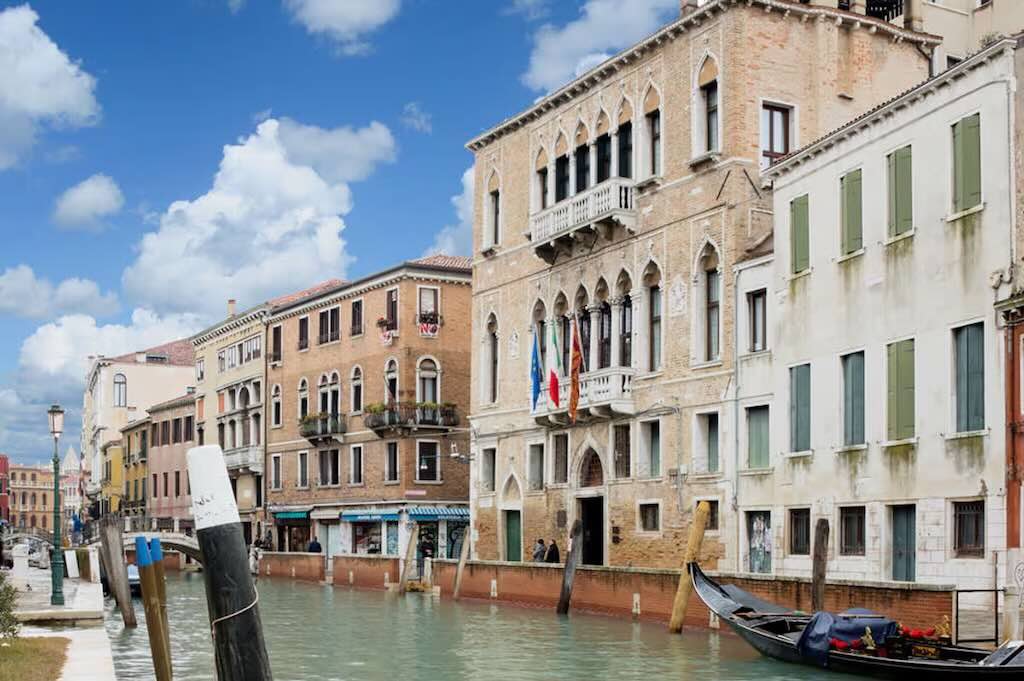
I was in Venice on a group trip organised by Kirker, called An Insider’s Venice, 15-21 Nov. 2026. Our 5-star boutique hotel was the Hotel Nani Mocenigo Palace, Fundament Nani 960, Dorsoduro, 30123 Venezia (+39 041 520 0145). As part of a travel package I can’t comment on the price.
In this case a “fondamenta”, is the Venetian word for a pedestrian walkway running alongside a canal.
The hotel is a relatively small establishment, with 30 rooms and suites, which distinguishes it from larger luxury hotels in Venice. Room sizes vary substantially, from 16 to 32 square metres. Some of the smaller rooms are accessible only by stairs, an important practical distinction in a converted historic building.
The palace is a medieval or late Gothic structure adapted over several centuries, but its canal-facing position reflects the traditional importance of waterways in Venetian urban life. For patrician residences, a canal frontage provided both access and a public architectural statement.
The Michelin Guide notes the juxtaposition of historic columns, stuccoes, frescoes and exposed brickwork in the public rooms. The hotel makes extensive use of Venetian flooring, antique furnishings, richly patterned fabrics and Murano glass chandeliers.
In a densely built city where open private space is relatively scarce, the enclosed garden provides a setting distinct from the public canal frontage. It is used for breakfast, drinks and dining in suitable weather. The hotel’s restaurant, La Bauta, provides Italian cuisine in a pleasant historic setting, along with that garden.
Ratings as of November 2026 were 9.4/10 (752 reviews) for Booking, and 4.8/5.0 (397 reviews) for Tripadvisor. The Booking.com and Tripadvisor scores are broadly consistent, although they use different review populations and scoring systems. The strongest areas are location, cleanliness, service and sleep quality. The hotel had slightly lower value-for-money scores, but all luxury hotels in Venice are traditionally considered expensive.
Guests appreciated the attentive staff, the historic character of the interiors, the quiet canal-side location and the private garden. Guests also frequently praise the cleanliness of the property and the quality of the accommodation. The location is particularly successful because it provides access to important cultural sites without requiring guests to stay in the most heavily visited part of Venice.
The negative comments are less frequent but still informative. Some guests reported inconveniences associated with the layout of a historic building, including stairs and access arrangements for particular rooms. A few reviews mentioned air-conditioning difficulties, and differences between expected and actual room arrangements.
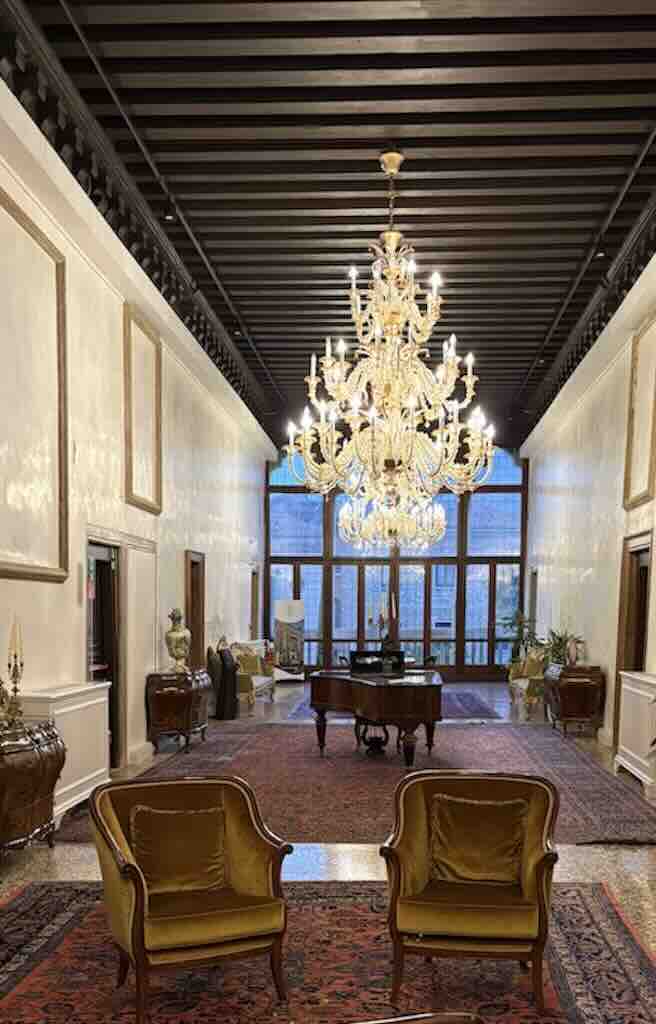
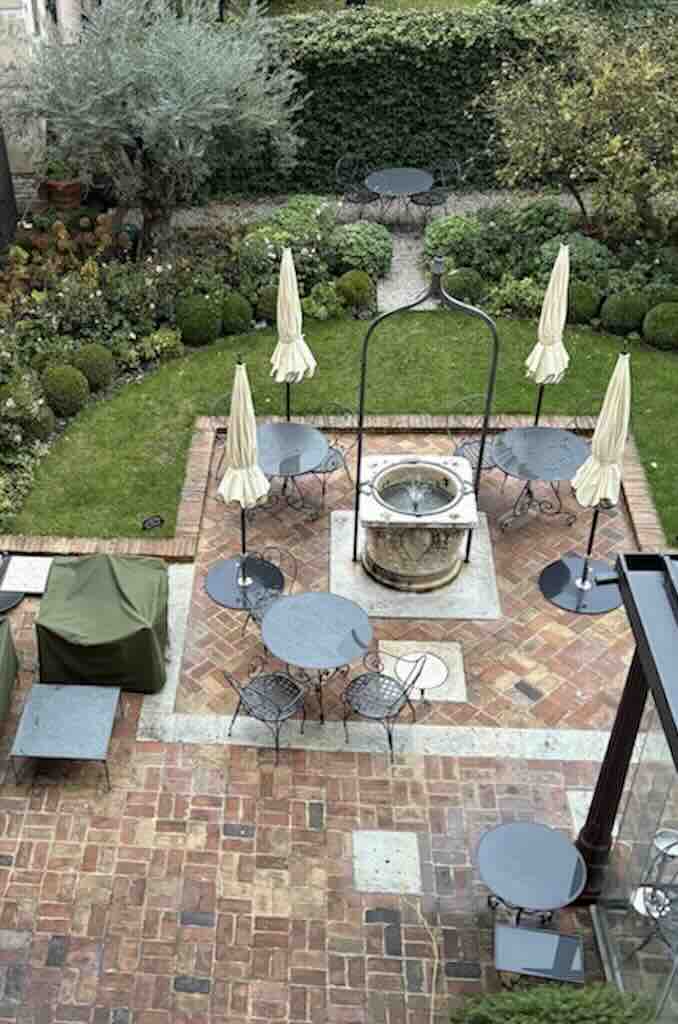
Above we can see a common room on the first floor providing access to the rooms (including mine). And the garden terrace, that in the summer must be a major asset to the hotel.
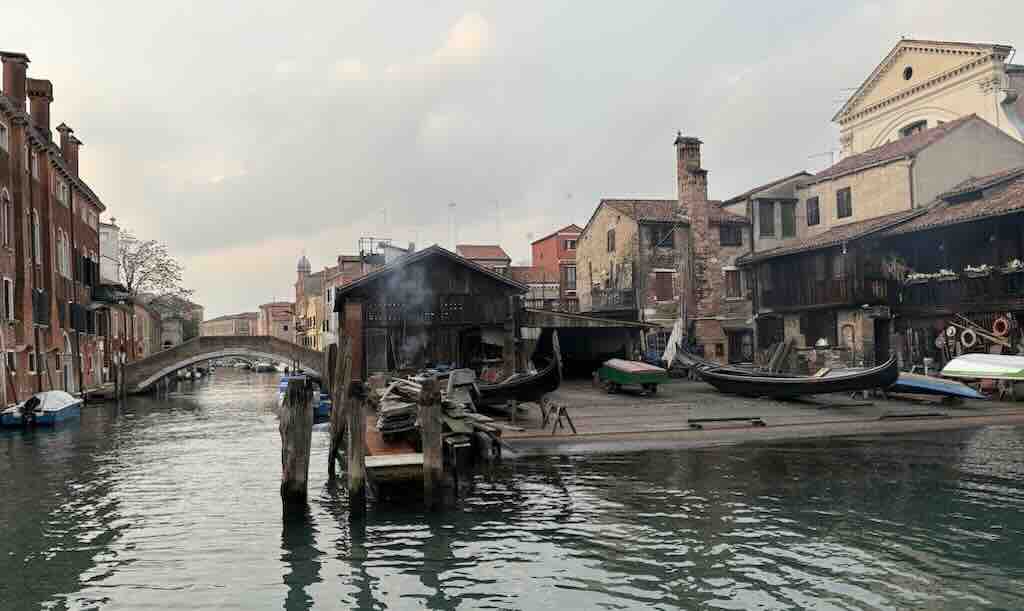
Just in front of the hotel is the Squero di San Trovaso, a 17th-century boatyard still making traditional wooden gondolas.
My Room
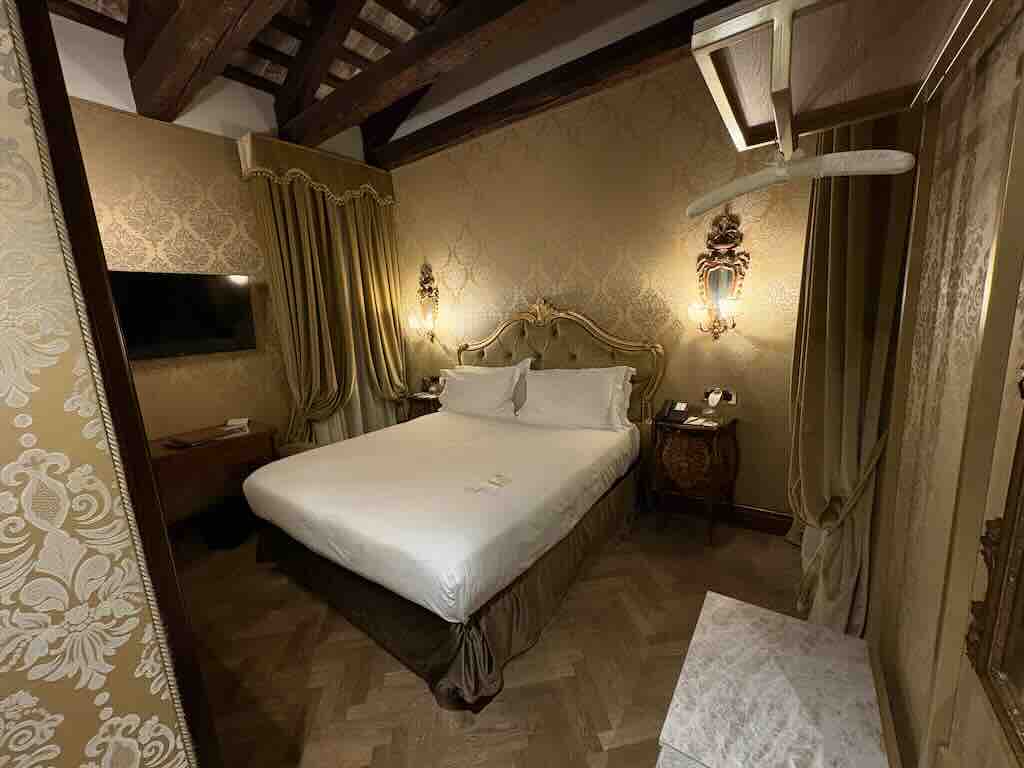
My room was one of the smaller ones, and the decor might not be to the taste of everyone. Positives were that the bed was excellent, and the safe was comfortably big enough for my laptop, etc. Cleanliness was impressive, and I appreciated the bottled water every day.
Negatives were that lighting was a bit limited, the desk and seating were “bijou”, and I didn’t immediately spot the USB charging points near the bed.
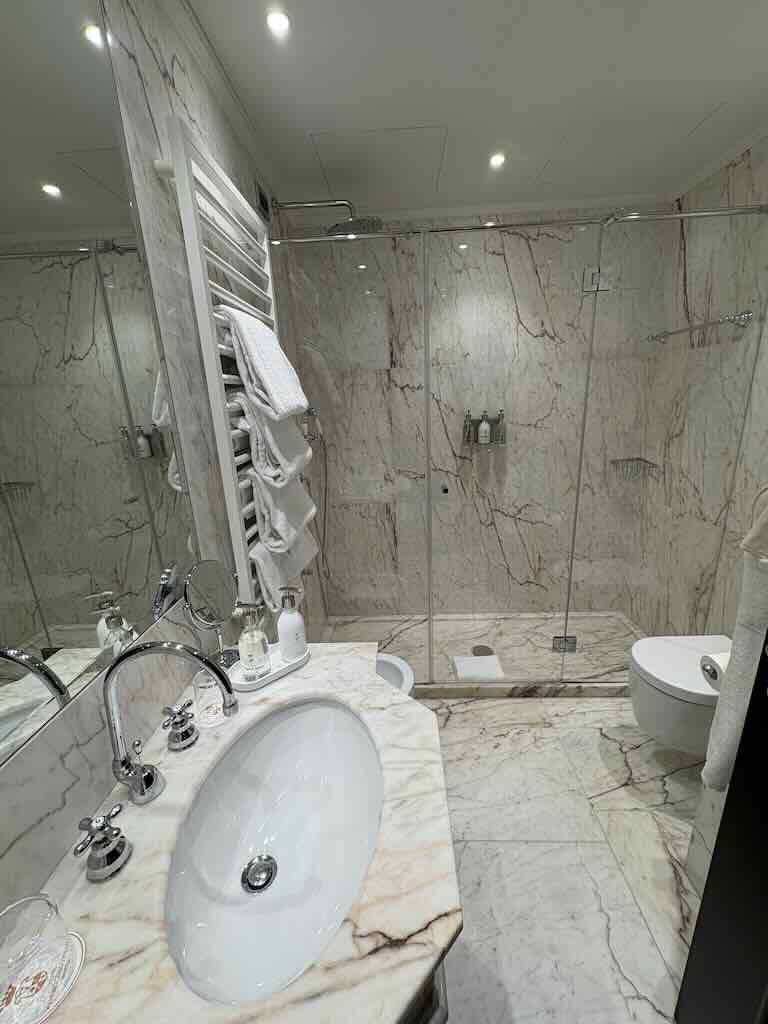
The bathroom was small, but the shower was spacious and the towels were excellent.
Breakfast

Breakfast was comfortable, as seen above. There was also fruit, yogurt, cold cuts, etc. as well as juice. And it included an optional egg menu, with sausages, bacon, and even porridge. There was also a separate à la carte menu, with omelette, avocado toast, waffles, etc.
Evening
Twice I took a drink and something from a bar menu. The bar was very comfortable and the offer was agreeable, and well prepared. An enjoyable and practical option.
A Bit of History
The Hotel Nani Mocenigo Palace occupies the historic Palazzo Barbarigo Nani Mocenigo, a 15th-century Venetian Gothic palace overlooking the Rio di San Troves in the Dorsoduro district of Venice.
The building has a more interesting history than its present use might suggest. It was associated with three prominent Venetian patrician families, housed one of the most important private antiquities collections in 18th-century Venice, and subsequently served as university premises before its conversion into a hotel.
Its location is also distinctive. Rather than standing on the Grand Canal or in the crowded streets surrounding Piazza San Marco, it occupies a relatively quiet canal frontage close to the Accademia, the Zattere waterfront and one of Venice’s surviving gondola boatyards.
The 15th-century palace and the Barbarigo family
The Italian Ministry of Culture identifies the building as Palazzo Barbarigo Nani Mocenigo, dates its origins to the 15th century, and records its location at Dorsoduro 960–964, between Fondamenta Nani and Calle Larga Nani.
The palace’s early history is connected with the Barbarigo family, one of the most influential patrician families of the Venetian Republic.
Two members of the family became doges in close succession, namely Marco Barbarigo, who governed from 1485 to 1486, and his brother Agostino Barbarigo, who governed from 1486 until 1501.
According to the hotel’s published history, the palace became the residence of Elena, daughter of Doge Agostino Barbarigo, and her husband, a member of the Nani family. The hotel associates this transfer with a marriage dowry, an important mechanism through which property passed between Venetian aristocratic families.
Renaissance alterations: Sansovino and Alessandro Vittoria
Although fundamentally Gothic in origin, the palace was altered and embellished during subsequent centuries. The Italian Ministry of Culture attributes remodelling to Jacopo Sansovino (1486–1570), the Florentine-born architect who became one of the leading figures of Venetian Renaissance architecture.
Sansovino’s better-known Venetian commissions include the Biblioteca Marciana and the Loggetta at the foot of the Campanile in Piazza San Marco. His association with Palazzo Barbarigo Nani Mocenigo places the building within the architectural transformation of 16th-century Venice, when Renaissance forms were increasingly introduced into older Gothic structures.
The same official heritage catalogue attributes decorative work to Alessandro Vittoria (1525–1608), one of the leading sculptors and stucco artists active in Venice during the later 16th century.
The hotel also associates some of its fresco decoration with Jacopo Guarana (1720–1808), an 18th-century Venetian painter who worked in the artistic environment of Giovanni Battista Tiepolo. Guarana’s presence would represent a later decorative phase, rather than part of the original Gothic building.
The 18th-century Museo
Perhaps the palace’s most historically important association is with the Museo Naniano, the private antiquities collection assembled by members of the Nani family.
The Biblioteca Nazionale Marciana confirms that the Nani family of San Trovaso possessed what it describes as the most important antiquities collection in Venice during the second half of the 18th century.
Two brothers were particularly responsible. Firstly, Bernardo Nani (1712–1761) developed the family’s collecting activities, benefiting partly from a legacy received from his cousin Giacomo da Riva. Then Giacomo Nani (1725–1797), also known as Jacopo Nani, pursued a naval career that took him through Dalmatia, Istria, the Peloponnese and the eastern Mediterranean. He undertook archaeological excavations and acquired antiquities, manuscripts and inscriptions.
The family’s collections included ancient marbles, sculptures, inscriptions, coins and manuscripts. The manuscript holdings were particularly substantial, including Greek, Latin, Italian, Oriental and Hebrew works.
The Nani residence was not merely a private display of wealth. The family made its library accessible to scholars, and printed catalogues were prepared to facilitate consultation of the manuscripts and inscriptions.
Following Giacomo Nani’s death in 1797, his testamentary arrangements provided for important manuscript and coin collections to pass to the Biblioteca Marciana. The transfer was delayed by opposition from his widow, Moceniga Vendramin, and was substantially completed in 1800, with the exception of the Hebrew manuscripts.
This connection gives the palace a genuine place in the history of European antiquarian scholarship and collecting, rather than simply the history of Venetian aristocratic domestic life.
University use and conversion into a hotel
During the modern period, the palace became associated with Ca’ Foscari University of Venice and housed university teaching and departmental activities, including Philosophy and Letters.
The university eventually decided to dispose of the property. A contemporary report published in La Nuova Venezia on 5 November 2015 provides a useful chronology. The building was offered for sale in 2005 and sold to private interests in 2007. At the time of the sale, the university’s rector, Pier Francesco Ghetti, expressed doubts about its suitability for hotel accommodation.
Nevertheless, the property was subsequently authorised for conversion, and restoration work proceeded under the ownership of Fox Srl, associated in the contemporary report with Venetian accountant Paolo Caffi.
The project was initially described as the future luxury Hotel Vitraria, with completion anticipated in 2017. The hotel eventually opened under the Nani Mocenigo Palace name.
The palace remains subject to heritage protection. A Ministry of Culture record dated 5 April 2024 documents an authorisation concerning a pergola in the hotel’s garden and identifies the building as protected under Italian cultural heritage legislation, with a protection notification dating back to 17 March 1924.
More recently, municipal planning documents from 2025 refer to proposals involving the classification of adjacent buildings and an enlargement of the hotel complex. These establish that further development was being considered, but do not by themselves indicate the situation today.
Piazza and Palazzo
Venice traditionally reserves the word Piazza for Piazza San Marco. Other public squares are called:-
- Campo: a square, often originally an open grassy area, frequently associated with a parish church.
- Compile: a smaller square or courtyard.
- Piazzetta: a small square, notably the Piazzetta San Marco adjoining the main Piazza.
This distinction survives in Venetian place names today. Venice’s official tourism website explicitly confirms this.
Under the Venetian Republic, the traditional distinction was that the Palazzo Ducale was the palace of the state, whereas even the grandest private residences of noble families were called Ca’, an abbreviation of casa, meaning house.
The distinction reflected an important political principle, namely the Republic was supposed to stand above any individual family, however wealthy or powerful.