This particular posting was inspire by an entry entitled Secondary Modern on History Workshop.
It pointed to another site Sec Mod on Blogspot (now officially known as Blogger).
But it looks as it hasn’t been very active since 2022.
Nevertheless, it inspired me to document my life in my secondary modern school, or at least what I remember of it.
Early years in the Grange Secondary School
We moved from Harrow to Aylesbury when I was around 9-10 years old, and I attended Broughton Junior School, which was 200-300 metres up the road from where we lived. I found a few of my old school reports, and I can see my parents must have been disappointed. My report from July 1961 summed things up quite well, poor spelling and easily distracted (averaged a D- or D, and a C for writing and comprehension, but an E for spelling). Things picked up in 1962 with a “satisfactory”, a few D’s and C’s, and an A for handwriting (I remember my Dad helped me), but still an E for spelling. However I did get a Certificate of Merit (Second Class) for my Scripture Examination at our local Baptist Church. My final certificate from my primary school summed me with a “good progress“.
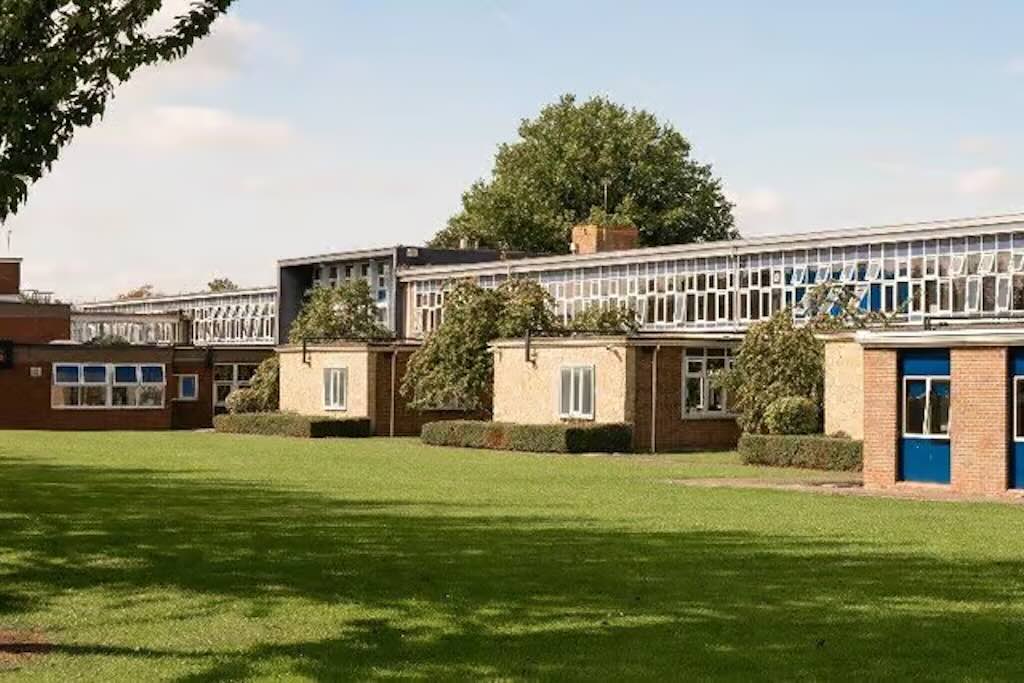
I’m not sure what I failed, the 11+ or just an initial screening test. In any case I failed, and was sent to The Grange Secondary School on Wendover Way, also in Aylesbury. I look back now and I am certain that Grammar School would have been a disaster for me.
The only person I remember from that time was David D from down the end of our road. He went to Technical School/College on the Oxford Road, and got a bicycle (it was over 2 miles away). Naturally he no longer mixed with a failure.
I remember very well making that first walk to my new school in September 1963. It was about 1 mile away, and the place looked enormous. My apprehension disappeared quickly, when I found some of my school friends from Broughton. I was put in a class called (I think) One-Alpha-Two. As far as I could tell this just meant we did German (not French) and metalwork (not woodwork). I was already 11 years 10 months old, and I think that made a big difference. I was taller and heavier than most kids, and after a few skirmishes they left me alone.
I don’t know how many pupils were in the school, hundreds and hundreds, and there was this very long corridor on the first floor.
At school nothing much happened. My close friends were Roger M, Willy N and Paddy K. Looking back it was a strange world. We never saw Willy except at school, he was bussed in everyday from Longwick, about 8 miles away. We rarely saw Paddy out of school, because he lived over in Eastgate, the other side of town. My closest friend was Roger, who lived down Highbridge Road, on the way into town. And there was Bogdan V, who might have been of Ukrainian decent (his parents never let him out).
I got my bike sometime in 1964, and I have my National Cycling Proficiency Certificate to prove it. This bike was life changing. Not only did it get me back and forth to school, but I also bought an evening newspaper round. After school I would cycle up to a place near the local church in St Mary’s Square in Aylesbury, pick up my copies of the Evening Standard and Evening News, and cycle home delivering them. I quickly sold the evening round for a small profit, and got a morning round at the local Bunces in Parton Road (not 100% sure about the shops name). I would sometimes cycle back and forth to school with the daughter of the manager of the small greengrocers across the road (not sure of the name, but Piggott’s or even SPAR come to mind). Later in Bunces I became the “marker upper”, tagging the newspapers with the addresses and preparing the rounds for the other boys. The manageress then gave me little jobs, e.g. display the toys, puzzles, etc., rearrange the magazines, etc.
What was the Grange Secondary School like?
It’s important to realise that the leaving age until 1972 was 15 years old. And National Service in the UK ended in 1960. I’m not sure when, but it must have gradually dawned on me that I would have to leave school, and start work. I know the idea of an apprenticeship gradually grew in my mind.
My early memories of the school can be summarised as follows. Bad at English and I hated Literature (Wuthering Heights, Macbeth, and a collection of poems). History was OK, but I loved Geography, or more truthfully, I loved Miss X the teacher. Mathematics and chemistry were average, and science was OK, but the physics teacher Mr. Laxton was a nice guy. On the other hand I enjoyed statistics and art. The German teacher learnt the language whilst in the Army in Germany, and it showed in his “teaching method”. After several years I could count “eins bis zehn”, which proved useful in my later life.
Top of my list was metalwork, and building and technical drawing. My plan was to find an apprenticeship. I actually spent a couple of days in a heavy engineering company over the other side of Aylesbury. They were quite positive, and asked that I make some things to show what I could do. The metalwork teacher was very positive and helpful, and I made a wrought iron fork for grilling in a open fire, then I raised and planished by hand a small copper bowl, finishing with a small foot ring brazed in place.
But my pièce de résistance was a toolmaker’s parallel clamp, a kind of handscrew clamp (sometimes called a machinist’s clamp or parallel-jaw clamp). I had to hand make the pieces, case-hardened the jaw tips, and show I could turn on a lathe, then add tapping and threading, and knurling. I was really proud of this, and I still have it. I then went out to see two other local companies (one an instrument maker), and got some really positive feedback. When I told my Dad that I would leave school like my friends, he surprised me. No, you stay and do the exams. For me this was totally incomprehensible, but so be it. If it was exams they wanted, I would get some exams.
The transition was hard. With my close friends Roger M, Willy N and Paddy K, we decided to go on holiday together. We were all still 15 years old, but our parents agreed that we could go alone to Butlin’s for a week. It was our coming of age. Would that be possible today?
Little did we know that our friendship would breakup in the coming months. Roger M would quit school, and go into the army, and Willy N would go into the family garage business. Paddy K and I would change classes, but I don’t remember why. Paddy K would have his girlfriend, and I suddenly found Susan P, a girlfriend of my own. Not sure she viewed our relationship as such, and in any case it lasted a bit less than a year before she dumped me.
Exams, certificates, and then?
I don’t know when the school introduced O-level, and even A-level classes. I have the impression that the 6th-form had only started the year before. Firstly, I didn’t know what “exams” meant, nor did I know that even the existence of O- and A-level classes in a secondary modern school was, at that time, quite unusual.
Again I didn’t really understand the difference between passing an exam and getting a good result. My aim was to get as many certificates as possible.
It was only in the 6th year that I realised that my secondary modern school was quite experimental. Firstly, they introduced what I guess was an early form of “team teaching”. I remember everyone in the year coming together for a kind of big class, then separating into smaller groups.
The weekly schedule worked on 6 days, with Day 6 stepping through the calendar (replacing Monday in the first week, then replacing Tuesday in the next week, and so on). The idea was that in Day 6 we did things that were not “academic”. I remember learning sewing, darning and cooking, as well as doing some chemistry. The girls all did woodwork, and their parents all got turned candle holders for Christmas. Not sure when, but I also learned to type, and took a speed-reading course which radically changed the way I read and learn, even today.
Also religious instruction was replaced with Social Ethics. In fact, the school was trying to help its pupils start life “on the outside”. Staying on, I didn’t really know how helpful the school was in job hunting. But I do know they tried to tell everyone how to open a bank account, how to deal with health care, the role of justice in society, and even the importance of savings and pensions.
Certainly in the 6th-form we saw a lot of young teachers arriving, and a lot of rugby players. Initially I thought that the school was attracting good teachers, and perhaps it was. I later learned that still in the late 60s, forward-looking secondary modern schools were few and far between.
The result was that I collected 11 GCEs, 5 CSEs, an Oxford Proficiency in Arithmetic and an Oxford Proficiency in the Use of English, followed by 3 A-levels in Pure and Applied Mathematics, Statistics, and Physics. I will be honest up front, the grades were secondary, its was the collection that counted. For example, I did an O-level in chemistry in a few hours per week for one year. Did I learn any chemistry? Probably not, but I got the O-level.
A secondary modern education is only the beginning
The reality of the 60s was that the Grammar School was for the academic pupil, the Technical School was for the technically “gifted” pupil, and the Secondary Modern School was for everyone else.
When I had collected some O-levels I had to decided what I wanted to do. Leave and get a job, or go on to A-levels, and even beyond. In the 60s virtually no one had qualifications, only doctors hung their qualifications on the wall of their cabinets. But I began to realise that collecting certificates was a way to avoid committing to a job (that you would do for life).
School was useless in helping me think about this. My parents were supportive, but didn’t really know what was on offer. I loved building and technical drawing (and metalwork). I had my own draftsman table at home from the age of 12, and I spent a lot of time drawing buildings, etc. So architect was an obvious choice. I went to the Buckinghamshire Council building in Walton Street, in Aylesbury, and asked to speak to some architects. Their language was particularly florid, but the message was clear, I would be an idiot to do architecture.
I remember feeling very lost for a few days. Doing Maths, Stats, and Physics at A-level, appeared to give me the widest possible choice in the future. I learned one important lesson, too much choice leads to confusion, and confusion can lead to a non-optimal decision (i.e. bad). But at least I had already learned that education was a good way to avoid having a job (for life).
I was in a new class, preparing for the O-levels. I found two new friends Mike H and Mark B. I also transitioned from school basketball to hockey. And here I have an old photo, so I can say hello to George, Peter, Jeff, Steve, Nick, Wad, and Jane, Linda and Jackie.
And through to the last year, there was not much to happening. I and Mark B had summer jobs as bin men. I continued to work in the newsagents, but not on early morning paper rounds. And we (me, Mark B, Mike H) went for a walking holiday down the Rhine.
With my A-levels I did a thin-sandwich course in Applied Physics, and I learned that I was good at building things in a laboratory. This was paid for in part by my local council, and in part during the different 6-month industrial periods. Important was that I had no loans to repay.
Initially I got a job on the London buses which gave me the time to think about what I wanted to do. Keeping my options open, I then found that I had won a grant to study for a PhD in Italy (where I would meet the most wonderful woman in the world). Later I was a nomad physicist, doing research in Germany, Italy and France. I then joined the European Commission as nuclear inspector, specialist in measurement systems. At the age of 40 I would transition again, and would manage a number of different European research programs. I retired at 55, and live in Luxembourg, Spain and Italy.
I have no lesson to give, except that someone once said “Better to be lucky than clever”. I agree. But if you need a more suggestive thought, try “Chance favours the prepared mind”. However, the single most important thing in my life, was the 49 years I spent with my wife.