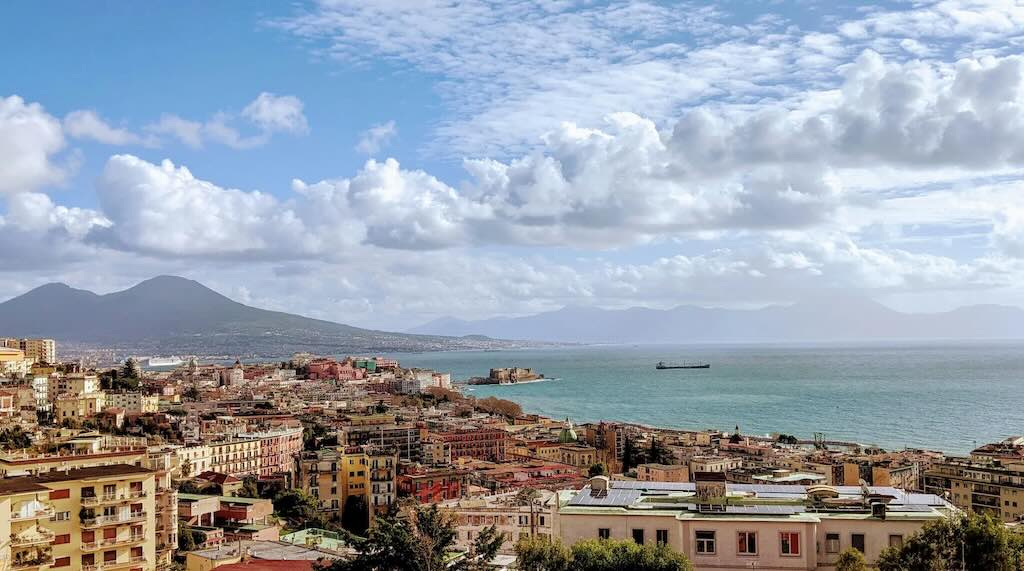
Between the 16-24 April 2026 I stayed in the Grand Hotel Santa Lucia, in Naples (see hotel review). The hotel (with breakfast) was pre-booked with a New Scientist Discovery Tours entitled “Uncovering Vesuvius, Pompeii and Ancient Naples“, and organised by Kirker Holidays. This trip included…
18 April – National Archaeological Museum (my review)
19 April – Visit to Pompeii (my review)
20 April – Visit to Herculaneum and Villa Oplontis (my review)
21 April – Visit to Mount Vesuvius (my review)
And I added 3 more days:-
17 April – Visit to the Royal Palace of Capodimonte (my review)
22 April – Making Pizza Napolitano and Tiramisu (my review)
23 April – Visit to Paestum (my review)
This particular post provides a general introduction to Naples, using the small historical area of Borgo Santa Lucia as a reference point. It then moves on to describe Piazza del Plebiscito as a kind of navigation tool to the royal history of the city.
Campania
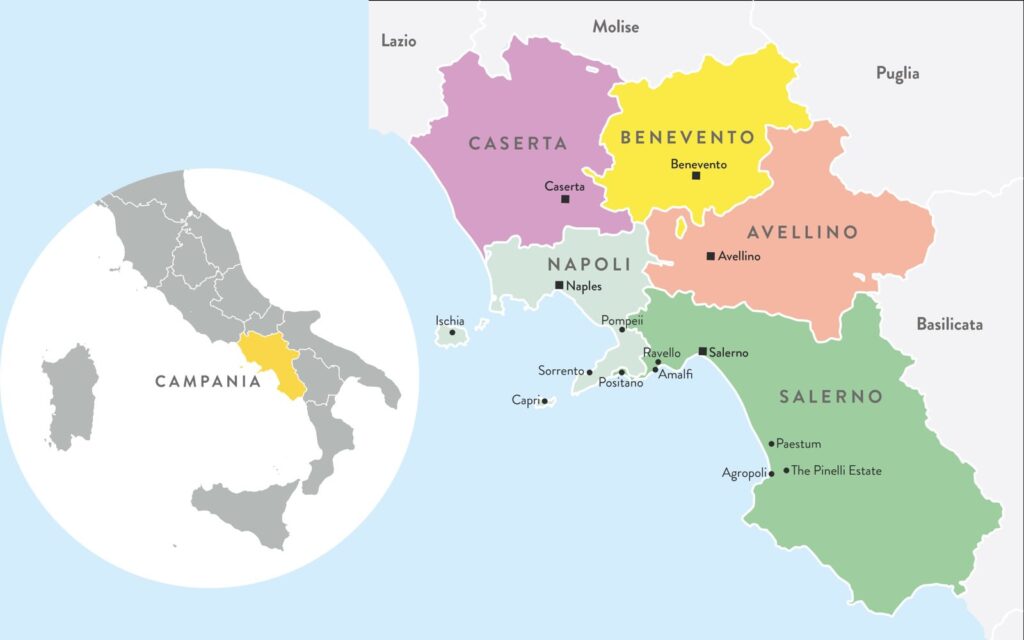
Campania is an administrative region of southern Italy, bordering Lazio to the northwest, Molise to the north (never heard of it), Apulia (Puglia) to the northeast, and Basilicata to the east, with a long western coastline on the Tyrrhenian Sea.
Its capital is Naples, one of Italy’s largest cities, and the region has a population of roughly 5.6–5.8 million, making it among the most densely populated in the country. Campania is divided into five provinces (Naples, Salerno, Caserta, Avellino, Benevento) and is geographically defined by a mix of coastal plains, volcanic zones, and inland mountains.
It includes the active volcano Mount Vesuvius and extensive volcanic fields such as the Campi Flegrei. Other attractions are Pompeii, Herculaneum, Paestum and the Amalfi Coast.
Naples
Let’s start with the word “Napule” which is the Neapolitan-language form of “Napoli” (Naples). Its origin is linguistic and is the result of how the local language (Neapolitan) evolved from Latin. The ultimate root is the Greek name Neapolis (Νεάπολις), meaning “new city” (nea = new, polis = city). And this became Neapolis in Latin, the standard Roman name.
But Neapolitan tends toward open syllables and softer endings, producing Na-pu-le instead of Na-po-li. And remember the Neapolitan language is a recognised Romance language with millions of speakers (and has its own multiple dialects).
Initially, the city of Naples was not divided into neighbourhoods (quartieri). The preferred approach was to divide the city into homogeneous zones based on the activities they engaged in.
Subsequently, the Romans divided cities into blocks delimited by decumani, which were the main east-west streets of Roman cities, arranged orthogonally. Although the term “decumani” is of Roman origin, the urban layout to which it refers actually dates back to a typically Greek street layout.
The street layout common in Greek times was orthogonal, and that of Neapolis branched into three different streets that, running parallel to one another, were called plateiai. The plateiai traversed the city centre of ancient Naples, dividing it into four distinct sections. These same main streets were in turn crossed from north to south, perpendicularly, by other minor roads (called stenopoi). Famous examples at the time were the three axes of Naples (Inferiore/Spaccanapoli, Maggiore, Superiore). Synonyms in urban planning include strada/via (Latin: via).
The division of Naples into neighbourhoods (quartieri) was decreed in 1779 by King Ferdinand IV of Bourbon to improve citizen safety by designating a court for each. The neighbourhoods of Naples were thirty sectors within the city that were identified by particular geographical, topographical, functional, and historical characteristics.
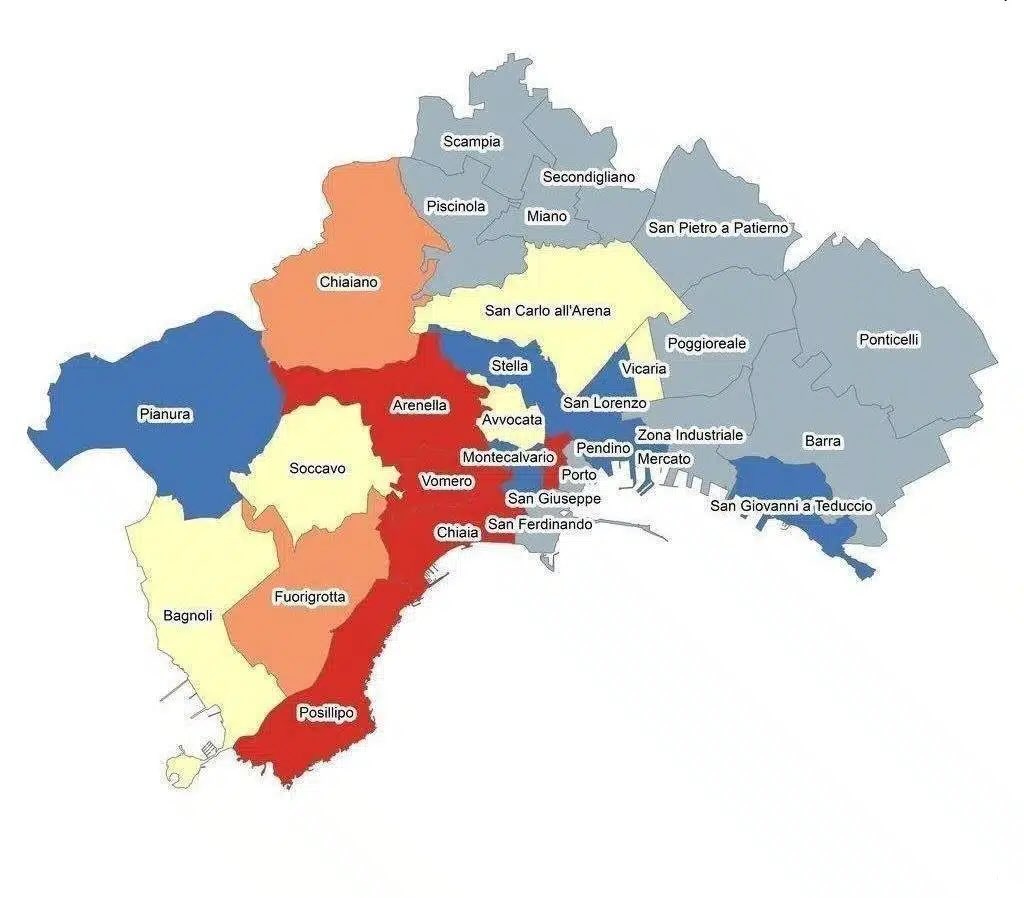
The colour codes shown above also help us understand a little better what makes up Naples. What we are looking at is the turnout for the European Parliament elections of 2019. Since the first elections in 1979, the turnout rate has dropped from 86.12% that year to 56.09%. But this was for Italy, whereas for Naples it dropped to 40.02%.
However, turnout was not the same in all neighbourhoods, and it reflected the city’s socioeconomic geography. On one side, in the disadvantaged neighbourhoods located in the suburbs and in the historic centre of the city (lowest with blue, then grey and then yellow) turnout was between 30% and 40%. For the richer central and hilly neighbourhoods (orange and then red) turnout was between 40% and 52%.
Delving a little deeper (for 2025), the average annual income in Chiaia is €49,980, whereas in Forcella and Borgo Sant’Antonio Abate, it’s €13,840. There’s a difference of over €36,000 in income between those living in Naples’ richest neighbourhoods and those living in the poorest. Chiaia also has the highest concentration of people who declare over €120,000 in annual income (8.5% of the neighbourhood population). In Naples, the average annual income is €22,600. The capital is second to last among large Italian cities, compared to €37,200 in Milan. Only Palermo fares worse, at €21,800.
The unemployment rate in Naples, updated to 2023, stands at 29%, “the highest among major Italian cities, along with Palermo at 19.8%”. The majority (21.7%) work in trade (both wholesale and retail), which also includes car and motorcycle repair (6.3%), 12% in transportation and warehousing, etc.
In 2005, the city was divided into ten districts, also called municipalities (comuni), which grouped the thirty neighbourhoods into zones. The first municipality includes the Chiaia, Posillipo, and San Ferdinando neighbourhoods, and also includes Borgo Santa Lucia, where our hotel was situated. This is one of the most beautiful areas of Naples, practically on the waterfront that runs from the port to Posillipo, passing through Mergellina.
It’s easy to get confused, because there is something called the Metropolitan City of Naples (città metropolitana di Napoli) which is a metropolitan city in the Campania region of Italy, with the city of Naples as capital. This “Naples” has 92 municipalities (comuni). And there is the Naples metropolitan area (Area metropolitana di Napoli), or Greater Naples, which is a metropolitan area centred on the city of Naples, which has itself 10 comuni.
It’s impossible to try to describe a city like Naples, so I will look at the general area around my hotel. The reality is that this hotel, and those along Via Partenope, can’t be separated from its historic waterfront location.
But by looking at this very small seafront neighbourhood, we can see how Naples evolved over several hundred years.
Below we can see the general area around Borgo Santa Lucia. The red dot is positioned on Piazza del Plebiscito, which is often treated as the ceremonial heart of Bourbon Naples.
Borgo has numerous meanings, ranging from a settlement, small village or hamlet, that grew around a castle, monastery, or outside the walls of a town. Today it’s often associated with medieval roots, narrow streets, and old stone buildings.
In fact Borgo Santa Lucia is not an official administrative district but a historically defined area centred on Via Santa Lucia, the Lungomare (Via Partenope), and the small harbour around Castel dell’Ovo. Its footprint is roughly 400–600 metres along the coast and 200–300 metres deep, yet it contains a dense layering of Greek, Roman, medieval, and modern urban heritage.
The first map below shows the coastal area of Santa Lucia within the larger administrative area of San Ferdinando, one of the historic cores of Naples. This larger municipality includes the Royal Palace, Piazza del Plebiscito, and the San Carlo opera house.
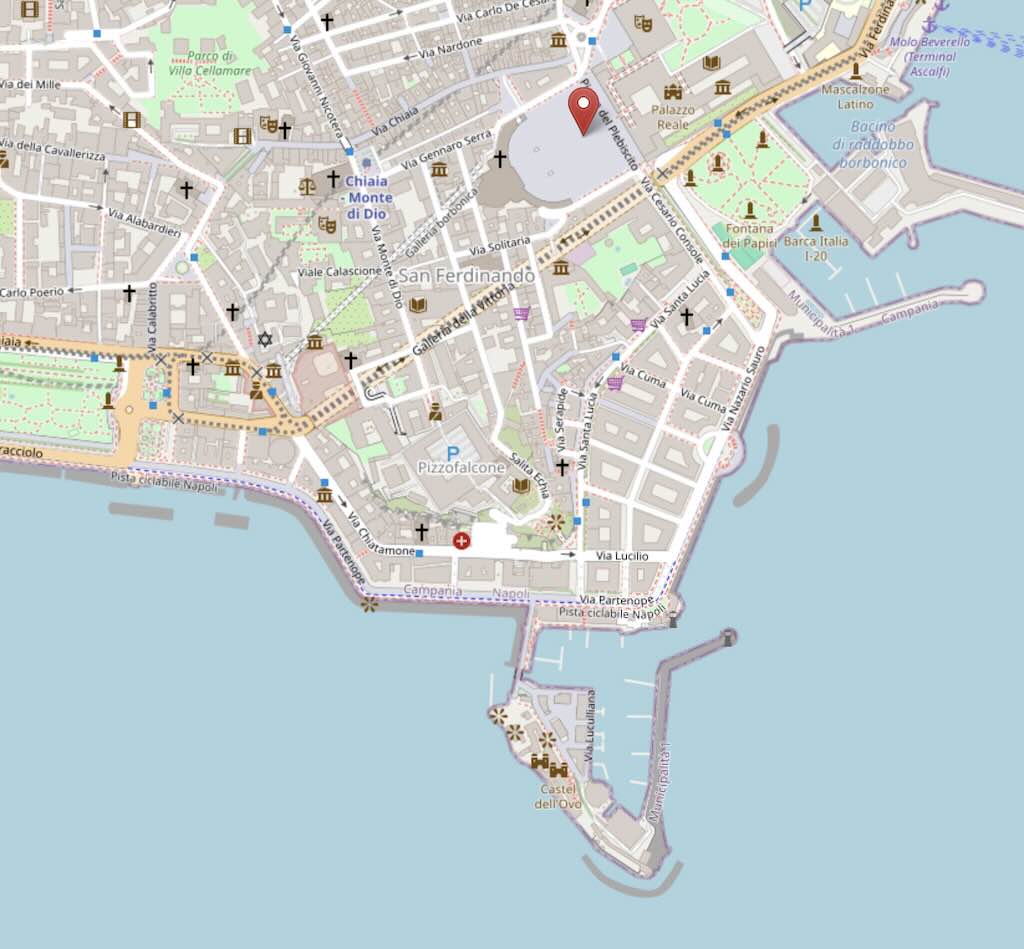
Borgo Santa Lucia is the lower part of the above map, where the dominant feature is the small peninsula projecting into the Bay of Naples, crowned by Castel dell’Ovo, the oldest fortification in the city.
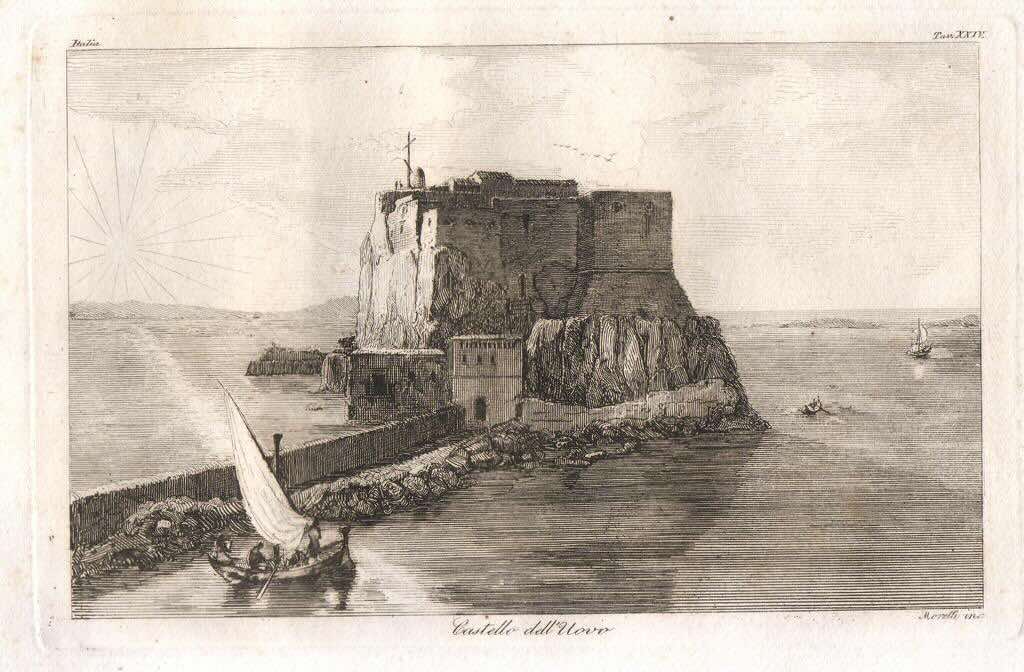
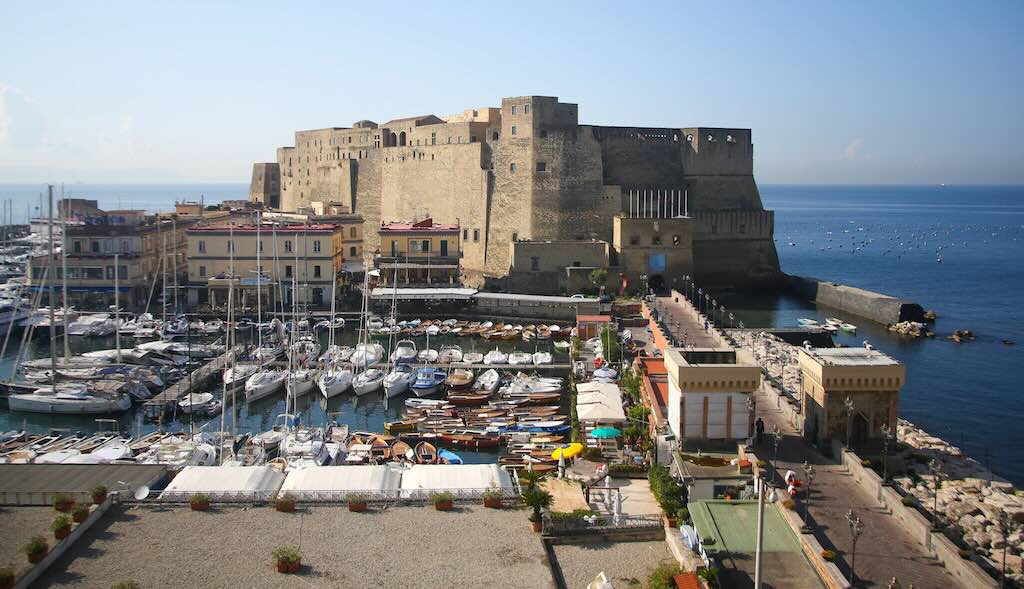
It is generally assumed that the island of Megaride was where Greek colonists of Magna Graecia from Cumae founded the original nucleus of the city in the 6th century BC. However, the main city of Neapolis (Naples) developed slightly later on the mainland. Below we have a plan drawn up by the Archaeological Superintendency of Naples.
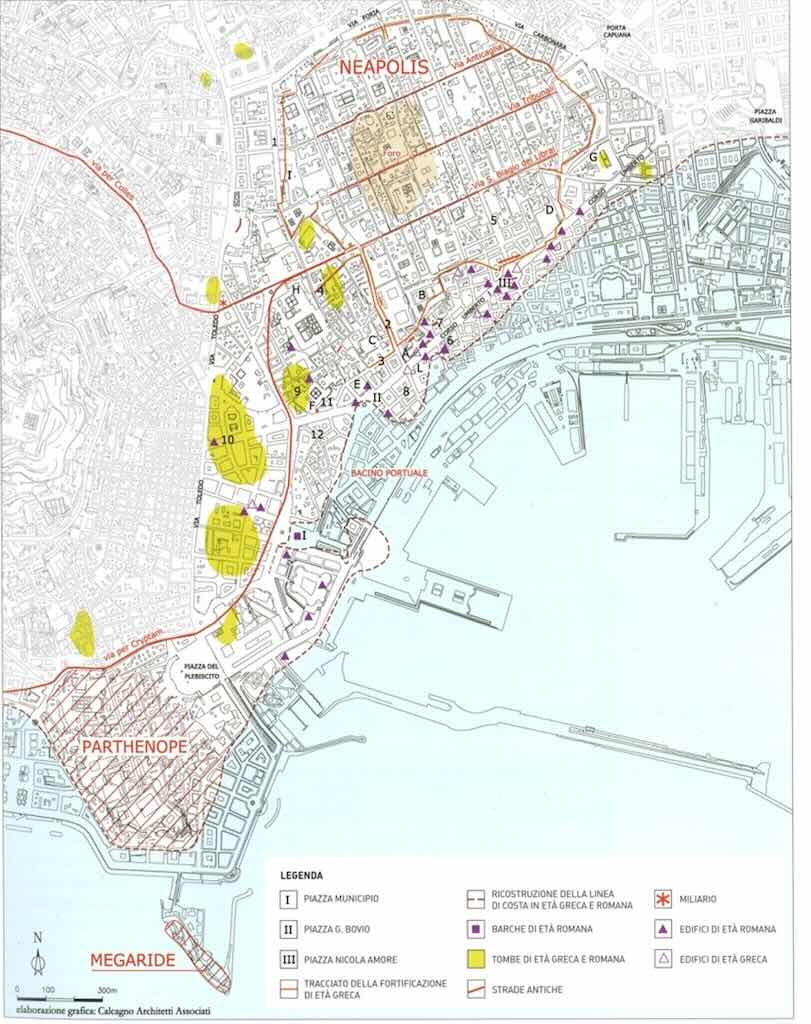
In the 1st century BC, the Roman patrician Lucius Licinius Lucullus (118–56 BC) built part of the magnificent villa, later called Castellum Lucullanum, on the island. The site was later fortified under Valentinian III (419-455), and the last Western Roman emperor, Romulus Augustulus (ca. 460–511), was exiled there in 476 AD after his deposition. And it is known that around 492 AD, the monk Eugippius founded a monastery on the site.
The villa of Lucius Licinius Lucullus was more like a luxury estate covering a whole coastal zone than a single villa. It stretched from the islet of Megaride (where Castel dell’Ovo stands today), up the slope to Monte Echia/Pizzofalcone, and possibly even farther inland. The villa wasn’t just big, it was one of the most extravagant private estates in the Roman world, and ancient writers used it as a symbol of elite luxury. Lucullus’ villa became shorthand for extreme wealth and refined excess. His name was associated with luxury banquets (“Lucullan feasts”), and writers used him as an example of how Roman elites shifted from military virtue to luxury lifestyles. It is said that he created elaborate seawater fish tanks (piscinae), and that he even pierced a hill to improve water circulation. The poet Horace mocked him for spending fortunes just to raise fish.
Later, it has been suggested that parts of the site might have been intentionally damaged or abandoned to prevent use by Saracen raiders.
What is sure is that the Normans did build a castle here in the 12th century. Roger II of Sicily (1095-1154) consolidated control of Naples around 1140 (but he retained his primary capital in Palermo).
Constance of Sicily (1154-1198) was captured in 1191 during a conflict with Tancred of Sicily (1138-1194), who then imprisoned her at Castel dell’Ovo (she was released in 1192 and later became queen).
Conradin (1252-1268), after his attempt to reclaim the Kingdom of Sicily for the Hohenstaufen dynasty failed, was captured and beheaded (not in Castel dell’Ovo but in Piazza Mercato, in the eastern part of the city).
Charles I of Anjou (1226-1285) built a new castle Castel Nuovo (1279) and moved the royal court there. Castel dell’Ovo then became administrative offices, the treasury, and eventually also a prison.
It would appear that the area around Castel dell’Ovo (especially Borgo Marinari and the Santa Lucia waterfront) had been a place of informal trade and fishing activity since at least the Middle Ages (c. 10th–15th centuries). Recognition of this mercantile activity in the Muricino area came with a document dated August 4, 1302, which established, through a public deed, the donation of that land, already in use, to the city of Naples, specifying “so that a market might be held there twice a week”. This officially establishing its state ownership and inalienability.
Muricino may derive from “muro” (wall), possibly referencing fortifications or sea walls. Borgo Marinaro or Borgo Marinari (“Sailors’ Quarter”) was a small fishing port under the walls of Castel dell’Ovo. The small port and the borgo were modified when large sections of the old seafront were torn down to make way for newer buildings (see later).
Joanna I of Naples (1325-1382) in 1381 was imprisoned for a short period in Castel dell’Ovo (later, in 1382, she was murdered on the orders of Louis I of Anjou).
The castle’s current shape largely dates from when Alfonso V of Aragon (1396-1458) conquered the city in 1442, through to 1503, when the Kingdom of Naples passed to Spanish (Trastámara/Habsburg) control after the Italian Wars (1494-1559).
Castel dell’Ovo, already a coastal fortification, became part of the defensive artillery network protecting the harbour. As such it suffered damage from artillery fire, especially to older medieval sections not designed for cannons. It was repaired and adapted to withstand artillery (thicker walls, lower profiles, angled defences).
So until the 16th century, Santa Lucia was just a beach with very humble fishermen’s houses that, to the east (at present-day Via Cesario Console), formed a deep inlet known during the Angevin era as Porto dei Provenzali.
From 1599 until 1620, various viceroys, from Guzman to Borgia, carried out a building redevelopment of the area, demolishing dilapidated houses, building a defensive wall on the beach, and, above all, clearing the seafront of insignificant buildings, thus restoring the view. This made Santa Lucia one of the most pleasant sites in the city, and its fame spread among foreign visitors.
In 1799, French revolutionary forces helped overthrow Bourbon rule in Naples, but they returned with allied support. Afterward, the Castel dell’Ovo continued in military use, but gradually declined in strategic importance in the 19th century.
After the upheavals of the late 18th century, Castel dell’Ovo steadily lost its frontline military importance. The castle continued to function as a prison and for coastal surveillance. In the mid–late 19th century (after Italian unification, 1861) many old fortresses became obsolete due to modern artillery and new military strategies. Castel dell’Ovo was neglected and suffered structural decay.
Goethe, who visited Naples in 1787 during his Italian Journey described the Neapolitan seafront in which Castel dell’Ovo was a defining feature. Alexandre Dumas, who for a time lived in Naples, refers to the city’s monuments and legends, including the famous “egg” myth tied to the castle.
According to local legend, the Roman poet Virgil (70-21 BC) hid a mysterious egg within the foundations of Castel dell’Ovo. The fate of the castle, and even the city itself, was said to depend on this fragile object. If the egg were ever broken, disaster would strike Naples. This story gave the fortress its name (“Castle of the Egg”).
In the early 20th century, the castle had little militarily relevant, and was occasionally used for offices, storage, etc., and its condition deteriorated. In the mid–late 20th century its historical value led to major restoration efforts starting in 1975.
During my visit the castle was closed as part of its on-going restoration.
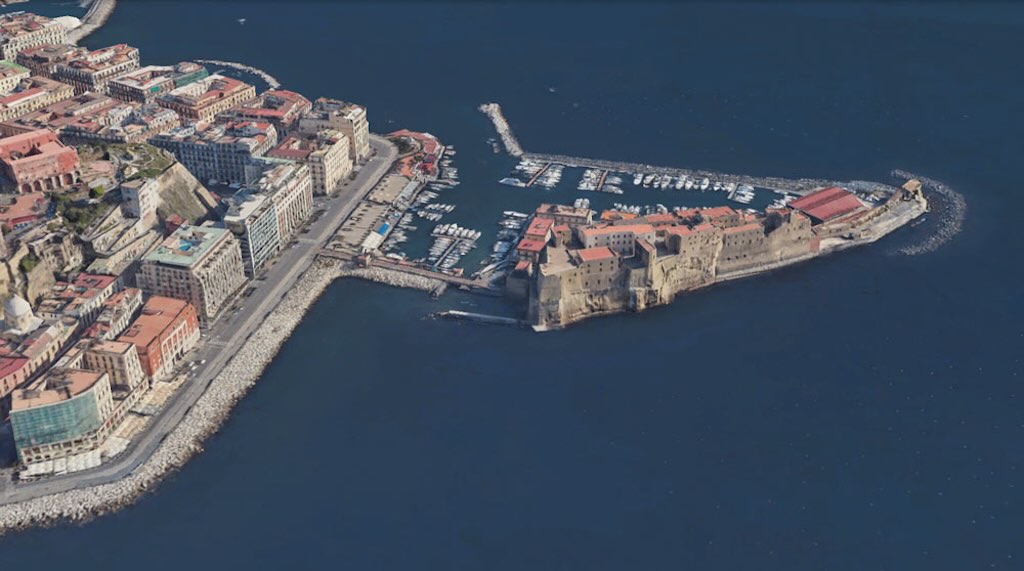
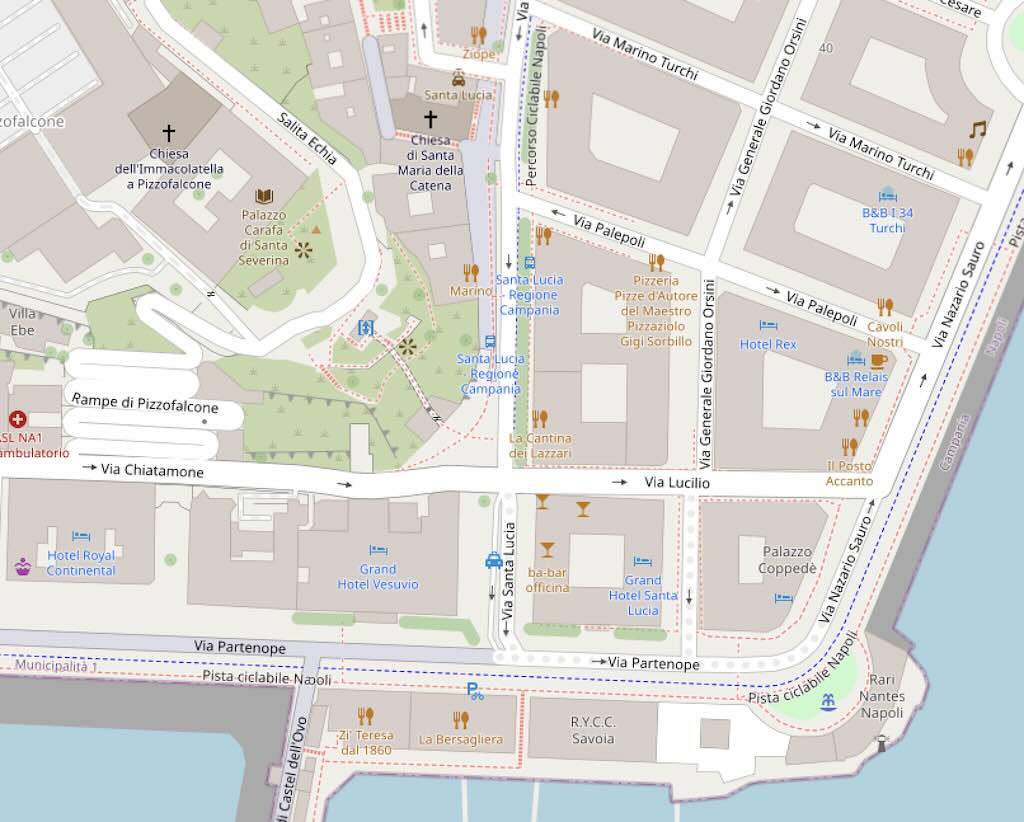
We will now look at a less obvious feature of the Borgo Santa Lucia. Above we had a more detailed view of the area around Via Santa Lucia.
My hotel was the Grand Hotel Santa Lucia, and during my stay the whole of the waterfront Via Partenope was being remodelling into a promenade. Part had already been complete (at 90%) along Via Nazario Sauro, and completion was expected by year-end 2026.
Il Risanamento di Napoli – the “Cleaning Up” of Naples. Neapolitans referred to the process as sventramento, literally, “gutting”.
So we are going to turn back the clock to 1839, when Ferdinand II of Bourbon (1810-1859) decided to radically alter the urban landscape of Naples. This included the creation of a working-class neighbourhood to the east of the city, new residential neighbourhoods to the west and on the hills of Posillipo and Vomero, new tunnels and funiculars, and remodelling of the seafront promenade along Via Chiaia. This required massive demolitions in the historic centre and the creation of wide, straight avenues. The remodelling was not just roads and buildings, but included the creation of a sewer system, and a small harbour for sailors (thus compensating them for the loss of the beach).
You have to remember that inadequacy of the sewage system in the working class areas was often the cause of cholera outbreaks (in 1855, 1866, 1873 and 1884).
I was in Naples during the El Tor cholera epidemic in late August 1973. The day after I arrived, most flights were cancelled, and I had to be inoculated in Rome, before I could even go to Naples and then Capri (too late to go back). “El Tor” is a particular strain of the bacterium Vibrio cholerae, the causative agent of cholera.
One major focus of the “cleaning up” was along the so called Rivera Chiaia, along to Mergellina. But we are just going to focus on the remodelling of a small part of the seafront promenade near the old Castel dell’Ovo.
And the key message, if we look at the above plan, was that Via Chiatamone and Via Santa Lucia were the sea front. Via Partenope and the roads and building between Via Nazario Sauro and Via Santa Lucia did not exist.
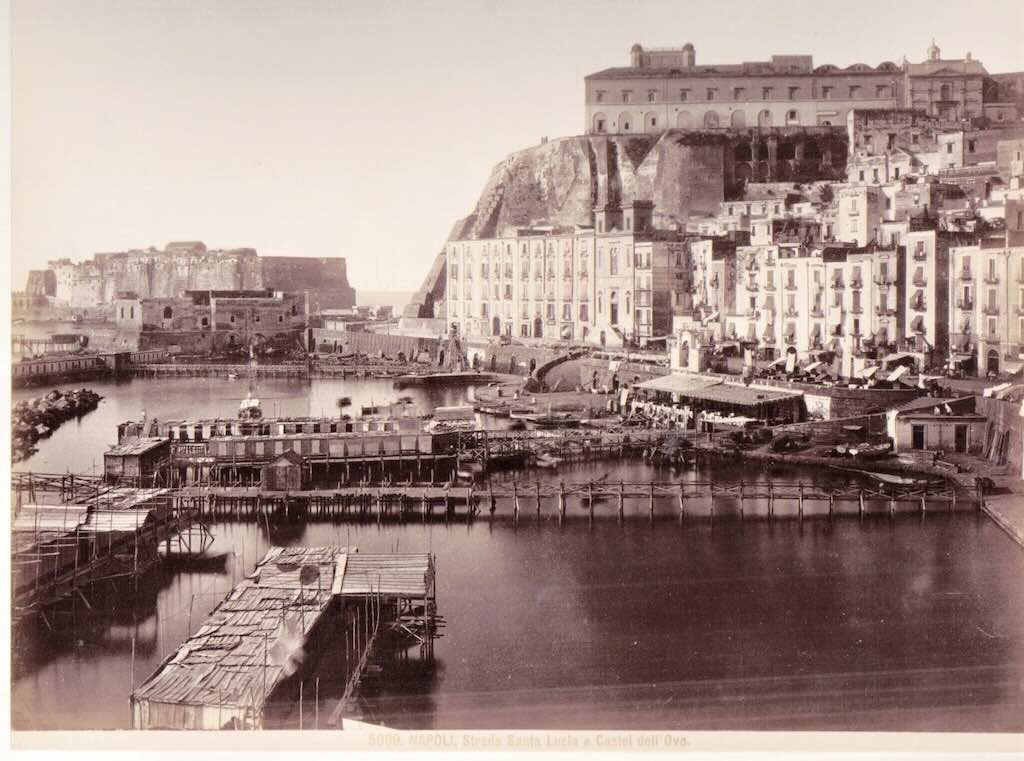
The present-day shoreline, along with all the hotels, etc. are built on reclaimed land.
In the above photo we can see the famous Monte di Dio – Monte Echia which refers to the same elevated area in Naples, often also called the hill of Pizzofalcone. We see that it descends to the seashore, whereas now it is setback by a series of building on the reclaimed land.
The name Pizzofalcone dates back to the mid-13th century, when the hill was not yet part of the city’s urban fabric. Charles I of Anjou practiced falconry in this area, having a falconry built on the hill for the “royal falconry hunt”. The name Monte di Dio comes from the church of the same name, founded in the 16th century at the end of Via Monte di Dio, which no longer exists. Monte Echia is an archaeological site.
The Risanamento was officially ended by decree in 1918, but it had actually petered out some years earlier. A report came to the conclusion that political infighting, rampant favouritism, Camorra (the Neapolitan mafia) and corruption, had made the campaign to remake Naples much less than it might have been.
The project for the reclamation of the seafront along Via Santa Lucia dated back to 1883, but it would take forty years to complete. With the construction of the new Orsini neighbourhood, Via Santa Lucia became an internal street, losing much of its legendary charm.
This created a new social situation that continues to this day, with new high-quality residential buildings on the outer side and the more popular inner side, including the infamous Pallonetto di Santa Lucia.
Firstly pallonetto just means “little ball”, but more generally something compact, rounded, enclosed, and in urban terms it means a tight, self-contained cluster of streets and buildings. So the Pallonetto di Santa Lucia was (and still is) hidden just behind-above a prestigious waterfront, so physically close to elite areas but socially very different. And like many inner-city quarters of Naples, this pallonetto was historically influenced by the Camorra. Small clans operated there, and their territory control and illicit activities shaped daily life. The area was neglected, with very tight alleys, deteriorating housing, and limited public services. High unemployment and overcrowding made it vulnerable, and during the 1970s–1990s the area became known for heroin dealing and later other drugs. The neighbourhood’s reputation spread beyond Naples largely because of cinema, and films like Le mani sulla città. The area was often portrayed as a raw, “authentic” but dangerous Naples. I thinks it calmed down now, but its still a working-class, very local neighbourhood, with a Strong community identity and traditions. So despite being near my hotel, it’s not a polished tourist area, and it still carries a reputation that locals understand immediately.
I found it odd, that right next to the Pallonetto di Santa Lucia is the headquarters of the Giunta della Regione Campania (regional government), located along Via Santa Lucia.
Piazza del Plebiscito
We are now going to visit Piazza del Plebiscito, a great public space with an area of approximately 25,000 square metres.
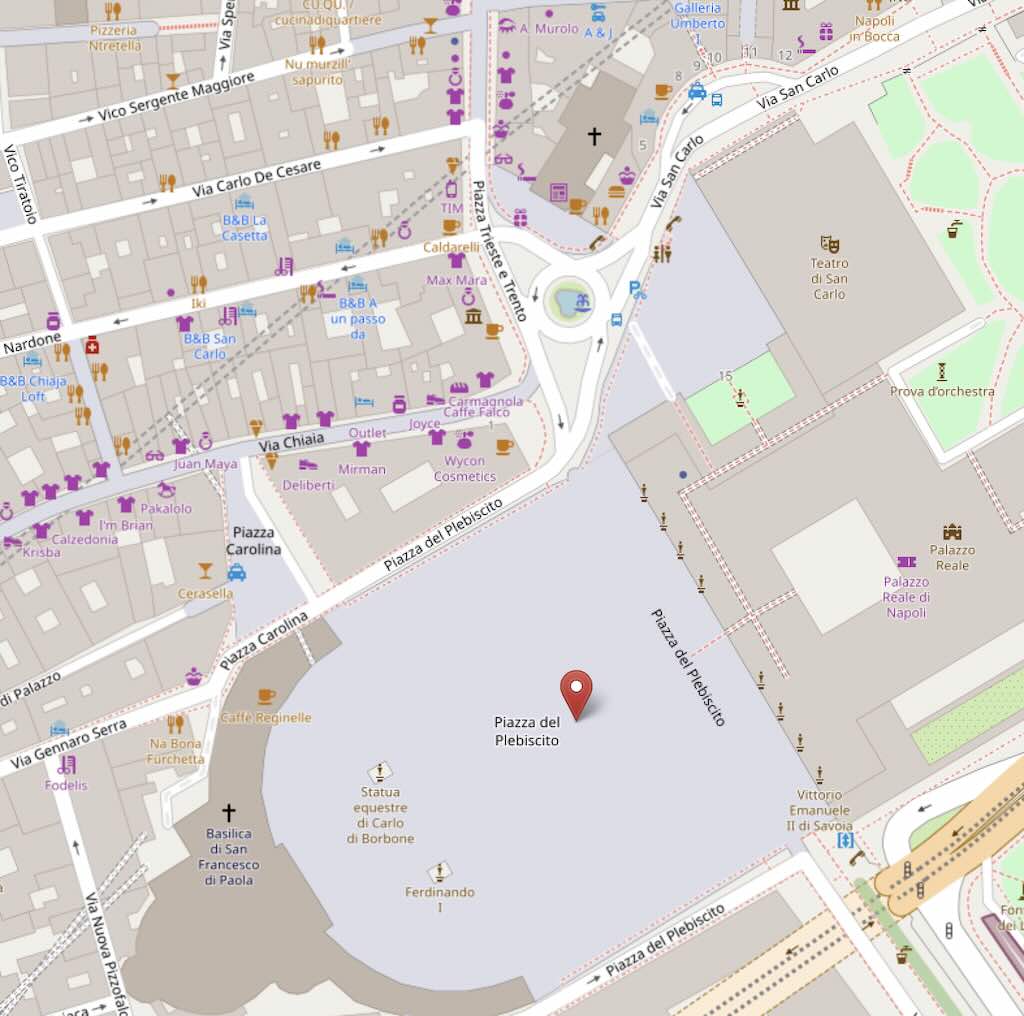
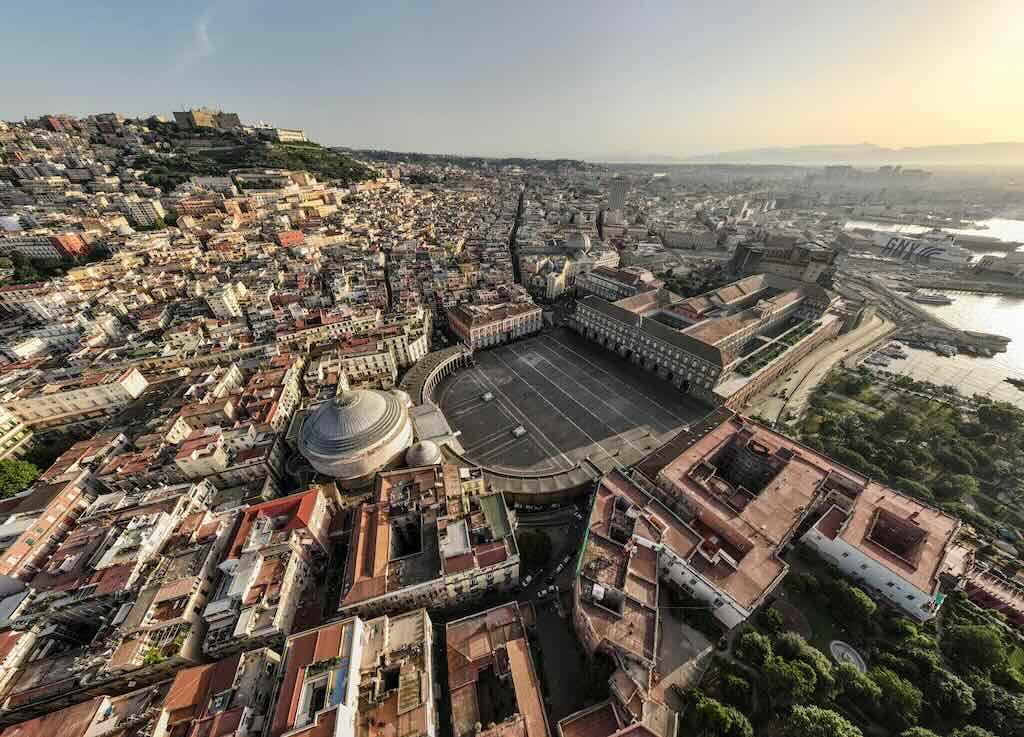
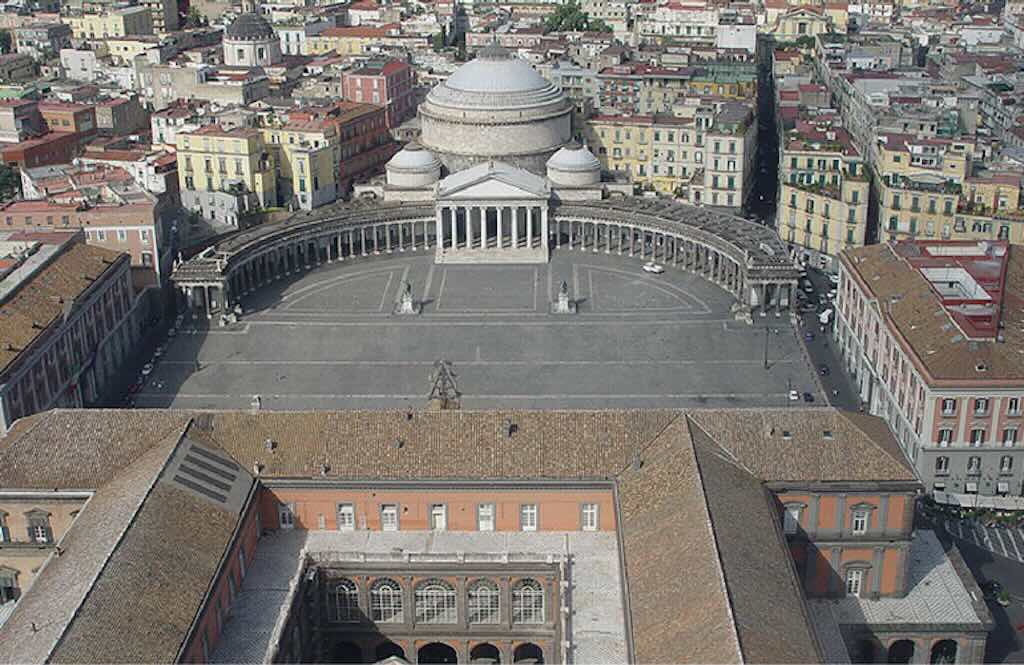
Piazza del Plebiscito is the largest and most famous square in Naples, located near the waterfront and at the heart of the historic city. Surrounded by impressive architecture, it is framed on one side by the grand Royal Palace of Naples (in one photo we are looking over the roof of this building) and on the other by the neoclassical Basilica of San Francesco di Paola, with its sweeping colonnade. The square itself is a vast open space often used for public events, offering visitors a striking view of Naples’ history and monumental style.
Piazza del Plebiscito was developed mainly in the early 19th century, during the rule of Joachim Murat (1767-1815), who was installed as king by Napoleon Bonaparte (1769-1821). Murat wanted to modernise Naples and create a grand, open square that would reflect the power and prestige of his government, so he ordered the demolition of older buildings in the area.
After Murat’s fall, the restored Bourbon king Ferdinand I of the Two Sicilies (1751-1825) completed the project and added the monumental Basilica of San Francesco di Paola in the 1810s–1820s, as a symbol of royal authority and religious devotion.
The square takes its current name from the plebiscite (popular vote) of 1860, when the Kingdom of the Two Sicilies voted to join a unified Italy (1861).
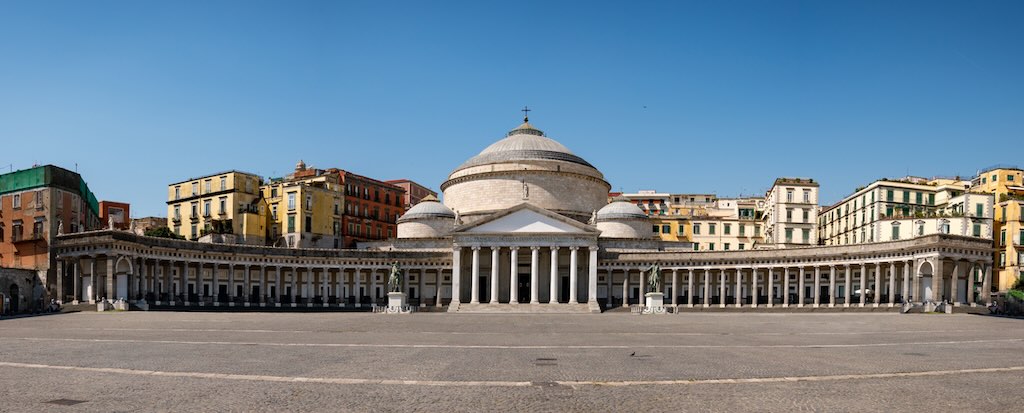
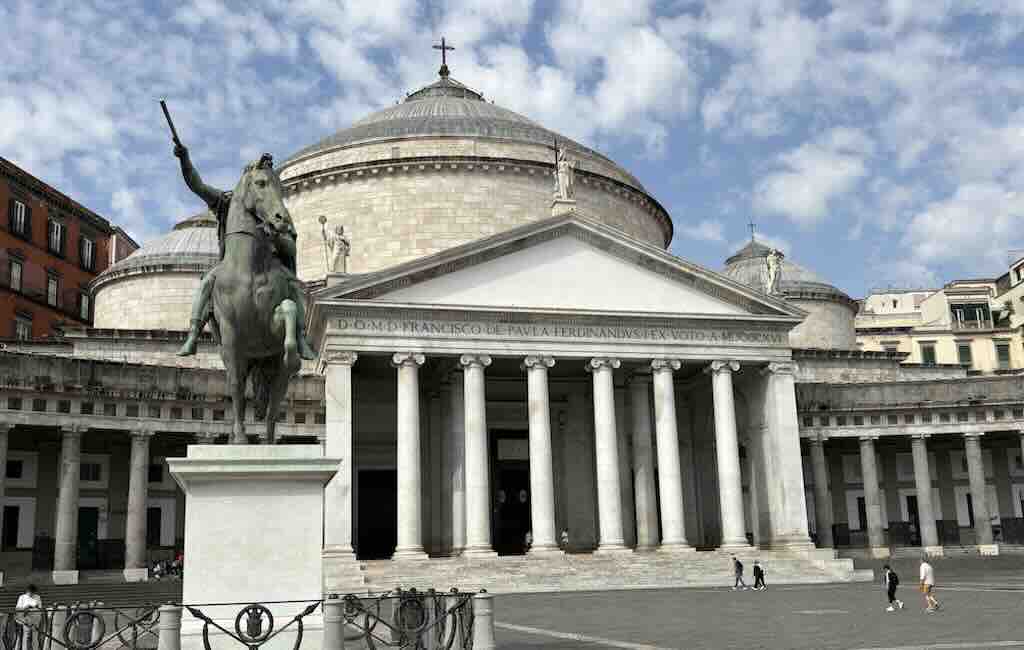
The exterior of the Basilica of San Francesco di Paola is striking because it was designed in a grand neoclassical style, deliberately echoing ancient Roman architecture, especially the Pantheon. Its most distinctive feature is the huge central dome paired with a deep portico supported by tall Ionic columns, giving it a temple-like appearance rather than a typical baroque church. The sweeping semicircular colonnade that embraces the square adds to its monumental, almost theatrical presence.
The basilica was designed by little known and long forgotten Swiss architect Pietro Bianchi. Construction began around 1816 and was completed in 1824, during the restoration of the Bourbon monarchy under Ferdinand I of the Two Sicilies.
Its classical style certainly makes it stand out in comparison with Naples’ dominant baroque tradition. As far as I know locals in Naples have a mixed but generally positive relationship with Piazza del Plebiscito and the Basilica of San Francesco di Paola.
On the positive side, the piazza is widely appreciated as a rare, large open space in a dense city. Neapolitans use it as a place to walk, meet friends, let children run around, and attend major events (e.g. concerts, celebrations, political gatherings, etc.). It’s often seen as a kind of “living room” of the city, especially in the evenings.
That said, it hasn’t always been loved. For a long time in the 20th century, the square was used as a parking lot, which damaged its image. Even today, some locals feel it’s a bit too empty or monumental, lacking the lively, chaotic character that defines much of Naples’ street life.
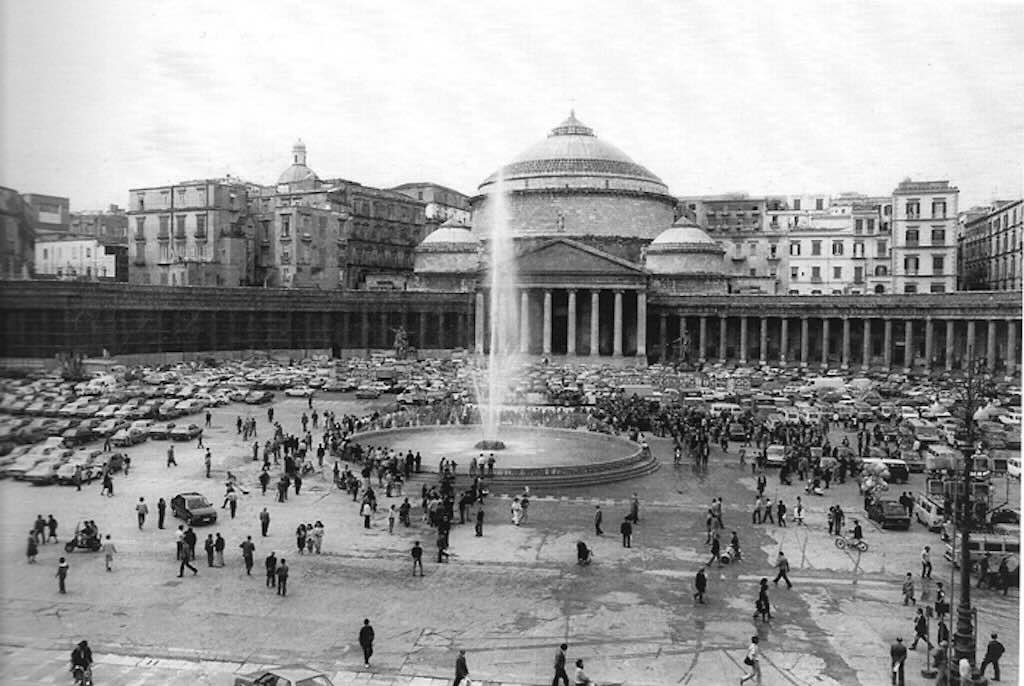
As for the basilica, it’s respected and admired for its imposing beauty and symmetry, but it doesn’t have the same emotional pull as some of Naples’ older, more richly decorated Baroque churches. Its elegant neoclassical style can feel a bit cold or “foreign” compared to the city’s traditional aesthetic.
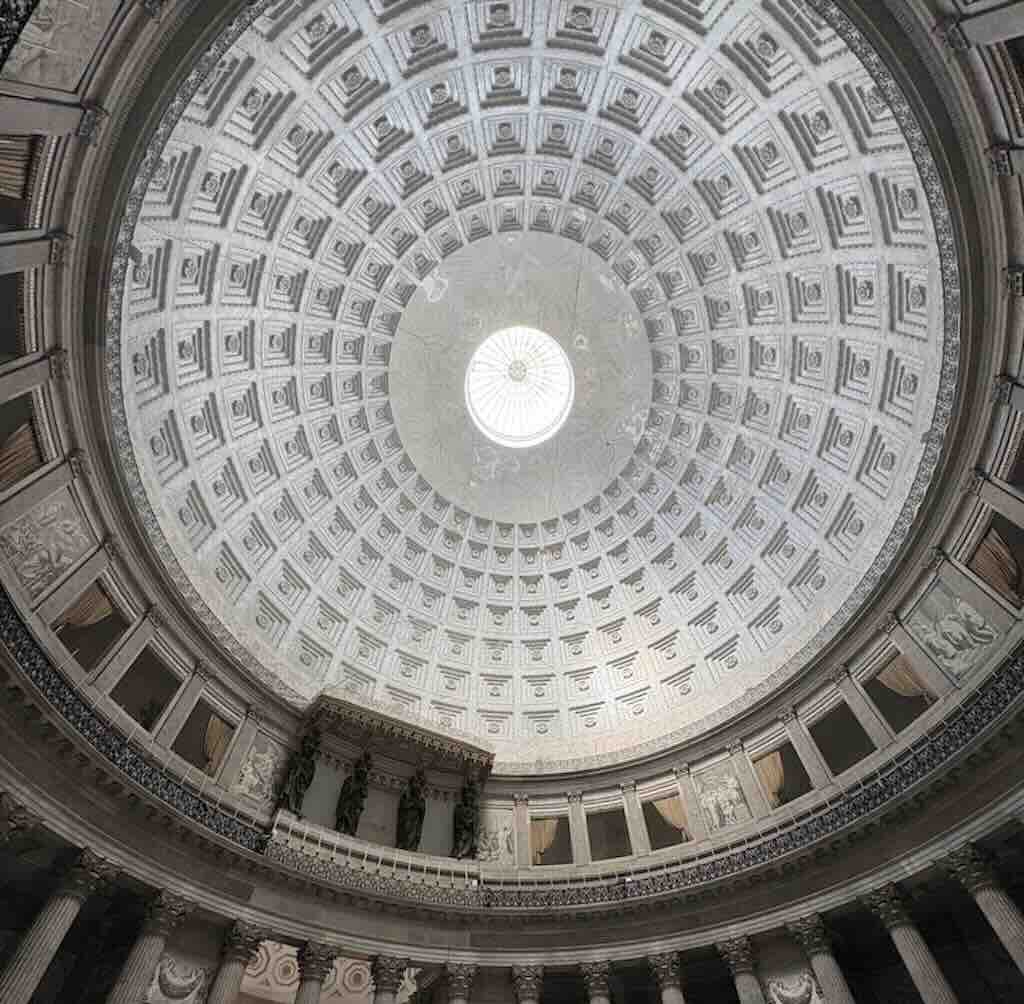
Inside, the vast circular space rises in a perfect hemisphere, its surface articulated by a regular grid of deeply recessed coffers that diminish in size toward the central oculus. This creates a strong visual pull upward, emphasising both height and symmetry. Around the base of the dome runs a ring of columns and niches, forming a continuous classical order that supports the structure and reinforces the sense of balance and proportion. It is also the work of Pietro Bianchi, who really tried to create something equivalent to the Pantheon.
Technically, the dome is a coffered masonry dome (real and not painted) with a central oculus that allows natural light to enter from above, illuminating the interior in a controlled, diffuse way. The coffering is not only decorative but also serves to reduce the weight of the dome without compromising structural integrity. My guess is that it still weighs ~20,000 to 30,000 tons, as compared to the larger Pantheon dome at around 4,500–5,000 tons (which uses Roman concrete with progressively lighter materials toward the top). The geometry is highly disciplined with a hemispherical form resting on a circular drum, with evenly spaced columns below distributing the load.
Compared to the richly decorated Baroque interiors common in Naples, this space feels a bit austere. There is little colour, minimal ornament, and a strong reliance on pure form, basically a circle, column, and dome. This simplicity reflects neoclassical ideals of clarity, harmony, and rationality. For some this gives the space a sense of calm grandeur, for others, it can feel somewhat cold or lacking in emotional warmth.
The dome itself has a diameter of about 34–35 metres, which is very close to that of the Pantheon (about 43.3 metres) in overall concept, though it looks noticeably smaller. The dome in St. Peter’s Basilica is about 42 meters in diameter, and Brunelleschi’s dome in Florence Cathedral spans about 45 meters.
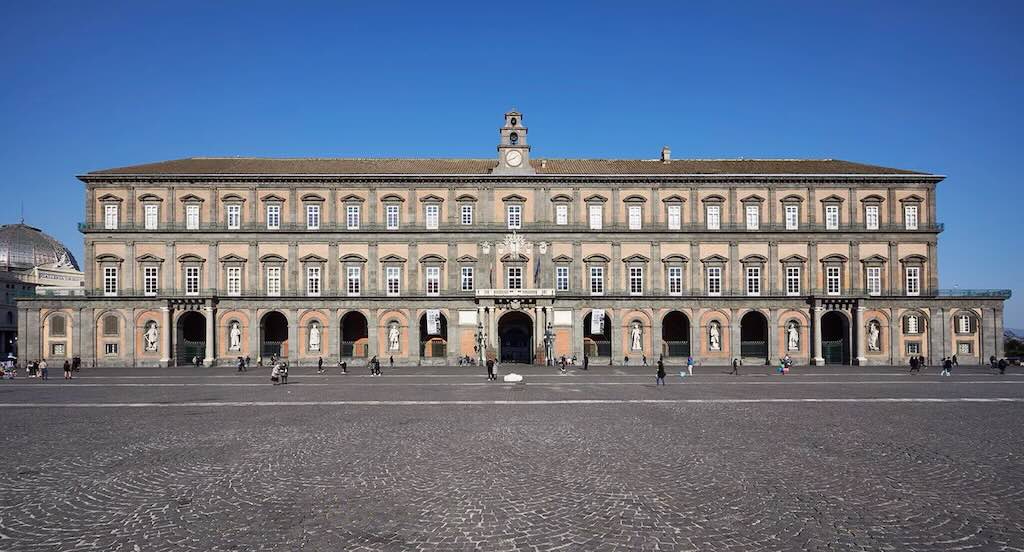
On the north side of Piazza del Plebiscito is Palazzo Reale, the seat of Spanish and later Bourbon power.
The Palazzo Reale (Royal Palace of Naples) was commissioned at the start of the 17th century by the Spanish viceroy Fernando Ruiz de Castro Andrade y Portugal (1548-1601), who governed Naples on behalf of the Spanish crown. Construction began in 1600, with the design entrusted to the architect Domenico Fontana (1543-1607), a leading figure of late Renaissance and early Baroque architecture.
Originally conceived as a grand residence to host the Spanish monarch Philip III of Spain (1578-1621) during a planned visit (never took place), the palace instead became the official seat of Spanish viceroys. Over the centuries, it continued to serve as a royal residence under subsequent rulers, including the Bourbons and later the Savoy dynasty after Italian unification (1861).
Today, the palace functions primarily as a museum and cultural site, housing historic apartments, artworks, and part of the National Library.
As suggested by our group guide, we can look at the 8 statues set in ground-level niches along the façade, as representing key periods in Naples history (starting from the left).
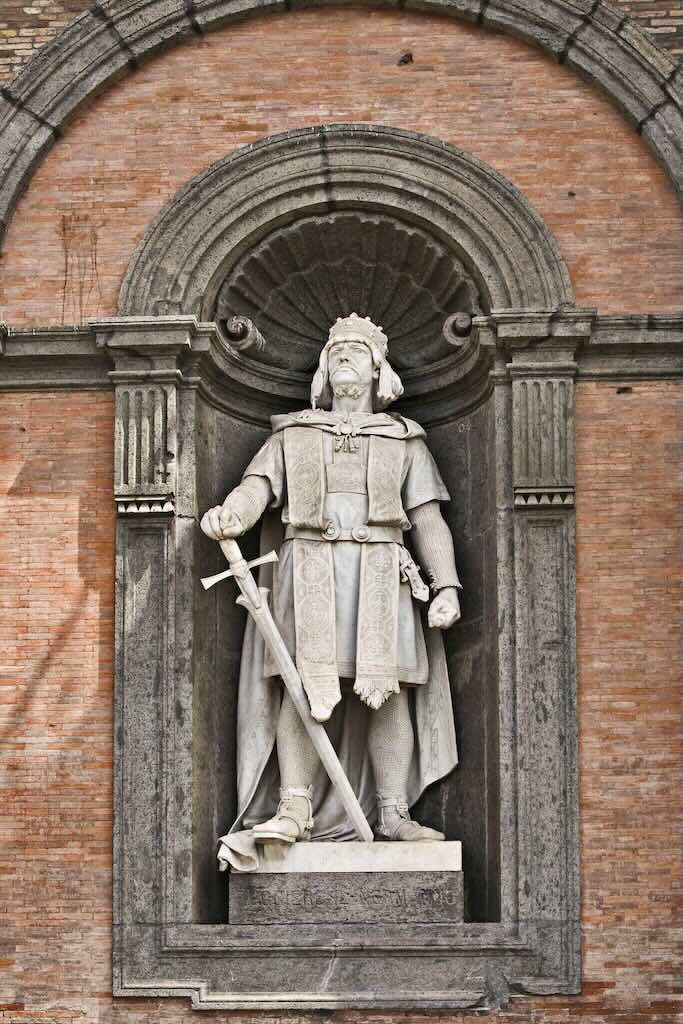
Roger II (1095-1154) represents the Norman conquest and consolidation of southern Italy (999-1194), marking the first time Naples became part of a strong, centralised kingdom rather than a semi-independent duchy. A Norman ruler of mixed Viking and French heritage, he became King of Sicily in 1130 and brought Naples under his control as part of a broader strategy to unify southern Italy and Sicily into one of the most sophisticated states in medieval Europe. His court, based mainly in Palermo, was famously multicultural (e.g. blending Latin, Greek, and Arab influences) and he promoted administration, law, and trade, helping stabilise a region long fragmented by competing powers.
Naples mattered to Roger II primarily as a strategic port and gateway to the mainland, strengthening his control over Mediterranean trade and military movement. Under his rule, the city lost its old autonomy but gained inclusion in a larger, more stable political system. His reign is often seen as a high point of medieval governance in the region, with effective bureaucracy and relative religious tolerance.
However, a major criticism of Roger II lies in how he imposed control. His conquest of southern Italy involved prolonged warfare and suppression of local independence, including Naples’ own traditions of self-rule. Some contemporaries and later historians also viewed his rule as authoritarian, concentrating power heavily in the monarchy and reducing the influence of local elites. While successful, his system depended strongly on his personal authority, making it harder to sustain after his death.
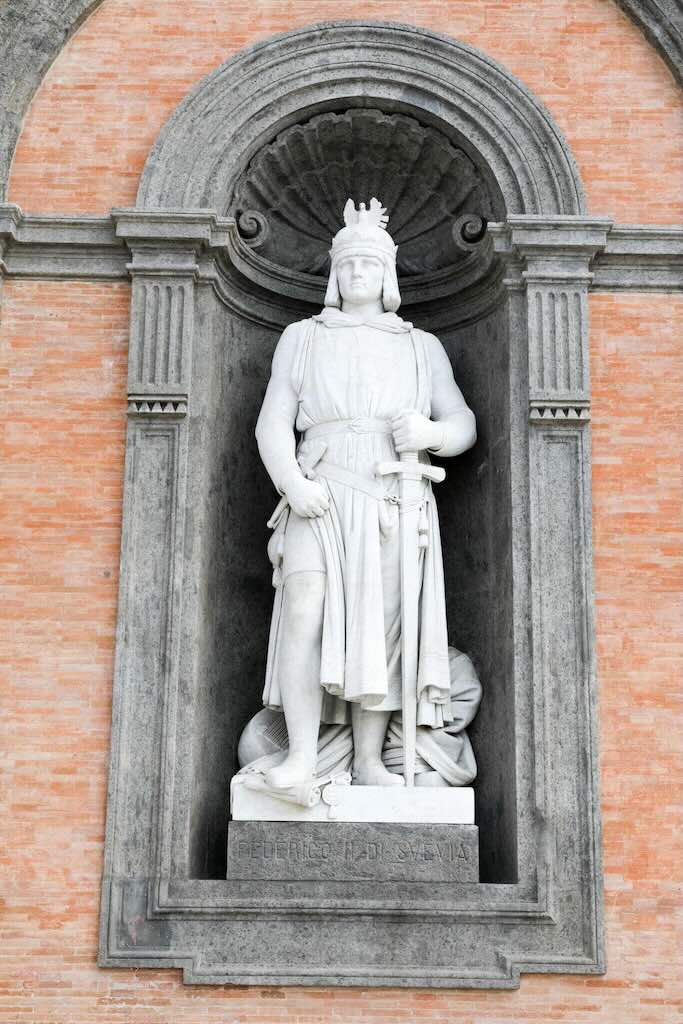
Frederick II (1194-1250) represents the period when Naples became part of a powerful imperial system under the Holy Roman Empire (800/962–1806), reinforcing and expanding the centralised model first imposed by the Normans. Ruling in the early 13th century, he inherited the Kingdom of Sicily and used Naples as a key mainland city within his dominion, though, like Roger II, he governed primarily from Sicily. His connection to Naples is especially significant because in 1224 he founded the University of Naples, one of the first state universities in Europe, designed to train administrators loyal to the crown rather than the Church. This reflects his aim to build a highly organised, secular state with strong legal and bureaucratic structures, reducing feudal fragmentation and limiting papal influence.
Frederick II is often seen as a remarkably modern ruler being a patron of science, law, and culture, but a major criticism of his rule is its authoritarian and confrontational nature, particularly toward the papacy. His repeated conflicts with the popes led to excommunication and political instability, and his heavy centralisation meant that cities like Naples had little political autonomy, functioning mainly as administrative centers within his empire rather than self-governing communities.
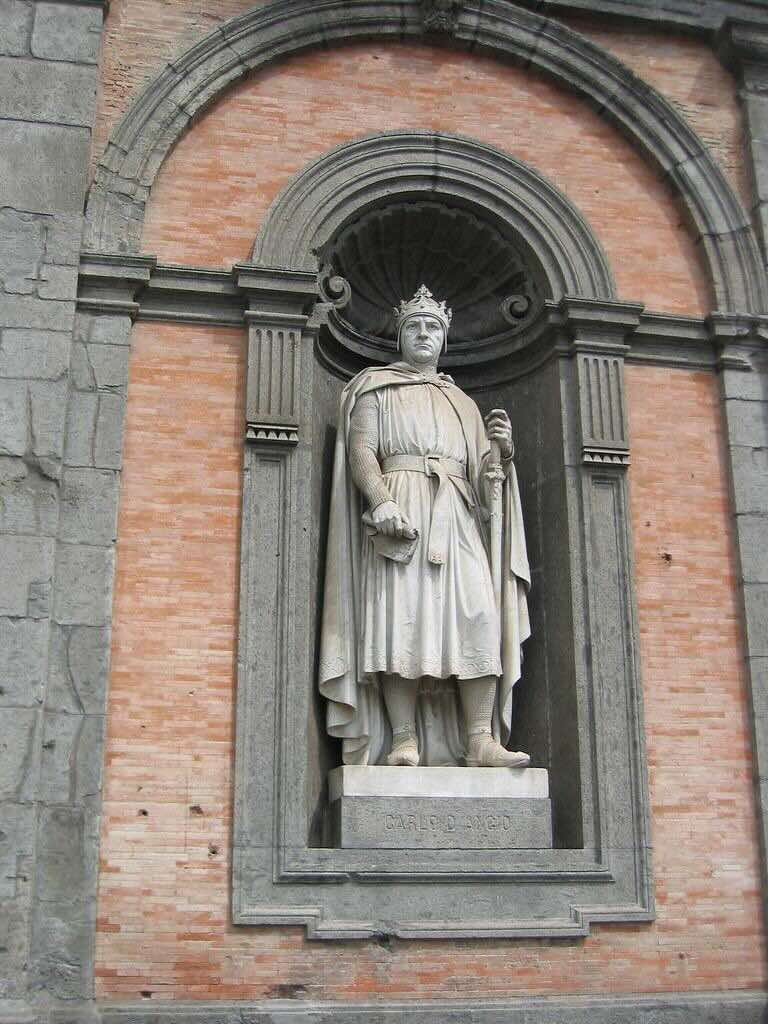
Charles I of Anjou (1226/1227-1285) represents a decisive turning point when Naples became the political capital of the kingdom for the first time. A French prince invited by the papacy, he defeated the Hohenstaufen dynasty (1079-1318 with the heirs of Frederick II) at the Battle of Benevento in 1266 and took control of southern Italy. Unlike previous rulers, Charles chose Naples as his capital city, shifting the center of power from Palermo to the mainland and transforming the city into a major administrative and political hub. Under his rule, large building projects were initiated, including fortifications and what would become the Maschio Angioino (Castel Nuovo), reinforcing Naples as a royal seat. His reign marks the beginning of Naples’ long history as a capital city rather than a secondary provincial port.
However, Charles I is heavily criticised for his harsh and extractive rule, particularly his heavy taxation and favoritism toward French officials, which alienated local populations across the kingdom. His rule contributed directly to the outbreak of the Sicilian Vespers in 1282, a violent uprising that led to the loss of Sicily and permanently split the kingdom into two parts. While he elevated Naples politically, his policies also created instability and resentment that weakened his broader rule.
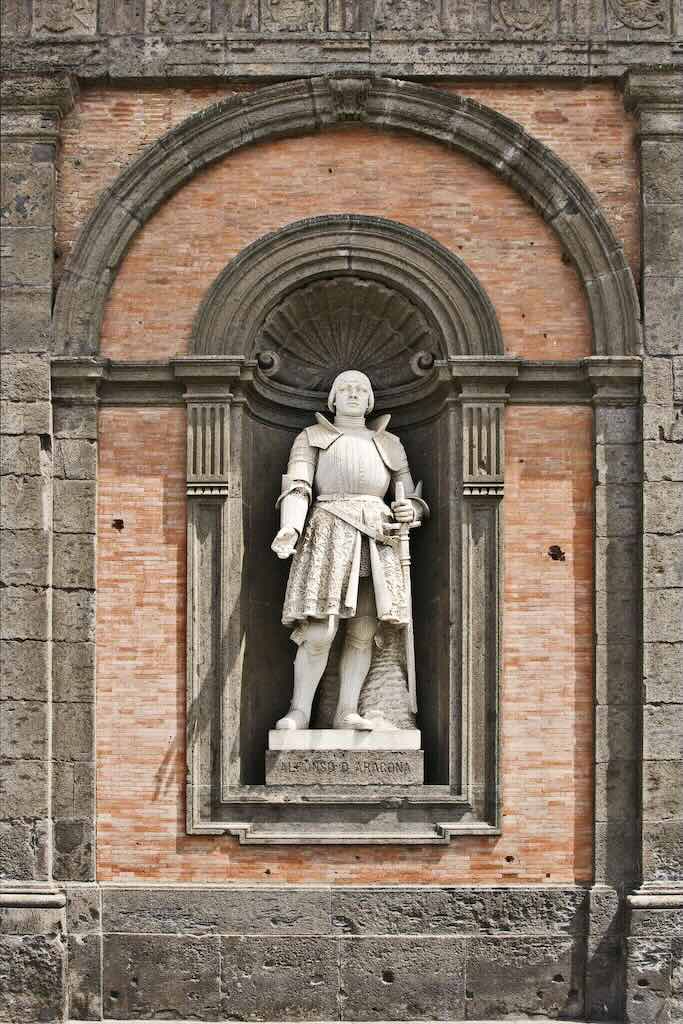
Alfonso V of Aragon (1396-1458) represents the moment when Naples became a major Renaissance court and a centre of Mediterranean politics. A Spanish ruler from the Crown of Aragon, he conquered Naples in 1442 after a prolonged conflict with the Angevin dynasty. Unlike earlier foreign rulers, Alfonso embraced Naples as his main residence, transforming it into a vibrant cultural capital. He promoted humanism, attracted scholars and artists, and reshaped the city architecturally. Most notably through the renovation of the Castel Nuovo, including its famous triumphal arch celebrating his victory. Under his rule, Naples became deeply connected to the wider Aragonese empire, linking Italy more closely with Spain and the western Mediterranean.
A major criticism of Alfonso’s rule is that, despite its cultural brilliance, it remained personally driven and fragile. His court depended heavily on his presence and patronage, and after his death, the kingdom was divided and weakened. Additionally, his conquest was achieved through prolonged warfare and siege, causing instability, and like previous rulers, he governed as a foreign monarch, meaning Naples’ political life remained controlled from above rather than locally rooted.
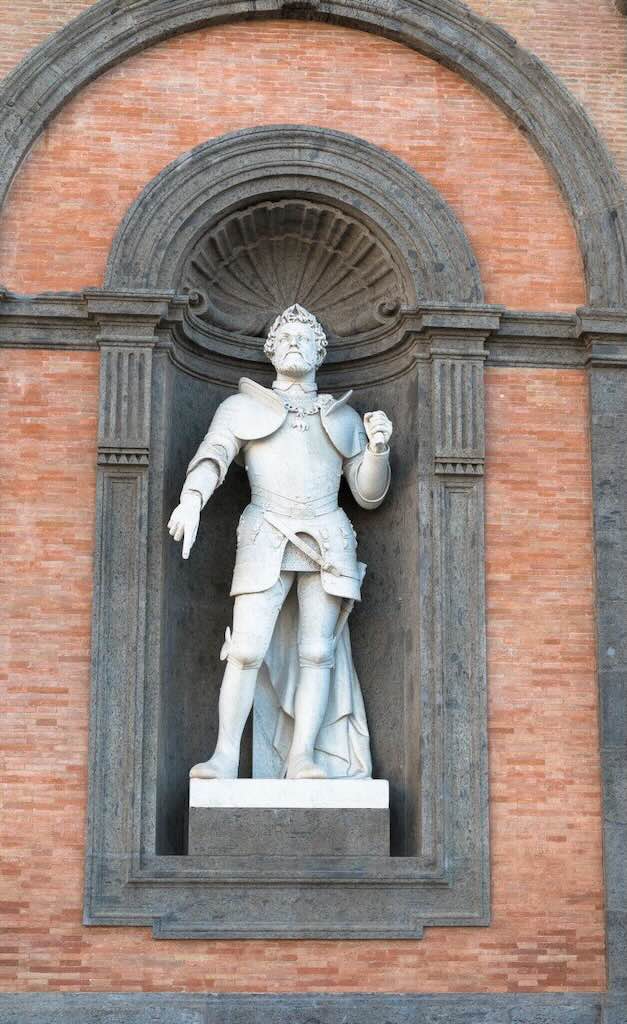
Charles V (1500-1558) represents the period when Naples was fully integrated into the vast Spanish Habsburg Empire (1516–1700), becoming one of its most important Mediterranean territories. Ruling in the 16th century, he did not live in Naples but governed through Spanish viceroys, reflecting a shift from resident monarchs to distant imperial control. Naples’ importance under Charles V was strategic, in that it served as a key military and naval base for defending against the Ottoman Empire (1299–1922) and controlling trade routes. During this time, the city was heavily fortified, with major projects like the strengthening of Castel Sant’Elmo and expanded defensive walls, showing its role as a frontline imperial stronghold rather than a cultural capital.
The major criticism of this period is that Naples became economically and politically subordinated to Spain. Heavy taxation was imposed to fund Habsburg wars across Europe, placing a burden on the local population and economy. Additionally, governance by viceroys meant that Naples had little direct political agency, reinforcing its role as a provincial outpost of a global empire rather than an independent or locally driven centre of power.
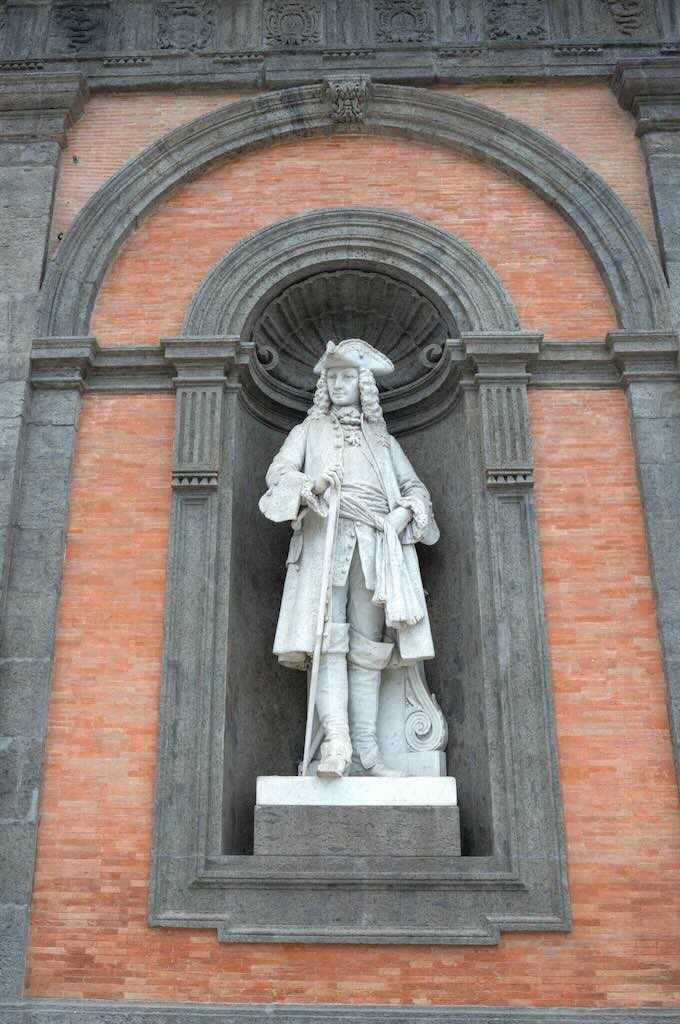
Charles III of Spain (1716-1788) represents a major turning point when Naples, after centuries of foreign-controlled rule, became the centre of a revived and a more independent Bourbon kingdom in the 18th century. He arrived in Naples in 1734 after the War of the Polish Succession (1733–35) and established an independent Bourbon monarchy, no longer directly governed by Spain. Unlike earlier distant rulers, Charles resided in Naples and actively invested in the city, promoting urban renewal, administration, and culture. His reign is associated with large-scale projects such as the expansion of the Palazzo Reale and the construction of the Reggia di Caserta, reflecting both political ambition and Enlightenment (1687–1789) ideals of order and governance. He also introduced administrative and economic reforms aimed at modernising the state and reducing feudal constraints.
However, a key criticism of Charles III’s rule is that, despite reformist intentions, it remained a form of enlightened absolutism, with power concentrated firmly in the monarchy. Many reforms were top-down and limited in depth, leaving underlying social inequalities largely intact. Additionally, when Charles left Naples in 1759 to become King of Spain, the continuity of his reforms weakened, showing that progress was still heavily dependent on the ruler rather than stable institutions.
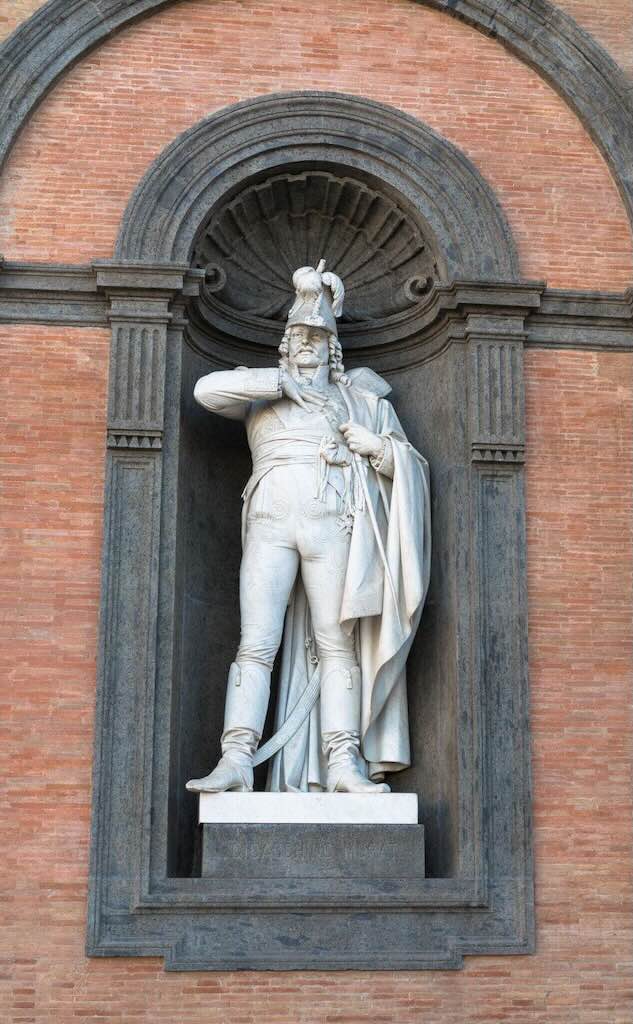
Joachim Murat (1767-1815) represents the brief but significant period when Naples came under Napoleonic control, bringing rapid reform and modernization. A marshal of Napoleon and his brother-in-law, Murat became King of Naples in 1808 after the French takeover of southern Italy. Unlike many earlier rulers, he ruled directly from Naples and aimed to transform it into a modern capital aligned with Napoleonic ideals. He introduced reforms such as the abolition of feudal privileges, administrative reorganisation, legal reforms based on the Napoleonic Code, and improvements to infrastructure and urban planning. This period marks a shift toward a more modern state structure, breaking with older aristocratic systems.
However, Murat’s rule is often criticised for being politically unstable and opportunistic. His authority depended entirely on Napoleon’s empire, and when that collapsed, his position quickly became untenable. In a last attempt to retain power, he turned against Napoleon and tried to rally Italian nationalism, but this failed. He was ultimately captured and executed in 1815. His reforms, while important, were short-lived and inconsistently applied, and Naples soon returned to Bourbon rule, limiting the long-term impact of his rule.
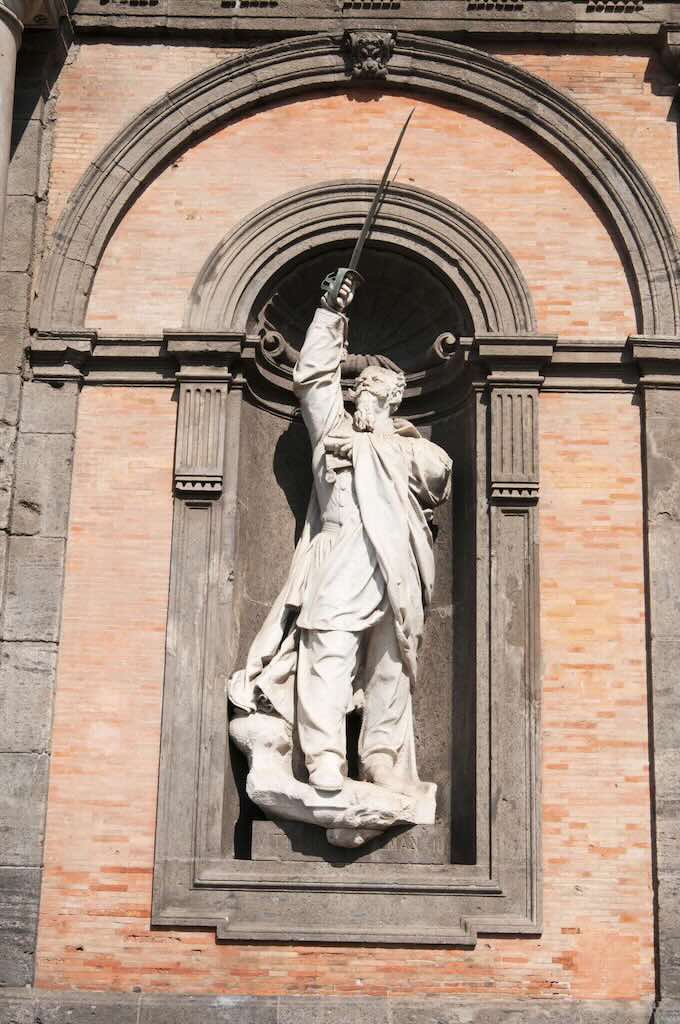
Victor Emmanuel II (1820-1878) represents the end of Naples as an independent kingdom and its incorporation into unified Italy. King of Sardinia-Piedmont, he became the first King of Italy in 1861 after the campaigns of Giuseppe Garibaldi (1807-1882), who conquered the Kingdom of the Two Sicilies (which included Naples) in 1860. Naples was important in this context as the largest city in southern Italy and the capital of the Bourbon kingdom, making its annexation a decisive step in national unification. Unlike earlier rulers, Victor Emmanuel II did not rule Naples as a separate entity, but it became part of a centralised Italian state governed from the north.
A major criticism of this period is that unification led to what many historians call the “Southern Question”, i.e. Naples and the wider south experienced economic decline, loss of political status, and social unrest after being absorbed into the new kingdom. Industries weakened, administrative power shifted away, and policies often favored northern regions. As a result, while unification created a modern nation-state, it also marked the end of Naples’ role as a capital and the beginning of long-term regional inequality that remains a subject of debate today.
Pino Daniele wrote and sang
“Napule è mille culure”
(Naples is a thousand colours)