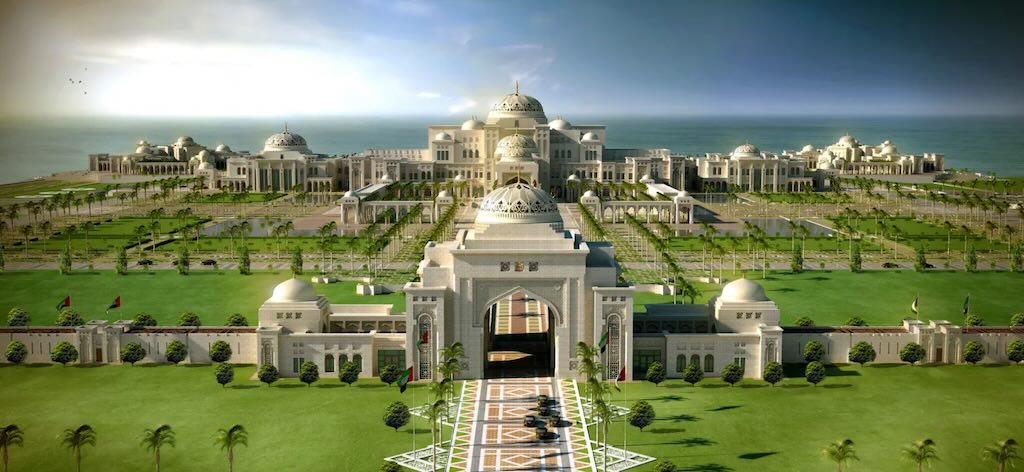
During my visit to Abu Dhabi in early December 2025, I visited the presidential palace, which has been open to the public since March 2019.
I booked a one-week holiday package with my local carrier Luxair, and I stayed at Hotel Beach Rotana (see my review).
I also visited (and reviewed):-
First Steps
I finally decided on three different sites, and the first one was the Great Mosque, the second was the Louvre Abu Dhabi, and the third and last site was Qaṣr Al-Waṭan, the “Palace of the Nation”, or presidential palace.
On the Palace website I pre-purchased a ticket for a specific day and time. And I purchased a separate ticket for a private tour.
There is an official dress code, because the site is a working government palace and a cultural landmark.
However, it is less strict than when visiting a mosque. Women should wear tops and dresses that cover shoulders, and skirts/dresses/trousers covering knees. They should avoid tight, transparent, or overly revealing clothing, but headscarves are not mandatory. Men should wear shirts with sleeves (no tank tops), and long trousers (knee-length shorts are accepted but long trousers are recommended). The key is modest dress with covered shoulders and knees.
Check out the palace website.
Also the photographer Dominik Gehl has an outstanding presentation of the palace.
Here is a video trip report, and here is the official visit video.
Occasionally you find videos of the hidden life of a building, here we have Dinamica concealed hinges adjustment and ABS brake, and the fire door tests. The doors themselves are made of solid maple wood with hand-carved designs detailed in gold. The patterns were hand-carved and its estimated that each door took 350-man hours to make.
The Palace Grounds
The Qaṣr Al-Waṭan (“Palace of the Nation”) is located on Ras Al Akhdar, the western end of the Abu Dhabi Corniche. It actually sits on a coastal promontory facing the Arabian Gulf. Ras Al Akhdar is not a single-purpose enclave. It is a mixed, state-controlled headland combining sovereign, hotels, and low-density residential uses. The area was historically associated with government officials, diplomats, and senior state employees.
Work on a secure coastal government zone started in 2011, and lasted about 6 years. One estimate put the cost of the palace at $490 million. Another estimate was that it took 150 million hours of work to build the palace. It’s been nicknamed the ‘Versailles of the Middle East’, in part because the entire security compound has 2,300 rooms.
The Presidential Palace of the United Arab Emirates was seen as a venue for Federal Supreme Council meetings, cabinet and high-level government sessions, and to host state visits and formal diplomatic receptions. So it was, and is even more so today, a symbolic seat of federal authority. It is not a residential palace.
In fact the palace was opened to the public on 11 March 2019. Public access is to the part of the palace used for ceremonial visits (the rest of the site remains a working presidential compound). It is already one of the most-visited palaces in the world, reported to welcome about 3 million visitors per year.
There is no published government statement explaining why this precise site was chosen, nor is there an official cost breakdown.
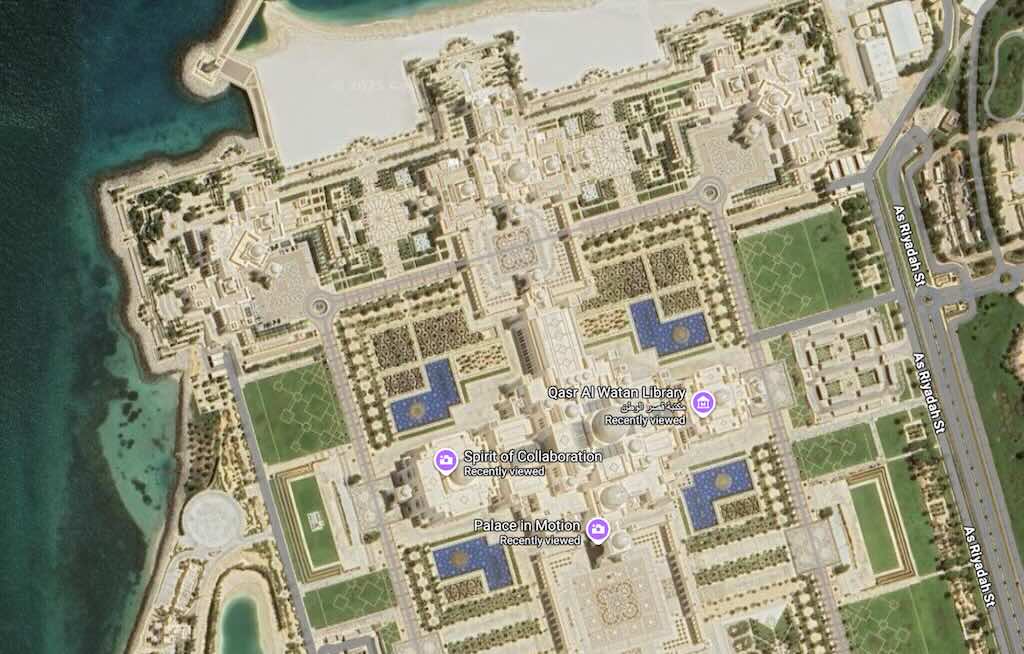
In addition to Qaṣr Al-Waṭan, there are three other, smaller, palaces, sitting behind the “Palace of the Nation”. These are for the President of the UAE, the Vice-President and the Crown Prince of Abu Dhabi.
The entire Presidential Palace compound, is estimated to cover 380,000 square-metres (so more than 50 full-sized football pitches).
Starting the Visit
As mentioned, I bought two tickets, one for access, and one for the guided visit.
Taking a taxi (very reasonably priced), we pasted in front of the palace, and drove round to the visitors entrance (more like a visitor centre).
There is a taxi rank, parking, a ticket office, and most important, the bus to go the palace itself. Tickets were in my iPhone wallet, so it was easy with my access ticket to go through and get on the bus.

Above we can see the palace from the back entrance. It’s obvious that the visit is only to a portion of this massive building, i.e. the great hall, and some of the more important side rooms.
Let us just stop for a moment and look again at the above photo. We have to imagine a modern reinforced concrete building, that would be clad (exterior and interior) with over one million square meters of intricate white granite and limestone, and 22,000 cubic meters of delicate decorative elements. This represents more than half-million pieces individually cut with high precision waterjets. It’s stated that more than 5,000 unique geometric, vegetal, and floral patterns can be seen in the decoration, but this claim is also made for the Grand Mosque. I didn’t count them there, nor here.
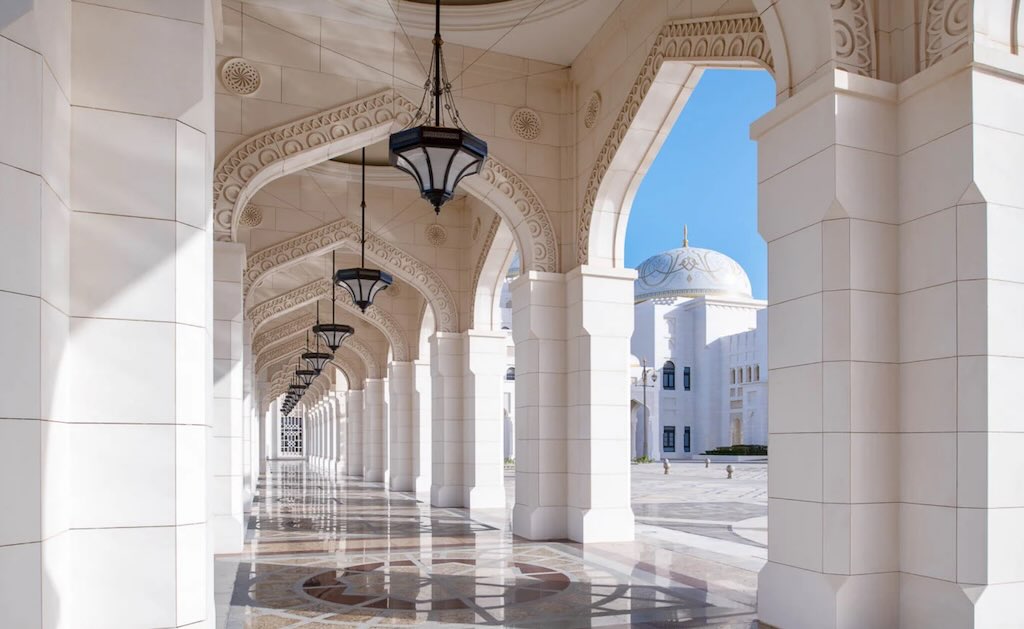
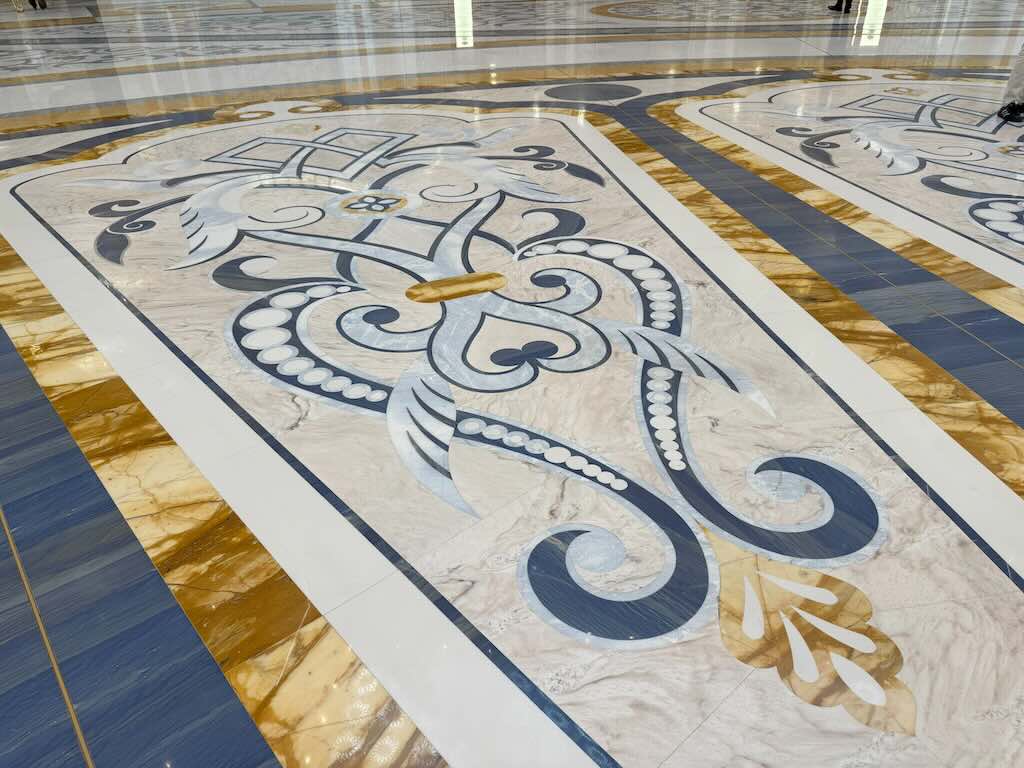
The bus dropped everyone at the colonnade at the front entrance over the far side, where there was also a station for the return trip (though a different exit route). Below we have the main entrance to the palace.
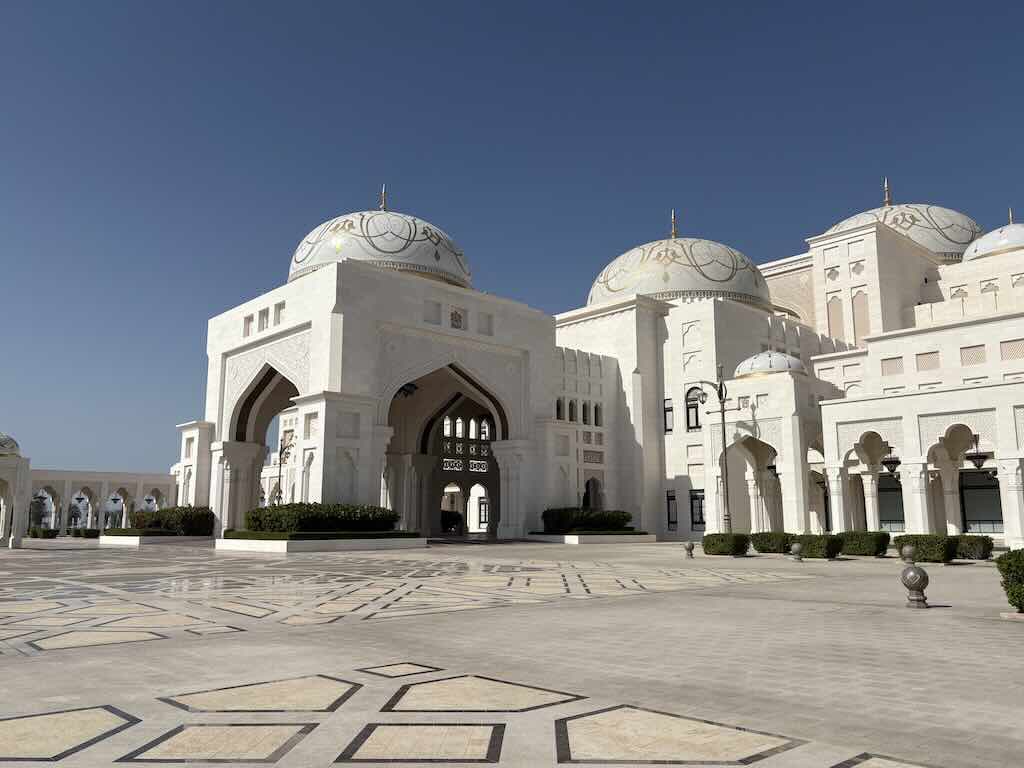
The guided tour is timed exactly, and as you approach the main hall there is a small desk to the left, where I picked-up my guide.
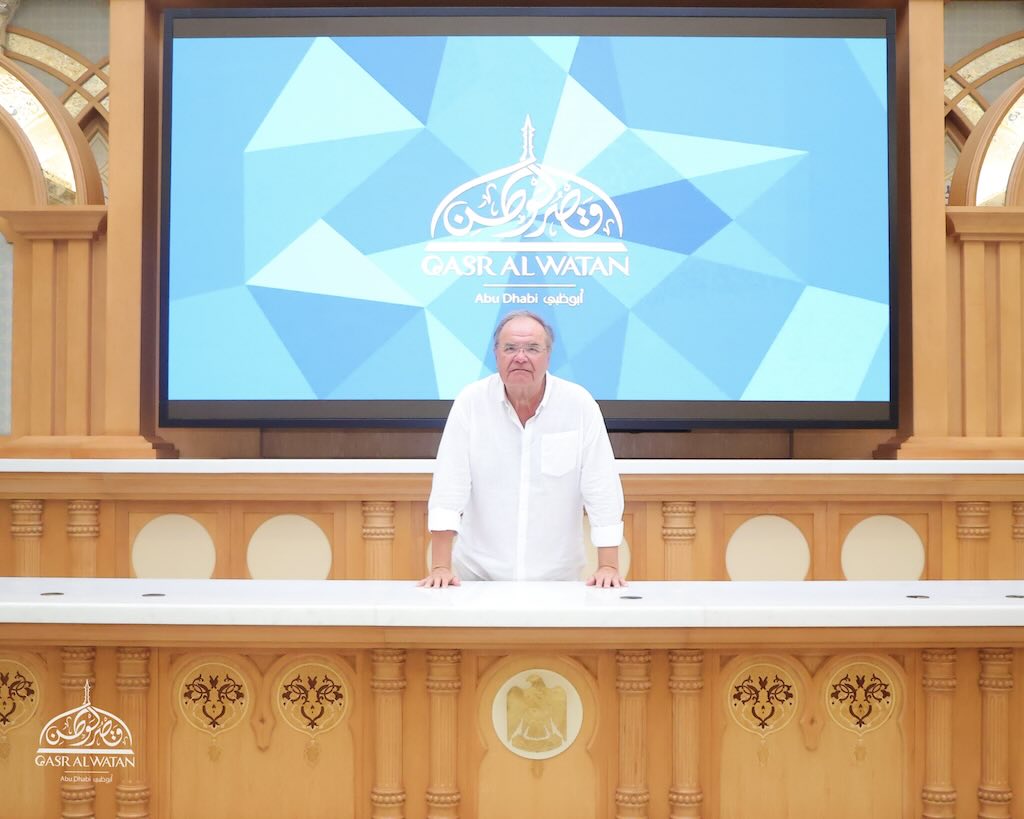
However, before my guided tour, I was “collared” by the local photographer for “A Memory from the Palace”. They take some photos standing, e.g. me waving my hands and arms around, and then also leaning on a desk in a meeting room. These are pasted into a variety of backgrounds, and offered (for a price). I took two largish photos that came with two fridge magnets, and downloaded the rest to my iPhone.
The Visit Starts
Exactly at 12:00 I picked up my private guide, and off we went for about 45 minutes. She was a small, youngish lady, dressed in a simple official looking trouser suit. And she spoke an excellent English. The focus of the visit was more on how the palace is used, and less on its building, etc.
In some ways our visit followed the route that an official guest would take.
Below we have the official floor plan.
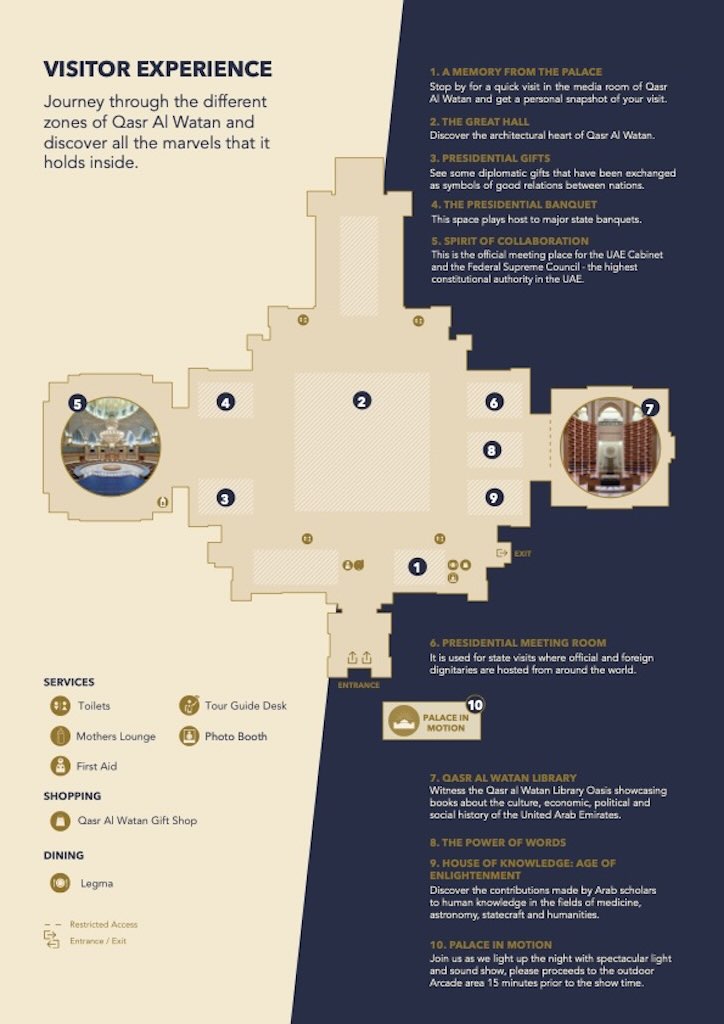
The interior was the work of the French designer Xavier Cartron (see this description). He was commissioned to design and supervise large portions of the interior, particularly the 80,000 square-metres of VIP and official rooms, and of course the Great Hall.
The design brief was for a blend of timeless elegance with local traditions and Islamic cultural principles, using geometry, ornamentation, and craftsmanship that resonates with Emirati heritage.
The Great Hall
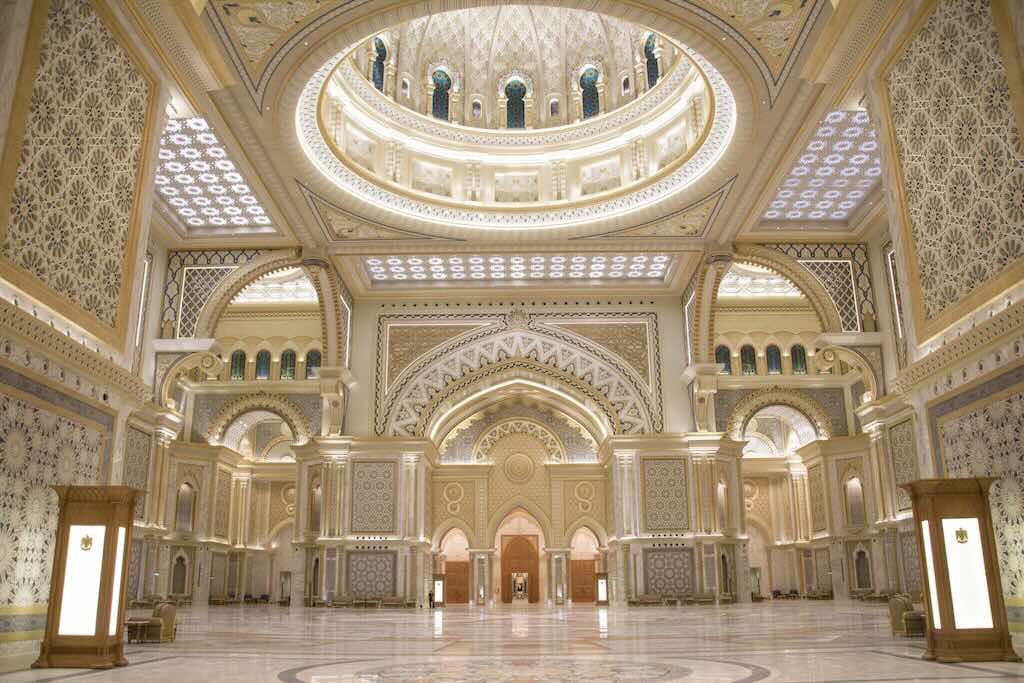
The first thing is that the palace is design around the idea of a “state visit”, so equal-to-equal or sovereign-to-sovereign. There is a massive amount of symmetry everywhere to ensure that symbolic equality is maintained.
But it’s important to note that the palace might not be used for a “working visit”. For example, French President Emmanuel Macron’s December 2025 working visit to Abu Dhabi did not take place at the presidential palace. His official meeting with UAE President Sheikh Mohamed bin Zayed Al Nahyan on 21 December 2025 was held at the Zayed National Museum. They held their talks there, and the luncheon in his honour, with his delegation, also took place in the museum. The next day Macron celebrating Christmas with French forces deployed near Abu Dhabi, and included discussions on France-UAE cooperation in security and defence contexts.
For a state visit, much would be decided by the respective protocol teams.
Normally the motorcade would enter the inner palace perimeter, and guests would be met inside, not at the main public entrance. The aim would be to shift from public ceremony to sovereign-to-sovereign (leader-to-leader), so no guard review, no crowds and media presence would be minimal and tightly staged.
Host and guests exchange greetings inside the palace, often standing in the centre of the Great Hall. It would not be a prolonged ceremony, There would be a brief pause for official photographs, usually against a backdrop of national flags.
The whole point would be a meeting of symbolic equals.

Many of the texts mention that the palace is Mughal-era inspired (not copied). But what does that mean?
The Mughal era (c. 1526–1857) was the period of Mughal rule in South Asia, producing a distinctive imperial architectural language, seen in buildings such as the Taj Mahal, Humayun’s Tomb, and the Red Forts.
What this means is that Qaṣr Al-Waṭan echo’s Mughal architecture with its symmetrical compositions, and monumental domes. The building has a clear central axes, and the repetition of a limited number of arch styles. Surfaces are often white or pale stone, and ornamentation is very repetitive, often geometric. Finally, the interior projects a sense of calm authority.
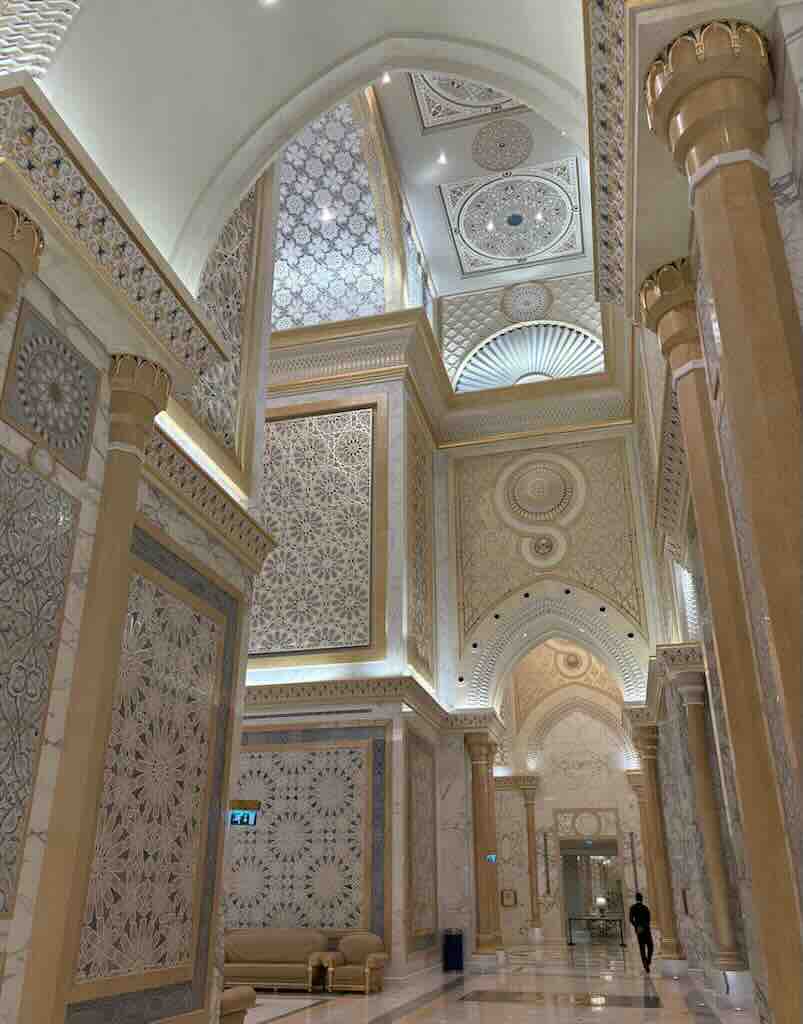
As we look around we can clearly see that Qaṣr Al-Waṭan, has vast symmetrical halls, and a huge central dome. The decoration is relatively restrained but densely geometric, and there is a certain calm authority created by the sense of space.
The sense of calm and space is certainly helped by the choice of three signature colours, blue, white and yellow. The blue is supposed to represents the waters of the Arabian Gulf, the white stands for purity (or sky), while the yellow is inspired by the colour of the desert sands.
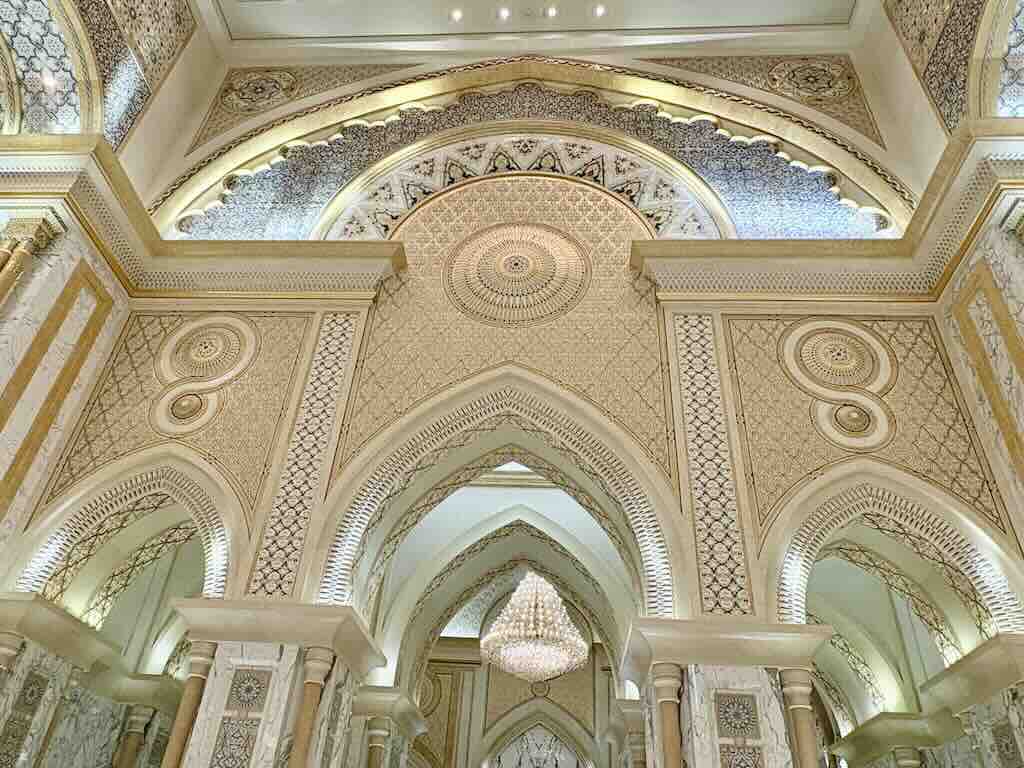
The Great Hall measures 100 metres by 100 metres (one hectare), and the most arresting feature is its central dome. The dome stands 60 metres above the ground and boasting a diameter of 37 metres, making it one of the largest in the world.
A geometric design is based on the division of the walls in to three levels. First level at 6.1 metres high, the second 15.5 metres and the third 21 metres. Why is this important? I’m guessing now, but it is probably important in the technique of decoration.
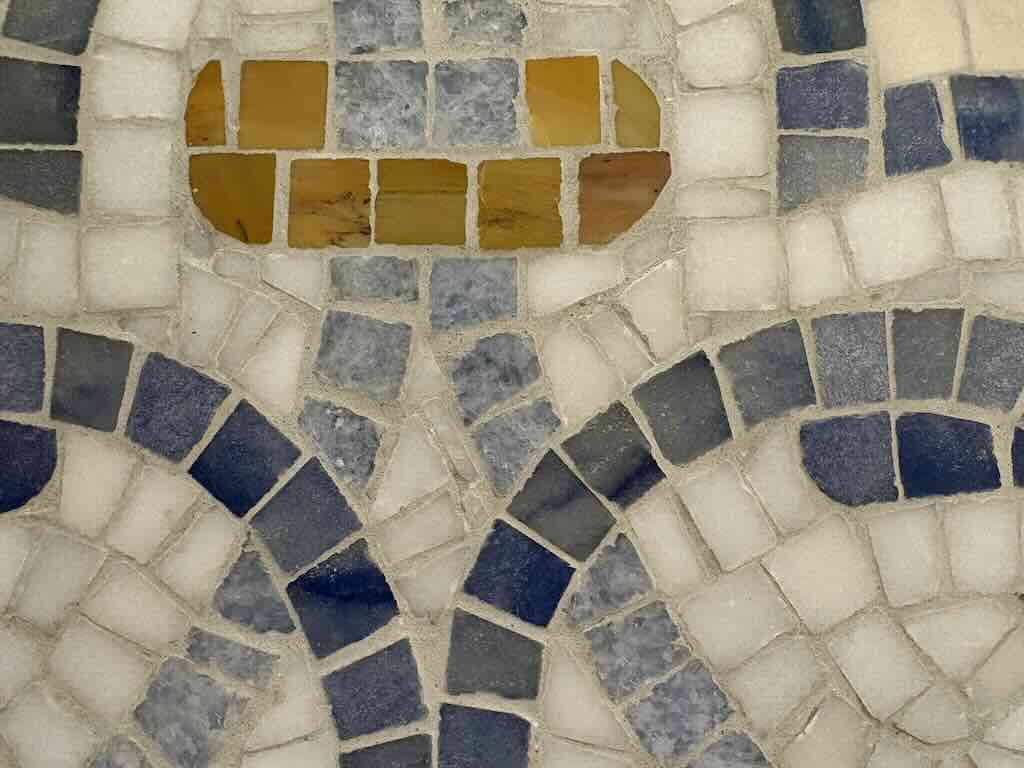
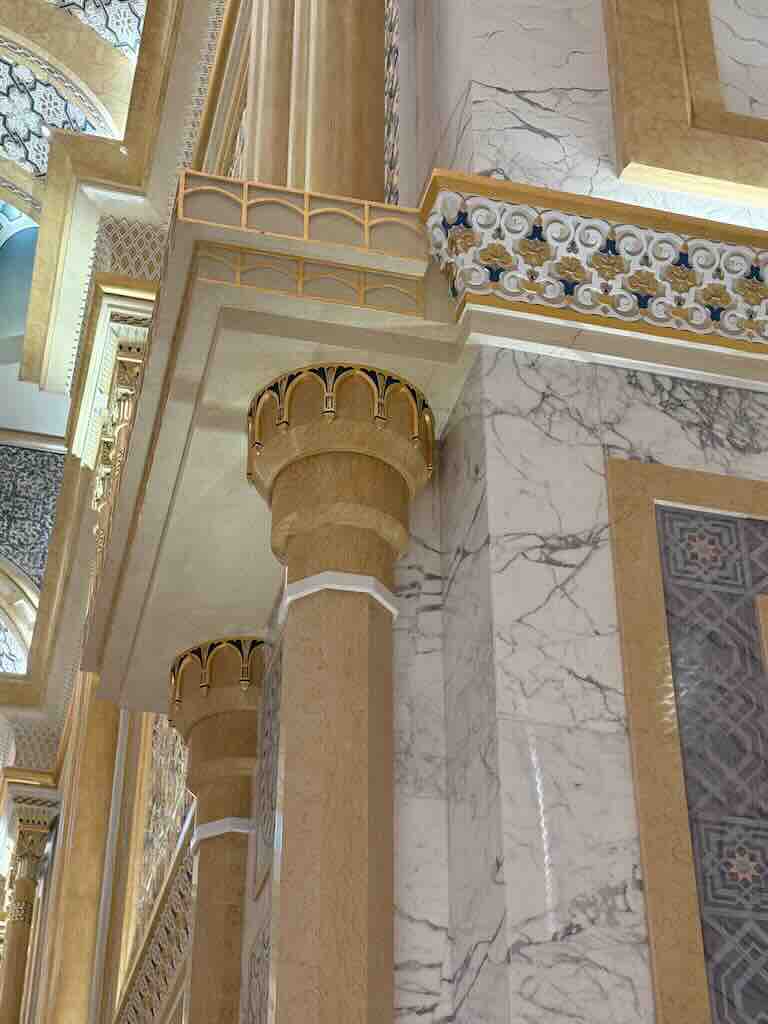
This is a photo I took of a portion of the lower wall in the Great Hall. It is clearly made up of hand cut pieces, hand placed on the wall, according to a pre-established design. It’s impossible, in my mind, to do this over all the surfaces everywhere in the Great Hall. The hint, in my opinion, comes from the mention of the high-pressure water-jet stone cutting. So it would start with panelised sub-structures pre-cut to receive inlaid pieces, then filled with small to medium in size different natural stones, each water-jet cut. This is not, in my opinion, plaster with pieces pushed into it (as in traditional mosaic bedding).
It will not be a simple transition, since water-jet panels work poorly with compound curves unless heavily subdivided. And this would still require hand assembly. But the large, symmetrical expanses are almost certainly panelised water-jet cut marble. Again the hint is in the flooring, which is clearly cut by machine.
Next in our Royal Visit
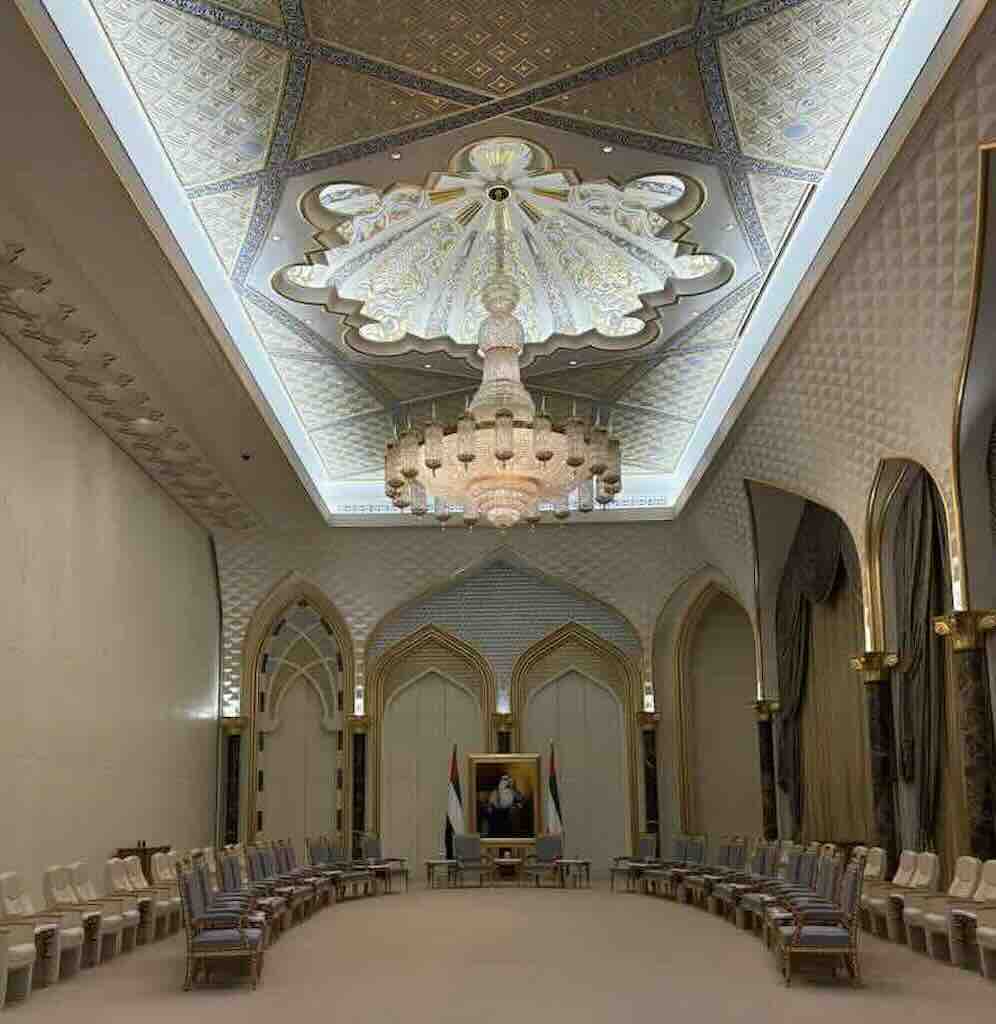
Then the honoured guests would move to a private reception room, only accompanied by one or two senior aides, interpreters, and protocol officers in the background. No press, and no recording. The meeting between equals would take typically 30-60 minutes and follow a pre-arranged agenda, touching always on state relations, security, and almost always economic ties. Seating could be opposite or more usual side-by-side, but never across a barrier such as a table or desk. Symmetry would be respected.
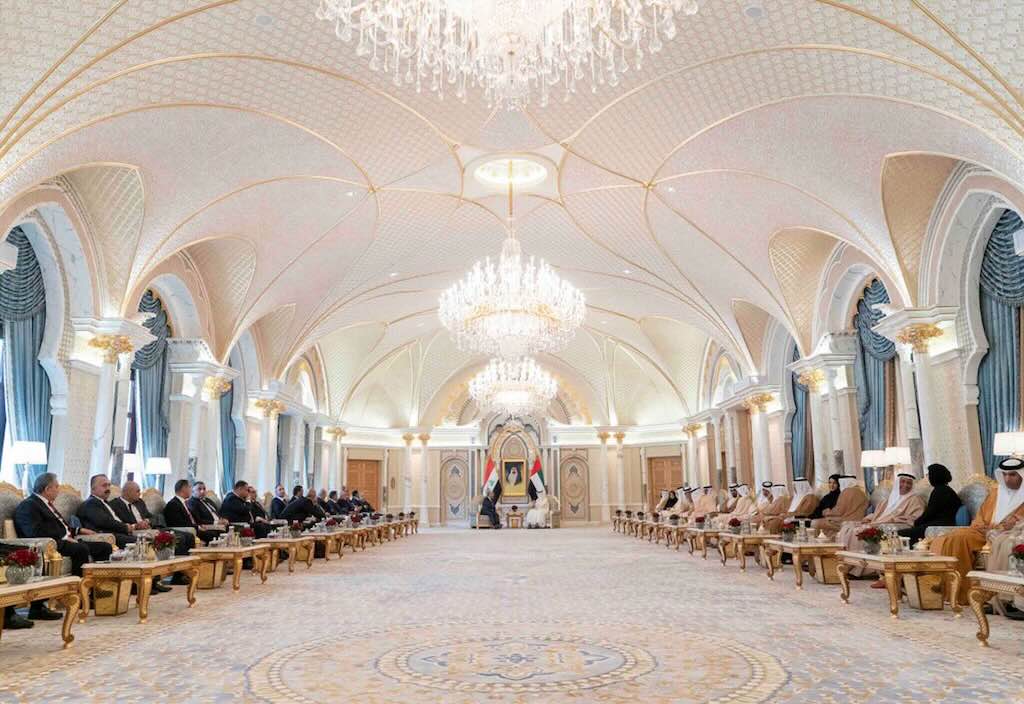

The above meeting room, Al Barza Majlis, is the next largest space in the palace, after the Great Hall. This room features the Brazilian granite pillars (Sodalite), a rare and valuable material covered with semi-precious stones. Al Barza (البرزة) was historically a ruler’s public audience, and Majlis (مجلس) literally means “a place to sit”.

Often, but not always, an expanded meeting between delegations would then take place. Senior ministers (e.g. foreign affairs, defence, economy, energy, etc.) might exchange short statements, but anything agreed would normally not be signed in this meeting.
The Presidential Banquet Hall
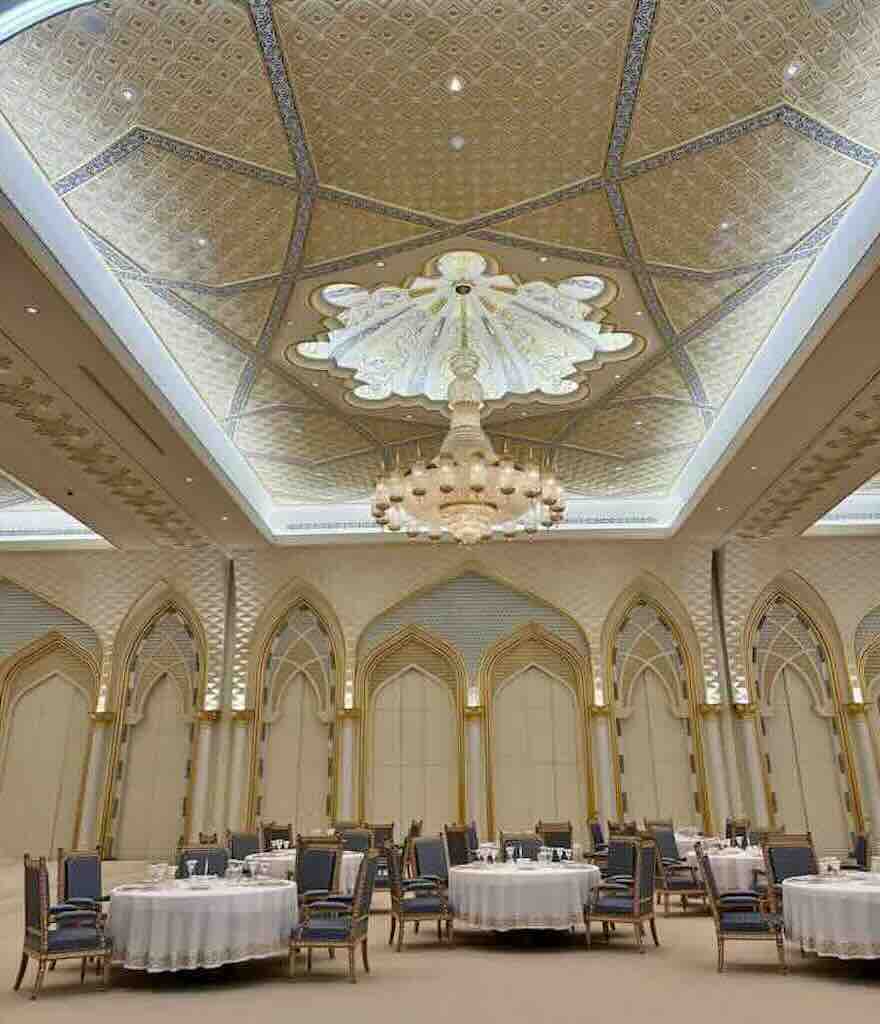
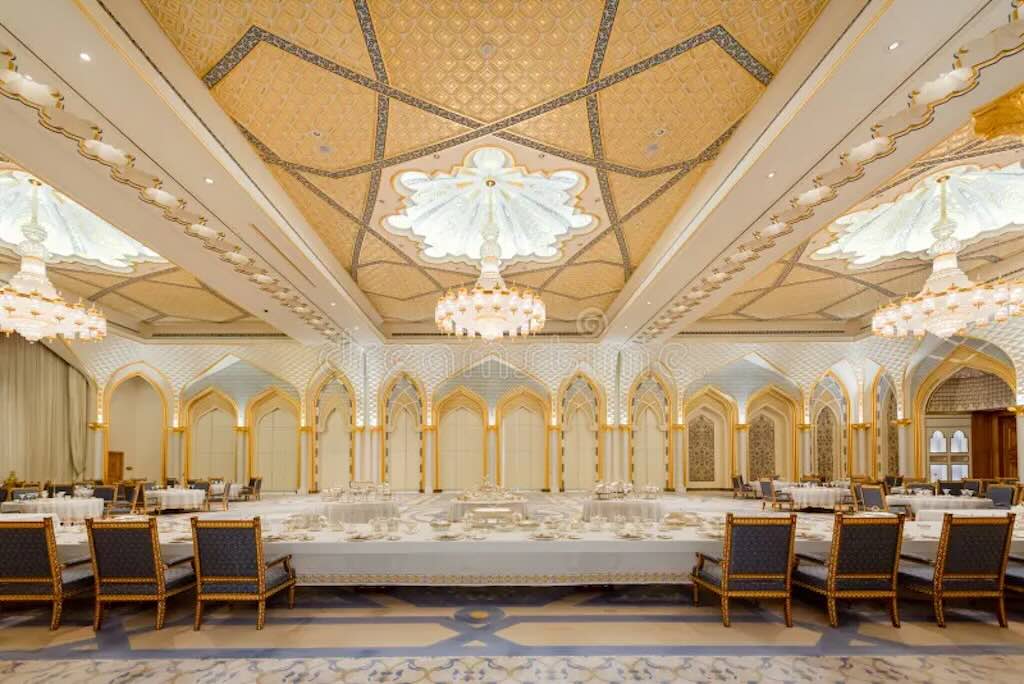
A full state visit would almost always include a presidential Banquet or Formal Luncheon. This would be held in the Presidential Banquet Hall. Seating would follow protocol, with the host at centre, and the guest of honour to the host’s right. Speeches would be limited to a few minutes.
The Presidential Banquet boasts an impressive 149,000 assortment of crystal, bone china and silverware that has been custom-made. I personally would have rounded it up to 150,000.
We had a long chat about alcohol and types of food. My guide was not sure, but said that alcohol would always be served discreetly, and depending on guest and context. She thought it might not be served at lunch. She understood that a gesture would be made to the guests at dinner, to include one of the their preferred dishes. Whereas at lunch the focus would be on Emirati specialities, along with international dishes. In any case it was all decided by protocol, not hospitality.
There might also be an optional, short, symbolic cultural moment. It might be a short, guided passage through a symbolic hall or a curated section of the palace narrative. It would not involving any wandering around, and permit no improvisation. The aim would be to stress legitimacy and the state identity.
Farewells would be private, normally no waving, and a media statement might be issued after the guests had left the palace grounds.
Muqarnas Ceiling
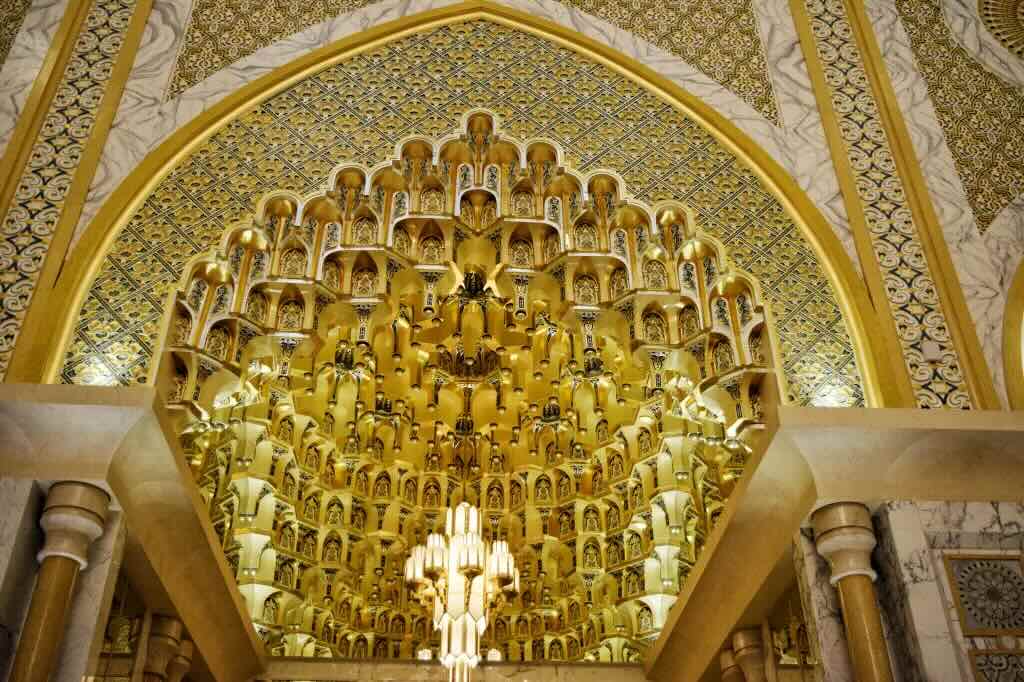
As we moved from the Great Hall to some of the larger, and equally important, spaces set around the hall, there are a number of connecting (anti-chambers). The most spectacular is certainly a small space with a muqarnas ceiling (honeycombs or stalactites).
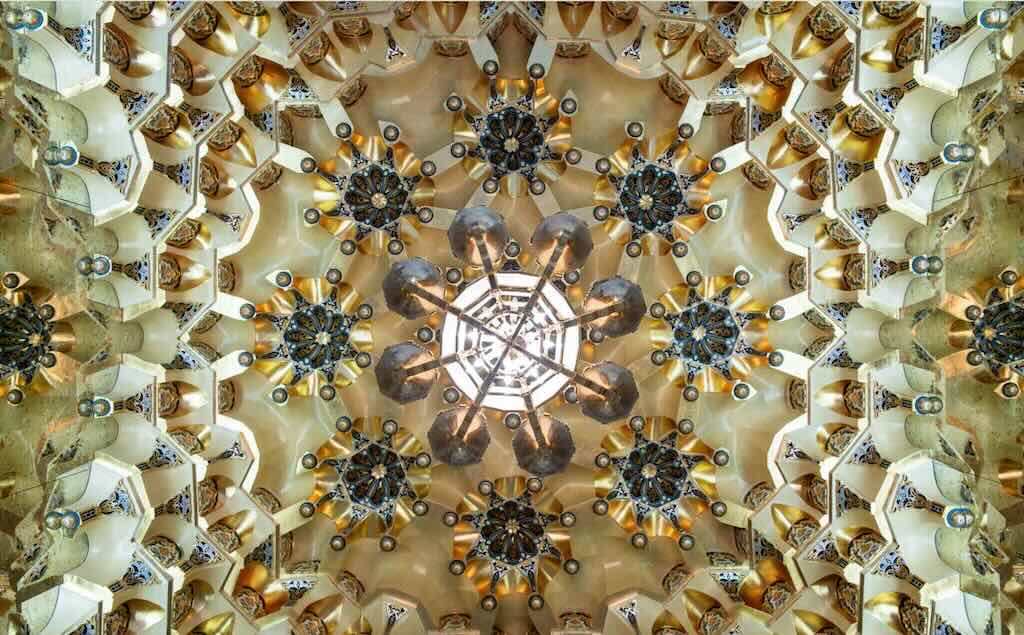
It is a form of three-dimensional decoration in Islamic architecture made up of rows or tiers of niche-like elements. And is a typically featured in domes and vaults, as well as iwans, entrance portals, or other niches. It is not a real room in itself, but creates a smooth, decorative zone of transition in an otherwise bare, structural space.
The Spanish term mocárabe is derived from the Arabic term muqarbaṣ, which was also used to denote muqarnas in the western regions of the Islamic world (e.g. Court of Lions in the Alhambra).
The Spirit of Collaboration

Another zone in the palace is called the Spirit of Collaboration, with its distinctive circular layout, where institutions such as the Federal Supreme Council, the Arab League and the Gulf Cooperation Council come together to map future actions, etc.
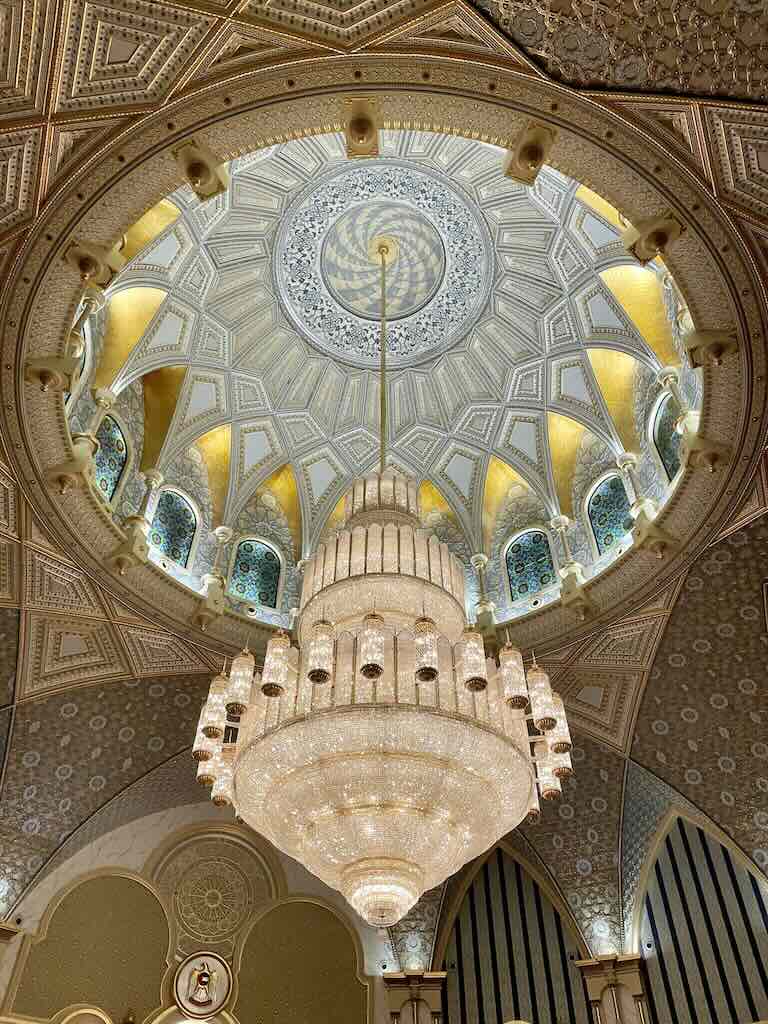
One of the highlights here is the chandelier. Designed to absorb ambient sounds in the room, this fixture comprises 350,000 crystals. Weighing an impressive 12 tonnes, this three-layered chandelier had to be assembled within the room due to its massive proportions.
Presidential Gifts Exhibition
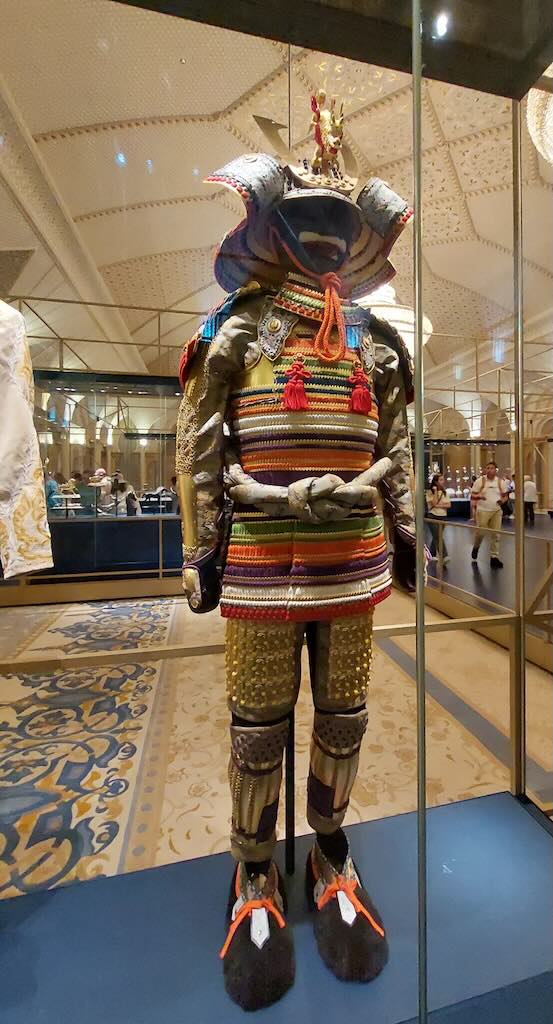
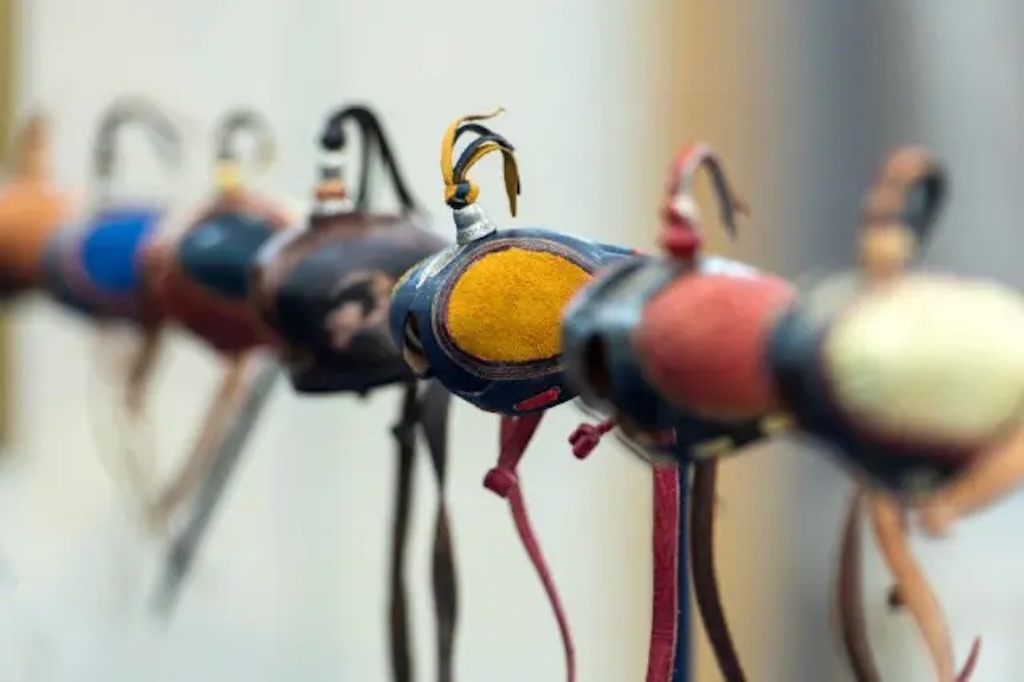
To step into the Presidential Gifts Hall is to be presented with the rare opportunity to enter the world of foreign and royal diplomacy through the gifts exchanged.
The unique collection of diplomatic gifts housed within the Palace of the Nation offers a way to witness the goodwill and mutual respect between the UAE and the world’s nations. It is also a spectacular representation of the richness and diversity of history, art and cultures from around the globe.
On display are samurai armors from Japan, hooded falcon masks from Germany, a traditional rifle from Kuwait, a vase from the Phoenician era, a moon vase from Korea, a most intricately designed carpet from Turkmenistan, as well as gold wreaths, medals and coins from various places and historical periods, and so on. A particular highlight of the collection are the religious manuscripts, including a Holy Quran swathed in a black covering with gold embroidery, a gift from the Kingdom of Saudi Arabia.
These are state-to-state gifts, and not personal gifts. During any state visit, past gifts would be given pride of place, as reminders of a longterm relationship, and even shared values.
Library House of Knowledge
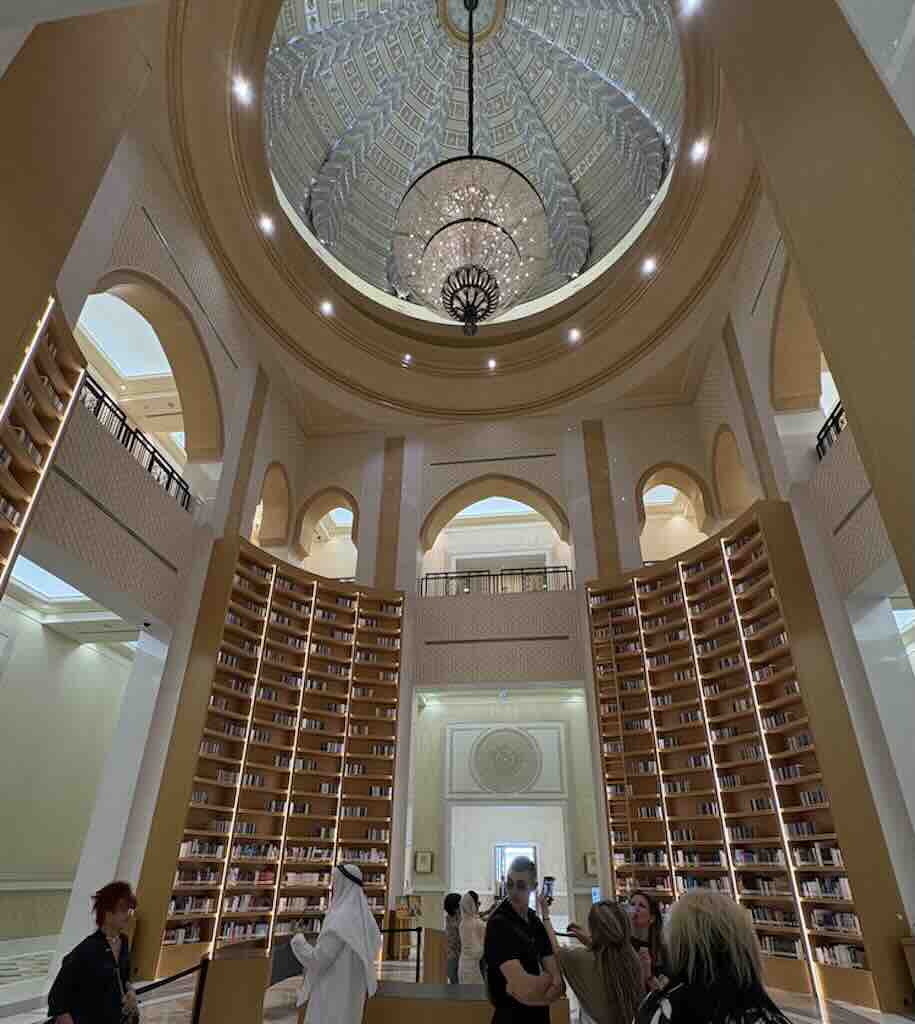
Library House of Knowledge, which exhibits a collection of artefacts and manuscripts that highlight origins of libraries in the Arab world and its contributions to various intellectual fields including science, arts, humanities and literature. The library curates a collection of ancient manuscripts dating back several centuries from different parts of the Arab world, including a replica of the Birmingham Qur’an represents the earliest surviving holy book written in the ancient Arabic script of Hijazi.
Golden Ink Exhibition
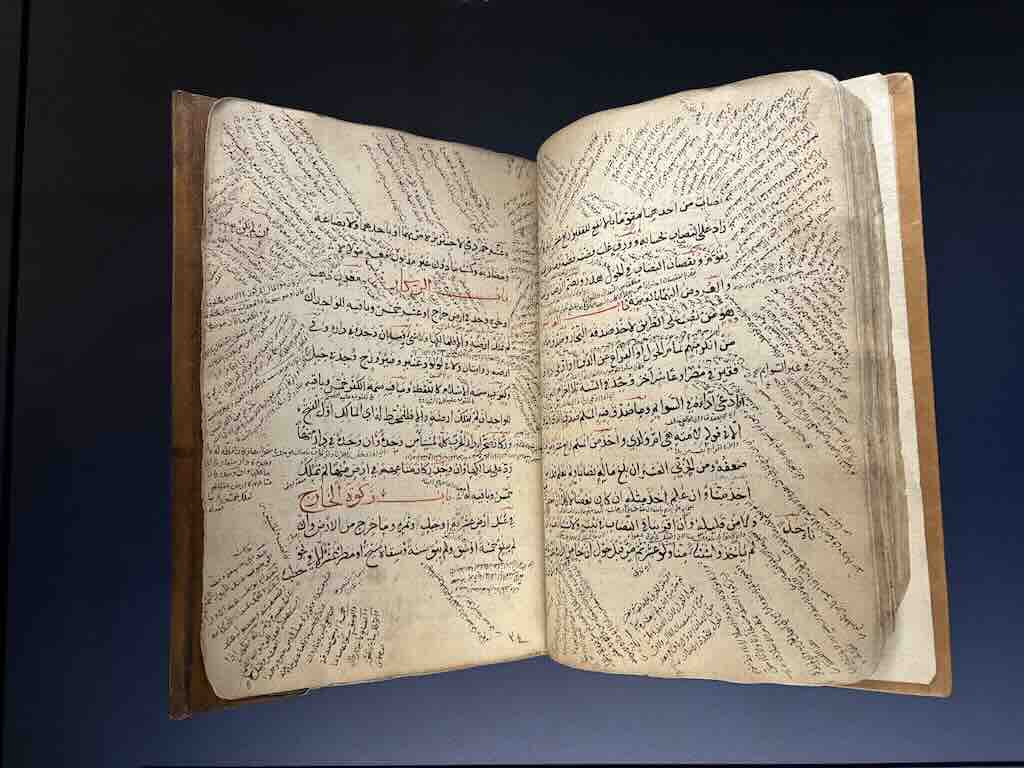
We ended our tour with a visit to an exhibition, subtitled “A Journey Through Arab and Islamic Manuscripts”.
I’ve always been fascinated by manuscripts that carrier additional text in the margins. They become social objects alive with traces of readers, scholars, and owners. Margins became spaces for commentary, debate, and reflection, revealing how texts were read, interpreted, and transmitted.
It’s a strange fascination, because I hate the idea of writing in the margins. Perhaps it’s linked to the idea of not leaving a trace as I pass through life, but my wife, Monique, would often scribble her thoughts in the margins. Yet, when she left this world, she made me promise to destroy everything she wrote, even shopping lists, etc. I force myself to respect her wishes.
Ownership notes, waqf declarations, and ijazahs testify to their circulation across generations. From prayers to scholarly notes, these markings transformed manuscripts into layered records of memory and learning. Far from static objects, manuscripts became dynamic artefacts, shaped by every hand that touched them.
The above example is an Islamic Religious Manual, dated to 1397. It has clearly been copied and studied for centuries, its margins contain notes by different hands, offering clarifications and interpretations that make it a layered, living text.